Version 1.0 — Published July 2026
Quick Answer
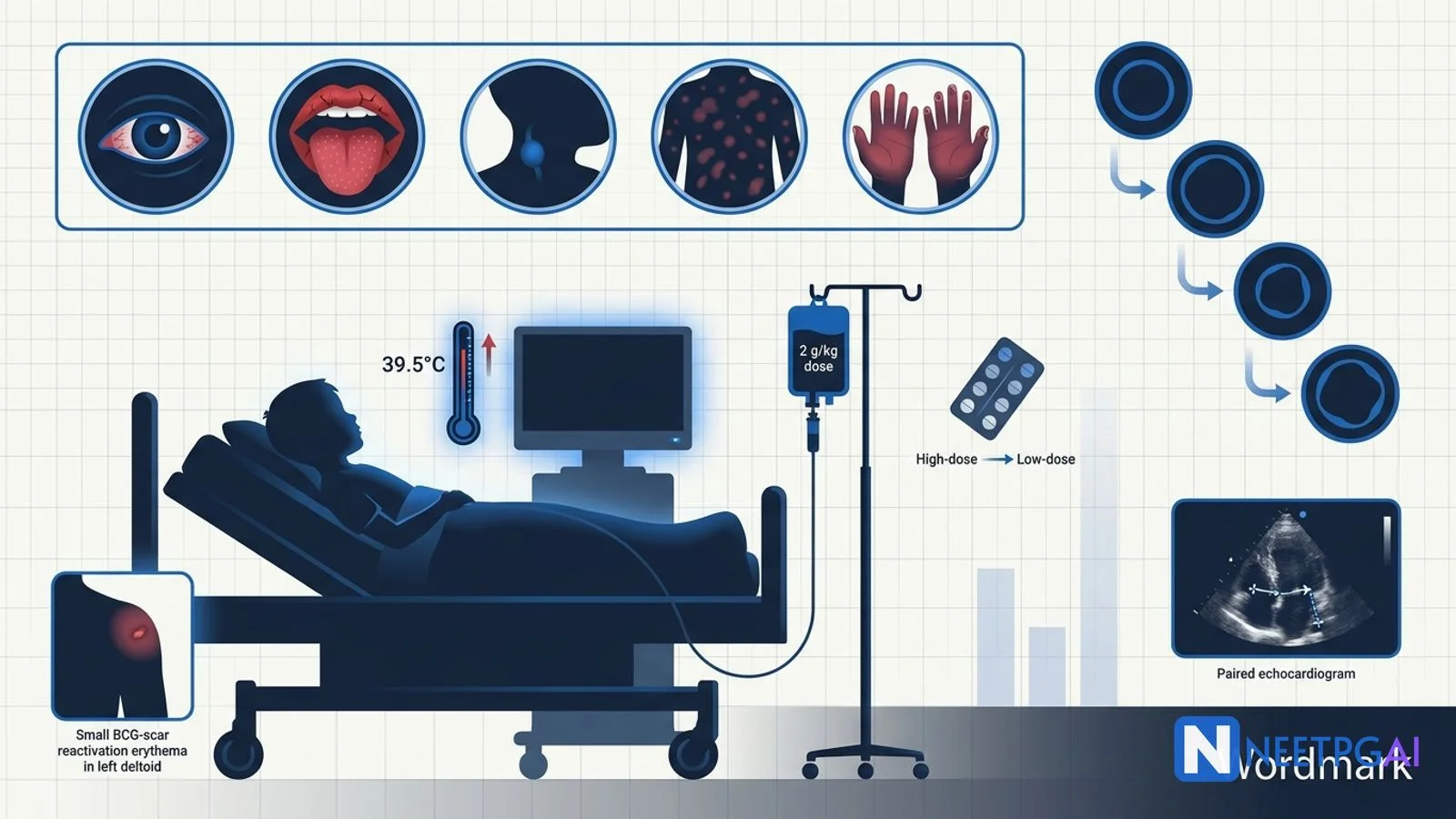
Kawasaki disease is the most testable pediatric vasculitis on NEET PG — the 5-day fever rule, AHA classic criteria, IVIG timing within 10 days, and coronary aneurysm risk appear in nearly every paper. A 3-year-old with day-6 unremitting fever, bilateral non-purulent conjunctivitis, strawberry tongue, cervical adenopathy, polymorphous rash, and swelling of palms and soles needs the following 8-step workflow:
- Recognise the pattern — fever at least 5 days plus 4 of 5 principal features (conjunctivitis, oral changes, cervical LN, extremity changes, rash) = classic Kawasaki
- Rule out mimics — measles (Koplik spots), scarlet fever (throat culture), systemic JIA (evanescent rash), staphylococcal TSS, DRESS
- Order labs — CBC (leucocytosis with left shift, later thrombocytosis over 450,000), CRP over 3 mg/dL, ESR over 40 mm/hr, ALT, albumin, urine (sterile pyuria), NT-proBNP
- Echocardiogram at diagnosis — coronary Z-score, aneurysm, pericardial effusion, LV function
- Consider incomplete Kawasaki if fever plus only 2-3 features but supportive labs and abnormal echo
- Give IVIG 2 g/kg single infusion within 10 days of fever onset — reduces aneurysm risk from 25 percent to under 5 percent
- High-dose aspirin 30-50 mg/kg/day until afebrile 48-72 h, then low-dose 3-5 mg/kg/day antiplatelet
- Follow-up echo at 2 and 6 weeks — giant aneurysms greater than 8 mm need lifelong cardiology follow-up and anticoagulation
The case
A 3-year-old boy is brought to the pediatric emergency of a tertiary hospital in Delhi by his parents with 6 days of high, spiking fever peaking at 39.5 degrees Celsius, unresponsive to paracetamol 15 mg/kg every 6 hours and ibuprofen 10 mg/kg every 8 hours. The fever started abruptly on day 1 with no obvious focus; the local pediatrician started oral amoxicillin-clavulanate on day 3 for a presumed upper respiratory infection, but the fever has not budged despite 4 days of antibiotics.
Over the past 2 days the parents have noticed redness of both eyes without discharge — the child is not rubbing them, there is no crusting on the lashes in the morning, and vision does not seem affected. Since day 4 they have observed cracked, dry, red lips with vertical fissures that bleed slightly on smiling; the tongue looks strawberry-red with prominent papillae. From day 5 the mother has felt a single tender lump on the right side of the neck that has increased in size over 24 hours.
On day 5 a red patchy rash appeared on the trunk, spreading from the abdomen to the back and thighs — the rash is not itchy, not vesicular, and blanches on pressure. Since yesterday the palms and soles are red, swollen, and shiny; the child cries when the mother tries to put on his usual sandals and refuses to walk.
Feeding history — poor appetite for 5 days, taking only sips of milk and occasional bites of bread; irritable and clingy. Passing urine less frequently than usual. Bowels normal until yesterday when a single episode of loose non-bloody stool occurred. No vomiting.
Past history — fully immunised for age (including MMR at 9 and 15 months, so measles is unlikely), no allergies, no previous hospitalisations. Developmental milestones age-appropriate. Recent history — no travel, no known TB contact, no pet exposure, one sibling well.
Family history — non-consanguineous parents, no autoimmune or vasculitis disease, no premature cardiac deaths. Middle-class urban family in Delhi.
On examination — irritable, clingy to mother, refuses to be laid flat. Temperature 39.6, pulse 148/min (age-normal 90-140 — mild tachycardia in keeping with fever), RR 32/min, BP 92/58, SpO2 98 percent on room air, weight 14.5 kg (50th centile), capillary refill under 2 seconds. Bilateral bulbar conjunctival injection is prominent — clearly non-purulent, no discharge, no crusting, and characteristically sparing the perilimbal 1-2 mm ring (limbal sparing). Lids are not oedematous.
Oral cavity — cracked, erythematous, fissured lips with fine bleeding on the lower lip; strawberry tongue with prominent fungiform papillae over a bright red background; diffuse pharyngeal erythema without tonsillar exudate. No Koplik spots (which would suggest measles). Dental hygiene normal.
Neck — a single tender, firm, mobile right anterior cervical lymph node measuring 1.8 cm in longest diameter, no overlying erythema or fluctuance, no other significant nodes.
Skin — polymorphous truncal rash — a mix of maculopapular and morbilliform lesions on the trunk, thighs, and perineum; non-vesicular, non-purpuric, blanching. No target lesions. No BCG-site erythema noted (a valuable pediatric-vasculitis clue in India — reactivation erythema at the BCG scar is present in 30-50 percent of Kawasaki in Asian children and is highly specific). On careful re-examination the BCG scar on the left deltoid is indeed erythematous and slightly swollen — a subtle but important finding.
Extremities — bilateral erythema and non-pitting oedema of the dorsum of hands and feet; palms and soles bright red, shiny, tender; the child pulls the leg away on light touch of the soles. Fingernails and toenails intact. No peeling yet (peeling typically appears at 2-3 weeks from fever onset).
Cardiovascular — pulse regular, mild tachycardia proportional to fever, no murmur, no gallop, no pericardial rub. JVP normal, no peripheral oedema.
Respiratory — clear, vesicular breath sounds bilaterally, no crackles.
Abdomen — soft, mild diffuse tenderness, no organomegaly, no ascites, bowel sounds normal.
CNS — irritable but conversant with mother, no meningism, no focal deficits, reflexes normal.
The paediatric resident recognises the pattern and initiates urgent labs and a stat pediatric cardiology consult for echocardiogram, with a working diagnosis of Kawasaki disease meeting classic AHA criteria.
Initial assessment and the time-critical principle
The single most important clinical principle in this case is that IVIG must be given within 10 days of fever onset — ideally within 7 days — to reduce coronary aneurysm risk from approximately 25 percent to under 5 percent. Every day past day 10 loses meaningful benefit; giving IVIG on day 6 as in this case is optimal.
A — Airway: patent.
B — Breathing: RR 32/min, SpO2 98 percent room air, no distress.
C — Circulation: mild fever-proportional tachycardia, BP normal for age, warm peripheries, no signs of shock. Kawasaki shock syndrome (5-7 percent — hypotension, need for fluids and inotropes) is a red flag but not present here.
D — Disability: irritable but AVPU-alert.
E — Exposure: as above.
Tier 1 investigations (same day)
- CBC — Hb 10.8 g/dL (mild normocytic anaemia — age-appropriate but supportive of Kawasaki labs), WBC 22,400/microL (marked leucocytosis with 82 percent neutrophils — left shift), platelets 380,000/microL (still in normal range on day 6; will rise to over 450,000 by end of week 2 in the classic thrombocytosis of Kawasaki)
- CRP 12.4 mg/dL (markedly raised; over 3 mg/dL supports Kawasaki)
- ESR 68 mm/hr (markedly raised; over 40 supports Kawasaki)
- AST 62, ALT 74 U/L (mildly raised — hepatitis pattern supports Kawasaki)
- Albumin 3.1 g/dL (low; under 3 g/dL is a supportive lab)
- NT-proBNP 780 pg/mL (raised — myocardial stretch in acute Kawasaki; supports)
- Urine routine — sterile pyuria (12 WBC per HPF, no organisms, culture negative) — supports Kawasaki
- Blood culture — negative
- Throat swab culture — no growth (rules out scarlet fever)
- ASO titre — 120 IU/mL (normal, rules against scarlet fever)
- Measles IgM — negative
- CMV, EBV serology — IgG positive, IgM negative (past exposure only)
- SARS-CoV-2 RT-PCR nasopharyngeal swab — negative; SARS-CoV-2 IgG negative (rules out MIS-C)
- Coagulation — PT 13 s, INR 1.1, aPTT 32 s, fibrinogen 620 mg/dL (raised acute phase)
- Ferritin 480 ng/mL (raised acute phase but not systemic-JIA range)
- Renal panel — creatinine 0.4 mg/dL, urea 26 mg/dL, Na 138, K 4.2, normal
Interpretation: fever plus classic 5/5 principal features plus CRP over 3 plus ESR over 40 plus low albumin plus raised ALT plus sterile pyuria — meets classic AHA Kawasaki criteria. Supportive labs also endorse it.
Tier 2 imaging (within 24 hours)
- Echocardiogram — pediatric cardiologist performs a targeted study. Findings: mild dilation of the left anterior descending coronary artery with Z-score of 2.3 (borderline — Z-score 2.0-2.5 = dilation; over 2.5 = small aneurysm; over 5 = medium; over 10 = giant). RCA Z-score 1.8. Coronary artery walls show mild echogenicity. Mild pericardial effusion (2 mm). Mild mitral regurgitation. LV systolic function normal, EF 62 percent. No LV wall motion abnormality.
- Chest X-ray — clear lung fields, cardiothoracic ratio 0.5, no pulmonary oedema, no consolidation.
- ECG — sinus tachycardia at 148/min, normal PR and QT intervals, no ST-T changes, no arrhythmia.
The child fulfils classic Kawasaki criteria (fever at least 5 days plus all 5 principal features) plus a highly supportive lab profile plus early echocardiographic changes (borderline LAD dilation, coronary echogenicity, mild pericardial effusion). Treatment must not be delayed.
The diagnostic algorithm — classic vs incomplete Kawasaki
NEET PG tests both the classic AHA criteria and the incomplete Kawasaki algorithm.
AHA classic Kawasaki criteria (2017 update)
Fever persisting at least 5 days PLUS 4 of 5 principal features:
| Principal feature | Details |
|---|
| Conjunctivitis | Bilateral bulbar, non-purulent, sparing the limbus |
| Oral changes | Cracked erythematous lips, strawberry tongue, diffuse oropharyngeal erythema (NOT ulcers, NOT exudates) |
| Cervical LN | Greater than 1.5 cm, usually unilateral, often single |
| Rash | Polymorphous — maculopapular, morbilliform, or scarlatiniform; truncal; non-vesicular |
| Extremity changes | Acute — erythema and swelling of palms and soles; Subacute (week 2-3) — periungual peeling |
Additional supporting features not in criteria but often seen — irritability out of proportion (aseptic meningitis component), BCG scar reactivation erythema (30-50 percent in Asian children — highly specific), arthritis, gallbladder hydrops, sterile pyuria, mild hepatitis, mild pericardial effusion.
Incomplete (atypical) Kawasaki algorithm
Fever at least 5 days (7 days in infants under 6 months) plus 2-3 principal features triggers the algorithm:
Step 1 — Check supportive labs: CRP greater than 3 mg/dL AND/OR ESR greater than 40 mm/hr.
Step 2 — If either raised, check 6 supplementary criteria (need 3 or more):
- Anaemia for age
- Platelets greater than 450,000/microL after day 7
- Albumin under 3 g/dL
- Raised ALT
- WBC greater than 15,000/microL
- Sterile pyuria greater than 10 WBC/HPF
Step 3 — If 3 or more supplementary criteria present, treat as Kawasaki (IVIG plus aspirin) and get echocardiogram.
Step 4 — Regardless, get echocardiogram. If Z-score greater than 2.5, aneurysm, or 3 or more suggestive features (pericardial effusion, mitral regurgitation, decreased LV function, coronary echogenicity) — treat as Kawasaki.
Infants under 6 months and children over 8 years disproportionately present as incomplete Kawasaki and paradoxically have the highest coronary aneurysm risk — a low threshold for echocardiogram is life-saving.
Differential diagnosis of Kawasaki disease
| Diagnosis | Distinguishing features | Confirmation |
|---|
| Measles | Koplik spots, cephalocaudal rash, 3 Cs (cough, coryza, conjunctivitis), no extremity swelling | Measles IgM serology |
| Scarlet fever | Sandpaper rash, circumoral pallor, tonsillar exudate, responds to penicillin | Throat culture, ASO |
| Systemic-onset JIA (Still) | Quotidian fever, evanescent salmon-pink rash appearing with fever spikes, arthritis, ferritin over 3000 | Clinical criteria, ferritin |
| Staphylococcal / streptococcal TSS | Hypotension, multi-organ dysfunction, more acute | Blood culture, toxin assay |
| DRESS | Drug exposure, eosinophilia, atypical lymphocytes, organ involvement | Drug history, biopsy |
| SJS / TEN | Mucositis with target lesions, epidermal detachment | Skin biopsy, drug history |
| Adenovirus | Pharyngoconjunctival fever, self-limited | PCR |
| MIS-C (post-COVID) | Recent SARS-CoV-2 exposure or positive serology, GI symptoms, cardiac dysfunction | SARS-CoV-2 serology |
| Leptospirosis (India) | Water exposure, myalgia, jaundice, renal impairment | MAT / IgM |
Why our patient is classic Kawasaki
Nine features confirm it: (1) fever at least 5 days (day 6 now, unremitting), (2) bilateral non-purulent limbus-sparing conjunctivitis, (3) cracked lips and strawberry tongue, (4) tender unilateral cervical node 1.8 cm, (5) polymorphous truncal rash, (6) erythema and swelling of palms and soles, (7) supportive labs — CRP 12.4, ESR 68, ALT 74, albumin 3.1, sterile pyuria, (8) BCG-scar reactivation erythema (bonus specificity for Asian children), (9) early echocardiographic changes — borderline LAD Z-score 2.3, coronary echogenicity, mild pericardial effusion, mild MR.
Diagnosis
Kawasaki disease meeting AHA classic criteria in a 3-year-old fully-immunised boy on day 6 of fever with all 5 principal features, supportive labs, BCG-scar reactivation, and early echocardiographic changes (LAD Z-score 2.3, coronary echogenicity, mild pericardial effusion) — for urgent IVIG 2 g/kg single infusion plus high-dose aspirin.
Management — IVIG, aspirin, and coronary surveillance
The treatment principle is give IVIG within the 10-day window. Any patient meeting criteria — classic or incomplete — receives IVIG without delay. Do not wait for the echocardiogram if the clinical picture is clear.
IVIG — the cornerstone
- Dose: 2 g/kg as a single infusion over 10-12 hours (fractionating over 2-4 days is inferior; single infusion is standard)
- Timing: ideally within 7 days of fever onset, definitely within 10 days
- Pre-medication: paracetamol plus diphenhydramine (some centres) to reduce infusion reactions
- Monitoring during infusion: vitals every 15 minutes for the first hour, then every 30 minutes; watch for fluid overload (especially in infants), aseptic meningitis, haemolysis (rare), anaphylaxis
- Expected response: defervescence within 24-36 hours in most cases; irritability and mucocutaneous features improve within 48-72 hours
- Late IVIG (after day 10) is still given if the child is still febrile OR has raised inflammatory markers OR has coronary abnormalities on echo — although efficacy is reduced, it is not zero
Aspirin — dose transition
- Acute inflammatory phase: high-dose aspirin 30-50 mg/kg per day in 4 divided doses (some centres, including North American, use 80-100 mg/kg per day in the first phase; both regimens are AHA-acceptable). Continue until the child has been afebrile for 48-72 hours OR until day 14
- Convalescent phase: low-dose antiplatelet aspirin 3-5 mg/kg per day once daily — continue until follow-up echocardiogram at 6-8 weeks is normal
- If coronary aneurysms present: low-dose aspirin indefinitely; add clopidogrel or warfarin for giant aneurysms
- Contraindications: varicella exposure (Reye syndrome risk — vaccinate against varicella at appropriate age and give annual influenza vaccine); switch to another antiplatelet if varicella develops on aspirin
High-risk features — consider adjunctive steroids at diagnosis
Some centres (based on the Japanese RAISE trial) add IV methylprednisolone 2 mg/kg per day tapered over 4-6 weeks to IVIG plus aspirin for high-risk children identified by Kobayashi, Egami, or Sano scores. These scores use age, sodium, ALT, CRP, and other markers; validated primarily in Japanese cohorts. Indian and international guidelines are still evolving — most Indian tertiary centres reserve adjunctive steroids for IVIG-resistant disease or for children with aneurysms at diagnosis.
IVIG resistance — 10-20 percent
Definition: persistent OR recrudescent fever 36 hours after IVIG infusion completion.
Management options:
- Second IVIG 2 g/kg — traditional first step
- IV methylprednisolone pulse 30 mg/kg/day for 3 days — Japanese preference
- Infliximab 5 mg/kg single infusion — increasingly first-line for resistance in high-quality Indian and international centres; often more effective and better tolerated than repeat IVIG
- Cyclosporine, cyclophosphamide, anakinra — refractory or very high-risk disease
Echocardiographic surveillance
| Timepoint | Purpose |
|---|
| At diagnosis | Baseline coronary Z-scores, aneurysm detection, LV function |
| 2 weeks | Peak aneurysm formation window |
| 6-8 weeks | Determines convalescent antiplatelet strategy (stop aspirin if normal) |
| 6 months if abnormal | Progression / regression of aneurysms |
| Long-term | Annual echo, stress testing, cardiac MRI or coronary CTA in adolescence for persistent aneurysms |
Z-score thresholds:
- Z-score 2.0-2.5 — dilation, borderline
- Z-score 2.5-5 — small aneurysm
- Z-score 5-10 — medium aneurysm
- Z-score over 10 or absolute diameter over 8 mm — giant aneurysm (highest MI risk)
Coronary aneurysm risk — the key exam pearl
Untreated Kawasaki carries approximately 20-25 percent coronary aneurysm risk. Timely IVIG plus aspirin reduces this to under 5 percent overall and under 1 percent for giant aneurysms. IVIG is the intervention that reduces coronary risk; aspirin alone does not.
Giant aneurysms greater than 8 mm are the highest-risk lesions — lifetime myocardial infarction risk, thrombosis at the aneurysm, stenosis at the aneurysm neck, sudden cardiac death. These children need lifelong cardiology follow-up, indefinite low-dose aspirin plus clopidogrel or warfarin (INR 2-3), annual stress testing, and coronary imaging (coronary CTA or cardiac MRI). Some develop indications for coronary artery bypass grafting or percutaneous intervention.
Complications — acute, subacute, and long-term
Acute (weeks 0-2)
- Coronary artery aneurysms (peak week 2-4)
- Kawasaki shock syndrome (5-7 percent — hypotension needing fluids and inotropes)
- Aseptic meningitis (irritability disproportionate to illness)
- Myocarditis (raised NT-proBNP, mildly reduced LV function)
- Hydrops of gallbladder (RUQ pain, tender GB on USG)
- Sterile pyuria
- Arthritis (10-15 percent — polyarticular, weight-bearing joints)
Subacute (weeks 2-6)
- Periungual desquamation — classic peeling starting under the fingernails
- Thrombocytosis over 450,000 to over 1,000,000/microL
- Coronary aneurysm progression or regression
- Beau lines in nails at 1-2 months
Long-term
- Persistent coronary aneurysm (10-30 percent of small; up to 60 percent of giant)
- Coronary artery stenosis at aneurysm necks
- Myocardial infarction (rare but reported in adolescence and adulthood in giant aneurysms)
- Sudden cardiac death (rare but reported)
- Premature coronary artery disease in adulthood (accelerated atherosclerosis at aneurysm site)
India-specific considerations
- Delayed diagnosis — Kawasaki is often missed in primary care in India because it mimics viral exanthems, measles, scarlet fever, and antibiotic-related rashes; fever plus rash plus conjunctivitis in a young child should trigger the AHA checklist by day 5
- BCG scar reactivation — erythema and induration at the BCG scar (usually left deltoid in India) is present in 30-50 percent of Kawasaki in Indian and Asian children — highly specific and a useful bedside clue
- Landmark Indian cohort data — the Chandigarh (PGIMER) and Delhi (AIIMS, Sir Ganga Ram) cohorts describe incidence estimates of 4.5-8 per 100,000 children under 5, with rising diagnosis rates reflecting better recognition rather than true rising incidence; coronary abnormality rates at first echo approximately 15-25 percent, dropping to under 5 percent with timely IVIG
- IVIG availability and cost — a single 2 g/kg dose costs approximately Rs 1.5-3 lakh depending on brand and city; PMJAY (Ayushman Bharat) covers Kawasaki IVIG under the pediatric vasculitis package — social workers must be engaged early to prevent cost-driven delay; state schemes (Chief Minister's Comprehensive Health Insurance in Tamil Nadu, MJPJAY in Maharashtra, ABMSSY in Rajasthan) also cover it
- Post-Kawasaki cardiology follow-up in tier-2 cities — often limited; refer to metros (AIIMS, PGIMER, CMC Vellore, KEM, NIMHANS) for coronary imaging beyond echo
- Coronary Z-score interpretation requires paediatric echocardiography expertise; not all district hospitals have this — a normal echo at a non-specialist centre in a clinically suggestive child does not rule out Kawasaki
- Vaccination after IVIG — live vaccines (MMR, varicella) should be deferred for 11 months after IVIG because passive antibodies interfere with vaccine seroconversion; killed vaccines (DPT, IPV) can proceed on schedule
How NEET PG tests Kawasaki disease
Seven recurring patterns.
Pattern 1 — The 5-days-fever plus 4-of-5 criteria question: Vignette gives a young child with day-5 to day-7 fever, red eyes, red lips, cervical node, rash, and swollen palms; asks the diagnosis. Kawasaki disease.
Pattern 2 — The IVIG timing question: Best time to give IVIG in Kawasaki? Within 10 days of fever onset, ideally within 7 days. Why? Reduces coronary aneurysm risk from 25 percent (untreated) to under 5 percent (treated).
Pattern 3 — The dose question: IVIG dose in Kawasaki? 2 g/kg as a single infusion. Aspirin dose in the acute phase? 30-50 mg/kg/day (or 80-100 mg/kg/day per some regimens) until afebrile 48-72 hours, then 3-5 mg/kg/day.
Pattern 4 — The incomplete Kawasaki question: A 4-month-old infant with fever for 7 days and only 2 principal features but raised CRP, ESR, and platelets and sterile pyuria — next step? Echocardiogram AND treat as Kawasaki (IVIG plus aspirin). Incomplete Kawasaki in infants under 6 months has the highest coronary risk; do not wait.
Pattern 5 — The coronary aneurysm question: Highest-risk coronary lesion in Kawasaki? Giant aneurysm greater than 8 mm. Lifetime risk — MI, thrombosis, stenosis, sudden death. Management — lifelong low-dose aspirin plus clopidogrel or warfarin.
Pattern 6 — The IVIG resistance question: Persistent fever 36 hours after IVIG — next step? Second IVIG dose OR IV methylprednisolone pulse OR infliximab 5 mg/kg.
Pattern 7 — The differential question: Most useful clue distinguishing Kawasaki from measles in an Indian child? Non-purulent limbal-sparing conjunctivitis plus extremity swelling plus BCG-scar erythema (Asian pediatric specificity). Measles has Koplik spots, cephalocaudal rash, and no extremity swelling.
High-yield one-liners:
- Kawasaki is a medium-vessel vasculitis; classic AHA criteria — fever at least 5 days plus 4 of 5 principal features
- Bilateral non-purulent limbus-sparing conjunctivitis is highly characteristic
- Cracked lips and strawberry tongue — oral mucosal changes
- Unilateral cervical node greater than 1.5 cm — often the "odd one out" feature
- Extremity changes — acute erythema and swelling of palms and soles; subacute periungual peeling week 2-3
- BCG-scar reactivation erythema — 30-50 percent of Asian pediatric Kawasaki; highly specific
- Supportive labs — CRP over 3, ESR over 40, WBC over 15,000, ALT raised, albumin under 3, sterile pyuria, thrombocytosis after day 7
- Untreated coronary aneurysm risk 20-25 percent; treated under 5 percent
- IVIG 2 g/kg single infusion within 10 days
- Aspirin high-dose 30-50 mg/kg/day acutely, low-dose 3-5 mg/kg/day convalescent
- Giant aneurysm greater than 8 mm — lifelong anticoagulation and cardiology
- IVIG resistance in 10-20 percent — second IVIG, methylprednisolone pulse, or infliximab
- Defer live vaccines (MMR, varicella) for 11 months after IVIG
- Kawasaki is a clinical diagnosis — do not wait for echocardiogram to give IVIG
Frequently Asked Questions
What are the AHA classic diagnostic criteria for Kawasaki disease?
The American Heart Association (AHA) 2017 classic Kawasaki disease criteria require fever persisting for at least 5 days plus 4 of 5 principal clinical features. The five principal features are (1) bilateral non-purulent bulbar conjunctival injection, characteristically sparing the limbus, (2) oral mucosal changes — cracked erythematous lips, strawberry tongue, or diffuse oropharyngeal erythema, (3) cervical lymphadenopathy greater than 1.5 cm, usually unilateral, often single, (4) polymorphous rash — maculopapular, morbilliform, or scarlatiniform, truncal, non-vesicular, (5) extremity changes — erythema and swelling of palms and soles in the acute phase, and periungual desquamation from the fingertips at 2-3 weeks. Fever in Kawasaki is typically high (over 39 degrees Celsius), spiking, and remarkably unresponsive to antipyretics. On NEET PG the vignette often gives 4 or 5 of these features plus a labs panel showing raised CRP and ESR, and asks for either the diagnosis, the next investigation (echocardiogram), or the treatment (IVIG plus high-dose aspirin).
How is incomplete or atypical Kawasaki disease diagnosed when full criteria are not met?
Incomplete (atypical) Kawasaki disease is suspected in an infant or child with fever for at least 5 days (7 days in infants under 6 months) and only 2 or 3 principal features. The AHA algorithm supports diagnosis when supplementary laboratory criteria are met — CRP greater than 3 mg/dL AND/OR ESR greater than 40 mm/hr — plus at least 3 of 6 supportive lab findings: (1) anaemia for age, (2) platelets greater than 450,000 per microlitre after day 7, (3) albumin under 3 g/dL, (4) raised ALT, (5) WBC greater than 15,000 per microlitre, (6) sterile pyuria greater than 10 WBC per HPF. An echocardiogram showing coronary artery Z-score greater than 2.5, aneurysm, or 3 or more suggestive findings (pericardial effusion, mitral regurgitation, decreased LV function, coronary echogenicity) is diagnostic even without full criteria. Infants under 6 months and children over 8 years are the age groups most likely to present with incomplete Kawasaki and paradoxically have the highest coronary aneurysm risk — a low threshold for echocardiogram is essential. NEET PG has begun testing the incomplete Kawasaki algorithm as post-2017 AHA updates trickle into Indian curricula.
What is the coronary artery aneurysm risk in untreated vs IVIG-treated Kawasaki disease?
Coronary artery involvement is the dominant long-term morbidity of Kawasaki disease. Untreated, approximately 20-25 percent of children develop coronary artery abnormalities — dilatation, ectasia, aneurysm, or giant aneurysm greater than 8 mm — with peak incidence at 2-4 weeks from fever onset. Timely IVIG (2 g/kg single infusion within 10 days of fever onset, ideally within 7 days) reduces coronary aneurysm risk to under 5 percent overall and to under 1 percent for giant aneurysms. Aspirin does not reduce the coronary risk on its own — IVIG is the key intervention. Giant aneurysms (greater than 8 mm or Z-score greater than 10) carry the highest lifetime risk of myocardial infarction, thrombosis, stenosis at the aneurysm neck, and sudden cardiac death — long-term dual antiplatelet or warfarin anticoagulation and lifelong cardiology follow-up are required. IVIG resistance (persistent or recrudescent fever 36 hours after the first IVIG infusion) occurs in 10-20 percent and is managed with a second IVIG dose, IV methylprednisolone pulse, or infliximab. NEET PG tests both the untreated 25 percent to treated 5 percent reduction and the greater than 8 mm giant-aneurysm cut-off.
How is Kawasaki disease treated and how is IVIG resistance managed?
First-line treatment is intravenous immunoglobulin (IVIG) 2 g/kg as a single infusion over 10-12 hours, given as early as possible within the first 10 days of fever onset, ideally within 7 days. Concurrently, high-dose aspirin 30-50 mg/kg per day (some centres use 80-100 mg/kg per day in the acute inflammatory phase) is given in 4 divided doses until the child is afebrile for 48-72 hours, then reduced to low-dose antiplatelet aspirin 3-5 mg/kg per day continued until a normal follow-up echocardiogram at 6-8 weeks. If coronary aneurysms are present, low-dose aspirin (with or without clopidogrel or warfarin for giant aneurysms) continues indefinitely. IVIG resistance is defined as persistent or recrudescent fever 36 hours after IVIG completion, seen in 10-20 percent of cases. Management options are a second IVIG 2 g/kg dose, IV methylprednisolone pulse 30 mg/kg for 3 days, infliximab 5 mg/kg single dose (increasingly first-line for resistance in high-quality centres), or cyclosporine and other biologics for refractory disease. Adjunctive corticosteroids at initial diagnosis (RAISE-trial-based regimens) are considered for high-risk children identified by validated scores (Kobayashi, Egami, Sano) more commonly used in Japan than in India. NEET PG tests the IVIG dose (2 g/kg), the aspirin dose transition (high-dose then low-dose), and the 10-day window.
What are the important differential diagnoses of Kawasaki disease and how are they excluded?
The Kawasaki differential is a fever-plus-rash-plus-mucocutaneous-changes list. (1) Measles — classic 3 Cs (cough, coryza, conjunctivitis), Koplik spots on buccal mucosa, cephalocaudal rash progression, no extremity swelling, IgM serology positive. (2) Scarlet fever — Group A Streptococcus with sandpaper rash, circumoral pallor, strawberry tongue, throat culture positive, ASO titre high; responds rapidly to penicillin. (3) Drug hypersensitivity reaction / DRESS syndrome — recent drug exposure (phenytoin, allopurinol, sulfa), eosinophilia, atypical lymphocytes, organ involvement (hepatitis, nephritis). (4) Systemic-onset juvenile idiopathic arthritis (Still disease) — quotidian fever, evanescent salmon-pink rash appearing with fever spikes, hepatosplenomegaly, arthritis, very high ferritin (over 3000). (5) Staphylococcal or streptococcal toxic shock syndrome — hypotension, multi-organ dysfunction, culture-confirmed toxigenic strain, more acute and severe. (6) Stevens-Johnson syndrome / TEN — mucositis with target lesions, epidermal detachment, drug trigger. (7) Adenovirus infection — pharyngoconjunctival fever, self-limited, PCR confirms. (8) Rocky Mountain spotted fever (rare in India) — tick exposure, palm/sole rash. The multisystem inflammatory syndrome in children (MIS-C) post-COVID has significant overlap with Kawasaki — history of recent SARS-CoV-2 exposure or positive serology and prominent gastrointestinal and cardiac features distinguish it. NEET PG most commonly tests the measles, scarlet fever, and systemic JIA distinctions.
This content is for educational purposes for NEET PG exam preparation. It is not a substitute for professional medical advice, diagnosis, or treatment. Clinical information has been reviewed by qualified medical professionals.
Written by: NEETPGAI Editorial Team
Reviewed by: Pending SME Review
Last reviewed: July 2026