Version 1.0 — Published July 2026
Quick Answer
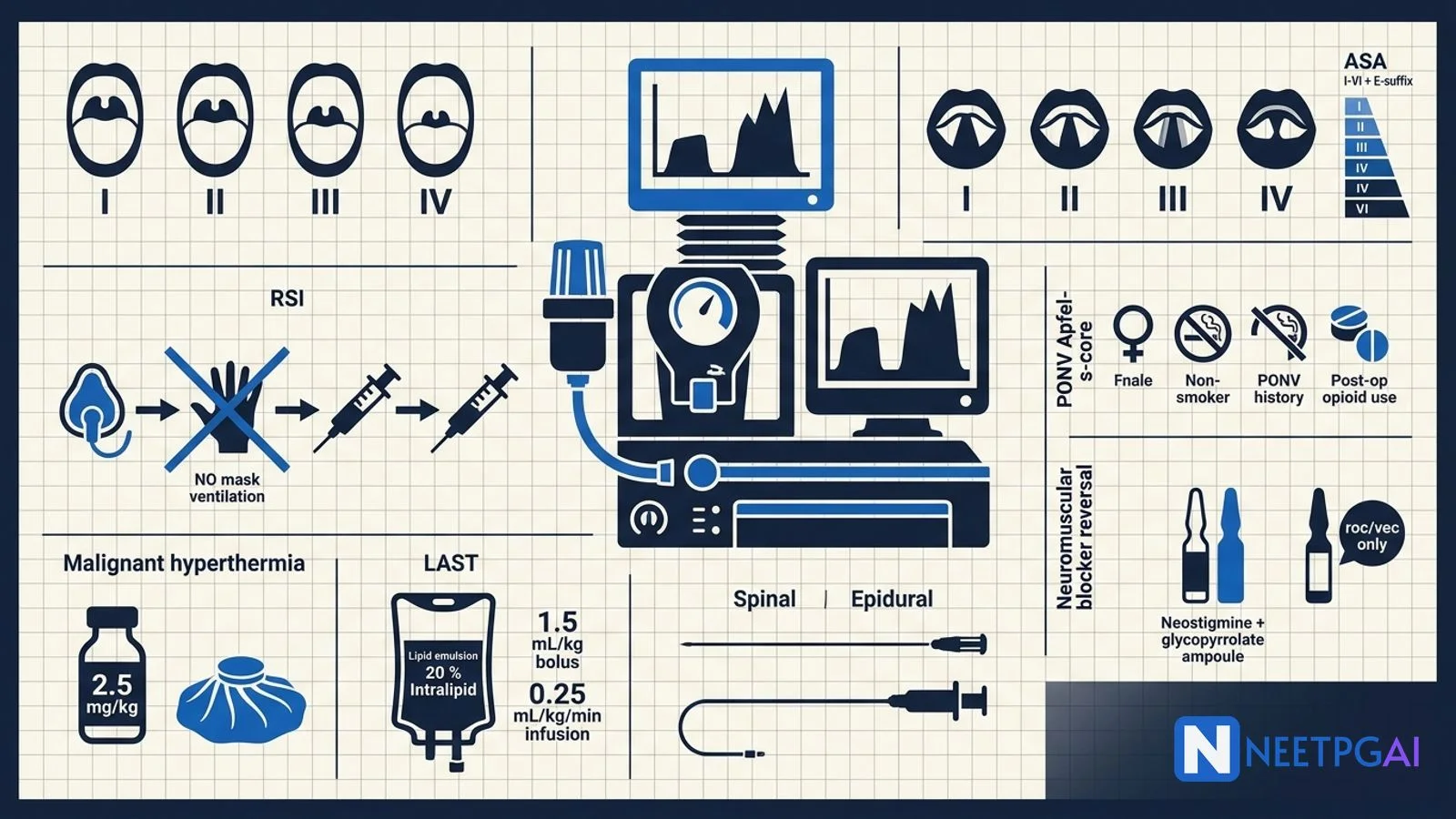
Anesthesia contributes 6-10 questions per NEET PG paper, often overlapping with pharmacology, medicine, and surgery. The 15 most expensive mistakes cluster around pre-op assessment, airway grading, induction, MH, LAST, PONV, regional anesthesia, and reversal. To protect your marks:
- Lock ASA physical status class I-VI plus E suffix — well-controlled comorbidity is class II, not III
- Distinguish Mallampati (pre-op) from Cormack-Lehane (intra-op) — pre-op prediction vs intra-op view
- Sequence RSI correctly — pre-oxygenate, cricoid pressure, induction, succinylcholine or high-dose rocuronium, NO mask ventilation between
- Memorise MH triggers — volatile halogenated agents (halothane, iso, sevo, des, enflurane) plus succinylcholine; nitrous, propofol, ketamine, opioids are safe
- Recognise MH by hypercarbia first, not hyperthermia — end-tidal CO2 rises before temperature; dantrolene 2.5 mg/kg
- Manage LAST with Intralipid 20 percent — 1.5 mL/kg bolus, then 0.25 mL/kg/min infusion; avoid vasopressin, CCB
- Score PONV with Apfel — 4 risk factors: female, non-smoker, prior PONV or motion sickness, post-op opioids
- Distinguish spinal from epidural — spinal: one-shot below L2, dense block; epidural: catheter, dermatomal titration
- Recognise post-dural puncture headache (PDPH) — young female, thin needle prevents (25-27G pencil-point), epidural blood patch treats
- Treat awareness under anesthesia with BIS 40-60 monitoring and endotidal agent monitoring
- Use neostigmine plus glycopyrrolate for non-depolarising reversal; sugammadex is specific for rocuronium and vecuronium only
- Adapt to pregnancy — aortocaval compression (15 degree left tilt), aspiration prophylaxis (sodium citrate, ranitidine), RSI, left uterine displacement
- Choose awake fiberoptic intubation for anticipated difficult airway — topical anesthesia plus minimal sedation
- Distinguish cardiac output methods — Fick (direct), thermodilution (PA catheter gold standard), PiCCO (transpulmonary)
- Discharge only when Aldrete score at least 9 — activity, respiration, circulation, consciousness, SpO2
Why anesthesia mistakes are costly
Anesthesia sits at the intersection of pharmacology, cardiovascular medicine, respiratory medicine, and surgery. A single misremembered ASA class, a wrong induction sequence, or a missed MH trigger can cost 1-2 marks on the paper and significant harm in actual practice. NEET PG, INI-CET, and FMGE examiners increasingly test anesthesia through clinical vignettes that probe the structured pre-op assessment, the sequence of induction, the recognition of emergencies, and the specific pharmacology of anesthetic drugs.
The 15 mistakes below come from analysis of NEET PG 2019-2024 anesthesia questions and represent the most frequent error patterns.
Mistake 1: Misclassifying ASA physical status
Why students get it wrong: Grade boundaries are subjective; well-controlled comorbidities can be mis-placed as class III when they belong in class II.
How to remember it correctly:
| Class | Description | Examples |
|---|
| I | Normal healthy patient | Fit young adult, minor sports injury |
| II | Mild systemic disease, no substantive functional limitation | Well-controlled HTN or DM, BMI 30-40, current smoker, pregnancy, social alcohol |
| III | Severe systemic disease with substantive functional limitation | Poorly controlled HTN or DM, COPD, morbid obesity BMI over 40, moderate EF drop, ESRD on dialysis, remote MI/stroke over 3 months |
| IV | Severe systemic disease that is a constant threat to life | Recent MI or stroke less than 3 months, EF under 30 percent, sepsis, DIC, ARDS |
| V | Moribund; not expected to survive without operation | Ruptured AAA, massive trauma, intracranial bleed with mass effect |
| VI | Declared brain-dead; organs for donation | Deceased-donor organ retrieval |
E suffix: append to any class for emergency surgery (delay would significantly increase risk to life or body part).
Trap: a diabetic on metformin with HbA1c 6.8 is class II (well-controlled); a diabetic with HbA1c 10 and CKD stage 3 is class III (poorly controlled with organ damage).
Mistake 2: Confusing Mallampati with Cormack-Lehane
Why students get it wrong: Both are 4-grade scales for airway; both are named after physicians; both predict difficult intubation.
How to remember it correctly:
| Feature | Mallampati | Cormack-Lehane |
|---|
| Setting | Pre-op bedside | Intra-op laryngoscopy |
| View | Mouth open, tongue out | Direct laryngoscopy view |
| Grade I | Soft palate, uvula, fauces, pillars all visible | Full glottis visible |
| Grade II | Soft palate, uvula, fauces visible (pillars hidden) | Posterior glottis or arytenoids only |
| Grade III | Soft palate and base of uvula only | Epiglottis only, no glottis |
| Grade IV | Hard palate only | Neither glottis nor epiglottis |
| Use | Predicts difficult intubation | Confirms difficult intubation |
Trap: Mallampati is pre-op; Cormack-Lehane is intra-op. Reversing them is a common NEET PG trap.
Mistake 3: Getting the RSI sequence wrong
Why students get it wrong: The sequence is compact but easy to reorder; the "no mask ventilation" rule is often forgotten.
How to remember it correctly:
The modified Rapid Sequence Induction (RSI) sequence:
- Pre-oxygenation with 100 percent O2 for 3-5 minutes (or 8 vital capacity breaths) — increases the safe apnoea time
- Positioning — sniffing-the-morning-air position (head elevated 10 cm, neck flexed at C4-C6, head extended at atlanto-occipital joint); ramping in obese
- Cricoid pressure (Sellick manoeuvre) — 10 N pre-induction, 30 N post-induction to occlude the oesophagus and prevent regurgitation
- Induction agent — propofol 1.5-2 mg/kg, or ketamine 1-2 mg/kg (shock), or etomidate 0.3 mg/kg (unstable)
- Neuromuscular blocker — succinylcholine 1-1.5 mg/kg OR rocuronium 1.2 mg/kg (higher dose for RSI, faster onset)
- DO NOT mask-ventilate between induction and intubation (increases risk of gastric insufflation and regurgitation)
- Intubate at 60 seconds (succinylcholine) or 60-90 seconds (rocuronium 1.2 mg/kg) and confirm ETT position by capnography, auscultation, and chest rise
- Release cricoid pressure after ETT cuff inflation and confirmed placement
Indications for RSI: full stomach, pregnancy after 14 weeks, bowel obstruction, GI bleed, trauma, non-fasted patient needing emergency surgery, GERD.
Mistake 4: Misidentifying MH triggers
Why students get it wrong: The trigger list has 6 items (5 volatiles + succinylcholine); missing one or including a safe drug is easy.
How to remember it correctly:
| Category | Triggers | Safe |
|---|
| Volatile halogenated | Halothane, isoflurane, sevoflurane, desflurane, enflurane | Nitrous oxide (N2O) is SAFE |
| Depolarising NMB | Succinylcholine (suxamethonium) | Non-depolarising NMBs SAFE (rocuronium, vecuronium, atracurium, cisatracurium) |
| IV induction | None | Propofol, ketamine, etomidate, thiopental — all SAFE |
| Opioids | None | Fentanyl, morphine, remifentanil — all SAFE |
| Local anesthetics | None | Lignocaine, bupivacaine, ropivacaine — all SAFE (amide and ester) |
Trap: nitrous oxide is often mistakenly listed as a trigger — it is NOT.
Mistake 5: Misrecognising MH presentation
Why students get it wrong: The name "hyperthermia" makes students expect fever as the first sign. It is not.
How to remember it correctly:
Sequence of MH signs (earliest to latest):
- Rising end-tidal CO2 (hypercarbia) — earliest sign despite adequate ventilation
- Tachycardia, tachypnoea, unexplained hypertension
- Muscle rigidity — masseter rigidity on succinylcholine is a strong pointer
- Mixed metabolic and respiratory acidosis
- Hyperkalaemia (dangerous — cardiac arrhythmia risk)
- Rhabdomyolysis — raised CK, myoglobinuria (tea-coloured urine)
- Hyperthermia — LATE sign (temperature can rise 1-2 degrees per 5 minutes)
Treatment (immediate):
- Declare MH emergency, stop trigger agent, hyperventilate with 100 percent O2
- Switch to non-triggering anesthetic (propofol, opioid)
- Dantrolene 2.5 mg/kg IV bolus every 5-10 min up to 10 mg/kg — the specific antidote
- Active cooling — cold IV fluids, ice packs, gastric/bladder lavage
- Treat hyperkalaemia (calcium gluconate, insulin-dextrose, sodium bicarbonate, salbutamol)
- Treat arrhythmias — avoid calcium channel blockers with dantrolene (cardiac arrest risk); avoid lidocaine
- Monitor CK, myoglobin; forced alkaline diuresis for myoglobinuria
- ICU 24-48 hours; refer family for MH susceptibility testing (caffeine-halothane contracture test; genetic RYR1/CACNA1S)
Mistake 6: Managing LAST incorrectly
Why students get it wrong: The lipid emulsion dose and rate are specific and often forgotten under exam pressure.
How to remember it correctly:
Presentation: biphasic — CNS excitation (perioral numbness, metallic taste, tinnitus, agitation, twitching, seizures) then CNS depression (coma) and cardiovascular collapse (hypotension, bradyarrhythmias, ventricular arrhythmias, arrest).
Maximum safe doses:
| Drug | Without adrenaline | With adrenaline |
|---|
| Lidocaine | 4.5 mg/kg | 7 mg/kg |
| Bupivacaine | 2 mg/kg | 3 mg/kg |
| Ropivacaine | 3 mg/kg | Same |
Treatment sequence:
- Stop injection immediately, call for help
- Airway with 100 percent O2
- Seizures — benzodiazepines (midazolam) or small propofol dose
- Start CPR if cardiac arrest — high-quality chest compressions
- Lipid emulsion 20 percent (Intralipid) — 1.5 mL/kg IV bolus over 1 minute, followed by 0.25 mL/kg/min continuous infusion; may repeat bolus once or twice; double infusion to 0.5 mL/kg/min if BP unstable; max cumulative 10-12 mL/kg
- Avoid vasopressin, calcium channel blockers, beta-blockers, lidocaine during LAST
- ECMO for refractory arrest
Mistake 7: Confusing PONV Apfel score risk factors
Why students get it wrong: The Apfel score has exactly 4 risk factors; picking the wrong ones is common.
How to remember it correctly:
Apfel simplified score (adults) — 4 risk factors, each 1 point:
- Female sex
- Non-smoker
- Prior PONV or motion sickness
- Post-operative opioid use
Score 0 → 10 percent PONV risk (no prophylaxis)
Score 1 → 20 percent (single-agent prophylaxis — ondansetron OR dexamethasone)
Score 2 → 40 percent (dual-agent prophylaxis)
Score 3 → 60 percent (triple-agent)
Score 4 → 80 percent (triple/quadruple-agent plus TIVA with propofol, avoid volatiles and nitrous)
Prophylaxis options: ondansetron 4 mg IV, dexamethasone 4-8 mg IV, droperidol 0.625-1.25 mg IV, scopolamine patch, metoclopramide (weaker), aprepitant (long-acting NK1 antagonist).
Mistake 8: Mixing up spinal and epidural anesthesia
Why students get it wrong: Both are neuraxial; both involve needles in the back; block levels can look similar.
How to remember it correctly:
| Feature | Spinal | Epidural |
|---|
| Site | Subarachnoid (into CSF, below L2 to avoid cord) | Epidural space (outside dura) |
| Volume | Small (1.5-3 mL) | Larger (10-20 mL) |
| Onset | Fast (2-5 min) | Slower (10-20 min) |
| Density | Dense, complete motor block | Segmental, titratable |
| Duration | Fixed (2-3 h for bupivacaine) | Prolonged with catheter |
| Catheter | No (typically single-shot) | Yes |
| Uses | LSCS, lower-limb ortho, hernia, TURP | Labour analgesia, thoracic/abdominal post-op |
| PDPH risk | Higher (dura punctured) | Lower (unless accidental dural puncture) |
Combined spinal-epidural (CSE): initial spinal for fast dense block plus epidural catheter for prolonged top-up — used for prolonged LSCS, complex labour analgesia.
Mistake 9: Missing intraoperative hypotension differential
Why students get it wrong: Multiple causes overlap; treatment differs by cause.
How to remember it correctly:
Differential of intraoperative hypotension:
| Cause | Clues | Treatment |
|---|
| Bleeding | Hemodynamic swings, tachycardia, low CVP, PP narrows, surgical field haemorrhage | Fluids, blood, damage control, tranexamic acid |
| Anesthetic-induced | Post-induction with propofol, thiopental; volatile agent deepening | Reduce agent, phenylephrine bolus, fluids |
| Anaphylaxis | Rash, bronchospasm, tachycardia, low ETCO2 (bronchospasm), high peak airway pressure | Stop trigger, IM adrenaline 0.5 mg (0.01 mg/kg), fluids, steroids |
| Vasovagal or high spinal | Bradycardia, block level above T4, nausea, hypotension after neuraxial | Atropine 0.5 mg, fluids, ephedrine, lower table |
| Cardiac | ST changes, arrhythmia, EF drop on TEE | Vasopressors, inotropes, cardiology consult, IABP |
| Aortocaval compression | Term pregnancy, supine position, sudden BP drop | Left lateral tilt 15 degrees or manual left uterine displacement |
| Tension pneumothorax | High peak airway pressure, tracheal deviation, absent breath sounds, distended neck veins | Needle decompression 2nd ICS MCL, then chest drain |
| Sepsis or embolism | Preceding features, hypoxia, ETCO2 changes | Fluids, vasopressors, source control |
Mistake 10: Managing PDPH incorrectly
Why students get it wrong: Confusion between post-dural puncture headache (PDPH), migraine, and pneumocephalus.
How to remember it correctly:
Post-dural puncture headache (PDPH):
- Risk factors: young female, thin patient, use of large-bore (cutting) needle, multiple attempts, pregnancy
- Onset: 24-72 hours post-procedure
- Features: postural headache (worsens on sitting/standing, relieved on lying); occipital or frontal; may radiate to neck; nausea, photophobia, tinnitus, cranial nerve palsies (rare — VI is most common)
- Prevention: use of small-gauge (25-27G) atraumatic pencil-point needles (Whitacre, Sprotte); avoid multiple punctures
- Conservative treatment: bed rest, hydration, oral caffeine 300 mg, paracetamol, NSAIDs, gabapentin
- Definitive treatment: epidural blood patch — 15-20 mL of patient's own blood injected into the epidural space at or one level below the puncture site; success rate 70-90 percent first attempt
Trap: epidural blood patch is the definitive treatment for PDPH, not fluid or caffeine.
Mistake 11: Reversing neuromuscular blockade incorrectly
Why students get it wrong: Sugammadex is specific — not all non-depolarisers are reversible by it.
How to remember it correctly:
| Reversal agent | Mechanism | Reverses | Dose |
|---|
| Neostigmine plus glycopyrrolate | Acetylcholinesterase inhibitor (increases ACh) plus anti-muscarinic (blocks muscarinic side effects) | ALL non-depolarising NMBs when at least 2/4 twitches present on TOF | Neostigmine 40-70 microg/kg + glycopyrrolate 10-15 microg/kg |
| Sugammadex | Gamma-cyclodextrin, encapsulates the drug | ONLY rocuronium and vecuronium (not atracurium, cisatracurium, pancuronium, mivacurium) | 2-4 mg/kg (routine); 16 mg/kg for immediate reversal after RSI dose |
Trap: sugammadex will NOT reverse atracurium or cisatracurium — they require neostigmine plus glycopyrrolate.
No reversal needed for succinylcholine — it is rapidly hydrolysed by plasma cholinesterase.
Succinylcholine deficiency (pseudocholinesterase deficiency) — prolonged apnoea; continue ventilation and sedation until spontaneous recovery (up to 4-8 hours); no antidote.
Mistake 12: Anesthesia in pregnancy — missing key adjustments
Why students get it wrong: Pregnancy physiology is nuanced; multiple adjustments are needed simultaneously.
How to remember it correctly:
Pregnant patients undergoing anesthesia (LSCS, non-obstetric surgery in pregnancy):
- Aortocaval compression in the supine position after 20 weeks — maintain 15 degrees left lateral tilt OR manual left uterine displacement
- Aspiration prophylaxis — pregnancy delays gastric emptying and reduces LES tone: sodium citrate 30 mL PO (non-particulate antacid immediately pre-op), ranitidine 50 mg IV (or an H2 blocker or PPI 8-12 hours pre-op), metoclopramide 10 mg IV (if not term)
- Rapid sequence induction — all pregnant patients after 14-16 weeks
- Difficult airway more likely — Mallampati class worsens by one grade during pregnancy; airway oedema (especially in pre-eclampsia); smaller ETT (size 6.5-7); videolaryngoscope readily available
- Higher risk of hypoxaemia — reduced functional residual capacity (FRC) and increased O2 consumption; pre-oxygenation is critical
- Uterine relaxation — volatile agents relax uterus at over 1 MAC (can worsen post-partum haemorrhage); avoid high MAC after delivery; give oxytocin after cord clamping
- Fetal considerations — most anesthetic agents cross placenta; benzodiazepines and NSAIDs avoided; opioids at delivery may cause neonatal respiratory depression (naloxone at delivery ready)
- General anesthesia vs regional anesthesia for LSCS — regional is preferred unless contraindicated (coagulopathy, refusal, fetal distress needing immediate delivery); spinal is the workhorse
Mistake 13: Failing to plan for anticipated difficult airway
Why students get it wrong: The default is direct laryngoscopy; awake fiberoptic is under-recalled.
How to remember it correctly:
Anticipated difficult airway — Mallampati III/IV, thyromental distance under 6 cm, mouth opening under 3 cm, limited neck mobility, buck teeth, morbid obesity, prior failed intubation, radiation to neck, head-neck malignancy, cervical spine instability.
Airway management options:
- Awake fiberoptic intubation — gold standard for anticipated difficult airway; topical anesthesia (lidocaine spray or nebulisation, nerve blocks — glossopharyngeal, superior laryngeal, translaryngeal); minimal sedation (dexmedetomidine, small doses of midazolam and fentanyl); patient maintains own airway and breathing throughout
- Videolaryngoscopy — first choice if fiberoptic not available or contraindicated; improves Cormack-Lehane grade by 1-2
- LMA / iGel as rescue if intubation fails
- Retrograde intubation — through cricothyroid puncture
- Surgical airway — cricothyroidotomy (emergency) or tracheostomy (planned) — cannot intubate cannot ventilate scenario
Mistake 14: Confusing cardiac output measurement methods
Why students get it wrong: Multiple methods overlap; the gold standard is often mis-recalled.
How to remember it correctly:
| Method | Principle | Setup | Notes |
|---|
| Fick method | O2 consumption divided by (arterial-venous O2 difference) | Requires arterial and mixed venous O2, VO2 measurement | Direct measurement; research and calibration |
| Thermodilution (PA catheter) | Cold saline injected into RA; temperature change measured at PA tip | Requires PA catheter (Swan-Ganz) | GOLD STANDARD; invasive |
| PiCCO (transpulmonary thermodilution) | Cold saline in central vein; temperature change at femoral arterial line | Central line plus femoral arterial line | Less invasive than PA catheter; continuous pulse contour |
| LiDCO | Lithium chloride dilution | Central line plus arterial line | Similar to PiCCO with lithium |
| Oesophageal Doppler | Aortic flow velocity | Oesophageal probe | Non-invasive; user-dependent |
| Impedance cardiography | Thoracic bio-impedance | Skin electrodes | Non-invasive; less accurate |
| Transthoracic / TEE | 2D echo plus Doppler | Handheld or transoesophageal probe | Real-time, structural information |
Trap: the gold standard is pulmonary artery catheter (PAC) thermodilution — although PAC use has declined due to complications, it remains the reference.
Mistake 15: Discharging from recovery too early
Why students get it wrong: Recovery discharge criteria (Aldrete score) are often forgotten in favour of vague "patient looks fine".
How to remember it correctly:
Modified Aldrete score — 5 parameters, 0-2 each, max 10; discharge when at least 9:
| Parameter | 0 | 1 | 2 |
|---|
| Activity | Cannot move | Moves 2 limbs | Moves 4 limbs voluntarily |
| Respiration | Apnoea | Dyspnoea, shallow | Deep, cough |
| Circulation (BP) | Change over 50 percent | Change 20-50 percent | Change under 20 percent from baseline |
| Consciousness | Not responsive | Arousable | Fully awake |
| SpO2 | Under 90 percent with O2 | Needs O2 for over 92 percent | Over 92 percent on room air |
PACU discharge to ward: Aldrete at least 9, no ongoing bleeding, stable pain control, no PONV, temperature over 36.
Day-care/ambulatory discharge home (Post-Anaesthesia Discharge Score — PADS): stable vitals, ambulation, tolerating oral fluids, minimal PONV, adequate pain control, no significant bleeding, responsible adult escort, understanding of discharge instructions.
How NEET PG tests anesthesia
Seven recurring patterns.
Pattern 1 — The ASA grade question: A patient with well-controlled DM on metformin needs ASA class — class II (not III, because DM is controlled).
Pattern 2 — The MH first sign question: Earliest sign of malignant hyperthermia? Rising end-tidal CO2 (hypercarbia), not hyperthermia.
Pattern 3 — The MH treatment question: Specific antidote for MH? Dantrolene 2.5 mg/kg IV bolus, repeated up to 10 mg/kg.
Pattern 4 — The LAST treatment question: First-line treatment for LAST cardiac arrest? Lipid emulsion 20 percent (Intralipid) — 1.5 mL/kg bolus then 0.25 mL/kg/min infusion.
Pattern 5 — The RSI sequence question: Order of RSI — pre-oxygenation → cricoid pressure → induction agent → succinylcholine or rocuronium 1.2 mg/kg → NO mask ventilation → intubate at 60 s.
Pattern 6 — The sugammadex specificity question: Which non-depolarisers does sugammadex reverse? Rocuronium and vecuronium ONLY (not atracurium, cisatracurium, pancuronium).
Pattern 7 — The PDPH treatment question: Best treatment for persistent post-dural puncture headache? Epidural blood patch (15-20 mL autologous blood at or one level below the puncture site).
High-yield one-liners:
- ASA class I healthy, II mild controlled, III severe, IV constant threat, V moribund, VI brain-dead; E suffix for emergency
- Mallampati is pre-op; Cormack-Lehane is intra-op
- RSI — pre-oxygenate, cricoid pressure, induction, sux 1-1.5 mg/kg or roc 1.2 mg/kg, NO mask ventilation
- MH triggers — 5 volatile halogenated (halothane, iso, sevo, des, enflurane) plus succinylcholine; nitrous, propofol, ketamine SAFE
- MH first sign — hypercarbia (rising end-tidal CO2), not fever
- MH antidote — dantrolene 2.5 mg/kg IV, up to 10 mg/kg
- LAST antidote — Intralipid 20 percent, 1.5 mL/kg bolus, 0.25 mL/kg/min infusion
- Apfel PONV — female, non-smoker, prior PONV, post-op opioids
- Spinal vs epidural — spinal below L2, dense; epidural catheter, titratable
- PDPH — postural headache, young female, thin needle prevents, epidural blood patch treats
- Sugammadex specific for roc/vec ONLY; neostigmine plus glycopyrrolate for others
- Pregnancy anesthesia — 15 degree left tilt, aspiration prophylaxis, RSI, videolaryngoscope
- Awake fiberoptic for anticipated difficult airway
- PA catheter thermodilution — gold standard for CO measurement
- Aldrete score at least 9 for PACU discharge; PADS score for ambulatory discharge home
Frequently Asked Questions
How many anesthesia questions appear in NEET PG and what are the highest-yield topics?
Anesthesia and pain medicine contribute approximately 6-10 questions per NEET PG paper based on 2021-2024 paper analysis, higher than the perceived low profile of the subject. High-yield clusters are pre-operative assessment (ASA physical status class I-VI plus E suffix, Mallampati grade vs Cormack-Lehane grade, airway assessment, fasting guidelines 2-4-6-8 rule), rapid sequence induction (RSI — pre-oxygenation, cricoid pressure, induction agent, succinylcholine or high-dose rocuronium, no mask ventilation between), malignant hyperthermia (triggers, presentation with hypercarbia first then hyperthermia, dantrolene 2.5 mg/kg), local anesthetic systemic toxicity (LAST — CNS excitation then depression, lipid emulsion 20 percent Intralipid), PONV Apfel score (4 risk factors — female, non-smoker, prior PONV or motion sickness, opioid use), regional anesthesia (spinal vs epidural, combined spinal-epidural, post-dural puncture headache), neuromuscular blocker reversal (neostigmine plus glycopyrrolate; sugammadex specific for rocuronium and vecuronium), high-risk anesthesia in pregnancy (aortocaval compression, RSI, left uterine displacement, aspiration prophylaxis), difficult airway (awake fiberoptic intubation, videolaryngoscopy), monitoring depth of anesthesia (BIS 40-60), and recovery discharge (Aldrete score at least 9). The 15 mistakes in this guide cover roughly 70-80 percent of typical anesthesia question failures.
What is the ASA physical status classification and how is it used pre-operatively?
The American Society of Anesthesiologists (ASA) physical status classification is a 6-tier stratification of pre-operative comorbidity that predicts peri-operative risk. Class I — a normal healthy patient with no systemic disease and no smoking or minimal alcohol; example, a fit 25-year-old with an ankle injury. Class II — mild systemic disease without substantive functional limitation; examples, well-controlled hypertension or diabetes, obesity BMI 30-40, current smoker, social alcohol, pregnancy. Class III — severe systemic disease with substantive functional limitation but not incapacitating; examples, poorly controlled hypertension or diabetes, COPD, moderate ejection fraction reduction, ESRD on regular dialysis, active hepatitis, morbid obesity BMI over 40, remote MI or stroke over 3 months, implanted pacemaker. Class IV — severe systemic disease that is a constant threat to life; examples, recent MI or stroke less than 3 months, ongoing cardiac ischemia, severe valve dysfunction, ejection fraction under 30 percent, sepsis, DIC, ARDS, ESRD not undergoing scheduled dialysis. Class V — moribund patient not expected to survive without the operation; examples, ruptured AAA, massive trauma, intracranial bleed with mass effect. Class VI — declared brain-dead patient whose organs are being removed for donation. The suffix E is added to any class for emergency surgery (an unplanned procedure where delay would significantly increase risk to life or body part). NEET PG tests the class definitions and the E suffix rules; a common error is placing a well-controlled diabetic in class III (should be II) or forgetting the E suffix on emergency cases.
What is the difference between Mallampati grade and Cormack-Lehane grade?
Mallampati grade is a pre-operative airway assessment done at the bedside with the patient sitting, mouth open maximally, tongue protruded without phonation. Grade I — soft palate, uvula, fauces, and pillars all visible. Grade II — soft palate, uvula, and fauces visible; pillars hidden by tongue. Grade III — soft palate and base of uvula visible only. Grade IV — soft palate not visible; only hard palate seen. Grades III and IV predict difficult intubation with moderate sensitivity but poor specificity — the Mallampati alone should never be used to make an intubation decision but should be combined with thyromental distance, neck mobility, mouth opening, buck teeth, and BMI (the LEMON assessment). Cormack-Lehane grade is an intra-operative laryngoscopic view during direct laryngoscopy — Grade I: full glottis visible; Grade II: only posterior glottis or arytenoids visible; Grade III: only epiglottis visible, no glottis; Grade IV: neither glottis nor epiglottis visible. Grade III and IV are difficult intubations and trigger the difficult-airway algorithm (backwards-upwards-rightwards pressure BURP, bougie, videolaryngoscope, LMA, awake fiberoptic, surgical airway). The key exam distinction is that Mallampati is pre-op and predicts difficulty; Cormack-Lehane is intra-op and confirms difficulty. Reversing these on NEET PG is a common trap.
How is malignant hyperthermia recognised and treated?
Malignant hyperthermia (MH) is an autosomal dominant pharmacogenetic disorder of the RYR1 (ryanodine receptor 1) or CACNA1S calcium channel, causing uncontrolled skeletal muscle calcium release when triggered by volatile halogenated anesthetics (halothane, isoflurane, sevoflurane, desflurane, enflurane) or the depolarising muscle relaxant succinylcholine. Nitrous oxide, propofol, ketamine, opioids, non-depolarising muscle relaxants, and local anesthetics are SAFE and do not trigger MH. Presentation — the earliest sign is unexplained rising end-tidal CO2 (hypercarbia) despite adequate ventilation; followed by tachycardia, tachypnoea, muscle rigidity (especially masseter rigidity on succinylcholine — pathognomonic in the anesthetic setting), mixed metabolic and respiratory acidosis, hyperkalaemia (dangerous — cardiac arrhythmia), rhabdomyolysis (raised CK, myoglobinuria — tea-coloured urine), and finally hyperthermia (which is a LATE sign, not early). Management — declare MH emergency, stop trigger agent immediately, hyperventilate with 100 percent oxygen, switch to a non-triggering anesthetic (propofol, opioid), give dantrolene 2.5 mg/kg IV bolus repeated every 5-10 minutes up to 10 mg/kg (mixing dantrolene takes 3-5 minutes per vial — call for extra hands early), active cooling (cold IV fluids, ice packs, gastric or bladder lavage, cool the surgical field), treat hyperkalaemia (calcium gluconate, insulin-dextrose, sodium bicarbonate), treat arrhythmias (avoid calcium channel blockers with dantrolene — cardiac arrest risk), monitor CK and myoglobin, forced alkaline diuresis for myoglobinuria, ICU admission for 24-48 hours, and family counselling with referral for MH susceptibility testing (caffeine-halothane contracture test on muscle biopsy, or genetic testing for RYR1 and CACNA1S mutations). NEET PG most commonly tests dantrolene 2.5 mg/kg dose, hypercarbia as the first sign, and the specific trigger list.
What is local anesthetic systemic toxicity (LAST) and how is it managed?
Local anesthetic systemic toxicity (LAST) is a life-threatening complication of local anesthetic overdose or inadvertent intravascular injection, typically presenting during or minutes after regional anesthesia (peripheral nerve block, epidural, spinal top-up, tumescent liposuction, dental block). Presentation is biphasic — CNS excitation (perioral numbness, metallic taste, tinnitus, lightheadedness, agitation, muscle twitching, seizures) followed by CNS depression (coma) and cardiovascular collapse (hypotension, bradyarrhythmias, ventricular arrhythmias, cardiac arrest). Bupivacaine is the most cardiotoxic (avoid intravascular injection); ropivacaine is less cardiotoxic; lidocaine is least. The maximum safe doses are lidocaine 4.5 mg/kg (7 mg/kg with adrenaline), bupivacaine 2 mg/kg, ropivacaine 3 mg/kg — commit these to memory. Management — stop injection immediately, call for help, secure airway with 100 percent oxygen, treat seizures with benzodiazepines (midazolam or small propofol dose — avoid large propofol because of its own cardiac depression), start CPR if cardiac arrest, and give lipid emulsion 20 percent (Intralipid) — 1.5 mL/kg IV bolus over 1 minute followed by 0.25 mL/kg per minute continuous infusion; the bolus may be repeated 1-2 times for persistent instability, and the infusion doubled to 0.5 mL/kg per minute if BP remains unstable; maximum cumulative dose 10-12 mL/kg. Avoid vasopressin, calcium channel blockers, beta-blockers, and lidocaine as antiarrhythmics during LAST. If cardiac arrest is refractory, extracorporeal life support (ECMO) is indicated. NEET PG tests lipid emulsion 1.5 mL/kg bolus and 0.25 mL/kg/min infusion as the treatment.
This content is for educational purposes for NEET PG exam preparation. It is not a substitute for professional medical advice, diagnosis, or treatment. Clinical information has been reviewed by qualified medical professionals.
Written by: NEETPGAI Editorial Team
Reviewed by: Pending SME Review
Last reviewed: July 2026