Version 1.0 — Published April 2026
The case
A 6-month-old male infant is brought to the pediatric OPD by his mother with complaints of "strange jerking episodes" for the past 6 weeks. She describes clusters of sudden flexion movements — the infant's head drops forward, arms flex and extend outward, and the trunk flexes — occurring 10-20 times in rapid succession, primarily upon awakening from sleep. Each episode lasts 1-3 seconds, and a single cluster may continue for 5-10 minutes. The mother says the episodes resemble "salaam attacks" (a term she found online). She also reports that the infant, who was previously babbling and reaching for objects, has stopped these milestones over the past 2 months.
The infant was born at full term via normal vaginal delivery with a birth weight of 3.1 kg. There were no perinatal complications. Immunizations are up to date. There is no family history of epilepsy. The infant was developing normally until approximately 4 months of age.
History and examination
West syndrome is a catastrophic epileptic encephalopathy of infancy, first described by Dr. William James West in 1841 when he observed the condition in his own son. It affects 2-5 per 10,000 live births (Nelson's Textbook of Pediatrics, 22nd Edition) with a slight male predominance. The typical onset age is 3-12 months, with peak incidence at 4-7 months — precisely matching this infant's presentation.
General examination:
- Weight: 7.2 kg (25th percentile — previously tracking 50th percentile, suggesting growth faltering)
- Head circumference: 43 cm (50th percentile)
- The infant appears alert between episodes but shows reduced social engagement — no social smile, no sustained eye contact
- Multiple hypopigmented macules (ash-leaf spots) noted on the trunk — 4 lesions, each 1-2 cm, oval-shaped, visible under Wood lamp examination
Neurological examination:
- Tone: axial hypotonia with increased peripheral tone (a pattern suggestive of upper motor neuron involvement)
- Reflexes: brisk deep tendon reflexes bilaterally
- No head control (expected by 3-4 months — this is a regression)
- Not reaching for objects (expected by 4-5 months — confirmed regression)
- Not babbling (expected by 6 months — arrested development)
Skin examination:
- Four ash-leaf macules on trunk (hypopigmented, more visible under Wood lamp)
- One shagreen patch (roughened, slightly elevated skin plaque) over the lumbosacral area
- These dermatological findings are critical — they suggest tuberous sclerosis complex (TSC), the single most commonly identifiable cause of West syndrome
Differential diagnosis
Infantile spasms with developmental regression is the clinical anchor, but the differential for episodic movements in a 6-month-old includes:
| Diagnosis | Points in favor | Points against |
|---|
| West syndrome (infantile spasms) | Clusters of flexion spasms on awakening, developmental regression, age 6 months, ash-leaf spots suggesting TSC | None — all findings consistent |
| Myoclonic epilepsy of infancy (benign) | Episodic jerking movements in an infant | Benign myoclonus does not cause developmental regression, jerks are isolated (not clustered), normal EEG |
| Epileptic spasms (non-West) | Similar spasm morphology | West syndrome requires the full triad; epileptic spasms without hypsarrhythmia or regression may be a different entity |
| Benign myoclonus of infancy | Episodic brief jerks in infancy | No developmental regression, normal EEG, self-resolving |
| Lennox-Gastaut syndrome | Multiple seizure types, developmental impairment | Onset typically 1-8 years (later than West), EEG shows slow spike-wave (<2.5 Hz), not hypsarrhythmia |
| Sandifer syndrome | Episodic dystonic posturing in infants | Related to GERD, no developmental regression, normal EEG |
The combination of clustered flexion spasms + developmental regression + age 4-12 months is virtually diagnostic of West syndrome, even before the EEG. The ash-leaf spots and shagreen patch strongly suggest tuberous sclerosis as the underlying etiology.
Investigations
Electroencephalography (EEG) is the most important investigation for confirming West syndrome.
Findings in this infant:
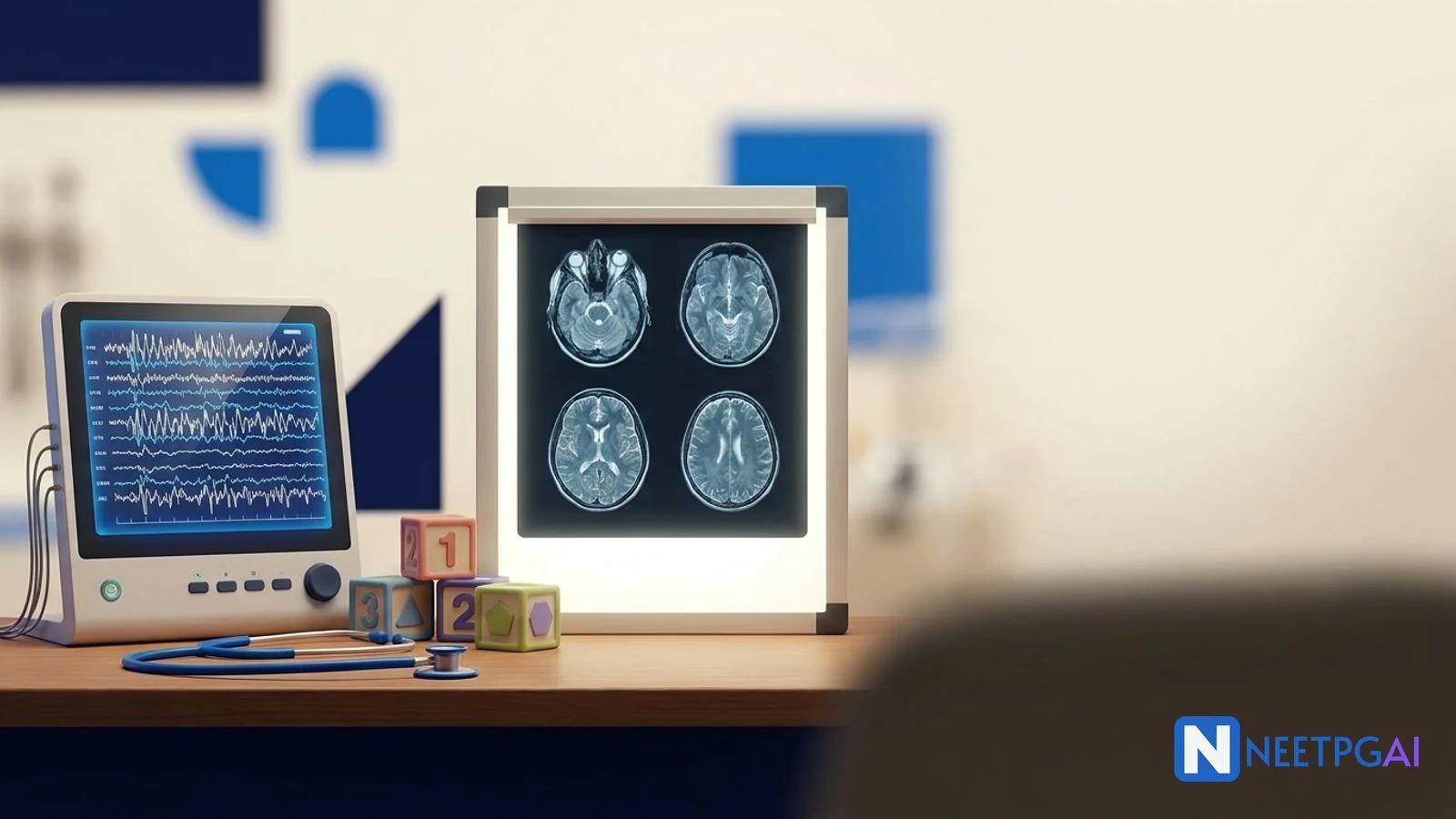
- Interictal EEG: Hypsarrhythmia — a chaotic, disorganized pattern with high-amplitude (>200 microvolts) slow waves and multifocal independent spikes and sharp waves arising from both hemispheres with no consistent pattern. This is one of the most dramatic and recognizable EEG patterns in all of neurology.
- Ictal EEG (during a spasm): Electrodecremental response — a sudden diffuse attenuation (flattening) of the background activity coinciding with the clinical spasm, followed by return of the hypsarrhythmic pattern.
- Modified hypsarrhythmia may be seen in some cases — interhemispheric asymmetry or persistent focal abnormalities suggest a structural lesion.
MRI brain:
- Multiple cortical/subcortical tubers (hamartomas) — hyperintense on T2-weighted and FLAIR sequences
- Subependymal nodules along the lateral ventricles — calcified in older children (CT is more sensitive for calcification)
- These findings confirm tuberous sclerosis complex (TSC) as the underlying etiology
Additional investigations for TSC workup:
- Renal ultrasound: screen for angiomyolipomas (present in 80% of TSC patients by adulthood)
- Cardiac echocardiography: screen for cardiac rhabdomyomas (may be present at birth, typically regress)
- Ophthalmological examination: retinal hamartomas (astrocytic hamartoma)
- Genetic testing: TSC1 (hamartin, chromosome 9) or TSC2 (tuberin, chromosome 16) mutation analysis
Routine investigations:
- CBC, electrolytes, blood glucose, calcium, magnesium — to rule out metabolic causes of seizures
- Metabolic screen (urine organic acids, serum amino acids) — if no structural cause is identified
Diagnosis
West syndrome secondary to tuberous sclerosis complex (TSC) — confirmed by the classic triad (infantile spasms + hypsarrhythmia + developmental regression) plus TSC diagnostic criteria (cortical tubers on MRI + ash-leaf spots + shagreen patch).
West syndrome diagnostic triad:
| Component | Finding in this patient |
|---|
| Infantile spasms | Flexion spasms in clusters on awakening, 10-20 per cluster |
| Hypsarrhythmia on EEG | Chaotic high-amplitude slow waves + multifocal spikes |
| Developmental regression | Loss of babbling, reaching, head control over 2 months |
TSC diagnostic criteria (Roach et al., ILAE): Two or more major features confirm the diagnosis. This patient has: cortical tubers (major), ash-leaf spots >3 (major), shagreen patch (major), subependymal nodules (major) — definite TSC.
Management
Management of West syndrome follows two parallel tracks: treating the infantile spasms and managing the underlying cause. The treatment choice depends critically on whether TSC is present.
First-line treatment: Vigabatrin (for TSC-associated infantile spasms)
Vigabatrin is the first-line drug for infantile spasms due to tuberous sclerosis — this is one of the most frequently tested facts in pediatric neurology for NEET PG.
- Mechanism: Irreversible inhibitor of GABA-transaminase, increasing GABA levels in the brain
- Dose: 50-150 mg/kg/day in two divided doses
- Efficacy in TSC: 90-95% spasm cessation rate (ICISS trial, Lancet 2004; Vigabatrin Infantile Spasms Study Group)
- Key ADR: Irreversible concentric visual field constriction (30-40% of patients with prolonged use) — requires regular visual field monitoring, though this is challenging in infants
- Duration: Typically 6 months, then taper if spasms are controlled
ACTH (for non-TSC infantile spasms)
ACTH (adrenocorticotropic hormone) is the first-line treatment for infantile spasms NOT due to tuberous sclerosis.
- Protocol: High-dose ACTH 150 IU/m2/day IM for 2-3 weeks, then gradual taper over 4-6 weeks
- Efficacy: 70-80% spasm cessation rate (UKISS trial, Lancet Neurology 2004)
- Key ADRs: Hypertension, immunosuppression (risk of opportunistic infections), electrolyte disturbances, irritability, Cushingoid features
- Monitoring: Blood pressure, electrolytes, blood glucose, signs of infection
Why this distinction matters for NEET PG
| Parameter | TSC-associated spasms | Non-TSC spasms |
|---|
| First-line drug | Vigabatrin | ACTH |
| Response rate | 90-95% | 70-80% |
| Key ADR to watch | Visual field defects | Hypertension, infections |
| Second-line if first fails | ACTH | Vigabatrin, valproate |
Additional management considerations
- Antiepileptic drugs for breakthrough seizures: Valproate, topiramate, or the ketogenic diet may be added if spasms persist
- TSC-specific therapy: Everolimus (mTOR inhibitor) is approved for TSC-associated subependymal giant cell astrocytomas (SEGAs) and has shown benefit for refractory epilepsy in TSC
- Developmental intervention: Early intervention programs (physiotherapy, occupational therapy, speech therapy) are essential given the high rate of developmental impairment
- Genetic counseling: TSC is autosomal dominant with variable expressivity. Parents should be screened (skin examination, renal ultrasound, brain MRI) — up to 70% of TSC cases are de novo mutations
Practice pediatrics MCQs with AI-powered explanations to test your clinical reasoning on epilepsy and neurology cases.
How NEET PG tests West syndrome
West syndrome is tested in NEET PG through three dominant patterns:
Pattern 1 — The triad identification: A vignette describing an infant (3-12 months) with clustered spasms + EEG findings + developmental regression. You identify West syndrome. The trap: calling it "myoclonic epilepsy" because the stem mentions "jerking." Remember — myoclonic jerks are brief and isolated; infantile spasms are sustained and clustered.
Pattern 2 — The treatment question: "What is the first-line treatment for infantile spasms?" The answer depends on whether the stem mentions tuberous sclerosis. If TSC is mentioned (ash-leaf spots, cortical tubers, cardiac rhabdomyoma), the answer is vigabatrin. If TSC is not mentioned or the cause is cryptogenic, the answer is ACTH. This is a direct, high-yield question.
Pattern 3 — The EEG pattern: "Which EEG pattern is associated with West syndrome?" The answer is hypsarrhythmia. Related EEG associations tested: Lennox-Gastaut = slow spike-wave (<2.5 Hz); absence epilepsy = 3 Hz spike-wave; juvenile myoclonic epilepsy = 4-6 Hz polyspike-wave.
High-yield one-liners for revision:
- West syndrome = infantile spasms + hypsarrhythmia + developmental regression
- Hypsarrhythmia = chaotic high-amplitude slow waves + multifocal spikes (most disorganized EEG pattern in pediatrics)
- Vigabatrin = first-line for TSC-associated spasms; ACTH = first-line for non-TSC spasms
- Peak onset: 4-7 months; resolves by 3-5 years but often evolves into Lennox-Gastaut syndrome
- Tuberous sclerosis = most common identifiable cause of West syndrome
- Ash-leaf spots + infantile spasms = think TSC until proven otherwise
Frequently asked questions
What is the classic triad of West syndrome?
The classic triad of West syndrome is infantile spasms (flexor, extensor, or mixed), hypsarrhythmia on EEG (chaotic high-amplitude slow waves with multifocal spikes), and developmental regression or arrest. All three components must be present for the diagnosis. This triad typically presents between 3 and 12 months of age, with peak onset at 4-7 months. NEET PG tests this triad directly — if all three are mentioned in the stem, the answer is West syndrome.
What is hypsarrhythmia?
Hypsarrhythmia is the characteristic EEG pattern of West syndrome — a chaotic, disorganized background with high-amplitude (greater than 200 microvolts) slow waves and multifocal independent spikes and sharp waves with no recognizable pattern or interhemispheric synchrony. It is one of the most recognizable EEG patterns in pediatric neurology. During a spasm, the EEG may show a brief electrodecremental response (sudden flattening). Hypsarrhythmia is pathognomonic for West syndrome in the right clinical context.
What is the first-line treatment for infantile spasms?
ACTH (adrenocorticotropic hormone) is the first-line treatment for infantile spasms NOT caused by tuberous sclerosis. The standard protocol is high-dose ACTH (150 IU/m2/day) for 2-3 weeks followed by a taper. For infantile spasms DUE to tuberous sclerosis, vigabatrin is the first-line drug. This distinction — ACTH for non-TS, vigabatrin for TS — is a direct NEET PG question point.
How do infantile spasms differ from myoclonic seizures?
Infantile spasms are sustained contractions lasting 1-5 seconds occurring in clusters (5-150 spasms per cluster), typically on awakening. Myoclonic seizures are brief shock-like jerks lasting under 100 milliseconds, usually not clustered. The EEG also differs: infantile spasms show hypsarrhythmia between episodes, while myoclonic epilepsy shows generalized polyspike-wave discharges. The clinical distinction matters because treatment and prognosis differ significantly.
What is the prognosis of West syndrome?
West syndrome has a guarded prognosis. Even with optimal treatment, 70-90% of children develop intellectual disability. About 50-60% develop other seizure types, including Lennox-Gastaut syndrome. Outcomes are better in cryptogenic (unknown cause) cases compared to symptomatic cases (identifiable brain pathology). Early treatment initiation — within 1 month of spasm onset — improves developmental outcomes. Tuberous sclerosis cases treated with vigabatrin have the best seizure control rates at 90-95%.
What causes West syndrome?
West syndrome has three etiological categories: symptomatic (70-80%) with identifiable brain pathology such as tuberous sclerosis, perinatal hypoxic-ischemic encephalopathy, cortical dysplasia, Down syndrome, or CNS infections; cryptogenic (10-15%) with suspected but unidentifiable cause; and idiopathic (5-10%) with no identifiable cause and normal prior development. Tuberous sclerosis is the single most commonly identified cause and appears frequently in NEET PG stems.
This content is for educational purposes for NEET PG exam preparation. It is not a substitute for professional medical advice, diagnosis, or treatment. Clinical information has been reviewed by qualified medical professionals.
Sources and references
- Nelson's Textbook of Pediatrics, 22nd Edition (Kliegman et al., 2023) — Chapter on Epilepsy in Infancy, West syndrome clinical features, EEG patterns, and management.
- ILAE Classification and Terminology Commission (2017) — updated classification of infantile spasms as epileptic spasms within developmental and epileptic encephalopathies.
- Ghai Essential Pediatrics, 10th Edition (2023) — Indian pediatric neurology reference for West syndrome diagnosis and treatment protocols.
Strengthen your pediatrics high-yield topic coverage and build clinical reasoning by working through epilepsy vignettes on the NEETPGAI practice platform. Ready for unlimited AI-powered MCQs with detailed explanations? Explore NEETPGAI Pro.
For personalized study guidance on pediatrics and neurology topics, try the AI Tutor — it adapts to your weak areas and explains concepts the way a senior resident would.
Written by: NEETPGAI Editorial Team
Reviewed by: Pending SME Review
Last reviewed: April 2026
This article is reviewed by qualified medical professionals for clinical accuracy and exam relevance. For corrections or updates, contact the editorial team.