Version 1.0 — Published May 2026
Quick Answer
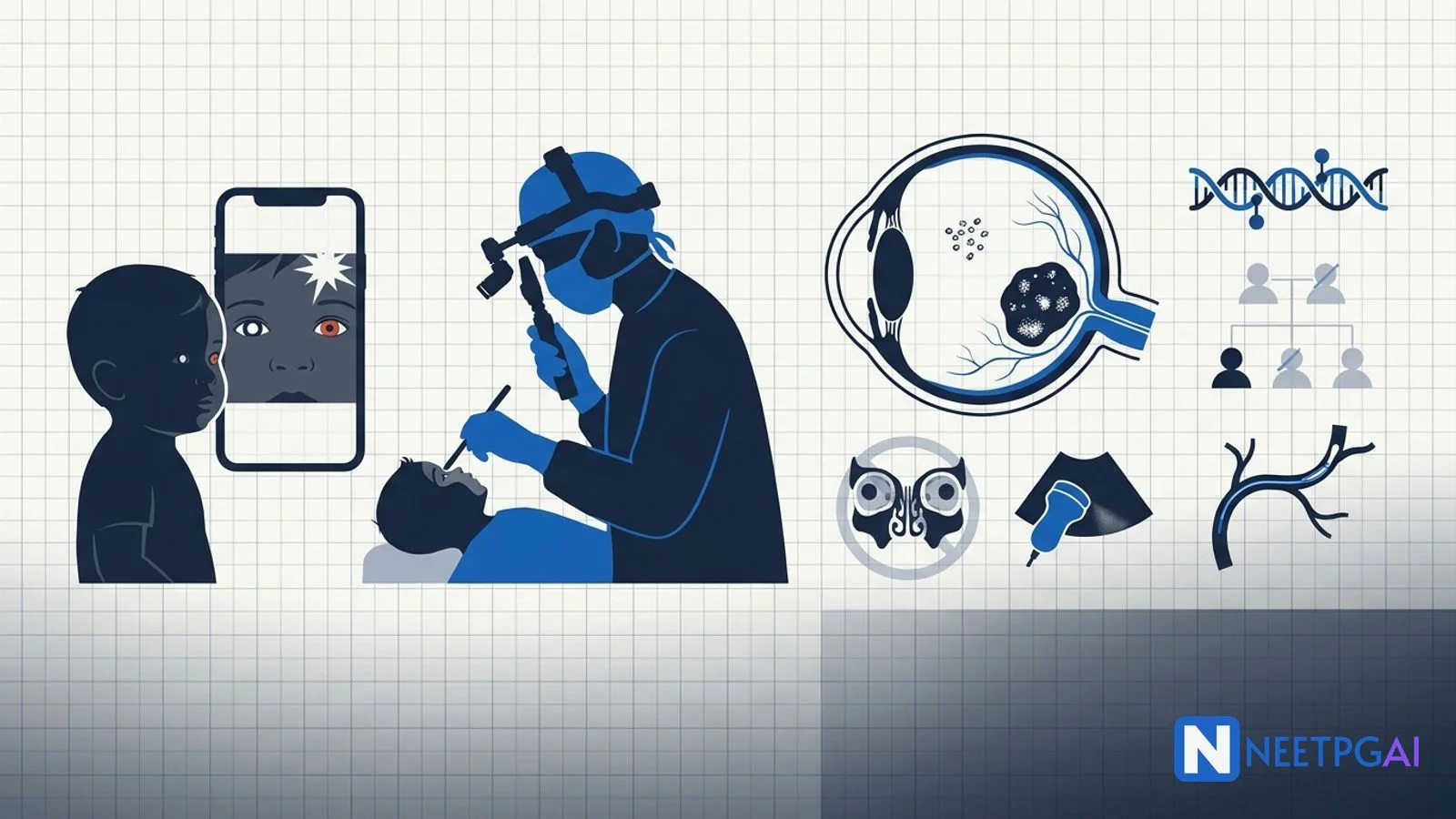
Leukocoria (white pupillary reflex) in a child is retinoblastoma until proven otherwise. The mother's flash-photograph observation is the commonest presenting sign in India and one of the highest-yield NEET PG paediatric ophthalmology stems. In a 2-year-old with leukocoria, follow this 8-step workflow:
- Confirm leukocoria — examine red reflex with a direct ophthalmoscope; absent or white on the affected side
- Examination under anaesthesia (EUA) with indirect ophthalmoscopy and 360-degree scleral depression — define number, size, location of tumours, vitreous seeding, subretinal seeding, extra-ocular extension
- Ultrasound B-scan — bedside, no radiation, demonstrates intraocular mass with high-amplitude internal calcification (the diagnostic acoustic signature)
- MRI orbit with gadolinium — characterises tumour, detects optic-nerve invasion, pinealoblastoma (trilateral RB), and CNS extension. NEVER CT — radiation increases second-malignancy risk in germline RB1 carriers
- Stage — IIRC Groups A-E (intraocular); IRSS Stages 0-IV (extra-ocular and metastatic)
- RB1 genetic testing of tumour + peripheral blood — guides surveillance of siblings and future children
- Treatment escalation — focal therapy (laser, cryotherapy, plaque brachytherapy) for small tumours → systemic or intra-arterial chemoreduction → intravitreal chemotherapy for vitreous seeds → enucleation for Group E or failed conservative therapy
- Follow-up — lifelong; serial EUAs, MRI surveillance for trilateral RB until age 5, second-malignancy surveillance for germline carriers
The case
A 2-year-old boy is brought to the paediatric outpatient clinic in a tertiary children's hospital in Mumbai by his mother. She reports that for the past 3 weeks she has noticed a "white spot" in her son's right pupil whenever she takes a flash photograph on her smartphone. Initially she thought it was a camera artefact and tried a different phone — the same white reflex appeared on the right eye only. The left eye shows the expected red reflex. The child is otherwise asymptomatic — feeding well, playing normally, no fever, no eye redness, no eye discharge, no head tilt, no apparent visual difficulty, no behavioural change. No history of trauma. No prematurity (term delivery at 38 weeks, birth weight 3.1 kg, uneventful neonatal period). No supplemental oxygen at birth, no NICU stay. Fully immunised per the National Immunisation Schedule. Developmental milestones age-appropriate.
Family history is critical and must be elicited carefully. Mother is 28, father is 32, both healthy, non-consanguineous. No family history of childhood eye cancer, no enucleations in any first- or second-degree relative, no childhood blindness. The father reports that his own paternal uncle "lost an eye as a child" but the diagnosis is unknown — a potentially important clue to germline RB1 carriage that warrants careful three-generation pedigree construction.
On examination, the child is alert, interactive, age-appropriate for height and weight. Anterior-segment external examination of both eyes: no proptosis, no orbital asymmetry, no eyelid swelling, no scleral injection, no corneal opacity. Both pupils equal and reactive at rest. Red reflex examination with the direct ophthalmoscope from 30 cm — the LEFT eye shows a clear orange-red reflex; the RIGHT eye shows a WHITE reflex (leukocoria) filling the pupil. No strabismus on cover test today, but the mother reports occasional drifting of the right eye outward over the past month. No nystagmus. Visual acuity in a 2-year-old is best assessed by fix-and-follow — left eye fixes and follows a small toy reliably; right eye fixation is poor and the child resists occlusion of the left eye (the classic objective sign of monocular visual deprivation).
The paediatrician immediately arranges urgent referral to the on-call paediatric ophthalmologist with a working impression of "leukocoria, right eye, retinoblastoma until proven otherwise".
ABCD assessment and initial investigations
This is not an emergency in the resuscitation sense — the child is well, vitals stable, no airway, breathing, or circulatory compromise. But it IS a time-critical oncology emergency in that any delay in diagnosis and treatment can mean the difference between eye-salvaging therapy and enucleation, and in advanced cases the difference between cure and metastatic death. The 5-year survival in India for intraocular retinoblastoma diagnosed and treated promptly approaches 95 percent; survival in extra-ocular and metastatic disease drops to 30-50 percent.
A — Airway, B — Breathing, C — Circulation: All normal. Proceed to focused ocular oncology workup.
D — Disability: Confirm leukocoria objectively. Assess fixation behaviour. Document any strabismus, head tilt, or signs of orbital extension. Document any neurological signs (cranial nerve palsies, raised ICP signs) — pinealoblastoma in trilateral RB and CNS extension produce headache, vomiting, papilledema, and posturing.
E — Exposure: Full body examination for café-au-lait macules (rule out neurofibromatosis), for haemangiomas (rule out Sturge-Weber), for general health and nutrition status, and for any palpable lymph nodes (preauricular and cervical — metastatic spread route).
Examination under anaesthesia (EUA) — the diagnostic gold standard
A 2-year-old cannot tolerate the prolonged, painful, dilated, indirect ophthalmoscopy with 360-degree scleral depression that is required to fully document intraocular retinoblastoma. EUA is mandatory for any suspected intraocular tumour in a young child. EUA components:
- Anterior segment slit-lamp examination — anterior chamber depth, iris neovascularisation, hyphema, pseudohypopyon (tumour cells layered in the anterior chamber), corneal status
- IOP measurement — raised IOP suggests neovascular glaucoma (advanced disease) or massive tumour
- Dilated fundoscopy with indirect ophthalmoscopy and 360-degree scleral depression — count tumours, measure each in disc-diameters, locate each with respect to optic disc and fovea, document vitreous seeds, subretinal seeds, retinal detachment
- RetCam fundus photography — wide-field digital documentation for serial comparison
- Ultrasound B-scan and A-scan — demonstrate intraocular mass with high-amplitude internal calcification (acoustic signature of retinoblastoma)
- Examine the contralateral eye — bilateral disease occurs in 30-40 percent of cases (presumed germline RB1)
- Document any extra-ocular extension — proptosis, orbital mass, conjunctival nodule
Initial investigations
- Ocular ultrasound B-scan: intraocular mass with high-amplitude internal echoes from calcification — pathognomonic in the right clinical context
- MRI orbit and brain with gadolinium contrast: mass arising from the retina, hypointense on T1, slightly hyperintense on T2 (typical), enhancing, with internal calcific foci; assess optic-nerve invasion (post-laminar invasion has prognostic significance), choroidal invasion, extra-ocular extension, and pineal region for pinealoblastoma (trilateral RB), and CNS for leptomeningeal disease
- CT — AVOIDED unless MRI is unavailable; radiation directly to the orbit increases the lifetime risk of second non-ocular malignancies in germline RB1 carriers (osteosarcoma, soft-tissue sarcoma, melanoma). The Royal College of Ophthalmologists and the Indian Ophthalmological Society guidelines explicitly recommend MRI as first-line
- CBC, LFT, RFT, LDH — baseline before systemic chemoreduction
- Bone marrow aspirate and biopsy + lumbar puncture for CSF cytology — required only if extra-ocular disease is suspected on imaging or histology (optic-nerve invasion to or beyond the cut margin, massive choroidal invasion, anterior-segment involvement) — staging the IRSS
- RB1 mutation analysis on peripheral blood lymphocytes (and on tumour tissue if enucleation is performed); cascade testing of siblings and parents
- Audiometry baseline before platinum-based chemotherapy
- Echocardiogram baseline before anthracycline-based chemotherapy
- Vision assessment — fix-and-follow, Cardiff cards, preferential looking in young children; assess visual potential of the affected eye
EUA findings in this child: Right eye — anterior segment normal; IOP 14 mmHg; single large intraretinal-exophytic tumour involving 40 percent of the retina inferotemporally, 8 disc-diameters in size, extending from the inferotemporal periphery towards but not involving the optic disc or foveola, with associated focal subretinal fluid and a small cluster of vitreous seeds in the inferior vitreous cavity; no anterior segment involvement, no neovascular glaucoma, no retinal detachment beyond the tumour. Ultrasound confirms a solid mass with high-amplitude internal calcific foci. Left eye on EUA — completely normal, no tumour. MRI orbit confirms the intraocular mass with internal calcification, optic nerve appears normal with no post-laminar invasion, no extra-ocular extension, no pinealoblastoma, no CNS disease.
Staging: Unilateral right-eye retinoblastoma, IIRC Group D (diffuse subretinal seeds or vitreous seeds in the absence of massive tumour filling), IRSS Stage 0 (intraocular, no extra-ocular spread).
The diagnostic algorithm — confirming retinoblastoma and excluding mimics
NEET PG tests the differential of leukocoria directly. Memorise the 7-cause list and the distinguishing features.
Differential diagnosis of leukocoria
| Diagnosis | Laterality | Key features | Imaging signature |
|---|
| Retinoblastoma | Unilateral 60%, bilateral 40% | White reflex, strabismus, occasionally proptosis or red eye late; family history may be positive | Calcified intraocular mass on ultrasound and MRI |
| Congenital cataract | Often bilateral | Opacified lens, leukocoria visible from birth; rubella, galactosaemia, idiopathic | Lens opacity on slit lamp; no retinal mass |
| Coats disease | Unilateral, boys, age 4-8 | Exudative retinopathy, telangiectatic retinal vessels, yellow subretinal exudate (not white), no family history | No calcification; subretinal exudate on USG; fluorescein angiogram shows telangiectasias |
| Persistent fetal vasculature (PFV) | Unilateral | Microphthalmic eye, retrolental fibrovascular tissue, cataract, glaucoma | Microphthalmia + retrolental tissue, no calcification |
| Retinopathy of prematurity (ROP) Stage 5 | Bilateral usually | Preterm, low birth weight, supplemental-oxygen history; total retinal detachment with retrolental tissue | History critical; no calcification |
| Ocular toxocariasis | Unilateral | Older child (5-10 years), peripheral granuloma, posterior pole granuloma, or endophthalmitis; raised serum Toxocara titres | No calcification; tractional retinal detachment, serology |
| Retinal detachment | Variable | Trauma, FEVR, Norrie disease (X-linked, boys); white reflex from detached retina | Detachment on USG; no mass, no calcification |
Why our patient is retinoblastoma
Five features lock it in: (1) age 2 (peak incidence 1-3 years), (2) isolated leukocoria with poor fixation on the affected side, (3) white intraocular mass with high-amplitude internal calcification on ultrasound — calcification in an intraocular mass in a young child is virtually pathognomonic for retinoblastoma, (4) MRI confirms calcified intraretinal-exophytic mass with vitreous seeds, and (5) no alternative diagnosis fits (no microphthalmia, no telangiectasias, no prematurity, no trauma, no lens opacity). RB1 mutation analysis is pending.
Diagnosis
Unilateral right-eye retinoblastoma, single large intraretinal-exophytic tumour with focal vitreous seeds — IIRC Group D, IRSS Stage 0 — in a 2-year-old boy with no apparent family history but a suggestive paternal-side history requiring three-generation pedigree analysis and RB1 mutation testing on tumour and peripheral blood lymphocytes to determine germline status and guide cascade testing of family members.
Management — eye-sparing therapy escalation
The two parallel goals are (1) save life and (2) save eye and vision. Life always trumps eye. Modern multimodal therapy at high-volume centres achieves both in the majority of intraocular Group A-D disease.
Treatment principles by IIRC group
| Group | Description | Standard approach |
|---|
| A | Small intraretinal tumour, away from foveola and disc | Focal therapy (laser photocoagulation, cryotherapy, transpupillary thermotherapy) |
| B | Larger intraretinal tumour, any location | Systemic chemoreduction + focal consolidation |
| C | Focal subretinal fluid or seeds | Systemic or intra-arterial chemoreduction + focal consolidation + intravitreal melphalan for vitreous seeds |
| D | Diffuse subretinal fluid or seeds | Intra-arterial chemotherapy (IAC) + intravitreal melphalan + focal consolidation; selected enucleation |
| E | Massive intraocular tumour, neovascular glaucoma, anterior segment extension | Primary enucleation (eye salvage rarely possible); adjuvant chemotherapy if high-risk histology |
Focal therapy (Group A and consolidation for B-D)
- Laser photocoagulation — argon or diode laser to seal feeder vessels around small posterior tumours (under 3 mm, away from fovea)
- Cryotherapy — for small peripheral tumours
- Transpupillary thermotherapy (TTT) — diode laser for small posterior tumours, often combined with chemoreduction (chemothermotherapy)
- Plaque brachytherapy (ruthenium-106 or iodine-125) — for medium-sized tumours not responding to focal therapy or chemoreduction
Systemic chemoreduction
- Vincristine + etoposide + carboplatin (VEC regimen) — 6 cycles, every 3 weeks
- Shrinks tumour to allow focal consolidation
- Reduces vitreous seeds (but seeds resist systemic chemo because of poor vitreous penetration)
- Standard of care for Group B and selected Group C disease
Intra-arterial chemotherapy (IAC)
- Super-selective ophthalmic artery cannulation via femoral artery under fluoroscopy
- Direct delivery of melphalan plus or minus topotecan plus or minus carboplatin to the ophthalmic artery
- Repeated every 3-4 weeks for 3-4 cycles
- High response rate in Groups C, D, and selected E
- Has revolutionised eye salvage; minimises systemic toxicity (no myelosuppression, no second-malignancy risk from radiation)
- Available in India at AIIMS Delhi, Sankara Nethralaya, LV Prasad Eye Institute, Aravind, NIMHANS, and a few other tertiary centres
Intravitreal chemotherapy
- Intravitreal melphalan (or topotecan) injection directly into the vitreous cavity
- For vitreous seeds resistant to IAC and systemic chemotherapy
- Safety footprint reduced by anti-seeding precautions (cryotherapy at injection site, irrigation)
Enucleation
- Indications: Group E disease, failed conservative therapy, no visual potential, neovascular glaucoma, anterior segment extension, optic nerve invasion on imaging
- Surgical principle: Remove globe with longest possible optic-nerve stump (15-20 mm) to ensure clear margin
- DO NOT violate the globe (no biopsy of intraocular retinoblastoma — risk of seeding the orbit and extra-ocular spread)
- Send for histopathology including optic-nerve margin assessment — invasion to or beyond the cut margin mandates adjuvant chemotherapy and orbital radiotherapy
- Orbital implant (porous polyethylene or hydroxyapatite) for cosmesis, followed by a prosthetic eye
- Counsel family — most parents experience anticipatory grief; psychological support is essential
External-beam radiotherapy (EBRT)
- Avoided in germline RB1 carriers if at all possible — increases second-malignancy risk (osteosarcoma in the radiation field, soft-tissue sarcoma) by 5-10-fold
- Reserved for orbital recurrence after enucleation, extraocular disease, or failed all other modalities
- Modern proton-beam therapy may reduce off-target dose
High-risk histology after enucleation
- Massive choroidal invasion (over 3 mm)
- Post-laminar optic-nerve invasion
- Anterior segment involvement
- Scleral invasion
- These features mandate adjuvant systemic chemotherapy (4-6 cycles of carboplatin-etoposide-vincristine) and orbital radiotherapy if optic-nerve cut margin is involved
Management of metastatic disease (IRSS Stages II-IV)
- Stage IV (metastatic to CNS, bone marrow, bones, lymph nodes) requires high-dose chemotherapy with autologous stem-cell rescue
- Outcome poor; 30-50 percent survival at 5 years even with intensive therapy
Complications — early and late
Early (during treatment)
- Chemotherapy-related toxicity — myelosuppression, mucositis, neuropathy, ototoxicity (cisplatin/carboplatin), nephrotoxicity
- IAC complications — femoral haematoma, ophthalmic artery occlusion (rare), eyelid oedema, vitreous haemorrhage, retinal detachment
- Intravitreal chemotherapy complications — vitreous haemorrhage, retinal detachment, salt-and-pepper retinopathy
- Enucleation complications — orbital infection, implant extrusion, anophthalmic socket syndrome
- Tumour seeding — if globe violated during procedures or trauma during chemotherapy
- Psychosocial — anticipatory grief, sibling anxiety, financial stress
Late (months to years)
- Visual impairment in treated eye and contralateral eye if bilateral disease
- Anophthalmic socket changes — implant migration, ptosis, conjunctival cyst
- Trilateral retinoblastoma (pinealoblastoma) — 5-15 percent of germline carriers; presents at age 2-5 years with headache, vomiting, papilledema; MRI surveillance every 6 months for 5 years
- Second non-ocular malignancies — germline RB1 carriers have a lifetime risk of 30-50 percent, particularly osteosarcoma (radiation field), soft-tissue sarcoma, melanoma, breast cancer; surveillance for life
- Genetic and reproductive consequences — 50 percent transmission to offspring if germline; preimplantation genetic diagnosis is an option
RB1 genetics and family counselling
The Knudson two-hit hypothesis (a NEET PG favourite)
- RB1 is a tumour suppressor gene on chromosome 13q14
- Retinoblastoma develops when BOTH copies of RB1 are inactivated in a single retinal precursor cell
- Sporadic (60 percent) — both mutations occur somatically in a single retinal cell; always unilateral, unifocal, no germline transmission
- Hereditary (40 percent) — first mutation is germline (inherited or de novo), present in every cell of the body; second somatic mutation in one or more retinal cells triggers tumour formation. Typically bilateral or unilateral multifocal; transmits to offspring with 50 percent probability per child
Who should be tested for RB1 mutation?
- All bilateral cases
- All unilateral multifocal cases
- All familial cases
- All unilateral unifocal cases under age 1 year (presumed germline)
- Optionally: all unilateral cases (modern guidelines increasingly recommend universal testing)
Cascade testing of family members
- If germline mutation identified in the proband, test parents, siblings, and any future children
- Cord-blood RB1 testing at birth for at-risk newborns
- Repeated dilated fundus examination under anaesthesia from birth in carriers — surveillance every 1-3 months for the first year, every 3-6 months until age 3, then every 6-12 months until age 7
India-specific considerations
- Late presentation is common — average age of presentation in India is 24-30 months versus 12-18 months in high-income settings; advanced disease (Groups D-E and extra-ocular spread) is more frequent
- Stigma and delayed care-seeking — parents may attribute leukocoria to "evil eye" or normal variant; awareness campaigns by Aravind Eye Care, Sankara Nethralaya, and LV Prasad have improved early detection
- Geographic access barriers — IAC, MRI under anaesthesia, and RB1 testing are concentrated in tertiary urban centres
- Free or subsidised RB1 testing is available through Children's Hospital networks, AIIMS Delhi, NIMHANS, and tertiary eye hospitals
- Pradhan Mantri Jan Arogya Yojana (PMJAY) and state schemes cover retinoblastoma treatment for eligible families
- Counselling families about enucleation — in many Indian communities, enucleation is perceived as disfiguring and unacceptable; clear communication about prosthetic eye cosmesis and the life-saving rationale is essential
How NEET PG tests retinoblastoma
Seven recurring patterns. Recognise the pattern and the question collapses to a 30-second answer.
Pattern 1 — The leukocoria-differential question: Vignette gives a 2-3 year old with white pupillary reflex on flash photography. First differential to exclude? Retinoblastoma. Imaging of choice? MRI orbit with gadolinium (NEVER CT).
Pattern 2 — The Knudson two-hit question: Bilateral retinoblastoma in a 1-year-old. Inheritance pattern? Autosomal dominant (germline RB1 mutation), Knudson two-hit hypothesis. Risk of transmission to each child? 50 percent. Trap: bilateral disease in a child of unaffected parents is still germline — a de novo mutation.
Pattern 3 — The imaging question: Why is CT avoided in suspected retinoblastoma? Radiation increases second-malignancy risk in germline RB1 carriers (osteosarcoma, sarcoma, melanoma). What replaces it? MRI orbit with gadolinium plus ultrasound B-scan.
Pattern 4 — The staging question: Vignette gives a tumour filling 70 percent of the globe with neovascular glaucoma. IIRC group? Group E. Treatment? Primary enucleation. Trap: aggressive eye-salvage attempts at Group E lead to extraocular spread and metastatic death.
Pattern 5 — The chemotherapy question: Standard systemic chemoreduction regimen for retinoblastoma? Vincristine + Etoposide + Carboplatin (VEC), 6 cycles. What revolutionised advanced eye salvage? Intra-arterial chemotherapy with melphalan delivered super-selectively to the ophthalmic artery.
Pattern 6 — The trilateral-RB question: Child with bilateral retinoblastoma develops headache and papilledema at age 3. Diagnosis? Trilateral retinoblastoma — pinealoblastoma. Surveillance? MRI brain every 6 months until age 5 in germline carriers.
Pattern 7 — The second-malignancy question: Adult who survived bilateral retinoblastoma in childhood (treated with EBRT) presents with a thigh mass at age 22. Most likely diagnosis? Osteosarcoma in the radiation field — the commonest second malignancy in germline RB1 carriers.
High-yield one-liners:
- Leukocoria = retinoblastoma until proven otherwise
- MRI orbit is the imaging of choice — NEVER CT (radiation risk)
- Ultrasound B-scan shows high-amplitude internal calcification (acoustic signature)
- RB1 gene on chromosome 13q14, Knudson two-hit hypothesis, tumour suppressor
- 40 percent hereditary (germline), 60 percent sporadic (somatic)
- Bilateral = always germline; unilateral may be sporadic or germline
- IIRC Group A-E for intraocular staging; IRSS Stage 0-IV for systemic staging
- VEC regimen (Vincristine + Etoposide + Carboplatin) for systemic chemoreduction
- Intra-arterial chemotherapy with melphalan — revolutionised advanced eye salvage
- Enucleation: longest optic-nerve stump (15-20 mm), no globe violation
- EBRT avoided in germline carriers — second-malignancy risk
- Trilateral RB = pinealoblastoma, MRI surveillance until age 5
- 50 percent transmission risk to offspring of germline carriers
- Late presentation in India — average 24-30 months; awareness and access are the bottlenecks
Frequently Asked Questions
Why is CT contraindicated in suspected retinoblastoma and what is the imaging of choice?
CT delivers ionising radiation directly to the orbit, and children with hereditary (germline RB1) retinoblastoma have a markedly elevated lifetime risk of second non-ocular malignancies, particularly osteosarcoma, soft-tissue sarcoma, and melanoma. Radiation exposure further increases this risk. MRI orbit with gadolinium is the imaging investigation of choice — it has no radiation, characterises the tumour, detects optic-nerve invasion, identifies pinealoblastoma (trilateral retinoblastoma), and screens for CNS extension. CT is used only when MRI is unavailable and calcification must be confirmed urgently, and even then it is the exception, not the rule. Ultrasound B-scan is the bedside investigation that demonstrates intraocular mass and calcification with no radiation.
What is the differential diagnosis of leukocoria in a child?
Leukocoria (white pupillary reflex) has seven major causes that NEET PG tests repeatedly. (1) Retinoblastoma — most important, malignant, calcified intraocular mass, can be bilateral, RB1 mutation. (2) Congenital cataract — opacified lens, can be detected early, surgical removal restores vision if treated within the critical period. (3) Coats disease — unilateral, boys, exudative retinopathy with subretinal lipid exudates, no calcification, telangiectatic retinal vessels. (4) Persistent fetal vasculature (PFV, previously PHPV) — unilateral, microphthalmic eye, retrolental fibrovascular tissue. (5) Retinopathy of prematurity (ROP) — preterm, low birth weight, supplemental-oxygen history, vascularised retinal-detachment retrolental tissue. (6) Ocular toxocariasis — Toxocara canis larva migrans, posterior pole granuloma or endophthalmitis, often older child. (7) Retinal detachment from trauma, FEVR, or Norrie disease. Retinoblastoma must be ruled out first because of life-threatening malignancy.
What is the difference between Reese-Ellsworth and International Intraocular Retinoblastoma Classification (IIRC) staging?
Reese-Ellsworth was the original classification (1963) used to predict eye salvage with external-beam radiotherapy — it has 5 groups (I-V) based on tumour size, location, and vitreous seeding. It is now considered obsolete because modern chemoreduction has replaced external-beam radiotherapy and outcomes do not map cleanly to Reese-Ellsworth groups. The International Intraocular Retinoblastoma Classification (IIRC) — also called the International Classification of Retinoblastoma (ICRB) — was developed in the 2000s to predict eye salvage with chemoreduction plus focal therapy. It has 5 groups (A-E). Group A: small intraretinal tumour away from foveola and disc. Group B: larger intraretinal, any location. Group C: focal subretinal fluid or seeds. Group D: diffuse subretinal fluid or seeds. Group E: massive intraocular tumour filling more than 50 percent of globe, neovascular glaucoma, or extension to anterior segment — usually requires enucleation. For metastatic and extraocular disease, the International Retinoblastoma Staging System (IRSS) Stages 0-IV is used.
When is enucleation indicated and what is the role of intra-arterial chemotherapy in retinoblastoma?
Enucleation is indicated for Group E disease (massive intraocular tumour filling more than 50 percent of globe, neovascular glaucoma, severe hyphema with no view, anterior segment extension, optic nerve invasion suggested on imaging, or no useful visual potential), failed conservative therapy, or when conservative therapy is unsafe. Surgical principle: remove the globe with the longest possible optic-nerve stump (15-20 mm), avoid violating the globe, send for histopathology including optic-nerve margin assessment. Intra-arterial chemotherapy (IAC, super-selective ophthalmic artery cannulation with melphalan plus or minus topotecan) has revolutionised eye salvage for advanced disease (Groups C, D, and selected E). IAC delivers high-dose chemotherapy directly to the eye with minimal systemic toxicity, reduces the need for enucleation and external-beam radiation, and is now standard of care for advanced unilateral retinoblastoma at high-volume centres. Intravitreal melphalan or topotecan injection is added for vitreous seeds resistant to IAC. In India, IAC is available at AIIMS Delhi, Sankara Nethralaya, LV Prasad Eye Institute, Aravind Eye Hospital, and a few other tertiary centres.
Why is RB1 genetic testing important and who should be tested?
Approximately 40 percent of retinoblastoma cases are hereditary (germline RB1 mutation), and 60 percent are sporadic (somatic RB1 mutation in retinal cell only). All bilateral cases, all unilateral multifocal cases, all familial cases, and all unilateral cases under 1 year are presumed germline until proven otherwise. Germline-mutation carriers have approximately 50 percent chance of transmitting the mutation to each child, a lifetime risk of trilateral retinoblastoma (pinealoblastoma) of 5-15 percent, and a substantially elevated risk of second non-ocular malignancies (osteosarcoma, soft-tissue sarcoma, melanoma) particularly if treated with external-beam radiation. RB1 testing is performed on tumour tissue (if available from enucleated eye) and on peripheral blood lymphocytes. If a germline mutation is identified, siblings and the parents are tested; future children should undergo cord-blood RB1 testing at birth and repeated dilated fundus examination under anaesthesia from birth. In India, free or subsidised RB1 testing is available through Children's Hospital networks, AIIMS Delhi, NIMHANS, and tertiary eye hospitals — counsel families to access these networks because private RB1 testing can cost Rs 25,000-40,000.
This content is for educational purposes for NEET PG exam preparation. It is not a substitute for professional medical advice, diagnosis, or treatment. Clinical information has been reviewed by qualified medical professionals.
Written by: NEETPGAI Editorial Team
Reviewed by: Pending SME Review
Last reviewed: May 2026