Version 1.0 — Published September 2026
Quick Answer
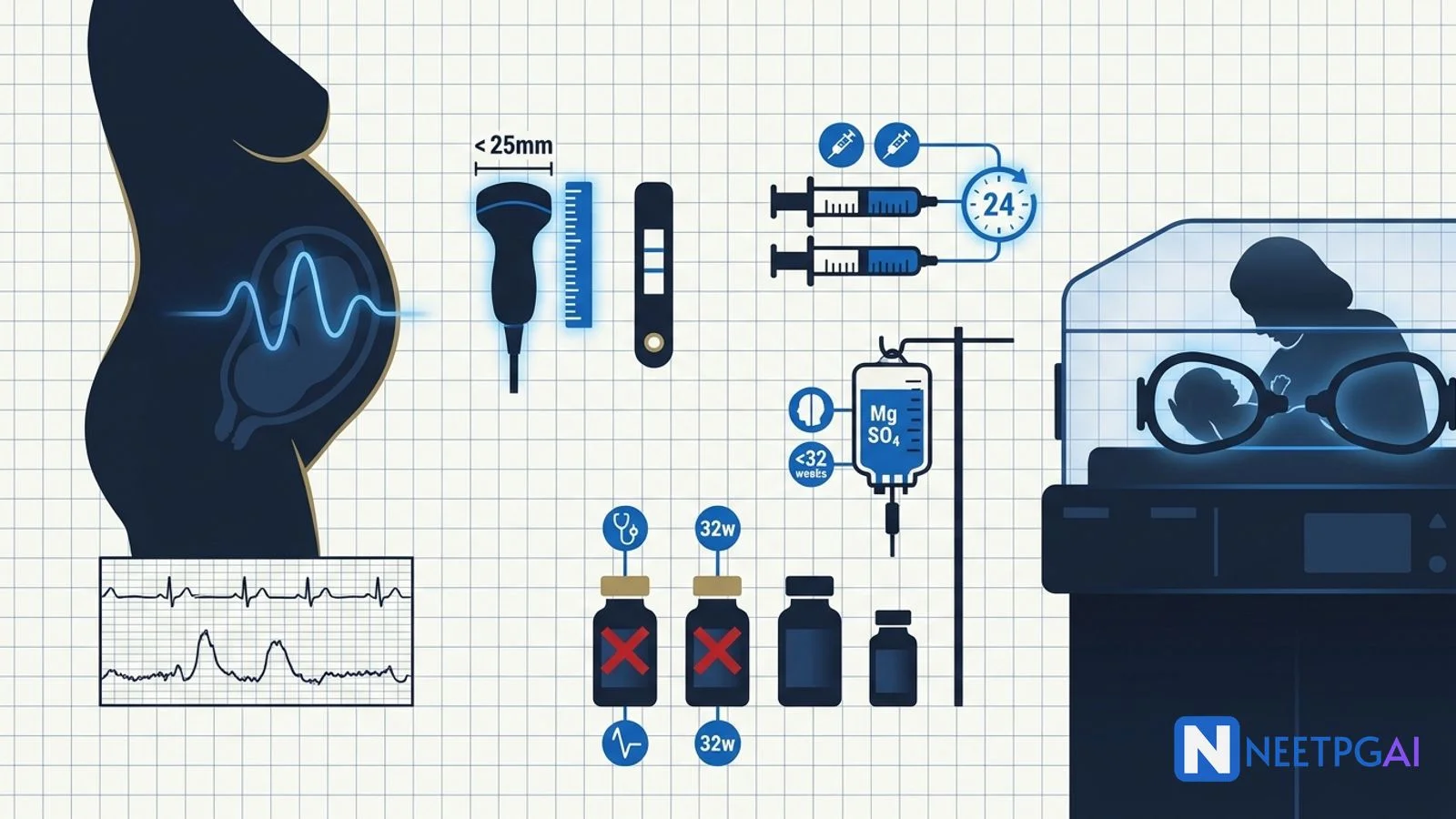
Preterm labour with PPROM is one of the highest-yield obstetric cases on NEET PG — corticosteroids, magnesium sulfate neuroprotection, nifedipine tocolysis, and the Mercer latency antibiotic regimen appear in nearly every paper. A 26-year-old G2P1 at 30 weeks with regular painful contractions every 5 minutes, ruptured membranes 2 hours ago, cervix 3 cm dilated and 60 percent effaced, transvaginal cervical length 15 mm, and positive fetal fibronectin needs the following 9-step workflow:
- Confirm PPROM and preterm labour — sterile speculum (pooling, ferning, nitrazine); avoid digital examination; regular contractions with cervical change confirm labour.
- Rule out chorioamnionitis and abruption — fever, tender uterus, tachycardia, purulent discharge, elevated WBC and CRP; bleeding suggests abruption; CTG for fetal distress.
- Admit, IV access, fetal monitoring — continuous CTG for baseline, tocograph, bedside ultrasound for presentation.
- Latency antibiotics for PPROM — ampicillin plus erythromycin (or azithromycin) — Mercer regimen; avoid amoxicillin-clavulanate (NEC in neonates per ORACLE).
- GBS prophylaxis — IV penicillin G or ampicillin in labour if positive or unknown at under 37 weeks.
- Antenatal corticosteroids — betamethasone 12 mg IM q24h x 2 doses OR dexamethasone 6 mg IM q12h x 4 doses; benefit at 24 hours, maximal at 48 hours.
- MgSO4 for neuroprotection — under 32 weeks; 4 to 6 g IV load then 1 to 2 g/hr for 12 to 24 hours; monitor for toxicity; calcium gluconate antidote.
- Tocolysis — nifedipine first-line (20 mg loading then 10 to 20 mg q4-6h); indomethacin under 32 weeks only; atosiban if available; avoid combining with MgSO4; up to 48 hours only.
- NICU consult, plan delivery, KMC counselling — antenatal transfer if delivery imminent; involve neonatologist; counsel on Kangaroo Mother Care and complications of prematurity.
The case
A 26-year-old G2P1 at 30 weeks gestation by early first-trimester ultrasound presents to the labour room of a tertiary care hospital in Pune with regular painful contractions every 5 minutes lasting 45 seconds each for the last 3 hours and a sudden gush of clear fluid 2 hours ago that has kept trickling since. Her previous pregnancy was a normal-term vaginal delivery of a 3.1 kg baby 4 years ago; no history of preterm birth. This pregnancy has been uneventful — booked in the first trimester at a PMSMA camp, first-trimester scan appropriate for dates, quadruple screen negative, gestational diabetes screen normal at 26 weeks. She had a mild upper respiratory tract infection 10 days ago that resolved without antibiotics. No history of vaginal bleeding, no urinary symptoms, no fever, no reduced fetal movement.
She lives with her husband and 4-year-old son in a two-bedroom flat; she works as a school teacher. She stopped work at 28 weeks. BMI at booking was 24; she has gained 8 kg in this pregnancy. She is a vegetarian, on iron-folic acid and calcium supplements. No smoking, no alcohol, no substance use, no cervical surgery, no LEEP, no cerclage. GBS swab was not performed (not routine in Indian antenatal care at this centre). Blood group O positive, indirect Coombs negative.
Examination on admission — appears anxious and uncomfortable. Temperature 37.0 °C, pulse 92/min, BP 118/72, respiratory rate 18, SpO2 98 percent on room air. Weight 62 kg. Cardiovascular and respiratory examinations normal. Abdomen — fundal height corresponds to 30 weeks, singleton, cephalic presentation, longitudinal lie, back on the right, fetal heart rate 150 by handheld Doppler and later on CTG. Uterus contracts every 5 minutes lasting 45 seconds; uterus is not tender between contractions.
Sterile speculum examination (no digital examination given rupture of membranes) — clear pool of fluid in the posterior fornix, positive ferning on microscopy of a dried sample, nitrazine paper turns blue (alkaline). Cervix is visibly 3 cm dilated, 60 percent effaced, no bleeding, no meconium, no purulent discharge. Vaginal swab is taken for high-vaginal culture. Transvaginal ultrasound shows cervical length of 15 mm with funnelling. Fetal fibronectin swab is positive.
Working diagnosis — Preterm labour with PPROM at 30 weeks in a low-risk G2P1 with no obvious infection. Plan of care combines latency antibiotics, corticosteroids, magnesium sulfate neuroprotection, short-course tocolysis for 48 hours to complete steroid course, GBS prophylaxis if delivery ensues, and NICU coordination.
The three time-critical principles
Principle 1 — Steroids in the next 30 minutes. The largest single-intervention effect size in preterm birth is antenatal corticosteroid; if delivery is likely within 7 days, do not wait for anything else. Betamethasone or dexamethasone should be prescribed and administered before further workup delays it.
Principle 2 — Latency antibiotics for PPROM; the right ones. Ampicillin plus erythromycin or azithromycin — 7-day Mercer regimen. Do not use amoxicillin-clavulanate; ORACLE showed increased necrotising enterocolitis. GBS prophylaxis is a separate intrapartum consideration.
Principle 3 — Tocolysis is a bridge, not a cure. Its role is to complete the 48-hour steroid window and enable maternal transfer if needed. It does not improve neonatal outcomes beyond that. Nifedipine is first-line in modern practice; the older beta-agonists are dangerous. Do not combine two tocolytics; do not combine nifedipine with magnesium sulfate.
Investigations
Bedside
- CTG (cardiotocography) — baseline 150, moderate variability, accelerations present, no decelerations, reactive over 20 minutes. Tocograph — contractions every 5 minutes.
- Sterile speculum — pool of amniotic fluid, ferning positive, nitrazine positive.
- Transvaginal cervical length ultrasound — 15 mm with funnelling.
- Fetal fibronectin — positive.
- Bedside abdominal ultrasound — singleton, cephalic, appropriate for gestational age, estimated fetal weight 1400 g at 30 weeks, amniotic fluid index reduced at 6 cm (consistent with rupture), placenta fundal not previa.
Laboratory
- CBC — Hb 10.8 g/dL, WBC 11,200/microL (upper normal, not markedly elevated), platelets 240,000/microL.
- CRP — 8 mg/L (mildly elevated but non-specific in labour).
- Urinalysis and midstream urine culture — sent to exclude UTI as trigger; nitrite and leucocyte esterase negative.
- High-vaginal swab — sent for culture including GBS.
- Blood group and cross-match — O positive, saved.
- Coagulation — PT INR 1.0, aPTT normal.
- Blood glucose — 92 mg/dL random.
- RFT, LFT — within normal limits.
Interpretation — preterm labour with PPROM; no biochemical evidence of overt chorioamnionitis; no evidence of abruption or preeclampsia; fetal wellbeing intact on CTG.
Diagnosis
Preterm labour at 30 weeks gestation with preterm premature rupture of membranes (PPROM) in a 26-year-old G2P1 with a healthy previous pregnancy, cervix 3 cm dilated and 60 percent effaced, transvaginal cervical length 15 mm, positive fetal fibronectin, cephalic singleton with reassuring fetal status and no evidence of chorioamnionitis — for latency antibiotics (Mercer regimen), antenatal corticosteroids (betamethasone), magnesium sulfate neuroprotection, short-course tocolysis with nifedipine for up to 48 hours to complete steroid course, GBS prophylaxis in labour, and coordinated NICU-level care.
Management — first hour, first 24 hours, latency phase, and delivery
First hour — start the 48-hour clock
- Admit to labour ward with continuous CTG and tocograph. Establish IV access (18G peripheral).
- Betamethasone 12 mg IM — first dose immediately; second dose in 24 hours. (Dexamethasone 6 mg IM q12h x 4 doses is an equivalent alternative.)
- Latency antibiotic regimen (Mercer, for PPROM):
- Ampicillin 2 g IV every 6 hours for 48 hours PLUS erythromycin 250 mg IV every 6 hours for 48 hours, then amoxicillin 250 mg orally every 8 hours plus erythromycin 333 mg orally every 8 hours for a further 5 days (7-day total course).
- Azithromycin 1 g orally as a single dose may substitute for erythromycin in units where tolerability is a concern.
- Do NOT use amoxicillin-clavulanate — ORACLE trial documented increased neonatal necrotising enterocolitis.
- Magnesium sulfate for fetal neuroprotection (under 32 weeks) — loading 4 to 6 g IV in 100 mL over 20 to 30 minutes then infusion 1 to 2 g/hour for at least 12 to 24 hours or until delivery. Monitor deep tendon reflexes hourly, respiratory rate over 12/min, urine output over 30 mL/hour. Have 1 g calcium gluconate ready at the bedside as antidote.
- Tocolysis with nifedipine — 20 mg orally loading, then 10 to 20 mg orally every 4 to 6 hours for up to 48 hours to complete steroids. Monitor BP (avoid if SBP under 90). Do not use nifedipine simultaneously with MgSO4 boluses due to additive hypotension and neuromuscular blockade; separate the two carefully, or use atosiban if available.
- Bladder catheterisation if MgSO4 infusion is running (accurate urine output).
- Call NICU / neonatology — brief on gestational age, weight estimate, expected complications; confirm cot availability. If no in-house NICU, arrange antenatal in utero transfer to a level III facility before delivery is imminent.
- Counsel the patient and family — expected NICU course, RDS, IVH, potential prolonged stay, Kangaroo Mother Care role, financial counselling under PMSMA and PMJAY, breastfeeding plan.
Latency phase — first 48 hours to 7 days
- Continue latency antibiotics per the Mercer schedule.
- Complete second dose of betamethasone at 24 hours; if delivery held off, benefit is maximal at 48 hours.
- MgSO4 for at least 12 to 24 hours; discontinue if delivery not imminent after 24 hours or if toxicity signs appear.
- Discontinue tocolytics after 48 hours; prolonged tocolysis has no benefit.
- Daily maternal temperature, pulse, respiratory rate, uterine tenderness, and fetal CTG.
- Serial WBC and CRP if infection is suspected; amniocentesis for infection markers only in select cases.
- Ambulate as tolerated; watch for VTE (LMWH prophylaxis per hospital protocol).
- Rescue steroid course only if first course was over 14 days ago and pregnancy is still under 34 weeks and delivery is anticipated within 7 days.
Signs mandating delivery
- Chorioamnionitis (maternal fever, tender uterus, tachycardia, purulent discharge, elevated WBC, fetal tachycardia).
- Non-reassuring fetal status on CTG.
- Placental abruption.
- Advanced cervical dilation with imminent birth.
- Prolapse of the umbilical cord.
- Reaching 34 weeks (in PPROM, benefit of remaining in utero is limited beyond 34 weeks; individualise between 34 and 37 weeks).
Delivery
- Mode — vaginal delivery preferred if cephalic, no other contraindication; cesarean for obstetric indication (breech, fetal distress before instrumental prerequisites, non-cephalic malpresentation, cord prolapse).
- GBS intrapartum prophylaxis — IV penicillin G 5 million units then 2.5 to 3 million units every 4 hours until delivery, or IV ampicillin 2 g then 1 g every 4 hours, if GBS positive or unknown status at under 37 weeks.
- Delayed cord clamping (30 to 60 seconds) — improves iron stores and reduces IVH in preterm neonates.
- Neonatologist at delivery with warmer, resuscitation equipment, and immediate NICU transfer.
Postpartum
- Placenta sent for histopathology (look for chorioamnionitis, funisitis).
- Continue antibiotics if chorioamnionitis was suspected.
- Uterotonics and standard PPH prevention (oxytocin bolus and infusion).
- Counsel about recurrence — preterm birth in a subsequent pregnancy carries a 20 to 40 percent recurrence risk; discuss progesterone supplementation (17-OHPC injections or vaginal progesterone) in future pregnancy, cervical length surveillance, and cerclage in appropriate candidates.
- Kangaroo Mother Care initiation as soon as the neonate is stable; breast milk expression from day 1 for gavage feeding.
Complications of prematurity — counsel the family
- Respiratory distress syndrome (RDS) — surfactant deficiency; treated with exogenous surfactant and CPAP.
- Intraventricular haemorrhage (IVH) — germinal matrix bleed; graded I to IV; grade III to IV associated with long-term neurodevelopmental disability.
- Bronchopulmonary dysplasia (BPD) — chronic lung disease of prematurity.
- Necrotising enterocolitis (NEC) — bowel injury; higher risk with formula feeding and amoxicillin-clavulanate exposure.
- Patent ductus arteriosus (PDA) — treated with fluid restriction, indomethacin, ibuprofen or paracetamol; surgical ligation in refractory cases.
- Retinopathy of prematurity (ROP) — screening under RBSK.
- Sepsis — early-onset (maternal transmission) and late-onset (nosocomial).
- Long-term — cerebral palsy (reduced by antenatal MgSO4), developmental delay, learning disability, hearing impairment.
India-specific context
- India carries the world's largest preterm birth burden — approximately 3.5 million preterm births per year, roughly 13 percent of live births.
- PMSMA (Pradhan Mantri Surakshit Matritva Abhiyan) — targets high-risk pregnancy identification on the 9th of every month; helps flag women at risk of preterm birth for tertiary transfer.
- Kangaroo Mother Care (KMC) — WHO recommends KMC for all preterm and LBW infants; India's national KMC scale-up has produced measurable reductions in neonatal mortality.
- SNCUs (Sick Newborn Care Units) under NHM at district and sub-district levels — extended neonatal care access beyond metros.
- Antenatal steroid coverage — Indian data show coverage rising but still under 60 percent nationally; ANC quality audits under LaQshya track this.
- Cervical length screening — not universal; increasingly available in tertiary centres; second-trimester TVS at anomaly scan is the practical opportunity.
- Progesterone for prevention — vaginal progesterone for short cervix and 17-OHPC for prior preterm birth; access improving under PMSMA and state schemes.
How NEET PG tests preterm labour and PPROM
Pattern 1 — The steroid regimen question: Which corticosteroid regimen for a 30-week PPROM? Betamethasone 12 mg IM q24h x 2 doses OR dexamethasone 6 mg IM q12h x 4 doses. Benefit at 24 hours, maximal at 48 hours.
Pattern 2 — The latency antibiotic question: Which antibiotic should be avoided in PPROM latency? Amoxicillin-clavulanate (ORACLE trial — increased NEC).
Pattern 3 — The tocolysis question: First-line tocolytic in modern practice? Nifedipine. Contraindications — hypotension, cardiac disease, concurrent MgSO4 boluses.
Pattern 4 — The MgSO4 neuroprotection question: Below what gestational age is MgSO4 recommended for fetal neuroprotection? Under 32 weeks.
Pattern 5 — The MgSO4 toxicity question: Antidote for MgSO4 toxicity? 1 g IV calcium gluconate. First sign of toxicity — loss of deep tendon reflexes.
Pattern 6 — The PPROM diagnosis question: Bedside tests for PPROM? Pooling, ferning, nitrazine (alkaline pH turns paper blue). Digital examination avoided to reduce infection risk.
Pattern 7 — The fetal fibronectin question: Utility of fetal fibronectin between 22 and 34 weeks? High negative predictive value — a negative test rules out delivery within 7 to 14 days.
Pattern 8 — The GBS prophylaxis question: Antibiotic for intrapartum GBS prophylaxis? IV penicillin G (or ampicillin, cefazolin if allergy; vancomycin for severe allergy plus resistance).
Pattern 9 — The indomethacin question: Why is indomethacin restricted to under 32 weeks and short courses? Premature closure of ductus arteriosus and oligohydramnios with prolonged use above 32 weeks.
Key takeaways
- Steroids first, always.
- Ampicillin plus erythromycin or azithromycin — avoid amoxicillin-clavulanate.
- MgSO4 neuroprotection under 32 weeks; monitor for toxicity; calcium gluconate is the antidote.
- Nifedipine is first-line tocolysis; do not combine with MgSO4 bolus.
- Tocolysis for a maximum of 48 hours to complete steroids and transfer.
- No tocolysis in chorioamnionitis, abruption, or non-reassuring fetal status.
- GBS prophylaxis in labour for positive or unknown status under 37 weeks.
- Antenatal in utero transfer beats postnatal transfer for a preterm neonate.
- Counsel family about NICU course, KMC, and future recurrence.
Frequently Asked Questions
How is preterm labour diagnosed and differentiated from Braxton Hicks contractions?
Preterm labour is defined as regular, painful uterine contractions occurring at least four times in twenty minutes or eight times in an hour before 37 weeks of gestation, associated with progressive cervical change (dilation, effacement, or both). Braxton Hicks contractions are irregular, generally painless, do not intensify with time, and produce no cervical change on serial examination. Bedside adjuncts sharpen the diagnosis when clinical picture is equivocal — transvaginal cervical length under 25 mm and a positive cervicovaginal fetal fibronectin (between 22 and 34 weeks) each raise the risk of delivery within seven to fourteen days; a negative fibronectin has a very high negative predictive value and can safely triage women away from hospitalisation and tocolysis. Rule out chorioamnionitis, placental abruption, urinary tract infection, and dehydration in every presentation.
Which tocolytics are used in preterm labour, and which are avoided?
Tocolytics are used to buy 48 hours for antenatal corticosteroids to work and to permit maternal transfer to a facility with a neonatal intensive care unit — they do not improve long-term neonatal outcomes on their own. Nifedipine, an oral calcium channel blocker, is the modern first-line agent (loading 20 mg orally, then 10 to 20 mg every 4 to 6 hours), with a good safety profile but avoided in maternal hypotension, cardiac disease or concurrent magnesium sulfate. Indomethacin (a COX inhibitor) is effective under 32 weeks but is limited to short courses (48 hours) because of the risk of premature ductus arteriosus closure and fetal oligohydramnios. Atosiban (oxytocin receptor antagonist) has an excellent safety profile and is used widely in Europe (not FDA-approved). Terbutaline (a beta-agonist) is largely reserved for short-term rescue because of maternal cardiac risk and an FDA black-box warning; ritodrine is no longer marketed in most countries. Combining two tocolytics is not recommended. Tocolysis is contraindicated in advanced dilation, chorioamnionitis, severe pre-eclampsia, non-reassuring fetal status, intrauterine fetal demise, and placental abruption.
What is the evidence for antenatal corticosteroids and how are they dosed?
Antenatal corticosteroids are the single most impactful intervention in threatened preterm birth — they reduce neonatal respiratory distress syndrome, intraventricular haemorrhage, necrotising enterocolitis and neonatal mortality. Regimens are betamethasone 12 mg intramuscularly every 24 hours for two doses or dexamethasone 6 mg intramuscularly every 12 hours for four doses. Benefit begins within 18 hours, is maximal at 48 hours and persists for about 7 days. Steroids are given between 24 and 34 weeks of gestation whenever delivery is anticipated within 7 days, and are considered up to 36 6/7 weeks under the ACOG late-preterm guidance for singleton pregnancies without previous corticosteroid exposure. A single rescue course may be given if the first course was more than 14 days earlier and the pregnancy is still under 34 weeks. Repeat weekly courses are not recommended because of concerns about reduced birth weight, brain growth and long-term neurodevelopment.
Why is magnesium sulfate given before delivery under 32 weeks?
Intravenous magnesium sulfate given to women at imminent risk of preterm delivery under 32 weeks reduces the risk of cerebral palsy and moderate-to-severe motor dysfunction in surviving infants, with a number needed to treat of approximately 45 to prevent one case. The mechanism is thought to be neuronal membrane stabilisation, reduced glutamate excitotoxicity, and improved cerebral blood flow. The standard regimen is a 4 to 6 g intravenous loading dose over 20 to 30 minutes followed by a 1 to 2 g per hour infusion for at least 12 to 24 hours or until delivery. Maternal monitoring includes deep tendon reflexes, respiratory rate (over 12 per minute), urine output (over 30 mL per hour), and serum magnesium levels. Toxicity progresses from loss of deep tendon reflexes at 8 to 12 mg/dL, to respiratory depression at 12 to 15 mg/dL, to cardiac arrest above 15 mg/dL; the antidote is 1 g of intravenous calcium gluconate. Concurrent nifedipine plus magnesium sulfate is avoided because both drop maternal blood pressure and may produce cardiotoxicity.
What is the latency antibiotic regimen for PPROM and why is amoxicillin-clavulanate avoided?
In preterm premature rupture of membranes (PPROM) between 24 and 34 weeks, latency antibiotics prolong pregnancy, reduce chorioamnionitis and reduce major markers of neonatal morbidity. The Mercer regimen — the standard — is ampicillin 2 g intravenously every 6 hours for 48 hours plus erythromycin 250 mg intravenously every 6 hours for 48 hours, followed by amoxicillin 250 mg orally every 8 hours for 5 days plus erythromycin 333 mg orally every 8 hours for 5 days (a total 7-day course). Azithromycin 1 g orally as a single dose is now often substituted for erythromycin because of better tolerance and simpler dosing. Amoxicillin-clavulanate is specifically avoided because the ORACLE trial showed an increased risk of necrotising enterocolitis in exposed neonates. Group B streptococcus prophylaxis (intravenous penicillin G or ampicillin) is initiated separately in labour if GBS status is positive or unknown at less than 37 weeks.
This content is for educational purposes for NEET PG exam preparation. It is not a substitute for professional medical advice, diagnosis, or treatment. Clinical information has been reviewed by qualified medical professionals.
Written by: NEETPGAI Editorial Team
Reviewed by: Pending SME Review
Last reviewed: September 2026