Quick Answer
Cystic fibrosis is a NEET PG paediatrics staple that ties genetics, respiratory microbiology and modern pharmacology together.
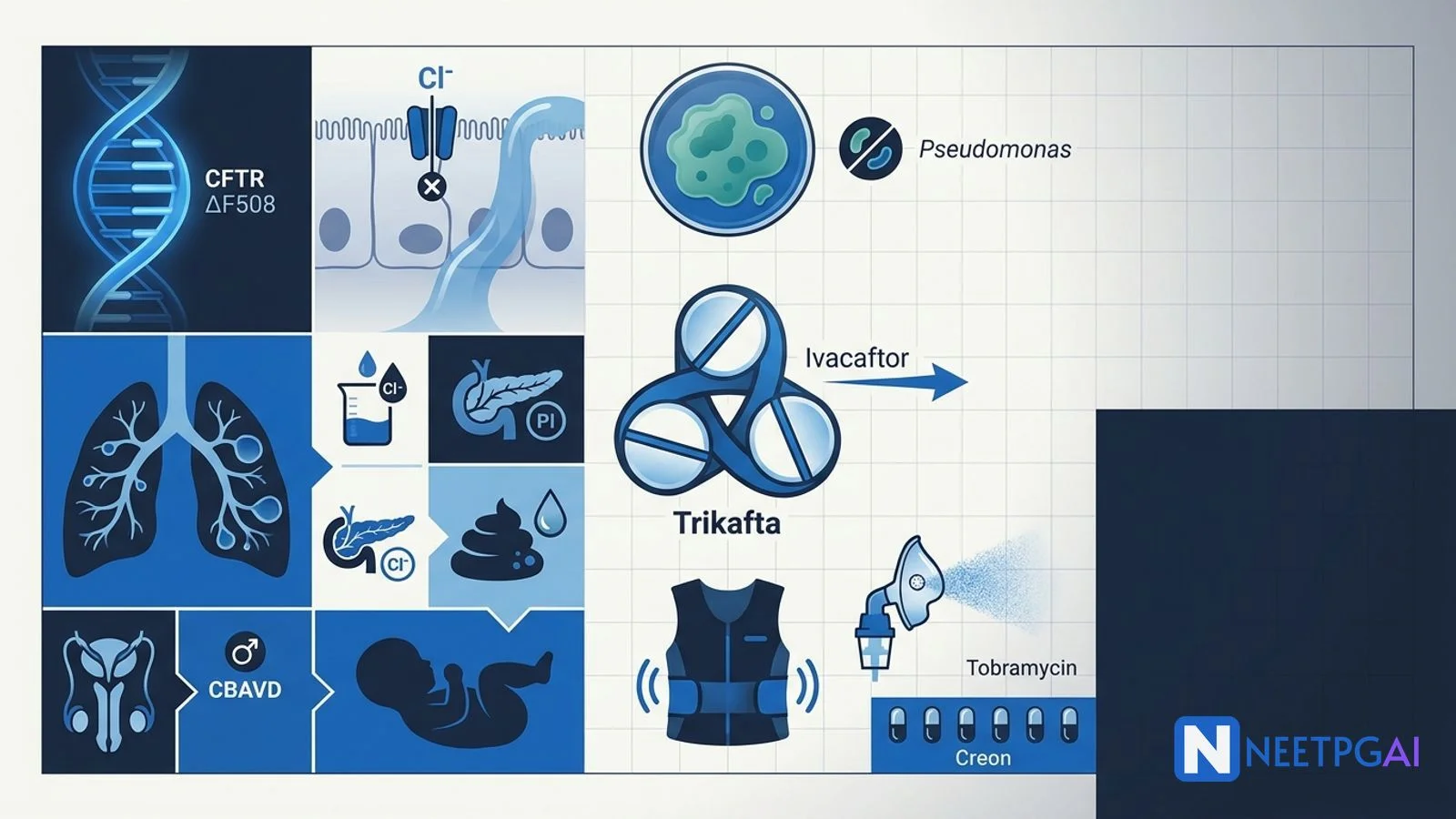
- Genetics — autosomal recessive CFTR gene mutation on chromosome 7q; F508del is the commonest mutation globally.
- Multi-organ disease — chronic sinopulmonary infection, pancreatic insufficiency, male infertility (CBAVD), elevated sweat chloride.
- Diagnosis — sweat chloride over 60 mmol/L twice; genetic panel; newborn screening via IRT then DNA.
- Microbiology ladder — Staph aureus early, Pseudomonas chronic, Burkholderia cepacia poor prognosis, NTM and Aspergillus late.
- Treatment — airway clearance, dornase alfa, hypertonic saline, inhaled antibiotics, pancreatic enzymes, ADEK vitamins.
- CFTR modulators — ivacaftor, lumacaftor/tezacaftor combos, and Trikafta (elexacaftor-tezacaftor-ivacaftor) for over 90 percent of patients.
- India context — underdiagnosed, atypical mutation spectrum, very limited modulator access, no universal newborn screening.
Cystic fibrosis remains a high-yield NEET PG paediatrics topic because it consolidates Mendelian genetics, ion-channel physiology, microbiology and cutting-edge precision medicine into a single disease. It is also increasingly relevant clinically in India as awareness rises and better molecular diagnostics uncover a substantial local burden long assumed to be Caucasian-only.
This NEETPGAI deep dive walks through CFTR biology, the age-stratified presentation, diagnostic pathway, microbiology of chronic infection, the modern management stack including CFTR modulators, and the Indian access reality every student should articulate. Pair this with the pediatric respiratory infections guide for the differential context.
CFTR biology and genetics
Cystic fibrosis is caused by mutations in the CFTR gene on chromosome 7q31.2, which encodes the cystic fibrosis transmembrane conductance regulator — a cAMP-regulated chloride channel expressed on the apical membrane of secretory epithelia (airways, sweat ducts, pancreas, biliary tree, intestine, vas deferens). Loss of CFTR function disrupts chloride and bicarbonate secretion; the resulting dehydrated, viscid airway surface liquid impairs mucociliary clearance and predisposes to chronic infection.
Mutation classes:
| Class | Defect | Example | Approach |
|---|
| I | No functional protein produced (nonsense, frameshift) | G542X | Read-through agents (ataluren — investigational) |
| II | Misfolded protein degraded before reaching membrane | F508del | Correctors (lumacaftor, tezacaftor, elexacaftor) |
| III | Protein at membrane but channel does not open (gating) | G551D | Potentiators (ivacaftor) |
| IV | Reduced channel conductance | R117H | Potentiators |
| V | Reduced amount of normal protein | 3849+10kbC-T | Potentiators plus correctors |
| VI | Reduced membrane stability | rescued F508del | Stabilisers (under study) |
F508del is a Class II corrector-responsive mutation. In global CF populations around 70 percent of patients carry at least one F508del allele; in India that figure drops to around 30 to 40 percent, with a much wider mutation spectrum including 3120+1G-A, R117H and unique regional variants.
Age-stratified presentation
Newborn — meconium ileus in approximately 20 percent of CF babies (distal small bowel obstruction with microcolon on contrast enema); a raised immunoreactive trypsinogen (IRT) on newborn screening prompts further work-up.
Infancy — failure to thrive, steatorrhoea from pancreatic insufficiency, recurrent lower respiratory infections, hyponatraemic hypochloraemic metabolic alkalosis with dehydration ("pseudo-Bartter"), rectal prolapse.
Childhood — chronic productive cough, bronchiectasis, nasal polyps (any child with nasal polyps deserves a CF work-up), digital clubbing, hepatobiliary disease.
Adolescence and adulthood — recurrent pulmonary exacerbations, CF-related diabetes (CFRD), osteoporosis, CF liver disease with focal biliary cirrhosis, distal intestinal obstruction syndrome (DIOS), pneumothorax, haemoptysis, male infertility from congenital bilateral absence of the vas deferens (CBAVD).
Diagnosis
The sweat chloride test using quantitative pilocarpine iontophoresis remains the gold standard.
| Sweat chloride | Interpretation |
|---|
| Under 30 mmol/L | CF unlikely in most populations |
| 30 to 59 mmol/L | Intermediate — repeat and add genetic testing |
| 60 mmol/L or higher on two occasions | Diagnostic of CF |
A CF diagnosis requires clinical features consistent with CF, a positive family history or a positive newborn screen, PLUS laboratory evidence — a positive sweat test, two disease-causing CFTR mutations or an abnormal nasal potential difference.
Newborn screening — IRT is measured on a heel-prick dried blood spot; a raised IRT triggers a genetic panel (CFTR mutation testing); positive cases are confirmed by sweat testing. India does not have a universal CF newborn screening programme.
Genetic testing — sequencing of the CFTR gene identifies the specific mutations, essential for CFTR modulator eligibility and family counselling.
Pulmonary microbiology in CF
The microbiological ladder in the CF airway has enormous prognostic weight.
| Age band | Typical pathogens |
|---|
| Infancy | Staphylococcus aureus (methicillin sensitive and resistant), Haemophilus influenzae |
| Childhood | Pseudomonas aeruginosa — initial intermittent, then chronic mucoid conversion |
| Adolescence | Burkholderia cepacia complex (poor prognosis, isolation precautions, exclusion from transplant listing in some centres) |
| Adulthood | Non-tuberculous mycobacteria (M. abscessus, M. avium complex), Aspergillus (ABPA), Achromobacter, Stenotrophomonas |
Chronic Pseudomonas colonisation — defined as three positive cultures over six months — is the strongest single predictor of pulmonary decline. First-isolate eradication with inhaled tobramycin or colistin plus oral ciprofloxacin for 28 days can delay chronic colonisation for years.
Management framework
CF management is chronic and multidisciplinary, delivered at accredited CF centres.
Airway clearance
Daily physiotherapy — postural drainage, chest percussion, positive expiratory pressure (PEP) masks, oscillatory PEP (Acapella, Flutter), high-frequency chest wall oscillation vests, autogenic drainage, active cycle of breathing.
Mucolytics and hydrators
- Dornase alfa (recombinant human DNase) — cleaves extracellular neutrophil DNA in purulent sputum; daily nebulised.
- Hypertonic saline (7 percent) — restores airway surface liquid volume.
- Mannitol dry powder — osmotic hydration for select patients.
Bronchodilators
Short-acting beta-agonists administered before airway clearance and inhaled antibiotics.
Antibiotics
- Chronic inhaled — tobramycin (alternate months), aztreonam lysine, colistin — for Pseudomonas-colonised patients.
- Oral azithromycin — anti-inflammatory and immunomodulatory; three times weekly.
- IV antibiotics — 2-week courses for pulmonary exacerbations, typically anti-Pseudomonas double coverage (piperacillin-tazobactam or ceftazidime plus an aminoglycoside).
CFTR modulators
The single biggest advance in CF care in the last decade.
| Drug | Class | Indication |
|---|
| Ivacaftor | Potentiator | Age 4 months and above with gating mutations (G551D and other class III/IV) |
| Lumacaftor-ivacaftor | Corrector plus potentiator | F508del homozygous (older combination) |
| Tezacaftor-ivacaftor | Corrector plus potentiator | F508del homozygous or one responsive mutation |
| Elexacaftor-tezacaftor-ivacaftor (Trikafta) | Dual corrector plus potentiator | Age 2 years and above with at least one F508del or responsive mutation — covers over 90 percent of patients |
Trikafta improves FEV1 by 10 to 14 percent, reduces exacerbations by 63 percent, improves quality of life dramatically and is expected to add 20 to 30 years of life expectancy. Annual cost outside insurance is around USD 300,000 — prohibitive in India without named-patient access.
Nutrition and pancreatic support
- Pancreatic enzyme replacement therapy (PERT) — pancrelipase (Creon) taken with every meal and snack; dosed by lipase units per gram of fat.
- Fat-soluble vitamins ADEK supplemented daily.
- High-calorie high-fat diet — 120 to 150 percent of the recommended daily allowance; gastrostomy feeds when growth fails.
- Salt supplementation — extra sodium chloride in infancy and hot climates.
CF-related diabetes (CFRD)
Screen annually from age 10 with a 2-hour OGTT. Treat with insulin only — oral hypoglycaemics are not indicated. CFRD accelerates lung function decline if untreated.
CF liver disease, osteoporosis, DIOS
Ursodeoxycholic acid for cholestatic liver disease (evidence limited), bisphosphonates and vitamin D for osteoporosis, polyethylene glycol or gastrografin enema for distal intestinal obstruction syndrome.
Lung transplantation
Considered when FEV1 falls below 30 percent predicted with rapid decline, in massive haemoptysis or in pulmonary hypertension. Bilateral sequential lung transplant is standard. Transplant does not cure the systemic disease.
Indian context
CF in India has a distinct clinical and epidemiological profile.
- Underdiagnosis — a common assumption that CF is Caucasian-only leads to missed cases; symptoms often attributed to recurrent tropical infections, tuberculosis or protein-energy malnutrition.
- Absent universal newborn screening — no national programme; state-level pilots exist.
- Atypical mutation spectrum — F508del prevalence is 30 to 40 percent versus 70 percent in Europe; a long tail of other mutations complicates diagnosis and modulator eligibility.
- Sweat testing capacity — accredited quantitative pilocarpine iontophoresis is limited to tertiary centres.
- Access to CFTR modulators — cost is the single biggest barrier; a handful of Indian patients access Trikafta through named-patient import, insurance appeals or philanthropic programmes. There is emerging advocacy for compulsory licensing.
- Anchor centres — KEM Hospital Mumbai, AIIMS Delhi, PGIMER Chandigarh, CMC Vellore, PD Hinduja Mumbai, SGRH Delhi, Kokilaben Mumbai lead multi-disciplinary CF care.
NEET PG MCQ traps
- Meconium ileus in a newborn — assume CF until proven otherwise; contrast enema shows microcolon.
- Any child with nasal polyps — screen for CF.
- Sweat chloride cut-off — over 60 mmol/L on two occasions is diagnostic.
- Newborn screening — IRT is the first-tier marker; genetic panel and sweat test follow.
- F508del mutation class — Class II; responds to correctors plus potentiator (Trikafta).
- G551D mutation — Class III gating; responds to ivacaftor (the first precision-medicine CF drug).
- Pseudomonas colonisation — strongest predictor of pulmonary decline; eradicate early.
- Burkholderia cepacia — poor prognosis; segregation precautions; may contraindicate transplant.
- Male infertility in CF — CBAVD (congenital bilateral absence of the vas deferens); sperm retrieval possible.
- Pseudo-Bartter syndrome — hyponatraemic hypochloraemic metabolic alkalosis in infants with CF.
- CFRD — treat with insulin only; annual OGTT from age 10.
- Fat-soluble vitamin deficiency — supplement ADEK daily.
- Trikafta age lowered — now approved from 2 years in the USA and 6 years in most Indian pathways.
- DIOS — treat with polyethylene glycol or gastrografin enema; not the same as meconium ileus equivalent in newborns.
- ABPA in CF — steroids plus itraconazole; check total IgE and Aspergillus-specific IgE.
- Nasal potential difference — abnormal in CF; useful when sweat and genetics are equivocal.
- Chest X-ray pattern — upper lobe predominant bronchiectasis with hyperinflation.
- Reye syndrome is not CF — do not confuse in exam stems.
- Ivacaftor age — from 4 months in gating mutations.
- India mutation spectrum — F508del only 30 to 40 percent; wide diversity.
Recent updates and India context
- Trikafta age expansion (2023) — FDA approval extended down to age 2 years; broader real-world evidence keeps confirming exacerbation reduction and FEV1 gains.
- Vanzacaftor-tezacaftor-deutivacaftor (Alyftrek, 2024) — next-generation triple therapy with once-daily dosing.
- Newborn screening pilots in India — Kerala, Punjab and Tamil Nadu have running pilots; national roll-out is not yet policy.
- Genetic testing panels — Indian-population-tailored CFTR panels (from NCBS and ICMR-collaborating labs) are improving detection of non-F508del variants.
- CF Foundation India patient registry — growing dataset; useful for MCH thesis work and advocacy.
- Compulsory licensing debate — Indian patient groups continue to petition for local generic access to Trikafta.
- Non-tuberculous mycobacteria (NTM) — India-specific overlap with pulmonary TB creates diagnostic complexity; culture and speciation are mandatory before therapy.
- COVID-19 in CF — surprisingly, most CF patients did not fare worse than the general population, likely due to intense infection control and hygiene practice.
Frequently asked questions
What is the gold-standard test for diagnosing cystic fibrosis?
The sweat chloride test using quantitative pilocarpine iontophoresis remains the gold standard. A value above 60 mmol/L on two separate occasions is diagnostic; 30 to 59 mmol/L is intermediate and needs genetic testing plus repeat; below 30 mmol/L makes CF unlikely in most populations. Genetic testing identifies the specific CFTR mutations and is essential for eligibility to CFTR modulators such as ivacaftor and Trikafta. Newborn screening starts with immunoreactive trypsinogen, then genetic panel, then sweat test for confirmation.
Why is Pseudomonas aeruginosa so important in cystic fibrosis?
Chronic Pseudomonas colonisation drives the progressive lung disease that determines long-term outcome in CF. Once established as a mucoid biofilm phenotype, it is essentially impossible to eradicate and accelerates decline in FEV1. Early or first-isolate eradication protocols using inhaled tobramycin, colistin or aztreonam for 28 days have transformed prognosis. Chronic suppressive inhaled antibiotics — tobramycin, aztreonam, colistin — reduce exacerbation frequency and preserve lung function in colonised patients.
What is Trikafta and which CF patients qualify for it?
Trikafta is a triple CFTR modulator combining elexacaftor and tezacaftor (correctors that improve F508del CFTR folding) with ivacaftor (a potentiator that boosts channel opening). Approved by the FDA in 2019 and expanded to age 2 and older by 2023, it is transformative — improving FEV1 by 10 to 14 percent, reducing exacerbations by 63 percent and adding an estimated 20 to 30 years of life. It is indicated for patients aged 2 years or older with at least one F508del allele or another responsive mutation, covering over 90 percent of the CF population.
How is CF-related diabetes different from type 1 or type 2 diabetes?
CF-related diabetes (CFRD) is a distinct entity caused by pancreatic fibrosis and progressive islet destruction, appearing typically in adolescence and affecting nearly half of adults with CF. Unlike type 1 diabetes, it usually presents insidiously without ketoacidosis; unlike type 2 diabetes, it lacks strong insulin resistance and is not associated with obesity. Insulin is the only recommended therapy — oral hypoglycaemics are not indicated. Annual OGTT screening starts at age 10 years.
Why is cystic fibrosis underdiagnosed in India?
CF is underdiagnosed in India for several reasons — lack of universal newborn screening, the mistaken belief that CF is a Caucasian-only disease, absence of accredited sweat testing at most centres, atypical Indian CFTR mutation spectrum where F508del accounts for only 30 to 40 percent of alleles versus 70 percent in Europe, and overlap with tropical infections and malnutrition that mask the presentation. Tertiary paediatric pulmonology centres at KEM Mumbai, AIIMS Delhi, PGIMER Chandigarh and CMC Vellore anchor Indian CF care, but access to CFTR modulators remains extremely limited due to cost.
This content is for educational purposes for NEET PG exam preparation. It is not a substitute for professional medical advice, diagnosis, or treatment. Clinical information has been reviewed by qualified medical professionals.
Written by: NEETPGAI Editorial Team
Reviewed by: Pending SME Review
Last reviewed: September 2026