Version 1.0 — Published April 2026
Quick Answer
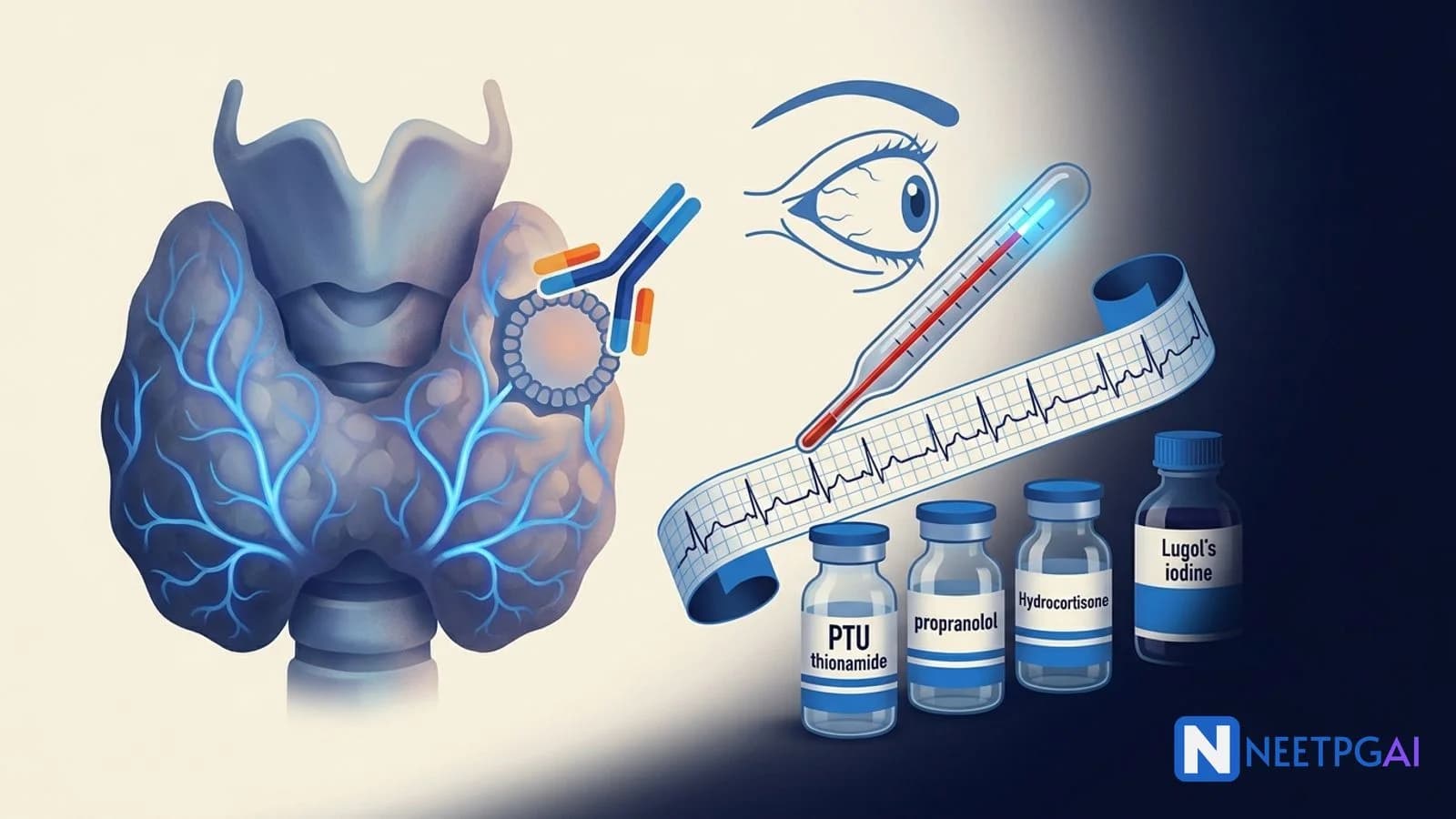
Thyroid storm is the lethal end of the hyperthyroid spectrum and a NEET PG favourite — particularly the sequential pharmacology and the iodine-timing trap. In a 28-year-old woman with Graves' disease decompensating after a URI, presenting with fever 39.5 C, tachycardia, agitation, and congestive features, follow this 6-step workflow:
- Recognise it clinically and score with Burch-Wartofsky — score ≥45 = storm, treat without waiting for labs
- Start beta-blockade immediately — propranolol IV (also blocks T4 to T3 conversion at high doses)
- Block synthesis with a thionamide — PTU loading dose preferred (additional D1 inhibition); methimazole acceptable
- Block release with iodine 1 hour LATER — Lugol's iodine or SSKI; never before the thionamide (Jod-Basedow trap)
- Block peripheral T4 to T3 conversion — hydrocortisone 100 mg IV q8h (also covers relative adrenal insufficiency)
- Treat the precipitant and give supportive care — culture-driven antibiotics, cooling, fluids, ICU monitoring
The case
A 28-year-old call-centre executive from Hyderabad is brought to the emergency department by her husband with 4 days of palpitations, restlessness, fever, and tremor that have escalated dramatically over the last 12 hours. She had a typical URI 10 days ago — sore throat, low-grade fever, body ache — for which her family doctor prescribed paracetamol and amoxicillin. Two days into the URI she ran out of her routine carbimazole and did not refill it because she was unwell to step out. Today her husband found her sweating profusely, pacing the room, talking incoherently, and refusing food and water; on the way to the hospital she vomited twice.
Past history: she was diagnosed with Graves' disease 14 months ago after presenting with a 6 kg weight loss, palpitations, heat intolerance, fine tremor, oligomenorrhea, and a diffuse painless goitre. TSH was suppressed (<0.01 mIU/L), free T4 was 4.8 ng/dL, free T3 was 12.4 pg/mL, and TRAb (thyrotropin receptor antibody) was strongly positive at 14 IU/L. She was started on carbimazole 30 mg daily plus propranolol 40 mg twice a day, with planned reassessment for definitive therapy after 12-18 months. She has had mild bilateral exophthalmos throughout — Graves' ophthalmopathy. No prior thyroid surgery, no prior radioactive iodine therapy. No diabetes, no cardiac, renal, or hepatic disease, no allergies, no other medications. She is married, planning a pregnancy in 2 years; not currently pregnant (LMP 6 days ago). No alcohol, no smoking.
On arrival, vitals are: pulse 152/min irregularly irregular (atrial fibrillation), BP 164/72 mmHg (wide pulse pressure), respiratory rate 28/min, SpO2 95 percent on room air, temperature 39.7 C, capillary glucose 178 mg/dL. She is restless, agitated, and intermittently combative; oriented to person but not to time and place. Skin is hot, flushed, and visibly diaphoretic. Hands show fine tremor. Neck examination shows a diffusely enlarged, smooth, non-tender thyroid (about 50 g) with an audible bruit over both lobes. Eyes show bilateral proptosis with lid retraction (von Graefe sign positive); no chemosis, no extraocular movement restriction. Cardiovascular: irregularly irregular pulse, AF on cardiac monitor, no murmurs, no S3, mild bibasal crepitations. Abdomen is soft; mild hepatomegaly (3 cm below costal margin); bowel sounds active. Reflexes are brisk with sustained ankle clonus.
Bedside ECG: atrial fibrillation with ventricular rate 152/min, no acute ischemic changes. The on-call resident calls the endocrinology registrar and starts simultaneous workup and treatment.
ABCD assessment and initial investigations
Thyroid storm has 10-30 percent mortality if treatment is delayed. The diagnosis is clinical; treatment cannot wait for lab confirmation.
A — Airway: Patent. GCS 13 (E3 V4 M6 — confused but protecting airway). Reassess every 30 minutes; deteriorating GCS warrants intubation.
B — Breathing: RR 28, SpO2 95 percent on room air. Mild bibasal crepitations consistent with high-output cardiac decompensation. CXR ordered. Continuous SpO2; nasal O2 if SpO2 falls under 94. ABG to rule out lactic acidosis.
C — Circulation: AF with rapid ventricular response, BP 164/72 (hyperdynamic). Two large-bore IV cannulas. Start propranolol 1 mg IV slow bolus every 10-15 minutes titrated to heart rate <100 (max 5-10 mg) — beta-blockade is first-line and provides rapid symptom control plus partial T4 to T3 inhibition at high doses. Monitor for hypotension and overt cardiac decompensation. Avoid IV labetalol (less data) and avoid esmolol if hypotensive. If overt heart failure or hemodynamic instability — diltiazem is an alternative; digoxin is poorly effective in hyperthyroid AF (decreased sensitivity). IV crystalloid 1 L Ringer lactate over 1 hour, then maintenance — these patients are profoundly volume-depleted from sweating and vomiting.
D — Disability/Dextrose: GCS 13, glucose 178, agitated. Cooling measures — paracetamol 1 g IV (NOT aspirin or NSAIDs — aspirin displaces T4 from TBG, raising free T4 and worsening storm), tepid sponging, ice packs in groin/axillae if temp >39.5. Avoid antipyretic shivering by cooling gently. Sedation cautiously (low-dose benzodiazepine) for severe agitation if airway is at risk.
Initial investigations (within 30 minutes):
- TSH: <0.005 mIU/L (suppressed)
- Free T4: 7.8 ng/dL (markedly raised; normal 0.8-1.8)
- Free T3: 22.4 pg/mL (markedly raised; normal 2.3-4.2)
- TRAb (TSH-receptor antibody): 28 IU/L (strongly positive — Graves' confirmed)
- CBC: Hb 11.4 g/dL, WBC 14,200 (left shift), platelets 240,000
- BUN: 28 mg/dL; creatinine 0.9 mg/dL
- LFTs: AST 78, ALT 92, ALP 168, bilirubin 2.1 mg/dL (mild transaminitis and hyperbilirubinaemia — common in storm; rules out baseline liver disease which would influence PTU choice)
- Glucose: 178 mg/dL
- Electrolytes: Na 138, K 3.6, Cl 102, HCO3 22
- Calcium: 9.4 mg/dL
- CRP: 48 mg/L (raised — supports infectious precipitant)
- Lactate: 2.8 mmol/L (mildly raised)
- Beta-hCG: negative (rules out pregnancy)
- Procalcitonin: 0.6 ng/mL (mildly raised)
- Urine analysis: WBC 30/HPF, nitrite positive, leukocyte esterase positive — UTI; urine culture sent
- Blood cultures: drawn before antibiotics
- CXR: mild bilateral pulmonary congestion, normal cardiac size
- ECG: AF with rapid ventricular response 152/min, no ischemic changes
- Echo (bedside): preserved LVEF 60 percent, no regional wall motion abnormality, no significant valvular lesion, no pericardial effusion
- CT head (because of altered sensorium): normal — no haemorrhage, no infarct
The Burch-Wartofsky Point Scale — score this patient
The Burch-Wartofsky Point Scale (BWPS) is the canonical NEET PG tool for diagnosing thyroid storm at the bedside.
| Domain | Finding | Points |
|---|
| Thermoregulation (°F / °C) | 99-99.9 / 37.2-37.7 | 5 |
| 100-100.9 / 37.8-38.2 | 10 |
| 101-101.9 / 38.3-38.8 | 15 |
| 102-102.9 / 38.9-39.4 | 20 |
| 103-103.9 / 39.5-39.9 | 25 |
| ≥104 / ≥40 | 30 |
| CNS effects | Mild agitation | 10 |
| Moderate (delirium, psychosis, lethargy) | 20 |
| Severe (seizure, coma) | 30 |
| GI-hepatic | Moderate (diarrhea, vomiting, abdominal pain) | 10 |
| Severe (unexplained jaundice) | 20 |
| Cardiovascular: tachycardia (bpm) | 90-109 | 5 |
| 110-119 | 10 |
| 120-129 | 15 |
| 130-139 | 20 |
| ≥140 | 25 |
| Congestive heart failure | Mild (pedal edema) | 5 |
| Moderate (bibasal crackles) | 10 |
| Severe (pulmonary edema) | 15 |
| Atrial fibrillation | Present | 10 |
| Precipitating event | Present | 10 |
Score interpretation: ≥45 highly suggestive of thyroid storm; 25-44 impending storm; <25 unlikely.
Our patient: temperature 39.7 (25), moderate CNS (20), GI moderate — vomiting (10), HR 152 (25), CHF moderate — bibasal crepitations (10), AF present (10), precipitant present — URI/UTI (10) = BWPS 110 — definitive thyroid storm.
Diagnosis
Thyroid storm (Burch-Wartofsky Point Scale 110) on a background of Graves' disease (14 months on carbimazole, TRAb 28 IU/L, diffuse goitre with bruit, bilateral mild exophthalmos), precipitated by abrupt antithyroid drug withdrawal plus intercurrent UTI in a 28-year-old previously controlled woman.
This phrasing tells the consultant the syndrome, the underlying disease, the precipitants, and the demographic context — exactly the structure NEET PG vignettes test.
Differential diagnosis — what else can mimic storm
Don't anchor; thyroid storm shares features with several other emergencies.
- Sepsis with septic shock — fever, tachycardia, altered sensorium; lactate raised; but TSH not suppressed and free T4 normal
- Pheochromocytoma crisis — paroxysmal hypertension, headache, tachycardia, sweating; plasma metanephrines raised
- Heat stroke — exertional or environmental heat exposure, anhidrosis common (vs profuse sweating in storm); core temp can exceed 40
- Sympathomimetic intoxication — cocaine, amphetamines, MDMA, anticholinergic drugs; toxicology screen
- Neuroleptic malignant syndrome and serotonin syndrome — recent psychotropic use, lead-pipe rigidity (NMS) or hyperreflexia plus clonus (serotonin)
- Anticholinergic toxicity — hot, dry, red skin (vs sweating in storm), mydriasis, urinary retention
- Encephalitis — fever plus altered sensorium; CSF analysis if focal neurology
- Acute alcohol or sedative withdrawal — autonomic hyperactivity, tremor, hallucinations; history is key
The thyroid axis (TSH, free T4, free T3) plus a Graves'-consistent history rapidly localises the diagnosis. TRAb confirms Graves' but takes 24-72 hours; treat on clinical suspicion.
Etiology of thyroid storm — precipitants matter
Storm rarely develops spontaneously. Identifying and addressing the precipitant is half the treatment.
| Precipitant category | Examples |
|---|
| Infection | Pneumonia, UTI, skin and soft tissue infection, sepsis from any source (most common in real practice) |
| Surgery | Thyroid surgery without adequate pre-op blockade (now rare with proper preparation); non-thyroid surgery in unrecognised hyperthyroidism |
| Iodine load | Contrast-enhanced CT (iodinated contrast), amiodarone (39 percent iodine by weight), povidone-iodine prep, kelp / iodised supplements |
| Pregnancy / parturition | Postpartum exacerbation, hyperemesis gravidarum, hCG-driven hyperthyroidism |
| Drug withdrawal | Abrupt stopping of carbimazole, methimazole, or PTU |
| Trauma / DKA / MI / PE / stroke | Any acute physiological stressor |
| Vigorous palpation | Of a large goitre — historically described |
| Radioactive iodine therapy | Rarely; transient release of stored hormone post-RAI |
Our patient has two precipitants: abrupt drug withdrawal (carbimazole stopped 8 days ago) plus an active UTI on a background of recent URI. Treat both.
Management — the sequential pharmacology that NEET PG loves
Thyroid storm pharmacology is best memorised as a sequence: block production → block release → block conversion → treat trigger and support.
Step 1: Beta-blockade (immediate)
- Propranolol 1 mg IV slow over 10 minutes, repeated every 10-15 minutes to achieve heart rate <100 (cumulative 5-10 mg in the first hour); follow with propranolol 60-80 mg PO every 4 hours as agitation allows
- Mechanism: blocks adrenergic effects (tachycardia, tremor, anxiety, fever component) and at high doses partially blocks D1 deiodinase (T4 to T3 conversion)
- Esmolol (0.05-0.5 mg/kg/min infusion) for ICU patients with concern for hypotension; titratable
- Caution — propranolol can precipitate decompensated heart failure in storm with reduced LV reserve; reserve esmolol or short-acting agents for these patients
- Diltiazem if beta-blockers contraindicated (severe asthma, decompensated CHF)
Step 2: Thionamide to block hormone synthesis
- PTU — loading dose 500-1000 mg PO/NG, then 250 mg every 4 hours (preferred in storm because it additionally blocks peripheral T4 to T3 conversion via D1 deiodinase inhibition — faster symptom relief)
- Methimazole — 60-80 mg PO/NG loading, then 20-30 mg every 6-8 hours (acceptable alternative; longer half-life; used when PTU unavailable or hepatotoxicity concern)
- Both block thyroid peroxidase, halting organification and coupling of iodotyrosines
- Black-box warning: PTU causes fulminant hepatic failure (rare but reported); methimazole can cause cholestatic liver injury and agranulocytosis (common to both thionamides — counsel patients to seek care for sore throat or fever)
Step 3: Iodine to block hormone release — but only AFTER thionamide
- Lugol's iodine 5-10 drops PO every 6-8 hours OR SSKI (saturated solution potassium iodide) 5 drops PO every 6 hours OR sodium iodide IV 0.5-1 g every 8-12 hours (IV form rarely available in India)
- Mechanism: floods the gland with iodine, transiently shutting down further hormone release (Wolff-Chaikoff effect)
- Critical timing rule — give iodine at least 1 hour AFTER the first dose of thionamide. Iodine given before thionamide acts as substrate for new hormone synthesis (Jod-Basedow phenomenon), worsening the storm
- Lithium (300 mg PO every 8 hours) is an alternative iodide for patients with iodine allergy or amiodarone-induced thyrotoxicosis; monitor lithium level
Step 4: Glucocorticoids to block T4 to T3 conversion + cover relative adrenal insufficiency
- Hydrocortisone 100 mg IV every 8 hours (or dexamethasone 2 mg IV every 6 hours)
- Mechanisms: blocks peripheral T4 to T3 conversion (D1 deiodinase), reduces inflammation in the gland, treats coexisting relative adrenal insufficiency (cortisol metabolism is accelerated in hyperthyroidism), and may have direct anti-storm immunomodulatory effects
- Continue until clinical and biochemical improvement, then taper
Step 5: Treat precipitant and provide supportive care
- Antibiotics for our patient — empirical ceftriaxone 1 g IV daily for UTI, narrow once urine and blood cultures return
- Cooling — paracetamol 1 g IV every 6 hours (NOT salicylates), tepid sponging, cooling blankets, ice packs in groin/axillae if temperature persists >39
- Fluid resuscitation — Ringer lactate 1-2 L over the first 1-2 hours, then maintenance; profound losses through sweating, vomiting, and tachypnea
- Glucose — dextrose-containing fluids; depleted hepatic glycogen
- Thiamine 100 mg IV if any nutritional concern; stress-induced consumption
- Plasmapheresis or therapeutic plasma exchange — for refractory cases with hormone levels not responding to maximal medical therapy or for thionamide intolerance; bridge to definitive surgery
- Emergent thyroidectomy — last-resort bridge for medically refractory storm; high peri-operative mortality
Definitive therapy after the storm has settled
Once the patient is euthyroid (typically 2-6 weeks of stable maintenance therapy), discuss definitive options for Graves':
- Radioactive iodine (I-131) ablation — outpatient, single dose, hypothyroidism is the expected outcome (lifelong thyroxine); contraindicated in pregnancy and breastfeeding; relative contraindication in moderate-to-severe Graves' ophthalmopathy (can worsen orbitopathy — give steroid cover if RAI chosen)
- Subtotal or total thyroidectomy — cure rate >95 percent; risks include recurrent laryngeal nerve injury, hypoparathyroidism (transient or permanent), and need for lifelong levothyroxine (after total) or possible recurrence (after subtotal)
- Long-term antithyroid drugs — methimazole 5-20 mg/day for 12-18 months; remission rate around 30-40 percent; option for patients with mild disease, low TRAb, small goitre, or those who decline ablative treatment
For our patient with planned pregnancy in 2 years and moderate Graves' ophthalmopathy: discuss with endocrinologist and ophthalmologist; total thyroidectomy after the storm settles is a reasonable option, avoiding RAI's orbitopathy risk and pregnancy delay, and providing definitive cure before conception.
Special scenario — hyperthyroidism in pregnancy
A common NEET PG twist: same patient, but pregnant.
| Trimester / situation | Preferred drug | Rationale |
|---|
| First trimester | PTU | Methimazole is teratogenic — aplasia cutis, choanal atresia, esophageal atresia, embryopathy syndrome |
| Second + third trimesters | Methimazole | PTU hepatotoxicity risk rises with continued use |
| Breastfeeding | Methimazole 20 mg/day or PTU 300 mg/day | Both safe at low-moderate doses |
| Severe disease unresponsive to drugs | Subtotal thyroidectomy in second trimester | RAI absolutely contraindicated (ablates fetal thyroid) |
| Postpartum | Methimazole; watch for postpartum thyroiditis exacerbation | TRAb crosses placenta — neonatal hyperthyroidism risk |
Use the lowest dose of antithyroid drug to keep maternal free T4 in the upper third of the normal range — overtreatment causes fetal hypothyroidism and goiter.
Complications — what to watch for
Of the storm itself
- High-output cardiac failure — preserved EF, raised CO, congestion; treat hyperthyroidism, gentle diuresis
- Atrial fibrillation with rapid ventricular response — rate-control with beta-blocker; anticoagulation per CHA2DS2-VASc; cardioversion only if refractory and storm controlled
- Acute liver failure — hyperthyroid hepatotoxicity, congestive hepatopathy; rarely PTU-induced
- Acute kidney injury — pre-renal from volume depletion
- Rhabdomyolysis and lactic acidosis — extreme metabolic demand
- Multi-organ failure and cardiogenic shock — high mortality
Of treatment
- Agranulocytosis (thionamide) — sudden severe neutropenia; counsel patient to seek immediate care for fever or sore throat; stop drug, supportive care
- Hepatotoxicity — PTU can cause fulminant failure; methimazole more often cholestatic
- ANCA-associated vasculitis — rare PTU complication
- Thyroid eye disease worsening — after RAI, unmasked or accelerated; pre-treat with steroids in moderate-severe ophthalmopathy
Long-term
- Hypothyroidism — expected after RAI or total thyroidectomy; lifelong levothyroxine
- Recurrent storm — if precipitant unaddressed or compliance poor; emphasise medication adherence and infection prevention
- Thyroid eye disease progression — independent of antithyroid treatment; may worsen even after biochemical control
- Reduced bone mineral density — long-standing hyperthyroidism; DEXA at follow-up
How NEET PG tests thyroid storm
Six recurring patterns. Recognise the pattern and the question collapses to a 30-second answer.
Pattern 1 — The diagnostic-criteria question: Vignette gives temp 39.5, HR 140, agitation, AF, vomiting, recent URI in known Graves' patient. Diagnosis? Thyroid storm (Burch-Wartofsky high). Trap: answers offering "sepsis" — both fit; the thyroid history and biochemistry distinguish.
Pattern 2 — The iodine-timing question: Patient with thyroid storm; order of medications? PTU first, then iodine 1 hour later. Trap: answers offering iodine first — Jod-Basedow phenomenon; iodine becomes substrate for new hormone synthesis if thionamide hasn't blocked organification.
Pattern 3 — The PTU-vs-methimazole question: First-trimester pregnant woman with Graves'. Drug of choice? PTU. Methimazole teratogenicity (aplasia cutis). Switch to methimazole from second trimester.
Pattern 4 — The antipyretic question: Thyroid storm with fever 39.5. Choose antipyretic? Paracetamol — NOT aspirin. Salicylates displace T4 from TBG, raise free T4, worsen storm.
Pattern 5 — The Graves'-ophthalmopathy question: Patient with moderate Graves' eye disease wanting definitive therapy. Best option? Antithyroid drugs first, then total thyroidectomy or RAI with steroid cover. RAI without steroid cover can worsen orbitopathy.
Pattern 6 — The hyperthyroid-AF question: Graves' patient with new AF and rapid rate. Best rate-control? Propranolol or another beta-blocker. Trap: answers offering digoxin — hyperthyroid AF is relatively digoxin-resistant (increased Na-K ATPase activity); beta-blockers preferred.
High-yield one-liners:
- BWPS ≥45 = thyroid storm — treat without waiting for labs
- TRAb is the diagnostic antibody for Graves'
- PTU loading 500-1000 mg in storm; methimazole in routine outpatient management
- Iodine ALWAYS after thionamide, ≥1 hour gap (Jod-Basedow trap)
- Hydrocortisone 100 mg IV q8h — blocks T4 to T3 conversion, covers relative AI
- Paracetamol, NOT aspirin, for fever in storm
- Propranolol first-line for tachycardia (also blocks T4 to T3 at high dose)
- Digoxin poorly effective in hyperthyroid AF
- Methimazole teratogenic in first trimester (aplasia cutis); PTU preferred
- RAI absolutely contraindicated in pregnancy and breastfeeding
Frequently Asked Questions
What is the Burch-Wartofsky score and how is it interpreted?
The Burch-Wartofsky Point Scale (BWPS) is a clinical tool to diagnose thyroid storm at the bedside, scoring five domains: thermoregulatory dysfunction (temperature), CNS effects (agitation to coma), GI-hepatic dysfunction (nausea, vomiting, diarrhea, jaundice), cardiovascular dysfunction (tachycardia, congestive heart failure, atrial fibrillation), and presence of a precipitating event. Scores at or above 45 strongly suggest thyroid storm and warrant immediate aggressive treatment. Scores 25 to 44 are suggestive of impending storm. Below 25 makes storm unlikely. The Akamizu Japanese Thyroid Association criteria are an alternative — they use diagnostic combinations of thyrotoxicosis plus CNS, GI, cardiac, fever, or congestive features.
Why must iodine be given AFTER thionamides and not before in thyroid storm?
Iodine inhibits thyroid hormone release from the gland (Wolff-Chaikoff effect) but also serves as substrate for new hormone synthesis. If iodine is given before a thionamide blocks organification, the iodine fuels a surge of new thyroid hormone production — the Jod-Basedow phenomenon — which can paradoxically worsen the storm, especially in iodine-deficient patients or those with autonomously functioning nodules. The correct sequence is: thionamide (PTU or methimazole) first to block organification and synthesis, then 1 hour later add iodine (Lugol's, SSKI, or oral sodium iodide) to block release. Wait at least 1 hour between thionamide and iodine.
When is PTU preferred over methimazole and vice versa?
PTU is preferred over methimazole in three settings: thyroid storm (PTU additionally blocks peripheral T4 to T3 conversion via D1 deiodinase inhibition, providing faster symptom control), the first trimester of pregnancy (methimazole is teratogenic — aplasia cutis, choanal atresia, esophageal atresia), and methimazole-intolerant patients. Methimazole is preferred for routine outpatient Graves' management because it has longer half-life (single daily dose), better compliance, less hepatotoxicity (PTU carries a black-box warning for fulminant hepatic failure), and faster restoration of euthyroidism. Methimazole becomes safe again from second trimester onwards in pregnancy.
What are the common precipitants of thyroid storm?
Thyroid storm is rarely spontaneous — a precipitant should always be identified and treated. The classic triggers are: infection (bacterial or viral, often pneumonia or urinary tract infection — most common in real practice), surgery (thyroid or non-thyroid) under inadequate antithyroid blockade, iodine load (contrast-enhanced CT, amiodarone, povidone-iodine wound prep), parturition or pregnancy-related hyperthyroidism, abrupt withdrawal of antithyroid drugs, vigorous palpation of an enlarged thyroid, diabetic ketoacidosis, trauma, myocardial infarction, pulmonary embolism, and stroke. Identifying and treating the precipitant is as important as the antithyroid pharmacology.
How is hyperthyroidism in pregnancy managed differently?
Pregnancy alters both diagnosis and treatment. Diagnosis: the normal range for TSH is lower (suppressed in first trimester from hCG cross-reactivity), and total T4 must be interpreted against pregnancy-specific reference ranges (1.5x non-pregnant). Treatment: PTU is preferred in the first trimester due to methimazole teratogenicity (aplasia cutis); switch to methimazole from second trimester to avoid PTU hepatotoxicity. Use the lowest dose to keep free T4 in the upper third of the normal range. Avoid radioactive iodine (crosses placenta, ablates fetal thyroid). Beta-blockers are used short-term; long-term use risks IUGR, fetal bradycardia, and neonatal hypoglycemia. Surgery (subtotal thyroidectomy in the second trimester) is reserved for drug intolerance or non-compliance.
This content is for educational purposes for NEET PG exam preparation. It is not a substitute for professional medical advice, diagnosis, or treatment. Clinical information has been reviewed by qualified medical professionals.
Written by: NEETPGAI Editorial Team
Reviewed by: Pending SME Review
Last reviewed: April 2026