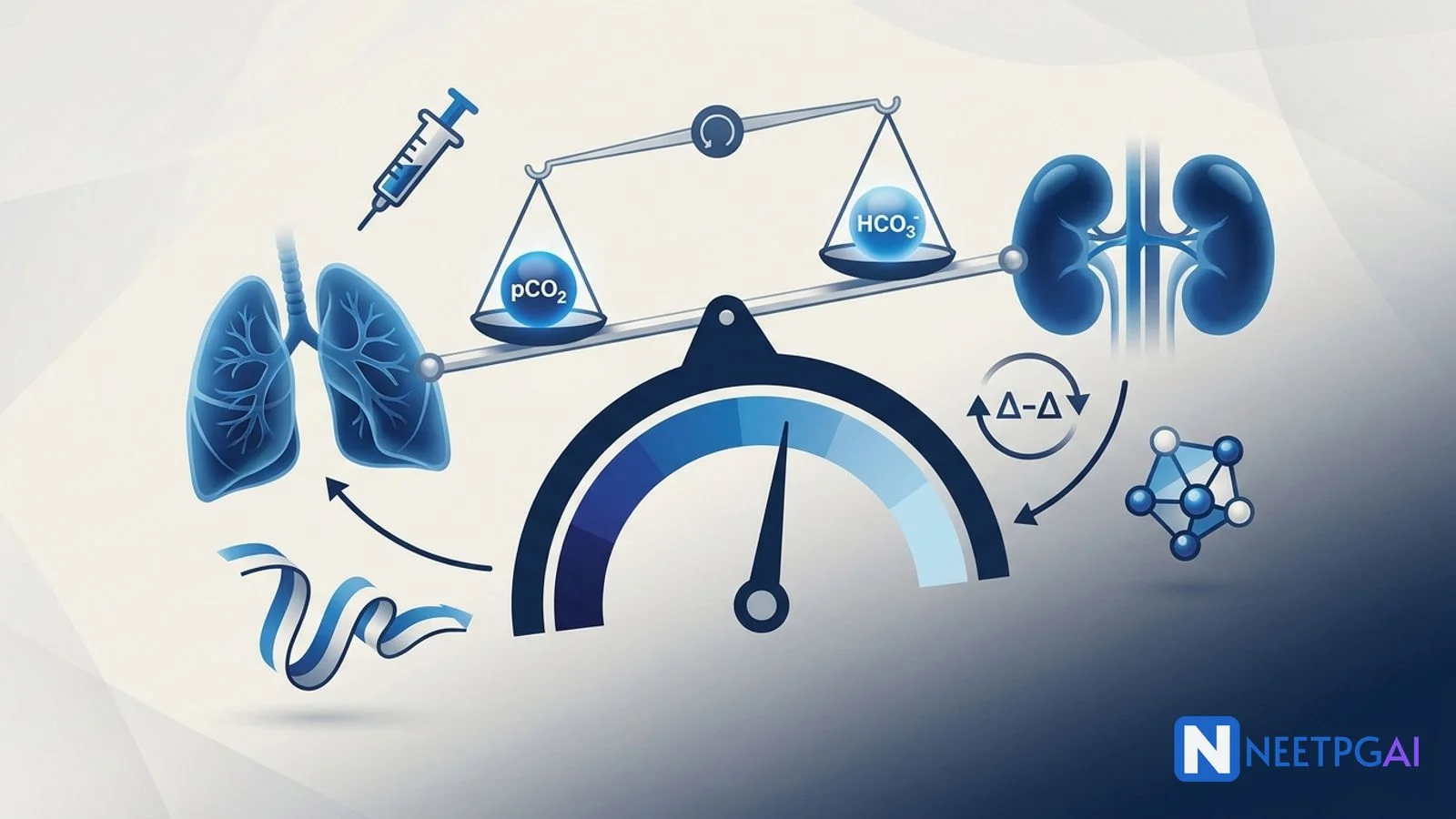
Acid-base balance contributes 5–7 NEET PG questions per paper across Physiology, Medicine and Anesthesia. The exam-ready algorithm:
pH first — acidemia (<7.35) or alkalemia (>7.45)?
Primary disorder — match pCO2 and HCO3 direction with pH.
Compensation — Winter's for metabolic acidosis; expected pCO2 for alkalosis; expected HCO3 for respiratory acid-base.
Anion gap — Na − (Cl + HCO3); raised AG = MUDPILES.
Delta-delta — to detect co-existing metabolic disorders.
Urinary anion gap — to split non-AG acidosis (RTA vs diarrhoea).
Acid-base disorders sit at the intersection of physiology, nephrology and emergency medicine — a single ABG can pivot diagnosis from sepsis to DKA to salicylate poisoning. Examiners reward a disciplined algorithm: pH → primary → compensation → AG → delta-delta. Learning the formulas is half the battle; recognising the clinical fingerprint of MUDPILES wins the rest.
This NEETPGAI deep dive walks through the entire ABG decision tree, the four primary disorders, every compensation formula on the syllabus, anion gap and delta-delta arithmetic, and the most-tested clinical scenarios. Pair this with the Physiology subject hub and the electrolyte disorders guide for full physiology fluency.
KDIGO 2024 AKI: acidosis treatment focuses on cause; bicarbonate replacement controversial except severe pH <7.1.
DKA in India: rural type 2 patients on SGLT2 inhibitors are increasingly presenting with euglycemic DKA (glucose <200 mg/dL but high AG) — high-yield emerging vignette.
Permissive hypercapnia in lung-protective ventilation is standard in ARDS guidelines.
Frequently Asked Questions
How do you interpret an ABG step by step?
First check pH (acidemia under 7.35, alkalemia over 7.45). Second identify the primary disorder by matching pCO2 and HCO3 direction with pH. Third apply the compensation formula (Winter's for metabolic acidosis, expected pCO2 for alkalosis). Fourth, calculate anion gap. Fifth, in raised AG metabolic acidosis check delta-delta for a co-existing disorder.
What is Winter's formula and when is it used?
Winter's formula predicts respiratory compensation in metabolic acidosis: expected pCO2 = (1.5 × HCO3) + 8 ± 2. If measured pCO2 is higher than expected, there is a co-existing respiratory acidosis; if lower, a co-existing respiratory alkalosis. It is one of the highest-yield single formulas in NEET PG physiology.
What is the anion gap and when is it elevated?
Anion gap = Na − (Cl + HCO3); normal 8–12 mEq/L. Elevated AG metabolic acidosis is caused by MUDPILES — methanol, uremia, DKA, propylene glycol, INH/iron, lactic acidosis, ethylene glycol, salicylates. Always correct AG for albumin: corrected AG = measured AG + 2.5 × (4 − albumin g/dL).
What is the delta-delta ratio?
Delta-delta = (delta AG) divided by (delta HCO3) — that is, (measured AG − 12) ÷ (24 − measured HCO3). Less than 1 means co-existing non-AG metabolic acidosis. Approximately 1 to 2 means pure AG metabolic acidosis. Greater than 2 means co-existing metabolic alkalosis. High-yield mixed-disorder finding.
What is the urinary anion gap useful for?
Urinary anion gap (UAG) = (urine Na + urine K) − urine Cl. Used in non-AG (hyperchloremic) metabolic acidosis. Negative UAG means high urinary NH4+ (appropriate renal response — GI loss like diarrhoea). Positive UAG means impaired NH4+ excretion (renal cause — RTA). NEET PG favourite to differentiate diarrhoea from RTA.
This content is for educational purposes for NEET PG exam preparation. It is not a substitute for professional medical advice, diagnosis, or treatment. Clinical information has been reviewed by qualified medical professionals.
Written by: NEETPGAI Editorial Team
Reviewed by: Pending SME Review
Last reviewed: April 2026