Quick Answer
Uterine fibroids and AUB carry 2 to 3 NEET PG questions per paper and overlap heavily with INI-CET image-based stems on USG findings. Lock these:
- Classification — submucosal (FIGO 0 to 2), intramural (3 to 4), subserosal (5 to 7), parasitic (8).
- AUB framework — PALM-COEIN (FIGO 2011).
- Investigation — TVS first; saline-infusion sonohysterography or hysteroscopy for submucosal; MRI for complex maps.
- Medical — tranexamic acid, NSAIDs, COCs, progestins, LNG-IUS, GnRH agonist/antagonist.
- Surgical — hysteroscopic myomectomy, laparoscopic myomectomy, UAE, hysterectomy.
- Fertility — submucosal fibroids reduce implantation; remove before IVF.
- India specific — late presentation with severe anemia; LNG-IUS uptake rising.
Uterine fibroids (leiomyomas) are the commonest benign uterine tumour, affecting 20 to 40 percent of Indian women of reproductive age — with later presentation and higher anemia burden than in Western cohorts. NEET PG questions reward students who can pair fibroid location with symptom pattern, choose the right imaging modality, and stratify medical versus surgical therapy by fertility intent.
This NEETPGAI deep dive walks through classification, the FIGO 2011 PALM-COEIN AUB framework, investigations, the full medical armamentarium, surgical options with their indications, fertility implications, India-specific pitfalls, and high-yield MCQ traps. Pair it with a focused revision of adenomyosis vs endometriosis for a complete uterine-bleeding map.
Classification of uterine fibroids
Fibroids are monoclonal smooth-muscle proliferations under oestrogen and progesterone control. Subtypes by location matter because location determines symptoms and the surgical approach.
FIGO leiomyoma classification (2011)
| Type | Location | Surgical relevance |
|---|
| 0 | Submucosal, pedunculated, entirely in cavity | Hysteroscopic myomectomy |
| 1 | Submucosal, less than 50 percent intramural | Hysteroscopic myomectomy |
| 2 | Submucosal, 50 percent or more intramural | Hysteroscopic if expert; otherwise laparoscopic |
| 3 | Intramural, contacts endometrium | Laparoscopic / open myomectomy |
| 4 | Intramural, no endometrial contact | Laparoscopic / open myomectomy |
| 5 | Subserosal, 50 percent or more intramural | Laparoscopic myomectomy |
| 6 | Subserosal, less than 50 percent intramural | Laparoscopic myomectomy |
| 7 | Subserosal, pedunculated | Laparoscopic myomectomy |
| 8 | Other (cervical, parasitic, broad-ligament) | Approach individualised |
Parasitic fibroid — pedunculated subserosal fibroid that loses its uterine pedicle and acquires blood supply from omentum or pelvic peritoneum. Can mimic adnexal mass on USG.
Histology and degenerations
Whorled bundles of smooth muscle in a fibrous matrix. Degenerations —
- Hyaline degeneration — most common (60 percent).
- Red (carneous) degeneration — pregnancy; severe pain plus low-grade fever; treat conservatively.
- Cystic degeneration — fluid-filled spaces, post-menopause.
- Calcific degeneration — post-menopause; "popcorn" calcification on X-ray.
- Sarcomatous change (leiomyosarcoma) — rare (under 0.5 percent); suspect rapid growth in post-menopause.
Clinical presentation
The triad — abnormal uterine bleeding, pressure symptoms, infertility.
Abnormal uterine bleeding (AUB)
- Heaviest with submucosal fibroids distorting the cavity.
- Mechanism — increased endometrial surface area, impaired uterine contractility, dysregulated angiogenesis.
- Leads to iron-deficiency anemia (often profound in Indian women presenting late).
Pressure symptoms
- Urinary frequency, incomplete bladder emptying (anterior fibroid on bladder).
- Constipation, tenesmus (posterior fibroid on rectum).
- Hydronephrosis (broad-ligament fibroid compressing ureter).
- Lower-extremity oedema or DVT (rare; very large fibroid compressing iliac veins).
Infertility and pregnancy complications
- Submucosal fibroids reduce implantation rates by 30 to 70 percent.
- Pregnancy complications — recurrent miscarriage, preterm labour, malpresentation, abruption, retained placenta, postpartum haemorrhage.
- Red degeneration common in second trimester pregnancy.
Other presentations
- Dyspareunia, especially with cervical or low-segment fibroids.
- Acute pain — torsion of a pedunculated subserosal fibroid, red degeneration.
- Asymptomatic — discovered incidentally on USG in about 50 percent.
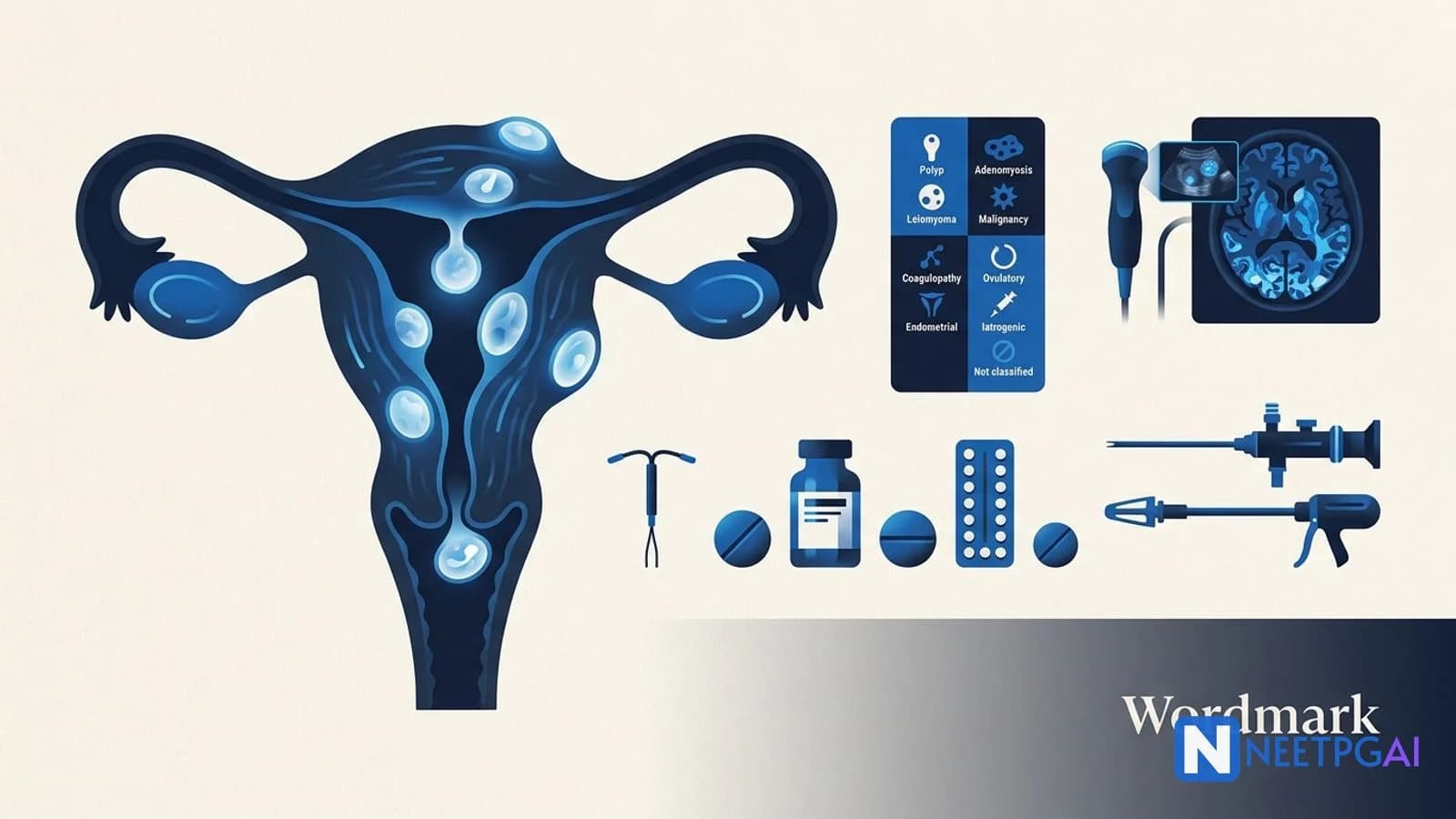
AUB-FIGO PALM-COEIN classification (2011)
The framework structures AUB in reproductive-age women.
Structural causes (PALM) — diagnosable on imaging or histology
- Polyp (AUB-P)
- Adenomyosis (AUB-A)
- Leiomyoma (AUB-L) — sub-classified as LSM (submucosal) or LO (other)
- Malignancy or hyperplasia (AUB-M)
Non-structural causes (COEIN)
- Coagulopathy (AUB-C) — von Willebrand disease, ITP
- Ovulatory dysfunction (AUB-O) — PCOS, thyroid, hyperprolactinemia
- Endometrial (AUB-E) — primary endometrial disorder of haemostasis
- Iatrogenic (AUB-I) — anticoagulants, IUDs, hormones, tamoxifen
- Not otherwise classified (AUB-N)
The framework replaced obsolete terms — menorrhagia, metrorrhagia, dysfunctional uterine bleeding. The current terminology is heavy menstrual bleeding (HMB) and intermenstrual bleeding (IMB).
Investigations
Imaging
- Transvaginal ultrasound (TVS) — first-line. Sensitivity 90 percent, specificity 87 percent. Identifies location, number, and size of fibroids.
- Saline-infusion sonohysterography (SIS) — gold standard for cavity assessment when submucosal fibroid suspected.
- Hysteroscopy — diagnostic plus therapeutic for FIGO type 0 to 2.
- MRI — best soft-tissue resolution for multiple fibroids, pre-operative mapping, and distinguishing fibroid from adenomyoma. Reserved for complex cases.
Laboratory
- CBC for anemia (often severe in Indian women).
- TSH, prolactin, coagulation profile if AUB without obvious structural cause.
- Endometrial biopsy if older than 45 or risk factors for endometrial cancer (obesity, PCOS, tamoxifen, unopposed oestrogen).
Medical management
The goal is to control bleeding and shrink fibroids while preserving fertility or buying time before surgery.
First-line for HMB without major structural pathology
- Levonorgestrel-releasing IUS (LNG-IUS, Mirena) — reduces bleeding 70 to 95 percent; first-line per NICE 2018 and FOGSI 2022 guidelines. Contraindicated if cavity distorted by submucosal fibroid.
- Tranexamic acid — antifibrinolytic, 1 g three times daily during menses, reduces bleeding by 30 to 50 percent. Caution in thromboembolic risk.
- NSAIDs (mefenamic acid 500 mg three times daily during menses) — reduce bleeding 20 to 50 percent plus dysmenorrhoea relief.
Hormonal options
- Combined oral contraceptive pills (COCs) — reduce bleeding 35 to 70 percent; not effective in fibroid shrinkage.
- Progestins (medroxyprogesterone acetate, norethisterone) — useful for AUB-O.
- GnRH agonists (leuprolide, goserelin) — induce hypogonadism, shrink fibroids 35 to 60 percent in 3 months; "add-back" oestrogen prevents osteoporosis; for pre-operative use up to 6 months only.
- GnRH antagonists (elagolix, relugolix) — oral, faster onset than agonists, no flare effect; relugolix combined with oestradiol-progestin (Myfembree) approved for fibroid-related HMB.
- Selective progesterone receptor modulators (SPRMs) — ulipristal acetate restricted globally after liver toxicity; rarely used in current practice.
Aromatase inhibitors
Letrozole is being studied for fibroid shrinkage — not standard of care.
Surgical management
Hysteroscopic myomectomy
- FIGO type 0 — pedunculated submucosal, simplest.
- FIGO type 1 to 2 — partial intramural extension; bipolar resectoscope or hysteroscopic morcellator.
- Risks — fluid overload (use saline with bipolar to reduce hyponatremia), perforation, intrauterine adhesions (Asherman).
Laparoscopic myomectomy
- Intramural, subserosal fibroids.
- Advantages — short hospital stay, faster recovery, better cosmesis.
- Limitations — operator skill, longer operating time, morcellation risk (FDA warning on power morcellation for occult leiomyosarcoma — use bag morcellation).
Open (abdominal) myomectomy
- Multiple, large, or deep intramural fibroids.
- Higher haemorrhage risk; pre-operative GnRH agonist reduces size and vascularity.
Uterine artery embolisation (UAE)
- Minimally invasive; interventional radiology.
- Reduces fibroid volume 30 to 60 percent at 6 months.
- Symptom relief 80 to 90 percent.
- Contraindications — desire for future fertility (controversial), pedunculated subserosal fibroid (risk of detachment), submucosal pedunculated (risk of expulsion).
- Post-embolisation syndrome — pain, fever, malaise for 7 days.
MRgFUS (magnetic resonance-guided focused ultrasound)
- Non-invasive thermal ablation.
- Limited availability in India; cost-prohibitive.
Hysterectomy
- Definitive treatment.
- Indicated for completed childbearing, severe symptoms refractory to other treatment, large fibroid burden, suspected malignancy, or rapid growth in post-menopause.
- Routes — vaginal, laparoscopic, robotic, abdominal — chosen by uterine size, mobility, comorbidities, surgeon expertise.
- Indian context — hysterectomy rates higher than Western benchmarks (often the only feasible option in patients presenting late with severe anemia and large fibroids).
Fertility implications and pregnancy
- Submucosal fibroids — myomectomy improves live-birth rates; recommended before ART.
- Intramural fibroids — benefit of myomectomy unclear unless larger than 4 cm or causing cavity distortion.
- Subserosal fibroids — no impact on fertility; myomectomy not indicated for fertility alone.
- After myomectomy — wait 3 to 6 months before conception. Caesarean delivery recommended if the cavity was breached or if any deep myometrial defect.
- Pregnancy with fibroids — increased risk of red degeneration (treat with NSAIDs, paracetamol, opioids; not surgery), preterm labour, malpresentation, placenta previa, PPH.
NEET PG MCQ traps
- Submucosal fibroids cause the most AUB despite often being smaller than intramural ones.
- Carneous (red) degeneration is the second-trimester pregnancy fibroid emergency — treat conservatively.
- LNG-IUS contraindicated if cavity distorted by submucosal fibroid.
- Ulipristal acetate restricted because of hepatotoxicity; not first-line currently.
- GnRH agonists need add-back if used over 6 months (osteoporosis risk).
- Pre-op GnRH agonist reduces size, vascularity, and intra-operative blood loss.
- UAE contraindicated in pedunculated subserosal fibroids (risk of detachment).
- Power morcellation risk — FDA black-box; use bag morcellation.
- Rapid post-menopause growth — rule out leiomyosarcoma (rare, under 0.5 percent).
- Cervical fibroid — dyspareunia, urinary retention, obstructed labour.
- Parasitic fibroid — pedunculated subserosal with omental blood supply; mimics adnexal mass.
- PALM-COEIN is the AUB classification; structural and non-structural.
- Mirena is the first-line for HMB without structural pathology (NICE 2018, FOGSI 2022).
- Tranexamic acid — best non-hormonal medical option for HMB.
- Endometrial biopsy is mandatory in AUB over age 45 or with risk factors before treatment.
Recent updates and Indian context
- NMC CBME 2024 — fibroid management in OBG core curriculum; emphasises image-based questions on USG and MRI fibroid mapping.
- FOGSI 2022 GCPR — recommends LNG-IUS as first-line for HMB without structural pathology; tranexamic acid for those who decline IUS.
- Ulipristal acetate restriction — EMA 2020 and FDA 2018 actions; severely limited current use.
- GnRH antagonist combinations (relugolix-oestradiol-progestin) — approved 2021 in US/EU; entering Indian market gradually.
- Indian epidemiology — high baseline anemia (NFHS-5: 57 percent in women 15 to 49), late presentation with large fibroids, and high hysterectomy rates reflect access gaps and counselling deficits.
- NEXT — expects integrated stems linking USG findings, hemoglobin, and management decisions; recent INI-CET trends favour PALM-COEIN classification with image stems.
Frequently asked questions
What is the PALM-COEIN classification of abnormal uterine bleeding?
PALM-COEIN is the FIGO 2011 framework for AUB in reproductive-age women. Structural causes (PALM) — Polyp, Adenomyosis, Leiomyoma, Malignancy or hyperplasia. Non-structural causes (COEIN) — Coagulopathy, Ovulatory dysfunction, Endometrial, Iatrogenic, Not otherwise classified. Leiomyoma is sub-classified by FIGO type 0 to 8 based on location.
Which fibroid location causes the most menstrual symptoms?
Submucosal fibroids (FIGO types 0, 1, 2) distort the endometrial cavity and cause the most menorrhagia and infertility despite often being small. Intramural fibroids cause symptoms only when large. Subserosal fibroids rarely cause AUB but produce pressure symptoms or pedicle torsion. Cervical fibroids cause obstructed labour and dyspareunia.
When should ulipristal acetate be used cautiously in fibroid management?
Ulipristal acetate (a selective progesterone receptor modulator) was withdrawn or severely restricted in many jurisdictions after reports of severe hepatotoxicity, including transplant-requiring liver failure. The EMA restricted use to women in whom surgical options had failed or are unsuitable and who are not undergoing pre-operative use. Liver function tests are mandatory before and during therapy.
What is the role of LNG-IUS in AUB management?
The levonorgestrel-releasing intrauterine system (Mirena) reduces menstrual blood loss by 70 to 95 percent in 6 to 12 months and is recommended as the first-line treatment for heavy menstrual bleeding without major structural pathology. It is contraindicated in submucosal fibroids distorting the cavity and in malignancy. Indian uptake is rising but remains low compared with progestin-only pills.
How is the choice between myomectomy and hysterectomy made?
Myomectomy preserves fertility and the uterus and is preferred in women desiring future pregnancy. It can be hysteroscopic (for submucosal type 0 to 2), laparoscopic, or open. Hysterectomy is definitive — chosen when childbearing is complete, fibroids are multiple or large, severe symptoms persist, or in suspected malignancy. Indian women often present late, when hysterectomy becomes the only feasible option.
This content is for educational purposes for NEET PG exam preparation. It is not a substitute for professional medical advice, diagnosis, or treatment. Clinical information has been reviewed by qualified medical professionals.
Written by: NEETPGAI Editorial Team
Reviewed by: Pending SME Review
Last reviewed: May 2026