Version 1.0 — Published October 2026
Quick Answer
FMGE 9 January 2027 is confirmed by NBEMS. 300 single-best-answer MCQs in two 150-Q blocks, 150 min per block, no negative marking, 150 marks to pass. Study 8-10 hours daily across 65 days with Weeks 1-2 on Pathology/Pharmacology/PSM, Weeks 3-4 on clinical, Weeks 5-6 on pre-clinical refresher, Weeks 7-8 on mocks. Attempt every question — blanks are strictly worse than any guess.
Why This Matters for NEET PG & INI-CET
FMGE is the single hardest Indian medical entrance by pass rate — the 20-25 percent historical pass rate reflects a real gap between foreign MBBS curricula and Indian clinical practice. Candidates who sit FMGE unprepared or who follow a generic NEET PG plan fail even with 6 months of study because the Indian-specific content (PSM programmes, Indian disease epidemiology, Indian medico-legal law, Indian pharmacopeia) is 40 percent of the paper and almost zero percent of the typical foreign MBBS curriculum.
A targeted 65-day plan structured around FMGE's unique pattern — no negative marking, pass-fail threshold, India-specific content weight — reliably takes an organised foreign MBBS graduate from a baseline 100-120 marks on an untimed mock to 170-200 marks on exam day. The plan requires no exotic resources — a single Indian question bank, a single Indian PSM textbook, Harrison's with Indian supplement, and disciplined mock-and-review cycles.
NEET PG 2026 was conducted on 30 Aug 2026 (now 180 Q / 720 marks / +4/-1 / 210 min / 5 locked sections). INI-CET November 2026 is confirmed for 1 November. FMGE is the gateway for a foreign MBBS graduate to NEET PG — passing FMGE unlocks the right to sit NEET PG, and 85-90 percent of your FMGE preparation transfers to NEET PG prep.
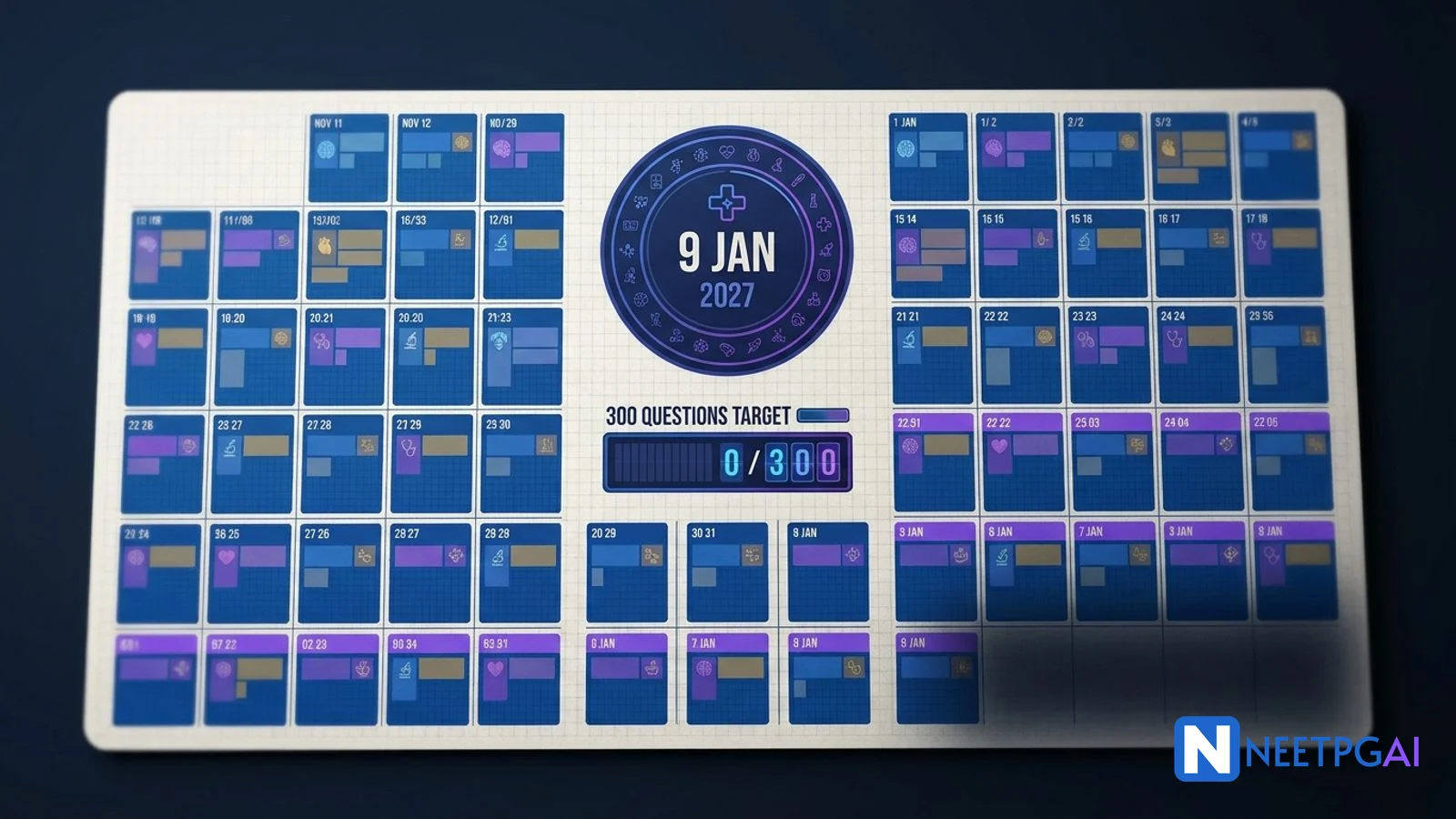
The 65-Day Calendar — 5 November 2026 to 9 January 2027
| Week | Dates | Primary focus | Secondary | Mock |
|---|
| 1 | 5-11 Nov | Pathology + PSM programmes | Pharmacology start | - |
| 2 | 12-18 Nov | Pharmacology + PSM epidemiology | Microbiology | 1 subject mock (Pathology) |
| 3 | 19-25 Nov | Medicine - CVS, Resp, Endo | OBG start | 1 full mock + 1 subject mock |
| 4 | 26 Nov-2 Dec | Medicine - GI, Neuro, Nephro | OBG + Paediatrics | 1 full mock + 1 subject |
| 5 | 3-9 Dec | Surgery - all systems | OBG + Paediatrics finish | 1 full mock + 1 subject |
| 6 | 10-16 Dec | Anatomy + Physiology + Biochem refresher | Forensic + Ophthal | 1 full mock + 1 subject |
| 7 | 17-23 Dec | Ophthal + ENT + Derm + Psychiatry | Orthopaedics | 1 full mock + 2 subject |
| 8 | 24-30 Dec | Anaesthesia + Radiology + weak-subject | Final PSM revision | 1 full mock |
| 9 | 31 Dec-6 Jan | Mock-intensive (3 full mocks across 7 days) | PYQ review only | 3 full mocks |
| Final | 7-9 Jan | Zero new material, one-liners, exam-eve protocol | PSM programme fact-sheet | - |
Daily hours: 8-10 hours actual study time, 1 half-day off per week (Saturday afternoon), 7-8 hours sleep.
Daily breakdown:
- 06:30 Wake + 500 mL water
- 07:00 Breakfast
- 08:00-10:00 Morning reading (new material, textbook or video)
- 10:00-10:15 Break
- 10:15-12:30 MCQ practice (first block, 100 Qs)
- 12:30-13:30 Lunch + rest
- 13:30-15:30 MCQ practice (second block, 100 Qs)
- 15:30-16:00 Break
- 16:00-17:00 Evening review of wrong-answer notes
- 17:00-18:00 Weak-subject targeted practice
- 18:00-19:00 Walk + dinner prep
- 19:00-20:00 Dinner
- 20:00-21:00 Light review of day's new material
- 21:00-22:00 Wind down, no screens
- 22:00 Lights out
Subject Weightage from Past FMGE Papers
| Tier | Subjects | Questions per paper (approx) | Prep allocation |
|---|
| 1 (high) | Medicine, Surgery, OBG, Pharmacology, Pathology, PSM | 20-30 each (total ~130-150) | 50% of total time |
| 2 (mod) | Microbiology, Physiology, Biochemistry, Anatomy, Forensic, Ophthal, ENT, Paediatrics | 10-18 each (total ~100-120) | 35% of total time |
| 3 (low) | Dermatology, Psychiatry, Orthopaedics, Anaesthesia, Radiology | 5-10 each (total ~40-60) | 15% of total time |
PSM over-weight warning: PSM carries 18-22 questions in FMGE versus 10-15 in NEET PG. This is deliberate — Indian National Health Programmes are the single largest curricular gap for foreign MBBS graduates. Treat PSM as a Tier-1 subject even if you treat it as Tier-2 for NEET PG later.
The India-Specific Content Gap (The 40 Percent)
Foreign MBBS curricula under-cover five India-specific content areas. All five are high-yield for FMGE.
1. Indian National Health Programmes (PSM)
| Programme | Launch | Nodal ministry | Key point |
|---|
| RNTCP / NTEP | 1997 / 2020 renamed | MoHFW | DOTS, CBNAAT, Nikshay portal, 2025 elimination target |
| NVBDCP | 2003 | MoHFW | Dengue, malaria, chikungunya, filariasis, kala-azar, JE |
| NACP | 1992 | NACO under MoHFW | HIV surveillance, ART, PPTCT |
| NLEP | 1983 | MoHFW | MDT, Grade 2 disability indicator |
| JSY | 2005 | MoHFW | Cash transfer for institutional delivery |
| Mission Indradhanush | 2014 | MoHFW | Immunisation coverage push |
| PMJAY (Ayushman Bharat) | 2018 | MoHFW | Rs 5 lakh/family/year insurance |
| IDSP | 2004 | MoHFW | Disease surveillance |
| NMHP | 1982 (revised 2017) | MoHFW | DMHP, suicide prevention |
| POSHAN Abhiyaan | 2018 | WCD | Nutrition mission |
| Ayushman Arogya Mandir | 2018 (renamed 2023) | MoHFW | HWCs — Health & Wellness Centres |
2. Indian disease epidemiology — rheumatic heart disease, tropical infections (dengue, Japanese encephalitis, scrub typhus, kala-azar, filariasis), TB in Indian pattern, enteric fever, snakebite, poisoning patterns.
3. Indian clinical guidelines — ICMR, Indian Hypertension Guidelines, Indian Lipid Guidelines, NTEP TB guidelines, FOGSI OBG guidelines.
4. Indian medico-legal context — IPC sections (post-2018 amendments), POCSO Act 2012, PCPNDT Act 1994, MTP Amendment Act 2021, Mental Healthcare Act 2017, Transplantation of Human Organs Act 1994.
5. Indian pharmacopoeia and brand names — Indian generic-brand patterns differ from US naming.
FMGE Test-Day Strategy
Pattern recap: 300 questions, two 150-Q blocks, 150 min per block, no negative marking, pass at 150/300.
Rules:
- Attempt all 300. No blanks. Random guess = 25 percent EV versus 0 percent for blank.
- 60 seconds per question target, 45 seconds first-pass.
- Two-pass method: first-pass answer and flag, second-pass revisit flagged.
- Between blocks: eat banana, drink water, box breathe 60 seconds, washroom. Do NOT review block 1.
- Image questions: same 60-second cap.
- Extreme-word elimination: 'always', 'never', 'all', 'none' are rarely correct.
- PSM programme questions: reward one-liner recall — launch year, nodal ministry, indicator.
- No negative marking means no attempt is wasted — if you have narrowed to 2 options, guess with 50 percent EV.
Mock-Test Discipline
Weekly Sunday full mock from Week 2. Each mock = 300 Qs, 300 min, no breaks except the inter-block gap. Review window is Sunday evening + Monday morning (6 hours total):
- Hour 1: review all wrong answers
- Hour 2-3: review all guessed-correct answers (lucky, not learned)
- Hour 4: identify weak subject or weak topic patterns
- Hour 5: targeted practice on top 3 weak topics
- Hour 6: add wrong-answer notes to your pre-marked one-liner list
By Week 7-8, your pre-marked one-liner notebook should be 20-30 pages of high-yield content you have missed on a mock at least once.
Resources — What to Use
- 1 question bank: pick NEETPGAI, Marrow, PrepLadder, DAMS or Prepladder — commit, do not switch.
- PSM: Park's Textbook of Preventive and Social Medicine (standard Indian text).
- Medicine: Harrison's with Indian supplement OR Davidson's with India-focused add-on.
- Surgery: Bailey and Love, SRB's Manual.
- OBG: Shaw's Textbook of Gynaecology + Dutta's Textbook of Obstetrics.
- Pathology: Robbins Basic Pathology.
- Pharmacology: KD Tripathi (Indian text, high-yield for FMGE naming).
- Microbiology: Ananthanarayan and Paniker.
- Anatomy: BD Chaurasia.
- Physiology: Guyton OR Ganong (either).
- Biochemistry: Harper's OR Vasudevan.
- Forensic: Krishan Vij.
Do not use more than one source per subject. Depth-plus-practice beats breadth-plus-skim at the FMGE 150-mark threshold.
High-Yield One-Liners
- FMGE 9 January 2027 confirmed, NBEMS.
- 300 MCQs, 2 blocks of 150, 150 min per block, no negative marking.
- Pass at 150/300 (50 percent); historical pass rate 20-25 percent.
- Attempt every question — blanks are strictly dominated by any guess.
- 60 seconds per question target, 45 seconds first-pass.
- PSM is Tier-1 for FMGE, not Tier-2 — 18-22 Q, programme-heavy.
- Study 8-10 hours daily, 7-8 hours sleep, 1 half-day off per week.
- Weekly Sunday full mock from Week 2.
- Pre-marked one-liner notebook grows every mock review.
- RNTCP renamed NTEP 2020, elimination target 2025.
- POSHAN Abhiyaan 2018 under WCD, not MoHFW — common exam trap.
- Harrison's with Indian supplement OR Davidson's — one source only.
- PSM = Park's Textbook, high-yield for FMGE.
- KD Tripathi for Pharmacology (Indian brand names).
- Final 3 days = zero new material, exam-eve protocol only.
Common Mistakes
- Treating PSM as a Tier-2 subject — FMGE deliberately over-weights PSM (18-22 Qs). Allocate at least 15 percent of total prep time to PSM.
- Leaving questions blank — no negative marking means every blank is a lost mark relative to any guess. Attempt all 300.
- Starting with Medicine or Surgery in Week 1 — the India-specific gap (PSM, Pharmacology, Pathology foundations) is the biggest unknown-unknown. Start there.
- Using multiple question banks or textbooks per subject — depth-plus-practice beats breadth. Commit to one source.
- Skipping the mock-review window — a mock without a 6-hour structured review is 50 percent of its value. Sunday mock + Monday review = non-negotiable.
Related Topics on NEETPGAI
Practice This on NEETPGAI
Mocks and PYQs are the measurable half of FMGE preparation. NEETPGAI carries over 28,000 MCQs tagged by subject and topic, 10 past FMGE papers digitised to the exact 300-Q, 2-block, 150-min structure, and analytics that project your current pass probability from each mock score. All free for every registered user. Sign up free and run your diagnostic 300-Q full mock this Sunday to anchor your 65-day plan.