Quick Answer
GDM is high-yield across OBG, Medicine, and PSM and yields 1 to 2 NEET PG questions per paper. Lock these:
- DIPSI — non-fasting 75 g OGTT, 2-hour cutoff 140 mg/dL or above. India default since the 2014 GOI guideline.
- IADPSG — fasting 75 g OGTT with cutoffs 92 / 180 / 153 mg/dL at 0, 1, and 2 hours; any one positive diagnoses GDM.
- First-line therapy — medical nutrition therapy plus exercise for one to two weeks; escalate to insulin if targets are not met.
- Glycaemic targets — fasting under 95, 1-hour postprandial under 140, 2-hour under 120 mg/dL.
- Insulin regimens — multiple daily injections (NPH plus rapid-acting analogues like aspart or lispro) are preferred over premixed.
- Postpartum — 75 g OGTT at 6 to 12 weeks; lifelong follow-up because half of GDM mothers progress to type 2 diabetes.
GDM affects 14 to 18 percent of Indian pregnancies — among the highest national rates worldwide — and the diagnostic philosophy in India is deliberately different from the West. NEET PG examiners exploit that exact divergence, asking which protocol the Government of India endorses, what the screening time-point is, and when to switch from diet to insulin. The 2013 WHO criteria, the 2014 GOI maternal health guideline endorsing DIPSI, and the 2024 FIGO update on metformin versus insulin are the modern reference points.
This NEETPGAI deep dive walks through pathophysiology, screening philosophy, OGTT interpretation, MNT, insulin and oral therapy, intrapartum management, and the postpartum 75 g OGTT that flags lifelong type 2 diabetes risk. Pair this guide with the antenatal care and complications guide for the full obstetrics map.
Pathophysiology
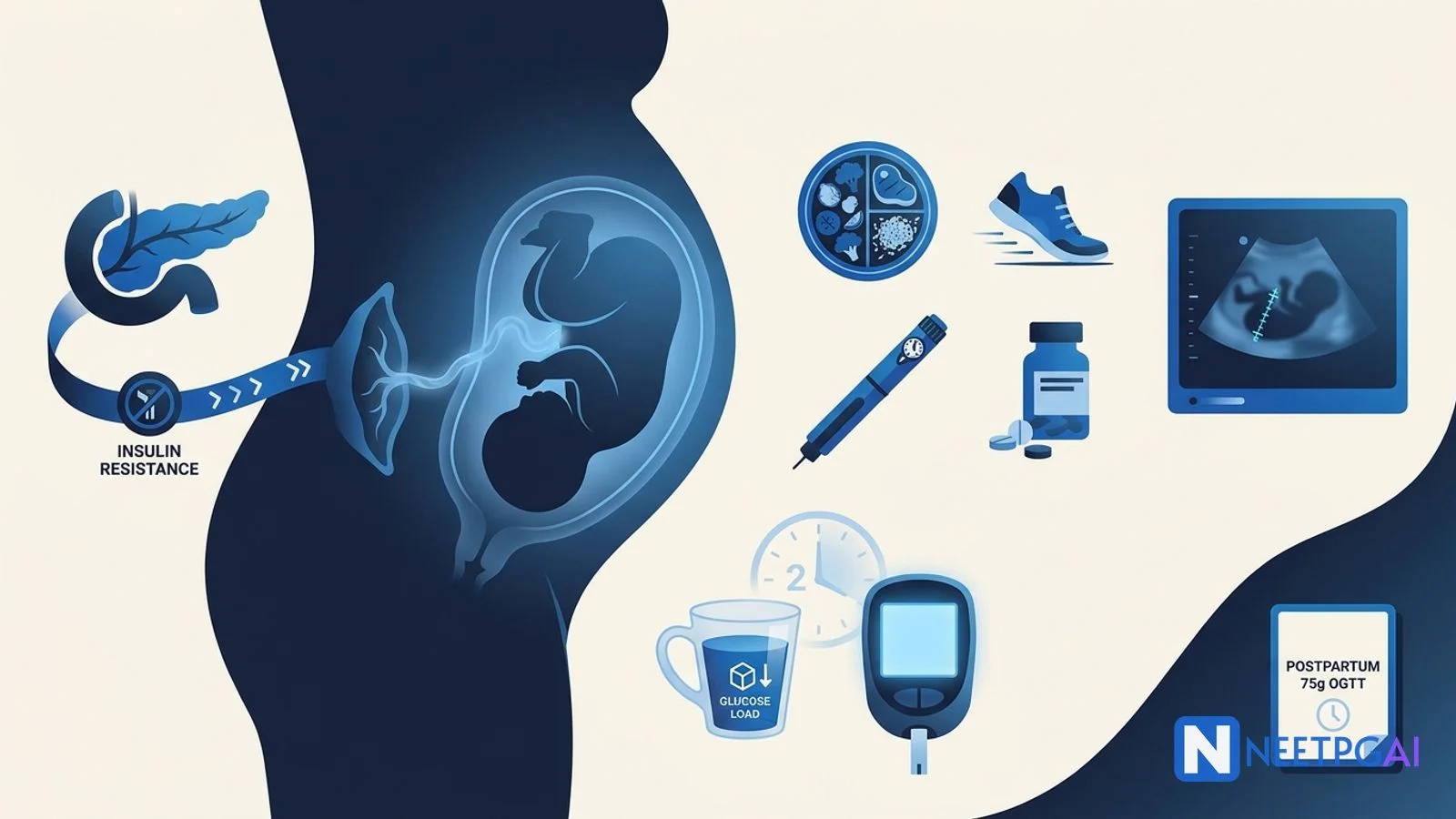
Pregnancy is a state of progressive insulin resistance driven by placental hormones — human placental lactogen (most important), placental growth hormone, cortisol, oestrogen, and progesterone. By 24 to 28 weeks insulin sensitivity falls by 40 to 50 percent. Women whose pancreatic beta cells cannot mount a compensatory hyperinsulinaemia develop GDM.
Foetal pathway
Maternal hyperglycaemia crosses the placenta but maternal insulin does not. The foetal pancreas hyper-secretes insulin, driving:
- Macrosomia — selective fat deposition on the trunk and shoulders (anabolic effect of insulin).
- Polyhydramnios — foetal polyuria from osmotic glucose load.
- Surfactant delay — insulin antagonises cortisol-mediated lung maturation, causing neonatal respiratory distress syndrome (RDS).
- Neonatal hypoglycaemia — within 1 to 2 hours of birth as the maternal glucose supply ends but foetal hyperinsulinaemia persists.
Risk factors
- Demographics — South Asian or African ethnicity, age above 25 years, BMI of 25 kg/m2 or above (Asia-Pacific cutoff 23 kg/m2 or above).
- Obstetric history — prior GDM (40 to 50 percent recurrence), previous macrosomic baby above 4 kg, unexplained stillbirth, congenital anomaly, polyhydramnios.
- Medical — first-degree family history of diabetes, polycystic ovarian syndrome, hypertension, dyslipidemia, current glycosuria, acanthosis nigricans.
Screening philosophy — DIPSI versus IADPSG
This is the single most-tested concept in NEET PG OBG.
IADPSG (one-step fasting 75 g OGTT)
Adopted by WHO 2013, ADA, and most international bodies. Performed at 24 to 28 weeks. Fasting overnight, then 75 g glucose load:
| Time | Cutoff |
|---|
| Fasting | At or above 92 mg/dL |
| 1 hour | At or above 180 mg/dL |
| 2 hour | At or above 153 mg/dL |
Any one value at or above the cutoff diagnoses GDM. IADPSG arose from the HAPO study which linked even mild maternal hyperglycaemia to adverse outcomes.
DIPSI (one-step non-fasting 75 g OGTT)
Designed by V Seshiah and the Diabetes In Pregnancy Study Group of India. Performed at the very first antenatal visit, irrespective of fasting state, and again at 24 to 28 weeks if the first test was negative:
- Give 75 g oral glucose mixed in 250 to 300 mL water.
- Single venous plasma glucose at 2 hours.
- Cutoff: 140 mg/dL or above diagnoses GDM.
The Government of India and FOGSI endorse DIPSI because it is feasible in busy antenatal clinics where a fasting sample is logistically difficult, and it captures both fasting and postprandial dysglycaemia.
Two-step (Carpenter-Coustan) — historical context
The two-step uses a non-fasting 50 g screen (1-hour cutoff 140 mg/dL), followed by a fasting 100 g 3-hour OGTT. Two or more abnormal values diagnose GDM. Mostly historical in NEET PG; ACOG still allows it in low-resource settings.
Special situations
Women with risk factors should be screened at the first visit and again at 24 to 28 weeks. A diagnosis of GDM in early pregnancy (before 20 weeks) often reflects pre-existing type 2 diabetes — confirm with HbA1c. An HbA1c of 6.5 percent or above at booking diagnoses overt diabetes in pregnancy, which carries higher risk of congenital anomalies and demands tight first-trimester control.
Maternal and foetal complications
Maternal
- Pre-eclampsia (twofold increase).
- Polyhydramnios.
- Operative delivery (Caesarean for macrosomia, shoulder dystocia).
- Postpartum haemorrhage.
- Future type 2 diabetes (50 percent within 10 years), metabolic syndrome, cardiovascular disease.
Foetal and neonatal
- Macrosomia (birth weight at or above 4 kg) and large-for-gestational-age.
- Shoulder dystocia and brachial plexus injury (Erb palsy).
- Neonatal hypoglycaemia (most common metabolic complication).
- Neonatal respiratory distress syndrome from surfactant delay.
- Hypocalcaemia and hypomagnesaemia.
- Polycythaemia and hyperbilirubinaemia.
- Cardiomyopathy (asymmetric septal hypertrophy).
- Long-term obesity and adolescent type 2 diabetes risk.
Note that congenital anomalies (cardiac, neural tube, caudal regression) cluster in pre-existing diabetes, not pure GDM, because organogenesis happens before GDM is diagnosed.
Management
Step 1 — Medical nutrition therapy and exercise
The first one to two weeks after diagnosis are managed with diet and exercise alone.
- Calorie target — about 30 kcal/kg ideal body weight per day in normal-weight women, 24 kcal/kg in overweight, 12 to 15 kcal/kg in morbidly obese. Total weight gain target 7 to 11 kg in overweight, 5 to 9 kg in obese pregnancies.
- Macronutrients — 40 to 50 percent complex carbohydrates, 20 percent protein, 30 to 40 percent fat with low saturated fat. Spread across three meals plus three snacks to avoid post-prandial spikes and overnight ketosis.
- Exercise — 30 minutes brisk walking or aerobics most days. Avoid supine positions in the second and third trimester.
- Self-monitoring blood glucose — fasting plus 1- or 2-hour post-prandial four times a day.
Step 2 — Targets
| Time-point | Target |
|---|
| Fasting | Under 95 mg/dL |
| 1-hour post-prandial | Under 140 mg/dL |
| 2-hour post-prandial | Under 120 mg/dL |
| HbA1c | Under 6 percent (under 6.5 percent if hypoglycaemia limits) |
Step 3 — Insulin
When MNT does not achieve targets within one to two weeks, or initial values are very high, start insulin.
- Regimens — basal-bolus with NPH plus rapid-acting analogue (aspart or lispro). Premixed insulins are second choice. Detemir is FDA category B. Glargine is increasingly used despite limited pregnancy-specific outcome data.
- Starting dose — total daily 0.7 units/kg in the first trimester, 0.8 units/kg second, 0.9 to 1.0 units/kg third. Split two-thirds in the morning (two-thirds NPH, one-third rapid-acting) and one-third in the evening.
- Titration — increase by 10 to 20 percent every 2 to 3 days based on the SMBG profile. Fasting hyperglycaemia is corrected with bedtime NPH; post-prandial spikes need pre-meal rapid-acting.
Step 4 — Oral hypoglycaemics
- Metformin — crosses the placenta. The MiG trial (NEJM 2008) showed similar maternal-foetal outcomes to insulin with less maternal weight gain. Endorsed by NICE 2015, FOGSI 2018, ACOG (as a reasonable option) and is widely used in India for first-line therapy. Long-term effects on offspring (childhood metabolic outcomes) are still being studied.
- Glyburide (glibenclamide) — was used in the past, but Camelo Castillo (JAMA Pediatr 2015) and a 2018 meta-analysis showed higher macrosomia and neonatal hypoglycaemia versus insulin. Falling out of guidelines.
- Other oral agents — sulfonylureas other than glyburide, GLP-1 agonists, SGLT2 inhibitors, and DPP-4 inhibitors are NOT recommended in pregnancy.
Antenatal foetal surveillance
- Anomaly scan at 18 to 20 weeks (especially if HbA1c was raised at booking).
- Foetal echocardiography at 22 to 24 weeks if HbA1c is at or above 6.5 percent at booking.
- Growth scans every 4 weeks from 28 weeks; weekly biophysical profile or non-stress test from 32 to 34 weeks if poorly controlled or insulin-requiring.
- Polyhydramnios surveillance — amniotic fluid index every visit in the third trimester.
Intrapartum and delivery
Timing
- Diet-controlled GDM with optimal control and no foetal concerns — induce by 41 weeks; can attempt spontaneous labour up to 40 weeks.
- Insulin or metformin requiring — deliver at 39 to 40 weeks.
- Poor control or foetal compromise — deliver between 36 and 38 weeks 6 days with antenatal steroids if before 37 weeks.
- Estimated foetal weight at or above 4.5 kg — offer elective Caesarean to reduce shoulder dystocia (ACOG threshold; FIGO uses 4.5 kg with diabetes).
Glycaemic control during labour
- Stop oral metformin and long-acting insulin the morning of induction.
- Start IV dextrose 5 percent 100 mL/hour with a sliding-scale insulin infusion to keep capillary glucose 70 to 110 mg/dL.
- Hourly blood glucose monitoring.
- Halve the previous insulin requirements immediately after placental delivery; many GDM mothers need no insulin postpartum.
Postpartum and lifetime follow-up
- Immediate — neonatal blood glucose at 30 minutes, then every 3 hours for 24 hours. Early breastfeeding within the first hour reduces neonatal hypoglycaemia.
- 6 to 12 weeks postpartum — 75 g OGTT (fasting, 0 and 2 hours). Diagnose impaired fasting glucose, IGT, or persistent diabetes using non-pregnancy criteria. About 5 to 10 percent are still diabetic at 6 weeks.
- Long-term — annual fasting glucose or HbA1c. Half develop type 2 diabetes within 10 years; metformin and lifestyle intervention reduce this risk by 50 percent (DPP study post-hoc).
- Future pregnancies — counsel about preconception glucose optimisation, folic acid 5 mg from 3 months before conception, and early first-trimester screening.
NEET PG MCQ traps
- Single-test default in India — DIPSI is the official Government of India screen; the 2-hour cutoff is 140, NOT 200.
- HbA1c at booking — at or above 6.5 percent diagnoses overt diabetes (not GDM); needs first-trimester optimisation and foetal echo.
- First-line oral agent — current Indian and FOGSI recommendation accepts metformin if patient declines insulin and there is no macrosomia/polyhydramnios; insulin remains gold standard.
- Glyburide is OUT — examiner trap stem mentions glyburide as first-line; this is outdated.
- Macrosomia plus shoulder dystocia — manoeuvre sequence is McRoberts then suprapubic pressure (Rubin I), then Wood corkscrew, Rubin II, Gaskin all-fours, then deliberate clavicle fracture or Zavanelli as last resort.
- NRDS in IDM — surfactant delay from foetal hyperinsulinaemia; antenatal steroids still indicated before 34 weeks.
- Pre-conception care — HbA1c target under 6.5 percent before pregnancy in known diabetics to reduce congenital anomalies; folic acid 5 mg.
- Postpartum 75 g OGTT — at 6 to 12 weeks; do NOT use HbA1c at this point because pregnancy-related red cell turnover skews values.
- Diabetic ketoacidosis in pregnancy — can occur at lower glucose levels (200 to 300 mg/dL) due to pregnancy-induced ketogenic tendency.
- White classification — historical; no longer used in modern practice but occasionally tested.
Recent updates and Indian context
- GOI Maternal Health 2014 guideline — universal DIPSI screening at first visit and again at 24 to 28 weeks.
- 2019 FIGO consensus — accepted both IADPSG and DIPSI; emphasised universal screening for South Asian women.
- MiG trial follow-up — 5- to 9-year offspring data showed no major adverse cardiometabolic effects from in-utero metformin exposure.
- Indian prevalence — 14 to 18 percent of pregnancies meet DIPSI criteria, with urban Tamil Nadu, Kerala, and Punjab having the highest rates.
- NMC and FMGE alignment — Indian undergraduate exams emphasise DIPSI cutoffs, the difference from IADPSG, and metformin as a culturally accepted alternative to insulin.
- Public-health emphasis — Anganwadi-based postpartum follow-up and Janani Suraksha Yojana incentives are pushing the postpartum 75 g OGTT into PSM-style questions.
Frequently asked questions
What is the DIPSI single-step protocol for GDM?
DIPSI uses a 75 g oral glucose load given irrespective of fasting state, with a single venous plasma glucose at 2 hours. A value of 140 mg/dL or above diagnoses GDM. The Government of India endorses DIPSI for all pregnancies because it is feasible in non-fasted antenatal clinic visits and avoids two visits.
How does IADPSG differ from DIPSI?
IADPSG is a fasting 75 g OGTT with three time-points. GDM is diagnosed if any one of fasting at or above 92, 1-hour at or above 180, or 2-hour at or above 153 mg/dL is met. It is more sensitive than DIPSI and is the WHO 2013 standard, but it requires a fasting visit, which is harder to operationalise in Indian primary-care antenatal practice.
When should insulin be started in GDM?
Insulin is indicated when one to two weeks of medical nutrition therapy fails to keep fasting plasma glucose under 95 mg/dL, 1-hour postprandial under 140 mg/dL, or 2-hour postprandial under 120 mg/dL. It is also first-line when initial fasting is at or above 110 mg/dL or 2-hour at or above 200 mg/dL, or with foetal macrosomia or polyhydramnios on ultrasound.
Are oral hypoglycaemics safe in GDM?
Metformin crosses the placenta and the MiG trial showed similar perinatal outcomes to insulin, but long-term data on offspring is still emerging; ACOG and FOGSI 2018 endorse it as an option. Glyburide has fallen out of favour after the Camelo trial showed worse macrosomia and neonatal hypoglycaemia versus insulin. Insulin remains the gold standard.
What is the postpartum follow-up for GDM?
Every GDM mother needs a 75 g OGTT at 6 to 12 weeks postpartum to detect persistent type 2 diabetes or impaired glucose tolerance. Roughly 50 percent develop type 2 diabetes within 10 years, and lifetime cardiovascular risk is doubled. Annual fasting glucose or HbA1c, breastfeeding for at least six months, and lifestyle intervention reduce conversion.
This content is for educational purposes for NEET PG exam preparation. It is not a substitute for professional medical advice, diagnosis, or treatment. Clinical information has been reviewed by qualified medical professionals.
Written by: NEETPGAI Editorial Team
Reviewed by: Pending SME Review
Last reviewed: May 2026