Quick Answer
Environmental emergencies — heat illness, hypothermia and frostbite, electrical injury, and drowning — appear reliably on NEET PG across medicine, surgery, forensic, and community-medicine papers. India's climate spectrum from Rajasthan summers to Himalayan winters plus urban electrical hazards and monsoon drownings makes these questions especially high-yield.
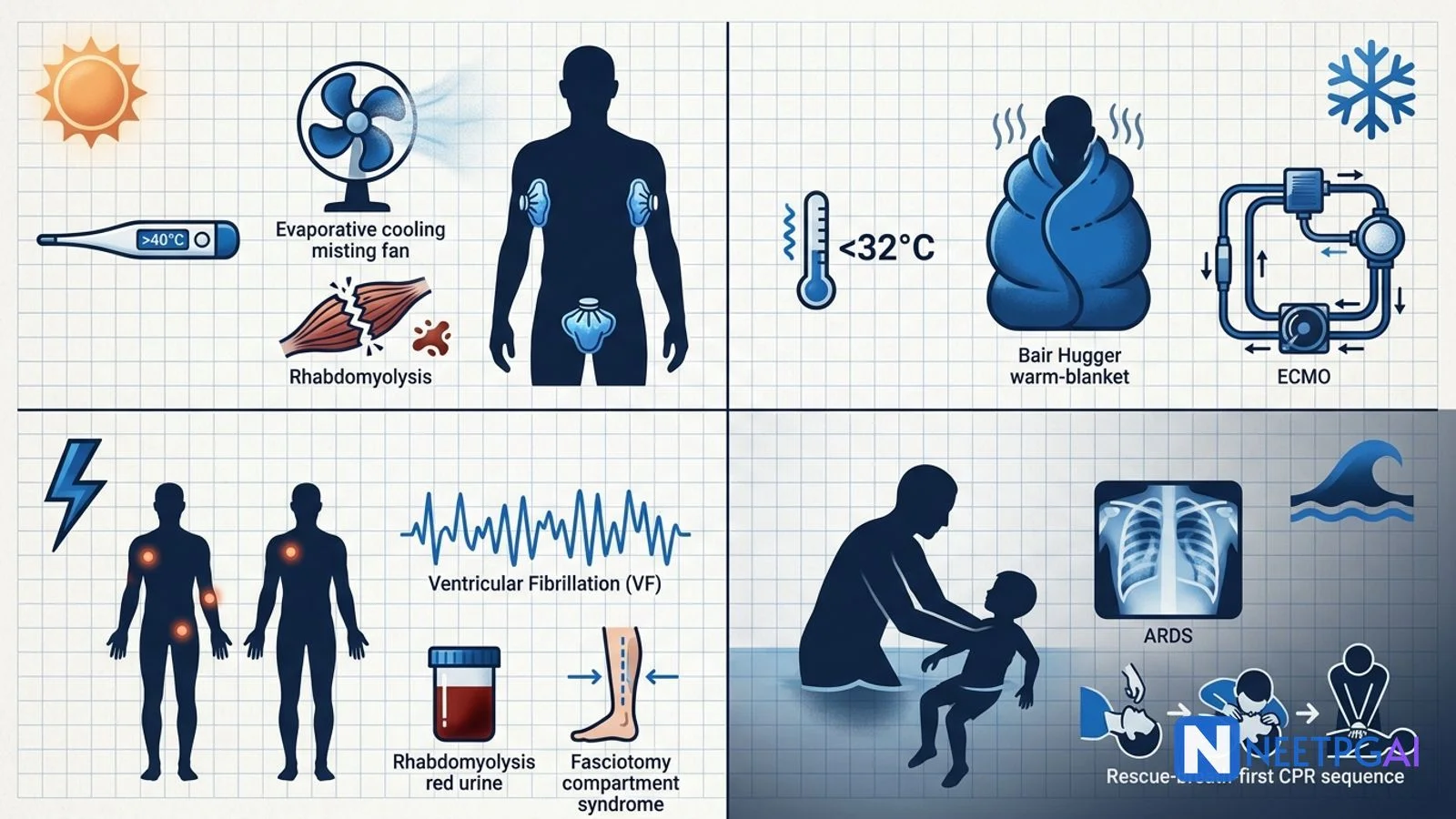
- Heatstroke — core temperature above 40 degrees Celsius PLUS altered mental status; cool aggressively to below 38.5 degrees Celsius within 30 minutes; cold-water immersion is best for exertional heatstroke; antipyretics are contraindicated.
- Hypothermia — mild 32-35, moderate 28-32, severe below 28 degrees Celsius; passive external for mild, active external for moderate, active internal for severe; not dead till warm and dead — CPR to 32 degrees.
- Frostbite — rapid rewarming in 37-39 degrees Celsius water bath; delay amputation 3-4 weeks for demarcation; NEVER rewarm if refreeze possible.
- Electrical injury — AC below 1000 V versus DC and high voltage above 1000 V; deep tissue injury disproportionate to skin in high voltage; 24-hour cardiac monitoring if LOC, arrhythmia, high voltage, or chest crossing.
- Drowning BLS — 5 rescue breaths BEFORE compressions (hypoxic primary mechanism); observe 4-8 hours for delayed pulmonary oedema.
- India-specific — heatwave deaths in summer among outdoor labourers; monsoon flooding drownings; toddler drownings in open wells and tanks.
Environmental emergencies contribute reliably to NEET PG papers because they combine forensic (mechanism, time-course), medicine (fluid resuscitation, monitoring), surgery (burn care, fasciotomy, amputation), community medicine (prevention, occupational risk), and pharmacology (bicarbonate, iloprost, tPA) principles into single vignettes. India carries a large and rising burden — over 700 recorded heatstroke deaths in the 2022 heatwave season, 30,000-plus annual drowning deaths (Global Burden of Disease), and thousands of electrical injuries among construction workers, farmers, and pole-climbing linemen.
This NEETPGAI deep dive covers the full environmental emergencies spectrum — heat illness (cramps to heatstroke), cold injury (hypothermia and frostbite), electrical injury (low vs high voltage, lightning), and drowning — with focus on the exam-facing recognition triggers, treatment thresholds, and India-specific epidemiology. Pair this with the snake-bite and scorpion envenomation guide for the broader tropical emergency-medicine cluster.
Heat illness — the spectrum
Heat-related illness is a continuum driven by heat load exceeding the body's dissipative capacity. Recognition triggers escalation.
Heat cramps
- Painful involuntary muscle cramps (calf, thigh, abdominal) after prolonged sweating and inadequate electrolyte replacement
- Core temperature is normal; mental status is normal
- Common in athletes, agricultural labourers, and factory workers rehydrating with plain water rather than electrolyte solutions
- Treatment — rest in a cool environment, oral rehydration with an electrolyte solution (ORS or a sports drink), gentle stretching; IV normal saline if severe or vomiting
Heat exhaustion
- Core temperature under 40 degrees Celsius, normal or mildly impaired mental status, fatigue, headache, nausea, vomiting, dizziness, tachycardia, orthostasis
- Skin often flushed and sweaty; volume-depleted
- Precedes heatstroke — recognise and treat aggressively
- Treatment — remove from heat, cool environment, remove excess clothing, oral rehydration if tolerated, IV normal saline 1-2 L if severe, monitor for progression
Heatstroke — the emergency
The defining features are core temperature above 40 degrees Celsius PLUS altered mental status (confusion, delirium, seizures, coma). Two forms:
| Feature | Classic heatstroke | Exertional heatstroke |
|---|
| Population | Elderly, chronic illness, on diuretics, alcoholics | Athletes, military recruits, labourers, wrestlers |
| Onset | Days during heatwave | Hours during exertion |
| Sweating | Often absent (anhidrosis) | Often preserved |
| Setting | Heatwave, poor cooling, urban | Physical exertion in hot conditions |
| Cooling method | Evaporative + fans + ice packs | Cold-water immersion first-line |
| Mortality | 10-70 percent | Lower with rapid cooling |
The intervention that changes outcome — rapid cooling to core temperature below 38.5 degrees Celsius within 30 minutes.
Cooling methods, ranked by efficacy:
- Cold water immersion (2-14 degrees Celsius) — best for exertional heatstroke, cooling rate 0.15-0.35 degrees Celsius per minute
- Evaporative cooling — mist room-temperature water on the skin plus high-flow fans; best for classic heatstroke and where immersion is not possible
- Ice packs — to axilla, groin, and neck (major vascular convergence zones) — augment either method
- Cold IV fluids — 1-2 L normal saline at 4 degrees Celsius; adjunctive
- Cooling blankets and endovascular cooling catheters — ICU-level
Do NOT give antipyretics. Paracetamol and NSAIDs act on the hypothalamic thermoregulatory set-point, which is normal in heatstroke — the problem is exogenous heat load exceeding dissipation, not a fever. NSAIDs also worsen AKI and GI bleeding in the setting of multiorgan injury.
Monitor for and manage complications:
- Rhabdomyolysis — CK often over 5000; treat with aggressive IV fluid targeting urine output 1-2 mL/kg/hour, sodium bicarbonate for urine alkalinisation
- AKI — from combination of hypovolaemia, direct thermal injury, myoglobinuria, and DIC
- DIC — from endothelial thermal injury; supportive with FFP, platelets
- Hepatic failure — often severe; may require transplant
- Hypoglycaemia — check and correct
- Electrolyte derangement — hyperkalaemia, hyponatraemia, hyperphosphataemia
- Cerebral oedema, seizures — supportive
- ARDS, cardiac dysfunction, and pancreatitis
Prevention and India-specific context
- Hydration and acclimatisation — outdoor workers need 250-500 mL of water per hour; acclimatisation over 7-14 days doubles heat tolerance
- Avoid mid-day exertion — schedule outdoor work before 11 am and after 4 pm during summer
- Cool rest breaks — mandated for outdoor labour in high-risk states
- Vulnerable groups — elderly, children, pregnant women, chronic illness, athletes, agricultural and construction workers
- India summer heatwaves — Uttar Pradesh, Bihar, Andhra Pradesh, Rajasthan, and Odisha carry the highest burden; recorded heatstroke deaths in the 2022 season exceeded 700 and this is widely under-reported
Cold injury — hypothermia
Hypothermia is core body temperature below 35 degrees Celsius. Staging is by temperature (measured with a low-reading rectal or oesophageal thermometer; standard thermometers only read down to 34 degrees Celsius).
Staging and clinical features
| Stage | Core temperature | Clinical features |
|---|
| Mild | 32-35 degrees Celsius | Intense shivering, tachycardia, tachypnoea, mild confusion, vasoconstriction, cold diuresis |
| Moderate | 28-32 degrees Celsius | Shivering stops, bradycardia, arrhythmia risk (atrial fibrillation, junctional rhythm), decreased consciousness, dilated pupils, hyporeflexia |
| Severe | Below 28 degrees Celsius | Coma, fixed pupils, apnoea, ventricular fibrillation or asystole, appears dead |
The Osborn J-wave (positive deflection at the QRS-ST junction) on ECG is classic below 32 degrees Celsius but is not specific.
Rewarming — matched to severity
Passive external rewarming (mild)
- Remove wet clothes, warm blankets, warm environment
- Rely on intact shivering; the fastest natural rewarming mechanism
- Rewarming rate 0.5-2 degrees Celsius per hour
Active external rewarming (moderate)
- Forced-air warming blanket (Bair Hugger)
- Warm-water blankets, radiant heaters
- Chemical heat packs to the trunk NOT the extremities
- Rewarming rate 1-2 degrees Celsius per hour
Active internal rewarming (severe)
- Warmed IV fluids at 40-42 degrees Celsius via central line
- Warm humidified oxygen at 40-42 degrees Celsius
- Warm peritoneal, pleural, gastric, or bladder lavage
- Extracorporeal rewarming — ECMO or cardiopulmonary bypass — the fastest, best for cardiac arrest
- Rewarming rate 4-10 degrees Celsius per hour with ECMO
Key principles
- Not dead till warm and dead — continue CPR and do NOT declare resuscitation futile until core temperature is above 32 degrees Celsius; cold-protected brains can survive prolonged arrest
- Avoid rough handling — cold myocardium is exquisitely irritable; rough movement can trigger ventricular fibrillation
- Avoid extremity rewarming in moderate to severe cases — prevents core temperature afterdrop from cold peripheral blood returning to the core
- Watch for arrhythmias — atrial fibrillation is common and usually reverts with rewarming; VF is refractory below 30 degrees Celsius — continue CPR while rewarming
- Cold diuresis — cold-induced diuresis causes hidden volume depletion; give fluids
Cold injury — frostbite and non-freezing injuries
Frostbite grading
Freezing tissue injury — intracellular and extracellular ice crystals disrupt cells and occlude microvasculature.
| Grade | Depth | Features after rewarming |
|---|
| Grade 1 | Superficial skin | Numbness, erythema, no blisters, no tissue loss |
| Grade 2 | Full-thickness skin | Clear or milky blisters over erythema within 24 hours, superficial tissue loss possible |
| Grade 3 | Subcutaneous tissue | Haemorrhagic blisters, deeper tissue loss |
| Grade 4 | Muscle, tendon, bone | Mummification, eventual amputation |
Treatment
- Rapid rewarming in 37-39 degrees Celsius circulating water bath for 15-30 minutes until tissue is soft and pliable
- Do NOT rewarm if refreezing is possible during transport — freeze-thaw-refreeze is far more destructive than remaining frozen
- IV opioid analgesia — rewarming is extremely painful
- Ibuprofen — thromboxane inhibition reduces further damage
- Tetanus prophylaxis
- Antibiotics — only if infection develops (not routine)
- Iloprost (prostacyclin analogue) and tissue plasminogen activator — salvage tissue in grade 3-4 within 24 hours of injury in specialised centres
- Delayed amputation — wait 3-4 weeks for full demarcation between viable and non-viable tissue; premature amputation removes tissue that would recover
Non-freezing cold injuries
- Chilblains (pernio) — localised inflammatory red-purple lesions on exposed skin from repeated cold and wet above-freezing exposure; supportive care with warmth, nifedipine for severe cases
- Trench foot (immersion foot) — prolonged cold and wet exposure of feet without freezing; pain, swelling, tissue loss; treatment is warming, elevation, drying, analgesia
Electrical injury
Electricity injures by three mechanisms — direct current effect on excitable tissue (heart, nerve, muscle), thermal burn from heat generated at points of resistance, and blunt trauma from tetanic contraction throwing the victim.
Voltage and current type
| Parameter | Feature |
|---|
| Low voltage | Below 1000 V — household 220 V in India; small entry/exit wounds; VF risk if current path crosses heart |
| High voltage | Above 1000 V — industrial, transmission lines; deep tissue injury disproportionate to skin |
| Alternating current (AC) | Household mains; tetanic contraction grips victim to conductor; longer exposure |
| Direct current (DC) | Batteries, lightning; single powerful contraction throws victim off |
Clinical features
Cardiac
- Ventricular fibrillation or asystole — commonest cause of on-scene death
- Delayed arrhythmia within 24 hours
- Myocardial injury with elevated troponin
- Non-specific ECG changes
Neurologic
- Loss of consciousness at scene
- Seizures, coma
- Delayed peripheral neuropathies
- Spinal cord injury from tetany-induced fractures
Renal and metabolic
- Rhabdomyolysis with myoglobinuric AKI (common in high voltage)
- Electrolyte disturbances (hyperkalaemia)
- Metabolic acidosis
Burns
- Entry and exit wounds
- Deep tissue burns often extensive beyond skin appearance (high voltage)
- Arc burns (current jumps across a gap without contact)
- Flash burns (from associated fire)
Musculoskeletal
- Fractures and dislocations from tetanic contraction (posterior shoulder dislocation is classic)
- Compartment syndrome from deep tissue swelling — may need urgent fasciotomy
Late complications
- Cataracts (months to years)
- Neurosensory hearing loss
- Chronic pain, neuropathy
Management
- ABC — CPR for cardiac arrest (defibrillation for VF)
- Continuous cardiac monitoring for 24 hours if — LOC at scene, any ECG abnormality on presentation, high voltage exposure, burns crossing chest, or symptomatic (chest pain, palpitations)
- Aggressive IV fluid resuscitation — target urine output 1-2 mL/kg/hour
- Sodium bicarbonate for urine alkalinisation (pH above 6.5) if myoglobinuria
- Wound care — tetanus, initial debridement, delayed definitive debridement after demarcation
- Fasciotomy if compartment syndrome
- Amputation if non-viable tissue
- Social evaluation — homicidal, suicidal, and accidental exposures all require documentation; occupational exposure needs incident report
Lightning strike — a special case
- Flashover phenomenon — most current travels over the body surface, producing less deep tissue injury than a comparable industrial voltage
- Lichtenberg figures — fern-like erythematous patterns on skin (pathognomonic, transient)
- Keraunoparalysis — transient limb paralysis and vasospasm (hours)
- Cardiac arrest is the hallmark — reverse triage in mass casualty (treat the apparently dead first because primary respiratory arrest may recover with brief ventilation)
- Ruptured tympanic membranes in half of victims
- Cataracts develop in weeks to months
Drowning
WHO definition — the process of experiencing respiratory impairment from submersion or immersion in liquid. Outcomes are death, morbidity, or no morbidity. The old wet vs dry classification is discarded — most victims aspirate at least small amounts, and salt vs fresh water differences are minimal clinically.
Pathophysiology
- Submersion produces initial breath-hold and laryngospasm
- Progressive hypoxia leads to loss of consciousness and laryngeal relaxation
- Aspiration of water surfactant washout, alveolar collapse, ARDS-pattern lung injury
- Pulmonary oedema from surfactant loss and inflammatory response
- Bradycardia and eventual asystole from progressive hypoxia
- Hypothermia often coexists in prolonged drowning and provides cerebral protection
BLS sequence — different from cardiac arrest
The primary aetiology is hypoxic, so start with 5 rescue breaths BEFORE chest compressions to correct hypoxia. Then proceed with the standard 30:2 compression-ventilation ratio.
- Rescue and remove from water — the first priority; do not risk your own life
- Assess responsiveness and breathing — 10-second look-listen-feel
- 5 rescue breaths — mouth-to-mouth or bag-mask if available
- Chest compressions at 30:2 ratio if pulseless
- AED as soon as available (dry the chest first)
- Advanced airway and IV access on arrival of ALS
Do NOT attempt Heimlich manoeuvre — it delays ventilation, increases aspiration risk, and does not remove water effectively from lungs.
Cervical spine precautions are indicated ONLY when the mechanism suggests trauma — diving into shallow water, high-speed watercraft, or visible signs of injury. Routine C-spine immobilisation is not required and delays airway management.
In-hospital management
- Warm and stabilise — treat hypothermia per protocol; not dead till warm and dead
- Respiratory support — oxygen, non-invasive ventilation, or intubation with PEEP for ARDS
- Chest X-ray — often normal initially; may show pulmonary oedema, atelectasis, or infiltrates
- Bloods — ABG, electrolytes, lactate, coagulation
- Observation for 4-8 hours — for any symptoms, abnormal chest X-ray, hypoxia, or altered mental status; delayed pulmonary oedema (previously called secondary drowning) can develop
- Neurologic prognosis — post-cardiac-arrest hypothermia protocol (targeted temperature management)
- Antibiotics — reserved for grossly contaminated water aspiration or clinical infection, not routine
India-specific drowning epidemiology
- Monsoon flooding — Bihar, UP, Assam; entire villages inundated with limited rescue capacity
- Coastal drowning — Andhra, Odisha, Kerala; low swimming literacy, limited lifeguards
- Open wells and tanks — toddler drownings in unfenced rural water sources
- Ritual bathing — religious congregations at ghats and rivers
- Bathtub drownings — infants left unattended
- Fishing boats — inland fishing without PFDs
- Swimming pools — urban India; often inadequate supervision
Prevention
- Supervision — never leave a child unattended near water
- Swimming lessons — from age 4 in most guidelines
- Four-sided pool fencing with self-closing gate
- PFDs on all boats and near water bodies
- Public education — schools, media, community
- Bystander CPR training — improves outcomes dramatically
NEET PG MCQ traps
- Heatstroke definition — core temperature above 40 degrees Celsius PLUS altered mental status
- Classic vs exertional heatstroke — anhidrosis in classic; sweating preserved in exertional; cold-water immersion for exertional
- Cooling target — below 38.5 degrees Celsius within 30 minutes
- Antipyretics contraindicated in heatstroke — set-point is normal; NSAIDs worsen AKI
- Ice packs to axilla, groin, neck — major vascular convergence
- Rhabdomyolysis in heatstroke — alkaline diuresis with sodium bicarbonate
- Hypothermia staging — mild 32-35, moderate 28-32, severe below 28 degrees Celsius
- Osborn J-wave on ECG in hypothermia below 32 degrees Celsius
- Passive external rewarming for mild; active external for moderate; active internal (ECMO) for severe
- Not dead till warm and dead — continue CPR until core above 32 degrees Celsius
- Avoid extremity rewarming in moderate to severe — prevents core temperature afterdrop
- Frostbite rewarming — 37-39 degrees Celsius water bath, 15-30 minutes
- NEVER rewarm frostbite if refreeze possible
- Delayed amputation in frostbite — wait 3-4 weeks for demarcation
- Chilblains and trench foot — non-freezing cold injuries
- AC vs DC — AC grips (tetany), DC throws
- Low vs high voltage — cutoff 1000 V; high voltage causes deep tissue injury disproportionate to skin
- 24-hour cardiac monitoring after electrical injury if — LOC, ECG abnormality, high voltage, chest crossing, symptomatic
- Rhabdomyolysis after electrical injury — alkaline diuresis
- Lichtenberg figures — pathognomonic of lightning strike (transient)
- Reverse triage in lightning mass casualty — treat apparently dead first
- Keraunoparalysis — transient limb paralysis after lightning
- Drowning BLS — 5 rescue breaths BEFORE compressions (hypoxic primary aetiology)
- Heimlich contraindicated in drowning
- Wet vs dry drowning classification abandoned by WHO
- Delayed pulmonary oedema ("secondary drowning") — observe 4-8 hours
- Cervical spine precautions in drowning only if mechanism suggests
- India drowning burden — monsoon flooding, open wells, ritual bathing, toddler drownings
Key takeaways
- The environmental emergencies spectrum is one of the highest-yield NEET PG topics because it touches medicine, surgery, forensic, and community medicine
- Heatstroke needs aggressive cooling to below 38.5 degrees Celsius within 30 minutes; antipyretics are contraindicated
- Hypothermia rewarming is matched to severity — passive external for mild, active external for moderate, active internal for severe; CPR continues until core above 32 degrees Celsius
- Frostbite is treated with rapid warm-water bath rewarming; amputation is delayed 3-4 weeks for demarcation
- Electrical injury deep tissue damage is often disproportionate to skin appearance in high voltage; 24-hour cardiac monitoring is required for at-risk patients
- Drowning BLS starts with 5 rescue breaths before compressions because the primary aetiology is hypoxic
- India's environmental emergency burden is rising with climate change, urbanisation, and occupational exposure — prevention and public education are the highest-return interventions
Frequently asked questions
What are the diagnostic criteria and cooling targets for heatstroke, and why are antipyretics contraindicated?
Heatstroke is defined by a core body temperature above 40 degrees Celsius PLUS altered mental status (confusion, delirium, seizures, coma) in the context of environmental heat exposure or extreme exertion. Two forms exist — classic heatstroke (elderly, comorbid patients, chronic diuretic use, during heatwaves; slow onset over days; anhidrosis common) and exertional heatstroke (young athletes, military recruits, agricultural labourers; rapid onset within hours; sweating often preserved). The mortality rate is 10-70 percent and rises steeply with the time the patient spends above 40 degrees Celsius. The emergency intervention that changes outcome is aggressive rapid cooling to a target core temperature below 38.5 degrees Celsius within 30 minutes of presentation. Methods — cold water immersion (2 to 14 degrees Celsius) is the most effective single technique especially for exertional heatstroke and is now standard first-line where available; evaporative cooling with room-temperature water misting combined with high-flow fans is a strong alternative when immersion is not feasible; ice packs to the axilla, groin, and neck augment either method. Antipyretics (paracetamol, NSAIDs) are contraindicated because they act on the hypothalamic thermoregulatory set-point, which is normal in heatstroke — the problem is exogenous heat load exceeding dissipation, not a fever. NSAIDs also worsen AKI and gastrointestinal bleeding risk in a patient who already has multiorgan injury. Complications include rhabdomyolysis, AKI, disseminated intravascular coagulation, hepatic failure, hypoglycaemia, hyperkalaemia, ARDS, and cerebral oedema — all needing ICU-level supportive management.
How is hypothermia staged and what is the correct rewarming approach for each severity?
Hypothermia is staged by core body temperature — mild is 32-35 degrees Celsius (shivering intense, tachycardia, tachypnoea, mild confusion), moderate is 28-32 degrees Celsius (shivering stops, bradycardia, arrhythmia risk, decreased consciousness, dilated pupils), and severe is below 28 degrees Celsius (coma, fixed pupils, apnoea, ventricular fibrillation or asystole). The Swiss staging system uses clinical features because a bedside core temperature probe is often unavailable at the scene. Rewarming is matched to severity. Passive external rewarming (remove wet clothes, warm blankets, warm environment) is sufficient for mild hypothermia because an intact shivering response is the fastest rewarming mechanism the body has. Active external rewarming (forced-air warming device such as a Bair Hugger, warm-water blankets, radiant heaters, chemical heat packs to the trunk not the extremities) is used for moderate hypothermia. Active internal rewarming (warmed IV fluids at 40-42 degrees Celsius, warm humidified oxygen at 40-42 degrees Celsius, warm peritoneal, pleural, gastric, or bladder lavage, and extracorporeal rewarming via ECMO or cardiopulmonary bypass) is needed for severe hypothermia and for any patient in cardiac arrest. The maxim not dead till warm and dead means CPR should continue and resuscitation should not be declared futile until the core temperature is above 32 degrees Celsius, because the cold-protected brain can survive prolonged arrest. Extremity rewarming is deliberately avoided in moderate to severe cases to prevent core temperature afterdrop, where cold peripheral blood returns to the core and worsens cardiac risk. Rough handling is minimised to prevent VF triggered by cold myocardium.
How do you grade and treat frostbite, and what other non-freezing cold injuries should NEET PG candidates know?
Frostbite is a freezing cold injury where tissue temperature drops below zero degrees Celsius, forming intracellular and extracellular ice crystals that mechanically disrupt cells and cause vascular occlusion. It is graded 1 to 4. Grade 1 is superficial with numbness and erythema after rewarming, no tissue loss. Grade 2 has clear or milky blisters over an erythematous base within 24 hours, some superficial tissue loss possible. Grade 3 shows haemorrhagic blisters and deeper tissue loss extending into subcutaneous fat. Grade 4 involves muscle, tendon, and bone with mummification and eventual auto-amputation or surgical amputation. The immediate treatment is rapid rewarming in a 37-39 degrees Celsius circulating water bath for 15-30 minutes until the tissue is soft and pliable; do NOT rewarm if there is any chance of refreezing during transport because a freeze-thaw-refreeze cycle is far more destructive. Adjuncts include IV opioid analgesia (rewarming is extremely painful), ibuprofen (thromboxane inhibition reduces further damage), tetanus prophylaxis, and antibiotics only if infection develops. Iloprost (a prostacyclin analogue) and tissue plasminogen activator can salvage tissue in grade 3-4 disease within 24 hours of injury in specialised centres. Surgical debridement or amputation is delayed for at least 3-4 weeks to allow full demarcation between viable and non-viable tissue — the wait and see rule prevents unnecessary tissue loss. Non-freezing cold injuries include chilblains or pernio (localised inflammatory red-purple lesions on exposed skin from repeated exposure to cold, wet, above-freezing conditions; supportive care with warmth and nifedipine for severe cases) and trench foot or immersion foot (prolonged exposure of feet to cold and wet conditions without freezing; produces pain, swelling, and eventual tissue loss; treatment is warming, elevation, drying, and analgesia). NEET PG regularly tests the frostbite grading, the rapid rewarming temperature and rationale, and the delayed amputation principle.
What are the key differences between low voltage and high voltage electrical injury, and when should a patient be admitted for monitoring?
Voltage classification splits electrical injuries at 1000 volts — low voltage (below 1000 V, typical household current 220 V in India) versus high voltage (above 1000 V, industrial or transmission lines). The current type also matters — alternating current (AC, household mains) causes tetanic muscle contraction that grips the victim to the conductor increasing exposure duration, while direct current (DC, batteries, lightning) produces a single powerful contraction that throws the victim off. Low voltage AC exposure typically produces small entry and exit wounds and localised burns but can still cause fatal ventricular fibrillation if the current path crosses the heart. High voltage injury produces massive tissue damage disproportionate to the visible skin injury because deep tissues (muscle, nerve, blood vessel) offer lower resistance and heat up more than skin; entry and exit wounds are dramatic but often understate the injury. Cardiac complications include immediate ventricular fibrillation or asystole (commonest cause of on-scene death), delayed arrhythmia within 24 hours, and myocardial injury with elevated troponin. Neurologic effects include loss of consciousness, seizures, coma, and delayed peripheral neuropathies. Rhabdomyolysis and myoglobinuric AKI are common in high voltage exposure — aggressive fluid resuscitation targeting urine output of 1-2 mL/kg/hour with sodium bicarbonate alkalinisation is standard. Compartment syndrome from deep tissue injury may need urgent fasciotomy. Cataracts (months to years later) and neurosensory hearing loss are late complications. Admission for continuous cardiac monitoring for 24 hours is required if the patient had loss of consciousness at the scene, has any ECG abnormality on presentation, sustained a high voltage injury, has burns crossing the chest, or is symptomatic (chest pain, dysrhythmia felt as palpitations); a completely asymptomatic patient with a normal ECG after a low voltage exposure may be discharged after a brief observation. Lightning strike is a special case — flashover phenomenon means most current travels over the body surface, producing Lichtenberg figures (fern-like erythematous patterns) and typically less deep tissue injury than a comparable industrial voltage, but keraunoparalysis (transient limb paralysis) and cardiac arrest are hallmarks.
How does the BLS sequence differ in drowning compared to cardiac arrest, and what is the India-specific epidemiology?
Drowning is defined by WHO as the process of experiencing respiratory impairment from submersion or immersion in liquid; outcomes are death, morbidity, or no morbidity. The old distinction between wet drowning and dry drowning has been discarded — most drowning victims aspirate at least some water, and salt versus fresh water differences are minimal clinically. Hypoxia is the pathophysiological common thread — laryngospasm initially, then aspiration, alveolar collapse, pulmonary oedema, and eventual cardiac arrest from progressive hypoxia. This is why the BLS sequence in drowning is different from primary cardiac arrest — start with 5 rescue breaths BEFORE chest compressions to address the primary hypoxic aetiology, then proceed with the standard 30:2 compression-ventilation ratio. Removing the victim from water is the first priority; do NOT attempt to drain water from the lungs (Heimlich manoeuvre is contraindicated because it delays ventilation and increases aspiration risk). Cervical spine precautions are indicated only when the mechanism suggests it (diving into shallow water, high-speed watercraft, signs of trauma). Hypothermia coexists in almost every prolonged drowning and provides cerebral protection — the not dead till warm and dead rule extends prolonged resuscitation attempts. Post-drowning admission for 4-8 hours of observation is standard for any patient with symptoms, abnormal chest X-ray, hypoxia, or altered mental status, because delayed pulmonary oedema (previously called secondary drowning) can develop within this window. The Indian burden is enormous — monsoon flooding and river accidents in Bihar, Uttar Pradesh, and Assam; coastal and beach drownings on the Andhra, Odisha, and Kerala coasts; toddler drownings in unfenced open wells, tanks, and bathtubs; ritual bathing accidents at religious congregations; and swimming pool drownings in urban India. Limited lifeguard training, low swimming literacy, and absence of PFDs on inland fishing craft drive high mortality especially in children under 5. Prevention includes supervision, swimming lessons, four-sided pool fencing, PFDs on all boats, and public education.
This content is for educational purposes for NEET PG exam preparation. It is not a substitute for professional medical advice, diagnosis, or treatment. Clinical information has been reviewed by qualified medical professionals.
Written by: NEETPGAI Editorial Team
Reviewed by: Pending SME Review
Last reviewed: September 2026