Quick Answer
Immunology — particularly hypersensitivity reactions and transplant immunology — accounts for 4 to 6 NEET PG questions per paper across Pathology, Medicine, and Microbiology. Lock these:
- Gell-Coombs types I-IV — mechanism, time course, and classic example for each.
- Hyperacute rejection — pre-formed antibodies, minutes to hours, no salvage.
- Acute rejection — T-cell mediated, days to months, steroid-responsive.
- Chronic rejection — antibody plus cell mediated, months to years, no cure.
- GVHD — donor T-cells attack recipient skin, liver, gut after allogeneic HSCT.
- Calcineurin inhibitors — cyclosporine and tacrolimus block IL-2 transcription.
- HLA-DR match — most important for kidney graft survival.
Immunology dominates NEET PG conceptual questions because every clinical specialty pulls from it — Rheumatology stems on SLE, Haematology stems on AIHA, Surgery stems on transplant rejection, OBG stems on Rh isoimmunisation. Examiners reward students who can map each clinical syndrome onto its Gell-Coombs type and recognise the signature immunosuppressant ADRs.
This NEETPGAI deep dive walks through the four hypersensitivity types, autoimmunity vs immunodeficiency, transplant biology, HLA matching, GVHD, every major immunosuppressant, and India-specific transplant law. Pair this guide with the autoimmune diseases deep dive for a complete immunology map.
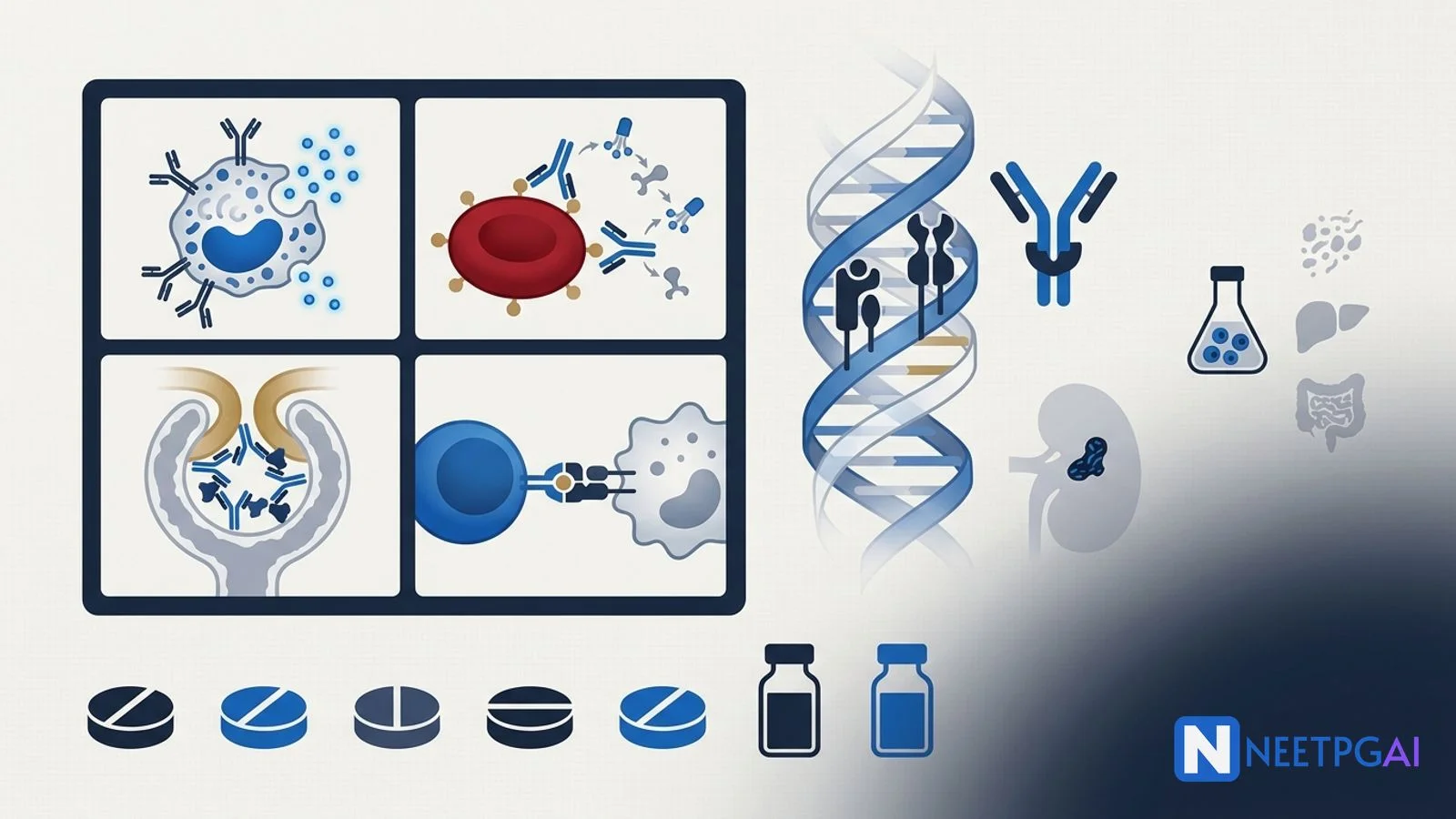
The Gell-Coombs hypersensitivity classification
Type I — IgE-mediated immediate hypersensitivity
Mechanism — first exposure sensitises B-cells to produce IgE, which binds FcεRI on mast cells and basophils. Re-exposure cross-links surface IgE, triggering degranulation of preformed histamine, tryptase, heparin, and de novo synthesis of leukotrienes (C4, D4, E4), prostaglandins, and platelet-activating factor.
Time course — minutes (immediate); late-phase response at 4 to 12 hours.
Examples — anaphylaxis (penicillin, peanuts, latex, bee sting), atopic dermatitis, allergic rhinitis (hay fever), allergic asthma, urticaria, angioedema.
Treatment — adrenaline (anaphylaxis DOC, 0.3 to 0.5 mg IM lateral thigh), H1 antihistamines, corticosteroids, leukotriene receptor antagonists (montelukast), omalizumab (anti-IgE) for severe asthma.
NEET PG trap — tryptase elevation (within 1 to 3 hours, normalising by 6 hours) confirms anaphylaxis retrospectively.
Type II — antibody-mediated cytotoxic
Mechanism — IgG or IgM binds cell-surface or extracellular-matrix antigens, recruiting complement (membrane attack complex), opsonising for phagocytosis, or triggering ADCC by NK cells.
Time course — variable (hours to days).
Examples
- Autoimmune haemolytic anaemia (warm IgG, cold IgM).
- ABO and Rh transfusion reactions, haemolytic disease of the newborn.
- Goodpasture syndrome (anti-glomerular basement membrane).
- Myasthenia gravis (anti-AChR antibody).
- Graves disease (TSI stimulates TSH receptor).
- Pemphigus vulgaris (anti-desmoglein 3).
- Bullous pemphigoid (anti-hemidesmosome).
- Rheumatic carditis (molecular mimicry — anti-streptococcal antibodies cross-react with cardiac myosin).
- Hyperacute graft rejection.
Treatment — corticosteroids, IVIG, plasmapheresis, rituximab.
Type III — immune-complex mediated
Mechanism — soluble antigen-antibody complexes deposit in tissues (vessel walls, glomerular basement membrane, synovium), activate complement, and recruit neutrophils that release lysosomal enzymes.
Time course — hours to weeks (serum sickness peaks at 7 to 14 days).
Examples
- SLE (DNA-anti-dsDNA complexes).
- Post-streptococcal glomerulonephritis.
- Serum sickness (heterologous antitoxin, monoclonal antibodies, drugs).
- Polyarteritis nodosa (often hepatitis B-associated).
- Henoch-Schonlein purpura / IgA vasculitis.
- Arthus reaction (local deposition after intradermal antigen).
- Hypersensitivity pneumonitis (farmer's lung, bird-fancier's lung).
Treatment — corticosteroids, plasmapheresis, removal of inciting antigen.
Type IV — T-cell mediated delayed hypersensitivity
Mechanism — sensitised CD4 helper T-cells release cytokines (IFN-gamma) recruiting macrophages, or CD8 cytotoxic T-cells directly kill target cells. No antibody involvement.
Time course — 48 to 72 hours peak.
Examples
- Contact dermatitis (nickel, poison ivy).
- Tuberculin (Mantoux) skin test.
- Granuloma formation (TB, sarcoidosis, leprosy).
- Type 1 diabetes mellitus.
- Multiple sclerosis.
- Hashimoto thyroiditis.
- Acute and chronic graft rejection.
- Stevens-Johnson syndrome / TEN (sulfa drugs, allopurinol, carbamazepine — HLA-B*1502 in Asians).
- Coeliac disease.
Treatment — corticosteroids, calcineurin inhibitors, biologics.
Autoimmunity versus immunodeficiency
Autoimmunity = loss of self-tolerance; immune system attacks self-antigens. Three mechanisms: molecular mimicry (rheumatic fever), epitope spreading (SLE), failed central or peripheral tolerance (AIRE mutation causes APECED). Female preponderance for most (SLE, RA, Hashimoto).
Immunodeficiency = absent or reduced immune component.
- B-cell defects (X-linked agammaglobulinaemia / Bruton, CVID) — encapsulated bacterial infections.
- T-cell defects (DiGeorge — 22q11.2 deletion) — viral, fungal, opportunistic infections.
- Combined (SCID — adenosine deaminase deficiency) — early-life infections, FTT.
- Phagocyte defects (chronic granulomatous disease — NADPH oxidase) — catalase-positive organisms (Staph aureus, Aspergillus, Nocardia).
- Complement defects — C5-C9 cause Neisseria infections; C1 inhibitor deficiency causes hereditary angioedema.
Transplant immunology
HLA matching
The major histocompatibility complex on chromosome 6 encodes HLA class I (A, B, C — on all nucleated cells, present to CD8) and HLA class II (DP, DQ, DR — on antigen-presenting cells, present to CD4).
For kidney transplant, the practical match is 6-antigen — 2 each of HLA-A, HLA-B, HLA-DR. HLA-DR matching has the greatest impact on graft survival, followed by HLA-B and HLA-A. HLA-C, DP, DQ matter less for kidney but increasingly for HSCT.
Pre-transplant work-up includes ABO typing, HLA typing, panel reactive antibody (PRA) percentage measuring pre-existing anti-HLA antibodies (PRA above 80 percent flags high immunological risk), and a lymphocyte cross-match — direct test of recipient serum against donor lymphocytes. A positive T-cell cross-match is an absolute contraindication.
Hyperacute rejection
Onset minutes to hours intra-operatively.
Mechanism — pre-formed recipient antibodies (anti-ABO or anti-HLA) bind donor endothelium, activate complement, cause microthrombi, ischaemia, and graft loss.
Pathology — neutrophilic infiltrate, fibrin thrombi, vascular necrosis.
Treatment — none medically effective; graft must be removed. Prevention is everything — ABO match plus negative cross-match.
Acute rejection
Onset days to 6 months (usually within 3 months).
Two patterns:
- Acute cellular rejection (commoner) — T-cell mediated, type IV. Tubulitis and interstitial mononuclear infiltrate on biopsy. Treatment — high-dose IV methylprednisolone; steroid-resistant cases get anti-thymocyte globulin (ATG) or muromonab-CD3 (now largely obsolete).
- Acute antibody-mediated rejection (AMR) — type II, donor-specific antibodies on biopsy plus C4d deposition. Treatment — IVIG, plasmapheresis, rituximab, bortezomib in refractory cases.
Chronic rejection
Onset months to years.
Mechanism — combined antibody and T-cell injury; intimal smooth-muscle hyperplasia, arteriolosclerosis, glomerular sclerosis, interstitial fibrosis.
Treatment — none effective once established; immunosuppression intensification may slow progression. Re-transplant the only definitive option.
Graft-versus-host disease (GVHD)
Unique to allogeneic HSCT and rarely to small-bowel transplant or large-volume transfusion (in immunocompromised). Donor T-cells recognise recipient tissues as foreign.
Acute GVHD (within 100 days) — skin maculopapular rash, hepatic cholestasis, voluminous diarrhoea. Graded I to IV.
Chronic GVHD (after 100 days) — sclerodermatous skin, sicca syndrome (Sjogren-like), bronchiolitis obliterans, hepatic dysfunction.
Prophylaxis — methotrexate plus cyclosporine or tacrolimus, post-transplant cyclophosphamide for haploidentical transplants.
Treatment — corticosteroids first-line; ruxolitinib (JAK inhibitor) for steroid-refractory.
Immunosuppressant pharmacology
Calcineurin inhibitors
Examples — cyclosporine, tacrolimus.
Mechanism — cyclosporine binds cyclophilin; tacrolimus binds FKBP-12. Both drug-immunophilin complexes inhibit calcineurin, preventing NFAT dephosphorylation and IL-2 gene transcription.
ADRs — nephrotoxicity (afferent arteriolar vasoconstriction), neurotoxicity (tremor, seizures), hypertension, hyperkalaemia, new-onset diabetes after transplant (tacrolimus more diabetogenic), gingival hyperplasia and hirsutism (cyclosporine), dyslipidaemia (cyclosporine), drug interactions via CYP3A4.
Antimetabolites
Azathioprine — converted to 6-mercaptopurine, blocking purine synthesis. ADRs: myelosuppression (worse with allopurinol — TPMT deficiency, dose-reduce 75 percent), hepatotoxicity, malignancy (skin, lymphoma).
Mycophenolate mofetil (MMF) — inhibits inosine monophosphate dehydrogenase, blocking de novo guanine synthesis in lymphocytes. ADRs: diarrhoea, leucopenia, foetal toxicity (avoid in pregnancy).
mTOR inhibitors
Examples — sirolimus (rapamycin), everolimus.
Mechanism — bind FKBP-12, but the complex inhibits mTOR (not calcineurin), blocking IL-2-driven T-cell proliferation.
ADRs — hyperlipidaemia, poor wound healing, mouth ulcers, interstitial pneumonitis, proteinuria. Non-nephrotoxic — useful when CNI nephrotoxicity is a concern. Drug-eluting coronary stents use sirolimus.
Corticosteroids
Mechanism — bind cytoplasmic glucocorticoid receptor, translocate to nucleus, broadly suppress cytokine and adhesion-molecule transcription via NF-kB inhibition.
ADRs — Cushingoid features, hyperglycaemia, osteoporosis, infection, cataracts, glaucoma, avascular necrosis, peptic ulcer.
Biologics
- Basiliximab and daclizumab — anti-CD25 (IL-2 receptor alpha chain) monoclonals. Used as induction therapy peri-transplant.
- Anti-thymocyte globulin (ATG) — polyclonal anti-T-cell antibodies, deplete T-cells. Used for induction in high-risk patients and steroid-resistant acute rejection.
- Rituximab — anti-CD20, depletes B-cells. Used for antibody-mediated rejection, AIHA, RA, lymphoma.
- Belatacept — CTLA-4-Ig blocks T-cell co-stimulation (CD80/86 on APC). Non-nephrotoxic alternative to CNI. Avoid in EBV-naive recipients (PTLD risk).
- Eculizumab — anti-C5, prevents complement-mediated injury. Used in atypical HUS, PNH, refractory antibody-mediated rejection.
Vaccines and immunology basics
- Live attenuated (MMR, varicella, OPV, yellow fever, BCG) — robust cellular plus humoral immunity, contraindicated in pregnancy and immunocompromised.
- Inactivated (IPV, hepatitis A, rabies, typhoid Vi) — safer, weaker, need boosters.
- Subunit / conjugate (Hib, pneumococcal PCV, HPV, hepatitis B) — safe in all populations.
- mRNA (COVID-19) — encodes spike protein, robust antibody plus T-cell response.
Post-transplant vaccination schedule per Indian Society of Organ Transplantation: live vaccines avoided after transplant; inactivated vaccines from 3 to 6 months post-transplant.
NEET PG MCQ traps
- Hyperacute rejection treatment — none; graft removal only.
- Cyclosporine vs tacrolimus side effects — cyclosporine causes gum hyperplasia and hirsutism; tacrolimus is more diabetogenic and neurotoxic.
- MMF in pregnancy — contraindicated (cleft palate, ear malformations).
- Azathioprine plus allopurinol — dose-reduce azathioprine 75 percent or risk fatal myelosuppression.
- TPMT polymorphism — homozygous deficient patients get severe myelosuppression on standard azathioprine.
- HLA-DR mismatch — biggest impact on chronic kidney rejection.
- Goodpasture — anti-GBM (alpha-3 chain of type IV collagen); treat with plasmapheresis, steroids, cyclophosphamide.
- Myasthenia gravis — type II; thymectomy, pyridostigmine, steroids, IVIG, plasmapheresis.
- Stevens-Johnson with carbamazepine — HLA-B*1502 screening recommended in Indian and East-Asian populations.
- Anaphylaxis DOC — adrenaline IM (not IV first-line unless cardiac arrest).
- Hereditary angioedema — C1 inhibitor deficiency; treat with C1-INH concentrate or icatibant (bradykinin B2 antagonist); steroids and adrenaline do not work.
- Sirolimus and wound healing — discontinue 1 to 2 weeks before major surgery.
Recent updates and Indian context
- Transplantation of Human Organs and Tissues Act 1994 (amended 2011) — defines living-related, near-relative, and unrelated donors; mandates Authorisation Committee for unrelated donations; criminalises commercial donation. Brain death certification by a 4-doctor panel required for deceased donation.
- NOTTO (National Organ and Tissue Transplant Organisation) — central coordination; deceased-donor rate in India is 0.65 per million population, far below Spain's 49 — the donor-pool problem is the biggest practical constraint.
- India and HLA matching — predominantly living-related transplants give haploidentical matches; HLA-DR mismatch tolerance with modern CNI regimens has been transformative.
- NEET PG and NEXT alignment — high-yield topics are hyperacute rejection mechanism, calcineurin inhibitor ADRs, GVHD organ targets, Gell-Coombs type for each classic disease, and HLA-disease associations (HLA-B27 with ankylosing spondylitis, HLA-DR3/DR4 with type 1 diabetes, HLA-B*5701 with abacavir hypersensitivity).
- Belatacept and Indian access — limited availability; cost prohibitive at over 80,000 rupees per dose.
Frequently asked questions
What are the four types of Gell-Coombs hypersensitivity?
Type I is IgE-mediated immediate (anaphylaxis, atopy). Type II is antibody-mediated cytotoxic (autoimmune haemolytic anaemia, Goodpasture, myasthenia gravis). Type III is immune-complex mediated (SLE, serum sickness, post-streptococcal glomerulonephritis). Type IV is T-cell mediated delayed (contact dermatitis, TB skin test, graft rejection). Onset, mediators, and treatment differ markedly across types.
What causes hyperacute graft rejection?
Hyperacute rejection occurs within minutes to hours of transplantation and is caused by pre-formed recipient antibodies against donor ABO antigens or HLA class I, deposited on the graft vascular endothelium. The complement cascade activates, microthrombi form, and the graft becomes mottled and cyanotic on the operating table. Prevented by ABO matching and pre-transplant lymphocyte cross-match. There is no medical treatment — the graft must be removed.
Which HLA matching is most important for kidney transplant?
HLA-DR (class II) matching has the strongest impact on graft survival, followed by HLA-B and HLA-A. Six-antigen matching (two each of A, B, DR) gives the best long-term outcomes. In India, where deceased-donor pools are small under the Transplantation of Human Organs Act 1994, living-related donors often provide haploidentical matches. Mismatched transplants require more intense immunosuppression and have higher chronic rejection rates.
What is the difference between GVHD and graft rejection?
Graft rejection is when the recipient's immune system attacks the donor graft, common in solid organ transplants. Graft-versus-host disease (GVHD) is the reverse — donor immune cells in the graft attack the recipient's tissues — and is specific to allogeneic haematopoietic stem cell transplants. Acute GVHD targets skin (rash), liver (cholestasis), and gut (diarrhoea). Chronic GVHD mimics autoimmune disease. Treated with steroids plus calcineurin inhibitors.
What is the mechanism of cyclosporine and tacrolimus?
Both are calcineurin inhibitors. Cyclosporine binds cyclophilin; tacrolimus binds FKBP-12. Both drug-protein complexes inhibit calcineurin, preventing dephosphorylation of NFAT and blocking IL-2 transcription. The net effect is reduced T-cell activation. Tacrolimus is 50 to 100 times more potent. Both share nephrotoxicity, neurotoxicity, hypertension, hyperkalaemia, and new-onset diabetes after transplant (tacrolimus more diabetogenic, cyclosporine more dyslipidaemic and causes gum hyperplasia/hirsutism).
This content is for educational purposes for NEET PG exam preparation. It is not a substitute for professional medical advice, diagnosis, or treatment. Clinical information has been reviewed by qualified medical professionals.
Written by: NEETPGAI Editorial Team
Reviewed by: Pending SME Review
Last reviewed: May 2026