Quick Answer
Menopause and HRT generate 2 to 3 questions per NEET PG paper across OBG, Medicine, Pharmacology and Community Medicine. Lock these:
- Definition — 12 months of amenorrhea; Indian median age 46 to 48.
- Physiology — ovarian reserve falls, FSH rises (greater than 30 IU/L), oestradiol falls (less than 30 pg/mL).
- Symptoms — vasomotor (hot flushes, night sweats), GSM (atrophic vaginitis, dyspareunia), mood, cognition.
- Long-term risks — osteoporosis, cardiovascular disease, dementia.
- HRT — combined E+P (intact uterus), E-alone (post-hysterectomy); timing-hypothesis window.
- Contraindications — breast cancer, VTE, CAD, stroke, undiagnosed bleeding.
- Non-hormonal options — SSRI/SNRI, gabapentin, fezolinetant, vaginal oestrogen, bisphosphonates, SERMs.
Menopause is no longer a footnote in obstetrics and gynaecology — it has become a major NEET PG, NEXT and FMGE topic because of the WHI fallout, the timing-hypothesis reconciliation and the recent expansion of non-hormonal therapies (fezolinetant, ospemifene, denosumab, romosozumab). The exam tests both the physiology of declining ovarian function and the nuanced HRT risk-benefit conversation that students must hold with patients.
This NEETPGAI deep dive walks through perimenopause and menopause physiology, vasomotor and genitourinary symptoms, osteoporosis and cardiovascular shifts, HRT indications and contraindications, and the rapidly expanding non-hormonal armamentarium. Pair with a review of polycystic ovary syndrome and the uterine fibroids and AUB guide for a complete reproductive endocrinology map.
Perimenopause vs menopause
- Reproductive years — regular menstrual cycles; preserved ovarian follicular pool.
- Perimenopause — variable cycle length (anovulation), occasional cycle skipping, vasomotor symptoms; lasts 4 to 8 years. Defined by FSH greater than 25 IU/L on a random sample plus menstrual irregularity.
- Menopause — 12 consecutive months of amenorrhea with no alternative cause. Median age in Indian women 46 to 48 (Western data 51).
- Postmenopause — all years after the final menstrual period.
- Premature ovarian insufficiency (POI) — menopause before age 40; FSH greater than 40 IU/L on two samples 4 weeks apart. Causes include Turner syndrome, fragile X premutation, autoimmune oophoritis, chemotherapy, radiotherapy, idiopathic. HRT is recommended at least until the natural age of menopause.
Physiology of declining ovarian function
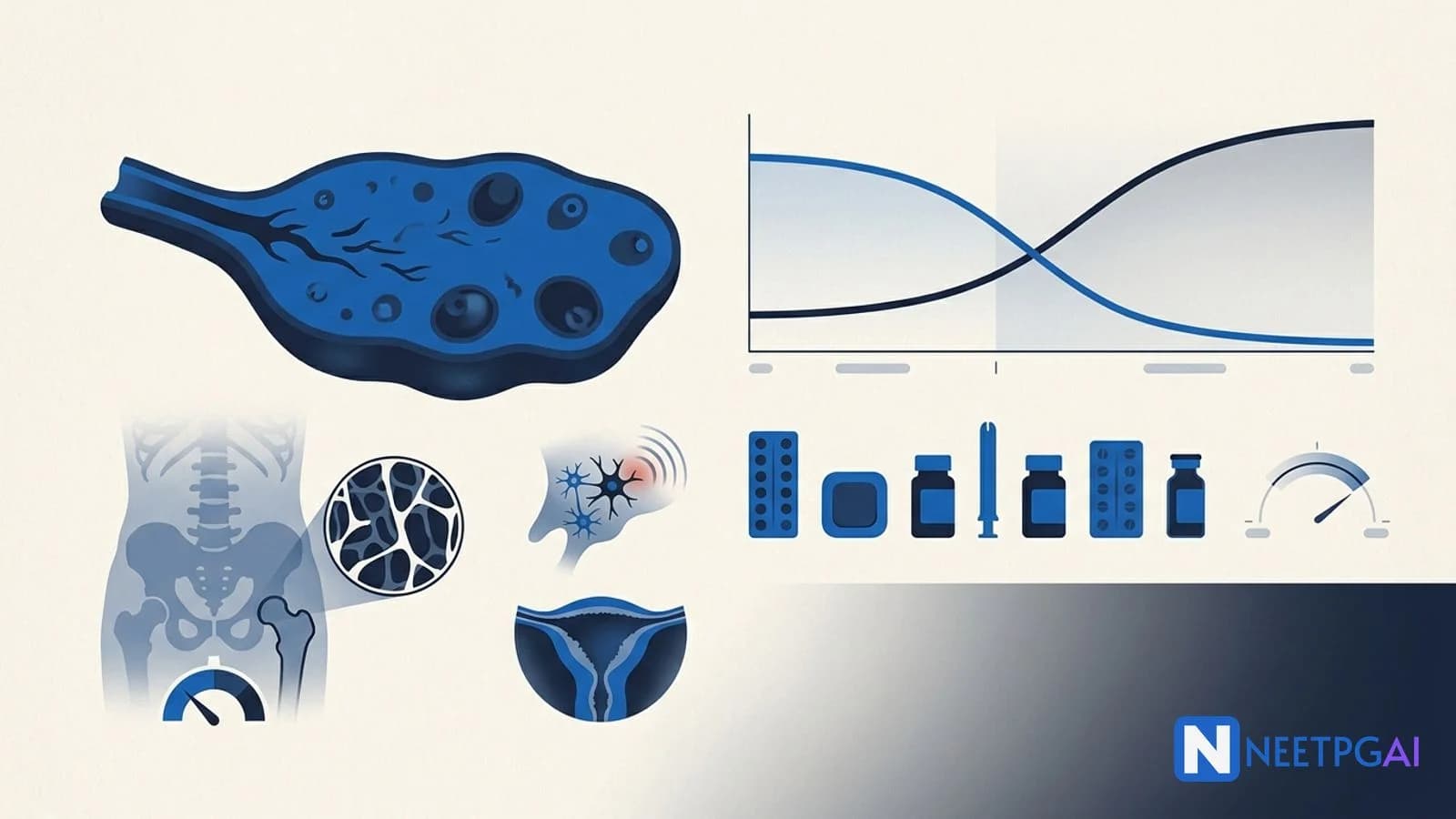
The primordial follicle pool is fixed at birth (about 1 million) and falls with age — under 1000 follicles at menopause. Granulosa cells of remaining follicles produce less inhibin B, which removes negative feedback on the pituitary → FSH rises (greater than 30 IU/L is diagnostic). Despite high FSH, follicles fail to ovulate or produce oestradiol consistently → oestradiol falls below 30 pg/mL.
LH also rises (less dramatically). The polycystic appearance of pre-menopausal ovaries is replaced by atrophic streak ovaries.
Adrenal androstenedione continues; peripheral aromatisation in adipose tissue produces oestrone (the dominant postmenopausal oestrogen, but only about 20 percent of premenopausal oestradiol).
Clinical features
Vasomotor symptoms
Hot flushes — sudden warmth in the face, neck, upper chest, lasting 1 to 5 minutes, often with sweating and palpitations; followed by chills. Affect 70 to 80 percent of perimenopausal women. Mechanism — narrowed thermoregulatory zone in the hypothalamic preoptic area driven by KNDy (kisspeptin-neurokinin B-dynorphin) neurons disinhibited by oestrogen withdrawal.
Night sweats disrupt sleep and aggravate fatigue, mood and cognition.
Genitourinary syndrome of menopause (GSM)
Vaginal atrophy (dryness, dyspareunia, burning), urethral atrophy (dysuria, urinary frequency, recurrent UTI), pelvic floor weakening. Examination — pale, thin vaginal epithelium with loss of rugae; vaginal pH greater than 4.5. Reversible with local oestrogen.
Mood and cognition
Mood swings, irritability, anxiety, depression; sleep fragmentation; mild cognitive slowing ("brain fog"). Most resolve in postmenopause; severe depression should be treated independently.
Skin, hair and body composition
Decreased collagen (thinning skin, wrinkles), increased androgen-to-oestrogen ratio (mild hirsutism), male-pattern hair thinning, central adiposity, weight gain.
Long-term sequelae
- Osteoporosis — bone loss accelerates 2 to 5 percent per year for the first 5 years postmenopause; fracture risk rises threefold.
- Cardiovascular disease — incidence catches up to men within 10 years; oestrogen loss raises LDL, lowers HDL, impairs endothelial function.
- Dementia — equivocal data; oestrogen may be neuroprotective when started early but not later.
Investigations
Menopause is a clinical diagnosis — routine FSH is not required in women over 45 with classic symptoms. Test FSH and oestradiol in suspected POI, atypical age, or after hysterectomy without oophorectomy.
Baseline assessment — BP, BMI, waist circumference, lipid profile, fasting glucose or HbA1c, TSH (exclude thyroid mimicker), Pap smear and mammography per age-appropriate screening, DEXA after age 65 (or earlier with risk factors).
Hormone replacement therapy (HRT)
Components and routes
- Oestrogen — oral (conjugated equine oestrogen, estradiol valerate), transdermal patch or gel, vaginal cream/ring/tablet (local).
- Progestogen (added to oestrogen if uterus present, to prevent endometrial hyperplasia and cancer) — cyclical (12 to 14 days per month, produces a withdrawal bleed; preferred in perimenopause) or continuous combined (no withdrawal bleed; preferred postmenopause).
- Tibolone — synthetic steroid with oestrogenic, progestogenic and weak androgenic activity; useful for symptoms in older postmenopausal women.
Transdermal oestrogen avoids hepatic first-pass metabolism and has a lower VTE and stroke risk than oral — preferred in women with obesity, hypertriglyceridaemia, gallbladder disease or smoking.
Indications
- Moderate to severe vasomotor symptoms.
- Premature ovarian insufficiency (until natural menopausal age).
- Genitourinary symptoms (often vaginal oestrogen alone suffices).
- Prevention of osteoporosis when other options are unsuitable.
HRT is not indicated for cardiovascular disease prevention or for cognition.
Absolute contraindications
- Known, suspected or past breast cancer.
- Oestrogen-dependent endometrial cancer.
- Undiagnosed abnormal vaginal bleeding.
- Active or recent VTE (DVT, PE).
- Active or recent arterial thromboembolism (MI, stroke).
- Active liver disease with abnormal LFTs.
- Known thrombophilia.
- Pregnancy.
- Porphyria cutanea tarda.
Relative contraindications — severe untreated hypertension, migraine with aura (consider transdermal), gallbladder disease, hypertriglyceridaemia, fibroids, endometriosis.
Risks and the timing hypothesis
The Women's Health Initiative (WHI) randomised over 16,000 women to combined HRT or placebo and showed increased breast cancer, CHD, stroke and VTE with HRT. Critique — mean age 63 (over 10 years post-menopause), oral conjugated equine oestrogen, medroxyprogesterone acetate.
Re-analysis with the timing hypothesis — women starting HRT within 10 years of menopause or under age 60 have neutral-to-favourable cardiovascular effects; women starting later have excess risk. Modern guidelines (NAMS 2022, IMS 2024) restrict HRT to the window of opportunity — symptomatic, recently menopausal, under 60.
Quantified risks — combined HRT increases breast cancer risk by about 8 cases per 10,000 women-years after 5 years (similar to obesity or alcohol). Oestrogen-only HRT (post-hysterectomy) does not appear to raise breast cancer risk substantially in the WHI E-alone arm.
Duration and review
Use the lowest effective dose for the shortest duration consistent with treatment goals; review annually. POI patients should continue at least to age 50. Stopping HRT — taper or stop abruptly; about 50 percent experience symptom recurrence.
Non-hormonal management
Hot flushes
- SSRIs/SNRIs — paroxetine (FDA-approved for VMS), venlafaxine, escitalopram, citalopram. Avoid paroxetine and fluoxetine in tamoxifen users (CYP2D6 inhibition).
- Gabapentin — 300 to 900 mg per day; helpful for night sweats; sedating.
- Clonidine — 0.1 mg twice daily; modest benefit; side effects (dry mouth, hypotension).
- Fezolinetant — NK3-receptor antagonist; targets KNDy neurons; approved by FDA 2023 for moderate to severe VMS; oral 45 mg per day; LFT monitoring.
- Cognitive behavioural therapy, mindfulness, cooling, dressing in layers.
- Soy isoflavones, black cohosh — modest at best; counsel about uncertainty.
Genitourinary symptoms
- Vaginal moisturisers and lubricants — first-line.
- Low-dose vaginal oestrogen (cream, tablet, ring) — minimal systemic absorption; safe even in many breast cancer survivors after oncology consultation.
- Ospemifene — oral SERM for dyspareunia and vulvovaginal atrophy.
- DHEA pessaries (prasterone) — alternative.
- CO2 laser, radiofrequency — investigational; not first-line.
Osteoporosis
| Drug | Mechanism | NEET PG pearl |
|---|
| Calcium 1000-1200 mg | Substrate | Often deficient in Indian diets |
| Vitamin D 800-1000 IU | Calcium absorption | Indian women widely deficient |
| Alendronate, risedronate | Oral bisphosphonate | First-line; osteonecrosis of jaw rare; atypical femur fracture with long-term use |
| Zoledronate | IV bisphosphonate annually | Useful when oral compliance poor |
| Denosumab | Anti-RANKL antibody | Subcutaneous every 6 months; rebound vertebral fractures if stopped without follow-on therapy |
| Teriparatide | PTH 1-34 analogue | Anabolic; 2-year limit; for severe osteoporosis |
| Romosozumab | Sclerostin antibody | Dual anabolic and antiresorptive |
| Raloxifene | SERM | Reduces vertebral fractures and invasive breast cancer; increases VTE risk |
SERMs (selective oestrogen receptor modulators)
Tissue-selective agonist/antagonist activity at the oestrogen receptor.
- Tamoxifen — antagonist in breast, agonist in endometrium (raises endometrial cancer risk) and bone; adjuvant for ER+ breast cancer.
- Raloxifene — antagonist in breast and endometrium, agonist in bone; for osteoporosis and breast cancer risk reduction.
- Ospemifene — agonist in vaginal epithelium; for dyspareunia and atrophy.
- Bazedoxifene — used with conjugated oestrogen as Tissue Selective Estrogen Complex (TSEC) for symptoms without progestogen.
NEET PG MCQ traps
- Menopause definition — 12 months amenorrhea, retrospective.
- FSH greater than 30 IU/L with oestradiol less than 30 pg/mL = postmenopausal.
- POI — menopause before age 40; FSH greater than 40 on two samples.
- Add progestogen if uterus is present — prevents endometrial hyperplasia/cancer.
- E-alone after hysterectomy — no progestogen needed.
- Transdermal route — lower VTE and stroke risk than oral.
- Timing hypothesis window — within 10 years of menopause or under age 60.
- WHI critique — mean age 63, oral CEE, MPA.
- Paroxetine and fluoxetine in tamoxifen users — avoid (CYP2D6 inhibition).
- Fezolinetant — NK3 antagonist; KNDy neuron pathway.
- Raloxifene — SERM; reduces vertebral fractures and breast cancer; raises VTE.
- Tamoxifen — raises endometrial cancer risk (agonist in endometrium).
- Denosumab rebound — vertebral fractures after stopping without bisphosphonate transition.
- Local vaginal oestrogen — safe in many breast cancer survivors (minimal systemic absorption).
- Bisphosphonate side effects — oesophagitis, osteonecrosis of jaw, atypical femur fracture.
Recent updates and Indian context
- Indian average menopause age 46 to 48 (Indian Menopause Society) — earlier than Western average; possibly nutrition, parity and SES related.
- HRT uptake in India is low (less than 5 percent of symptomatic women) — due to cultural reluctance, cost, fear after WHI, and limited postmenopausal clinic infrastructure.
- Osteoporosis under-diagnosed — only about 30 percent of postmenopausal Indian women have ever had a DEXA; vertebral fractures often attributed to "weakness".
- Ayushman Bharat HWCs — expanding menopause counselling and basic management at primary care.
- NMC 2024 curriculum — explicit competency on the menopause consultation, lifestyle counselling, HRT eligibility and non-hormonal alternatives.
- Fezolinetant is not yet widely available in India; cost remains a barrier.
Frequently asked questions
How is menopause clinically defined?
Menopause is defined retrospectively as 12 consecutive months of amenorrhea without another physiological or pathological cause, marking permanent cessation of ovarian follicular activity. The average age in Indian women is about 46 to 48 years (slightly earlier than the Western average of 51). Perimenopause is the transitional phase leading up to menopause with menstrual irregularity, vasomotor symptoms and hormonal fluctuation, lasting 4 to 8 years.
What is the timing hypothesis for HRT?
The timing hypothesis states that HRT started within 10 years of menopause or before age 60 has cardiovascular benefit and an acceptable risk profile in symptomatic women, while HRT initiated more than 10 years after menopause or after age 60 increases cardiovascular events and stroke. This reconciles the favourable observational data with the apparently negative WHI trial — the WHI cohort had a mean age of 63 at enrolment, well outside the window of opportunity.
What are the absolute contraindications to systemic HRT?
Absolute contraindications include known, suspected or past breast cancer; oestrogen-dependent endometrial cancer; undiagnosed abnormal vaginal bleeding; active or recent venous thromboembolism (DVT, PE); active or recent arterial thromboembolism (MI, stroke); active liver disease with abnormal LFTs; known thrombophilia; pregnancy; and porphyria cutanea tarda. Severe untreated hypertension is a relative contraindication. Transdermal oestrogen avoids hepatic first-pass and has a lower VTE risk than oral.
How is osteoporosis diagnosed and treated in postmenopausal women?
DEXA scan T-score at the lumbar spine or femoral neck — normal greater than -1.0, osteopenia -1.0 to -2.5, osteoporosis less than -2.5, severe osteoporosis less than -2.5 with fragility fracture. Treatment — calcium 1000 to 1200 mg per day, vitamin D 800 to 1000 IU per day, weight-bearing exercise, fall prevention. First-line pharmacotherapy is oral bisphosphonates (alendronate, risedronate) or annual zoledronate; second-line denosumab, teriparatide for severe disease, romosozumab. Raloxifene reduces vertebral fractures and breast cancer risk.
What non-hormonal options exist for vasomotor symptoms?
First-line non-hormonal options for hot flushes are SSRIs and SNRIs — paroxetine (the only FDA-approved option), venlafaxine, escitalopram, citalopram. Avoid paroxetine and fluoxetine in women on tamoxifen because they inhibit CYP2D6 and impair tamoxifen activation. Gabapentin (300 to 900 mg) helps night sweats; clonidine has modest effect. Fezolinetant, a novel NK3-receptor antagonist, was approved in 2023 and acts directly on the hypothalamic KNDy neurons driving hot flushes.
This content is for educational purposes for NEET PG exam preparation. It is not a substitute for professional medical advice, diagnosis, or treatment. Clinical information has been reviewed by qualified medical professionals.
Written by: NEETPGAI Editorial Team
Reviewed by: Pending SME Review
Last reviewed: May 2026