Quick Answer
Bacteriology contributes 12–15 NEET PG questions per paper across Microbiology, Medicine and PSM. The exam-ready framework:
- Gram-positive cocci — Staph (catalase+, coagulase splits species), Strep (catalase−, hemolysis splits groups), Enterococcus (PYR+, bile-esculin+).
- Gram-positive bacilli — Bacillus (aerobic, spores), Clostridium (anaerobic, spores), Listeria, Corynebacterium.
- Gram-negative — Enterobacteriaceae (lactose split, IMViC), Pseudomonas (non-fermenter, oxidase+), Neisseria, Haemophilus.
- Atypicals — Mycoplasma, Chlamydia, Legionella, Rickettsia.
- Zoonoses — Brucella, Bartonella, Yersinia, Francisella, Pasteurella.
Bacterial classification is the spine of NEET PG Microbiology — almost every clinical-vignette stem hinges on a single identifier (Gram reaction, hemolysis, catalase, coagulase, oxidase, IMViC pattern, growth medium). Examiners love multi-step traps: a Gram-positive cocci in clusters that is catalase+ AND coagulase+ AND novobiocin-sensitive is S. epidermidis, not S. saprophyticus.
This NEETPGAI deep dive walks through every high-yield organism with its identification ladder, virulence factors, key clinical syndrome, and the trap question pattern. Pair this with the Microbiology subject hub and the viral infections classification guide for full microbio fluency.
Identification ladder — the master algorithm
Every bacterial NEET PG question can be solved by walking down this ladder:
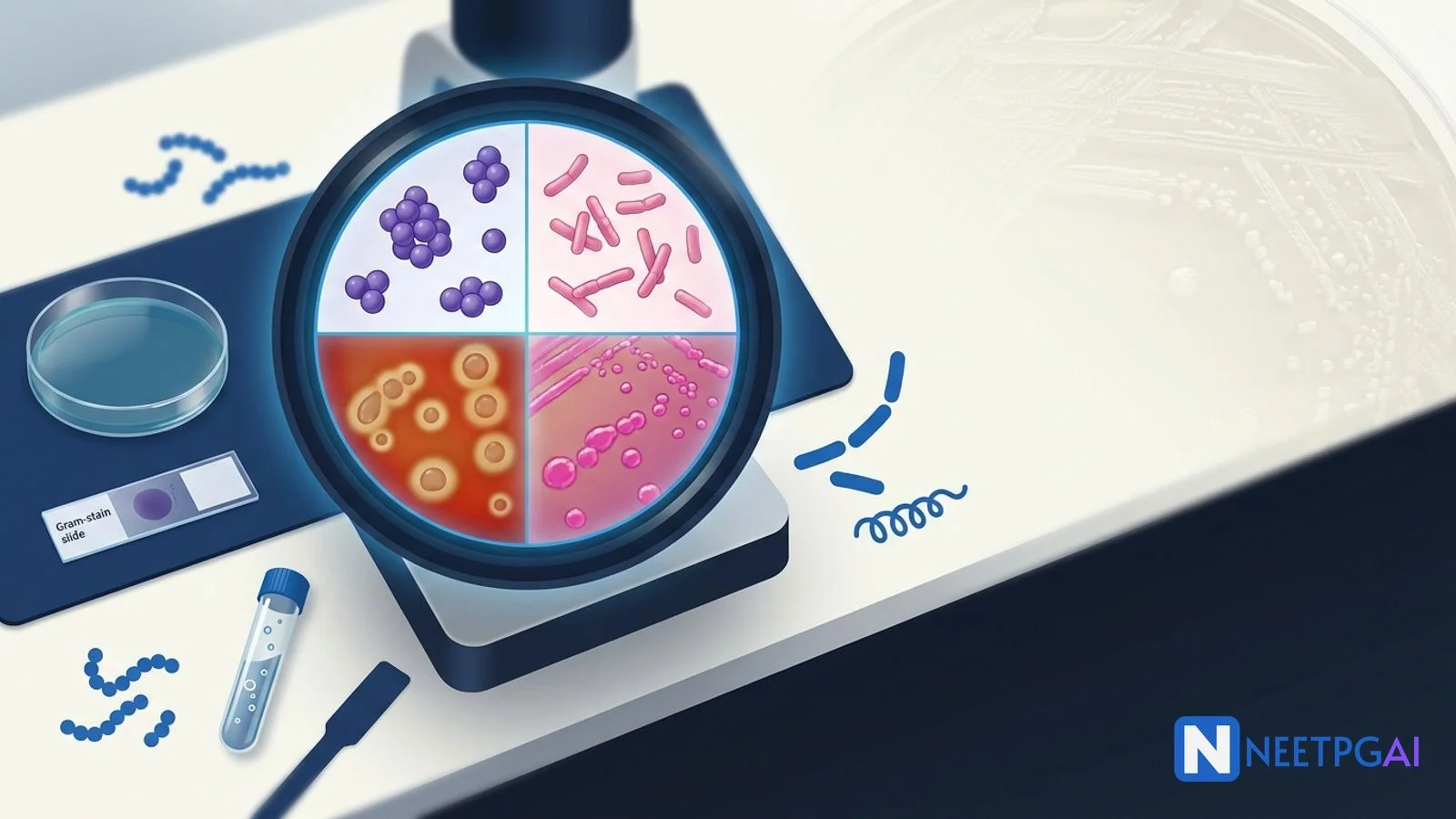
- Gram reaction (purple = +ve, pink = −ve)
- Morphology (cocci, bacilli, spirochete)
- Arrangement (clusters, chains, pairs, palisades)
- Catalase / oxidase / coagulase (key first split tests)
- Hemolysis pattern (alpha, beta, gamma)
- Specialty media (mannitol salt, MacConkey, CLED, Lowenstein-Jensen)
- Biochemicals (IMViC, urease, TSI, bile-esculin)
- Special features (spores, capsule, motility, pigment, odour)
Gram-positive cocci
Staphylococcus
- Gram +ve cocci in clusters, catalase +ve.
- Coagulase splits species:
| Species | Coagulase | Novobiocin | Mannitol | Classic syndrome |
|---|
| S. aureus | + | Sensitive | Ferments (yellow MSA) | Skin/soft tissue, endocarditis, food poisoning, TSS |
| S. epidermidis | − | Sensitive | Non-fermenter | Prosthetic device, IV catheter |
| S. saprophyticus | − | Resistant | Variable | UTI in young women |
- MRSA: mecA → altered PBP2a → resistance to all beta-lactams except 5th-gen cephalosporins (ceftaroline). Treat with vancomycin, daptomycin, linezolid.
- TSST-1, exfoliative toxin (SSSS), enterotoxin (food poisoning), Panton-Valentine leukocidin (necrotising pneumonia) — high-yield virulence factors.
Streptococcus
- Gram +ve cocci in chains, catalase −ve. Subdivided by hemolysis and Lancefield grouping.
| Species | Hemolysis | Lancefield | Key tests | Disease |
|---|
| S. pyogenes | β | Group A | Bacitracin sensitive | Pharyngitis, scarlet fever, rheumatic fever, PSGN, NF |
| S. agalactiae | β | Group B | CAMP test +, hippurate + | Neonatal sepsis, meningitis |
| S. pneumoniae | α | None (capsule typed) | Optochin sensitive, bile soluble | Pneumonia, meningitis, otitis media |
| Viridans group | α | Variable | Optochin resistant, not bile soluble | Subacute endocarditis, dental caries |
| Enterococcus | γ (sometimes α) | Group D | PYR +, bile-esculin +, growth in 6.5% NaCl | UTI, endocarditis, biliary sepsis |
- Rheumatic fever follows Group A pharyngitis (not skin); PSGN can follow either.
- VRE (vanA, vanB) — treat with linezolid, daptomycin, tigecycline.
Gram-positive bacilli
| Organism | Spores | Aerobic? | Key feature | Disease |
|---|
| Bacillus anthracis | + | Aerobic | Capsule, polypeptide D-glutamic acid | Anthrax (cutaneous, inhalational) |
| Bacillus cereus | + | Aerobic | Reheated rice food poisoning | Emetic and diarrhoeal toxins |
| Clostridium tetani | + (terminal, drumstick) | Anaerobic | Tetanospasmin (blocks GABA/glycine) | Tetanus |
| Clostridium botulinum | + | Anaerobic | Botulinum toxin (blocks ACh release) | Botulism (descending paralysis) |
| Clostridium perfringens | + | Anaerobic | Lecithinase (alpha-toxin) | Gas gangrene, food poisoning |
| Clostridium difficile | + | Anaerobic | Toxins A and B | Pseudomembranous colitis |
| Listeria monocytogenes | − | Aerobic | Tumbling motility, growth at 4°C | Neonatal sepsis, elderly meningitis, pregnancy listeriosis |
| Corynebacterium diphtheriae | − | Aerobic | Tellurite agar, metachromatic granules | Diphtheria (pseudomembrane), myocarditis |
Gram-negative bacteria — Enterobacteriaceae
All are oxidase-negative, glucose fermenters. The IMViC pattern splits the family:
| Organism | Lactose | Indole | MR | VP | Citrate | Urease | H2S | Classic stem |
|---|
| E. coli | + | + | + | − | − | − | − | UTI, neonatal meningitis (K1), HUS (O157:H7) |
| Klebsiella | + (mucoid) | − | − | + | + | + | − | Currant-jelly sputum, alcoholic pneumonia |
| Enterobacter | + | − | − | + | + | − | − | Nosocomial infections |
| Salmonella typhi | − | − | + | − | + | − | + (mild) | Typhoid, rose spots |
| Shigella | − | variable | + | − | − | − | − | Bloody dysentery, no H2S |
| Proteus | − | variable | + | − | + | + (strong) | + | Swarming, struvite stones |
| Yersinia enterocolitica | − | − | + | − | − | + | − | Pseudoappendicitis |
- E. coli serotypes (high-yield): O157:H7 (EHEC, Shiga toxin, HUS — no antibiotics, no antimotility); ETEC (heat-labile, heat-stable toxins, traveller's diarrhoea); EIEC (mimics Shigella); EPEC (infant diarrhoea); EAEC.
Non-fermenters and others
Pseudomonas aeruginosa
- Gram-negative bacillus, oxidase +, non-lactose fermenter, non-glucose fermenter.
- Pyocyanin (blue-green), pyoverdine (yellow-green fluorescent), grape-juice odour.
- Classic stems: hot-tub folliculitis, otitis externa (swimmer's ear, malignant in diabetics), CF lung colonisation, ventilator pneumonia, ecthyma gangrenosum (neutropenic).
- Treat: anti-pseudomonal beta-lactam (piperacillin-tazobactam, ceftazidime, cefepime, carbapenem) ± aminoglycoside ± ciprofloxacin.
Neisseria
- Gram-negative diplococci, oxidase +, glucose fermenter.
| Species | Glucose | Maltose | Disease |
|---|
| N. meningitidis | + | + | Meningitis, Waterhouse-Friderichsen |
| N. gonorrhoeae | + | − | Urethritis, cervicitis, PID, septic arthritis |
- N. meningitidis grows on Thayer-Martin medium; vaccinate household contacts and give chemoprophylaxis (rifampicin, ciprofloxacin, ceftriaxone).
Haemophilus
- Requires factor X (heme) and V (NAD); grows on chocolate agar.
- H. influenzae type B (capsulated) — was leading cause of meningitis in <5 years, now controlled by Hib vaccine.
- H. ducreyi — chancroid (painful genital ulcer with ragged edges, "school of fish" on Gram).
Atypical bacteria
| Organism | Key feature | Disease | Treatment |
|---|
| Mycoplasma pneumoniae | No cell wall; cold agglutinins | Walking pneumonia, bullous myringitis | Macrolide, doxycycline |
| Chlamydia trachomatis | Obligate intracellular, elementary/reticulate body | Trachoma, urethritis, LGV | Azithromycin |
| Chlamydophila pneumoniae | Obligate intracellular | Atypical pneumonia | Doxycycline |
| Legionella pneumophila | BCYE agar, silver stain, urinary antigen | Pontiac fever, Legionnaires' (water aerosols) | Azithromycin, levofloxacin |
| Rickettsia (typhus, RMSF, scrub typhus) | Obligate intracellular, Weil-Felix | Eschar, rash, fever | Doxycycline |
| Coxiella burnetii | Q fever — phase variation | Granulomatous hepatitis, endocarditis | Doxycycline + hydroxychloroquine |
Zoonoses — high-yield Indian context
| Organism | Reservoir | Transmission | Classic stem |
|---|
| Brucella melitensis | Goats, sheep | Unpasteurised milk | Undulant fever, hepatosplenomegaly, sacroiliitis |
| Bartonella henselae | Cats | Scratch, flea | Cat-scratch disease, bacillary angiomatosis (HIV) |
| Yersinia pestis | Rats, fleas | Flea bite, droplets | Bubonic, pneumonic, septicaemic plague |
| Francisella tularensis | Rabbits, ticks | Tick bite, inhalation | Ulceroglandular tularaemia |
| Pasteurella multocida | Cats, dogs | Bite | Cellulitis post-bite |
| Leptospira interrogans | Rats (urine) | Water contact | Anicteric to Weil disease (jaundice + AKI + pulmonary haemorrhage); high-yield monsoon vignette in India |
High-yield NEET PG MCQ traps
- Coagulase splits Staph — coagulase + = aureus; coagulase − = epi or sapro (novobiocin sensitivity differentiates).
- Optochin (P) vs Bacitracin (A) — pneumoniae sensitive to Optochin; pyogenes sensitive to Bacitracin.
- CAMP test — positive in S. agalactiae (GBS); also Listeria.
- Tumbling motility at room temperature, no growth at 37°C motility — Listeria. Grows at 4°C (cold enrichment).
- Currant-jelly sputum — Klebsiella in alcoholics.
- Black colonies on tellurite — Corynebacterium diphtheriae; Albert stain shows metachromatic granules.
- Pseudoappendicitis — Yersinia enterocolitica (mesenteric adenitis).
- Eaton agar / cold agglutinins / bullous myringitis — Mycoplasma pneumoniae.
- Eschar + thrombocytopenia + rash + monsoon — scrub typhus (Orientia tsutsugamushi); doxycycline first-line.
- No antibiotics for EHEC/STEC — antibiotics worsen Shiga-toxin release and HUS risk.
Recent updates
- WHO Bacterial Priority Pathogens List (2024) — carbapenem-resistant Enterobacteriaceae, A. baumannii, P. aeruginosa, plus rifampicin-resistant TB are critical priority.
- NTEP (formerly RNTCP) shifted to all-oral DR-TB regimens — bedaquiline, pretomanid, linezolid (BPaL/BPaLM) for 6 months.
- AMR in India: ICMR network reports show 70%+ ESBL prevalence in Klebsiella and E. coli — informs empirical antibiotic policies.
- Scrub typhus is now in the IDSP P-form for weekly reporting; doxycycline is first-line, even in pregnancy.
Frequently Asked Questions
How do you differentiate Staphylococcus aureus from other staphylococci?
S. aureus is catalase-positive (differentiates from streptococci) and coagulase-positive (differentiates from coagulase-negative staphylococci like S. epidermidis and S. saprophyticus). It is mannitol-fermenter (yellow on mannitol salt agar), DNase-positive, and beta-hemolytic on blood agar. MRSA carries the mecA gene encoding altered PBP2a.
Which bacteria are catalase positive and oxidase positive?
Catalase-positive AND oxidase-positive: Pseudomonas aeruginosa, Neisseria, Vibrio, Aeromonas, Helicobacter, Campylobacter, Moraxella. Pseudomonas is the classic NEET PG vignette — non-fermenter, oxidase-positive, produces pyocyanin (blue-green) and pyoverdine (fluorescent), grape-juice odour.
What is the IMViC pattern for E. coli vs Klebsiella?
E. coli: Indole +, Methyl Red +, Voges-Proskauer −, Citrate − (++--). Klebsiella: ++-+ wait, more cleanly: Indole −, MR −, VP +, Citrate + (--++). Mnemonic: E. coli = mid-late letters positive (I, M); Klebsiella = late letters positive (V, C). High-yield differentiation in urine and stool culture stems.
Which atypical bacteria do not Gram stain?
Mycoplasma (no cell wall, hence no peptidoglycan to bind crystal violet), Chlamydia (intracellular, no peptidoglycan in classical sense), Rickettsia (intracellular, poor staining), Treponema and Leptospira (too thin for light microscopy — visualised by dark-field). Legionella stains poorly with Gram and needs silver stain or BCYE agar culture.
What is the most common cause of bacterial meningitis in adults in India?
Streptococcus pneumoniae is the most common cause across all adult age groups in India, followed by Neisseria meningitidis (especially in outbreaks and young adults), and Listeria monocytogenes (over 50 years, immunocompromised, neonates, pregnant women). Empirical therapy: ceftriaxone + vancomycin, add ampicillin if Listeria risk.
This content is for educational purposes for NEET PG exam preparation. It is not a substitute for professional medical advice, diagnosis, or treatment. Clinical information has been reviewed by qualified medical professionals.
Written by: NEETPGAI Editorial Team
Reviewed by: Pending SME Review
Last reviewed: April 2026