Version 1.0 — Published September 2026
Quick Answer
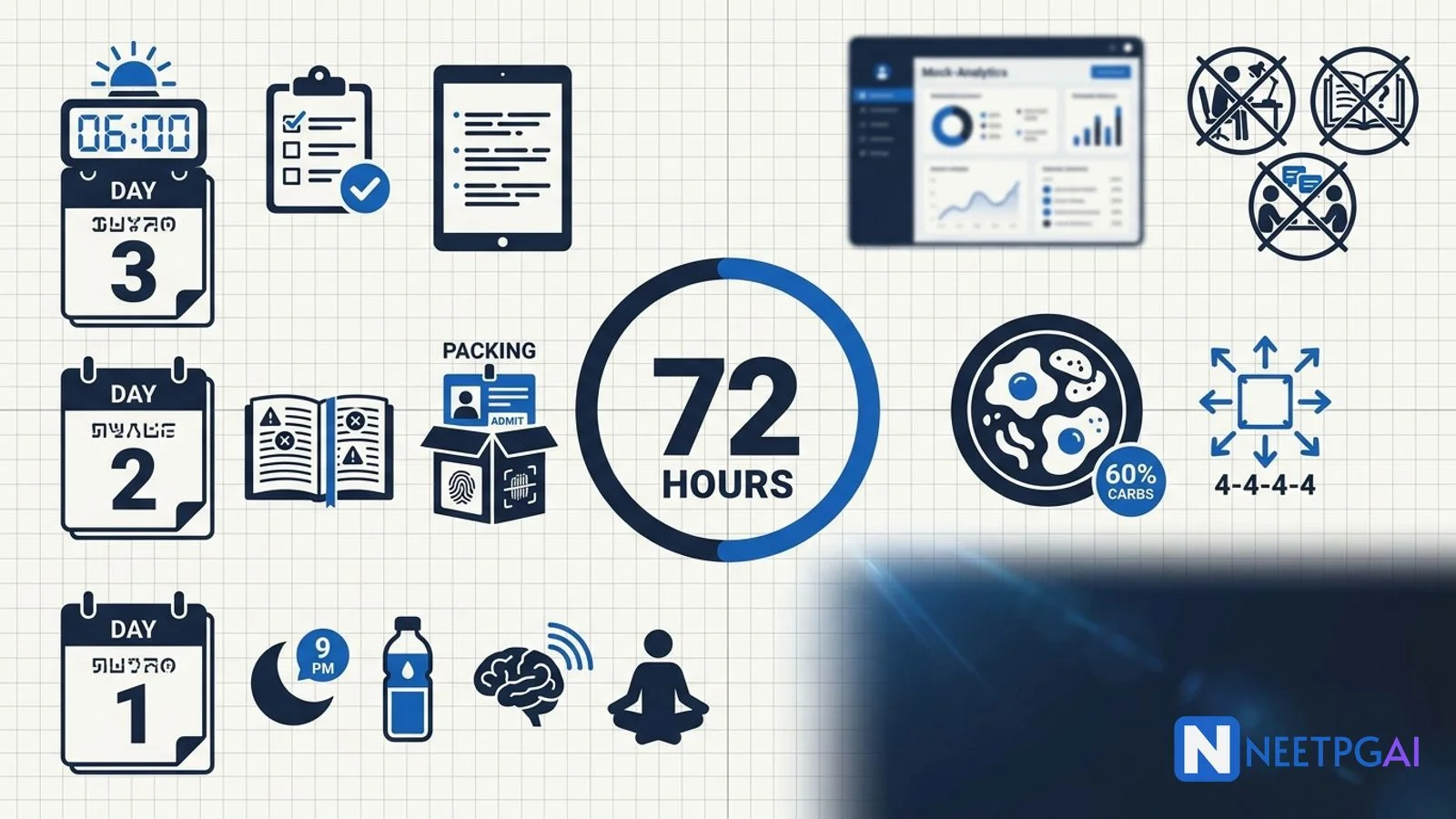
The last 72 hours before NEET PG are for consolidation and mental readiness, not new learning. The difference between a 350-mark and a 370-mark performance is execution and calm, not last-minute cramming. The evidence-based 3-day countdown protocol that consistently converts strong preparation into a strong result:
- Day 3 (72h out) — 6-hour deep-work morning of high-yield revision from mock analytics weakness cluster; 3.5-hour timed mock in the afternoon at exam time; 60-90 min debrief; early dinner; lights out 10 pm.
- Day 2 (48h out) — 4-hour morning of ERROR JOURNAL and cheat sheets ONLY; 2-hour afternoon of Pharma DOCs, PSM formulas, Micro criteria, Biochem enzymes; NO new full mock; pack exam bag; confirm logistics; lights out 9 pm.
- Day 1 (24h out) — 2-hour morning of mnemonics and relaxation; afternoon REST and hydration; NO social media, NO new topics, NO peer talk; visualisation; 9 pm lights out; 8 hours sleep.
- Exam morning — Wake 3-4h before; tested breakfast (60 percent carbs, 20 percent protein, 20 percent fat); hydrate moderately; arrive 60 min early with admit card, valid ID, photos.
- In-exam discipline — 3-pass method, 90-second Pass 1 cap, 30-second reset between each of the 5 sections; box breathing 4-4-4-4 before start.
- Post-exam — NO peer discussion, NO answer-key hunt, rest and eat; return to normal life until results.
- Ten mistakes to avoid — sleep deprivation, new topics, all-nighters, rich food, caffeine overdose, social media, peer comparison, mock marathon, logistics oversight, skipped breakfast.
Aspirants who follow this protocol consistently outperform their mock average on the actual exam by 8-15 marks compared to aspirants of identical preparation who wing the last 72 hours.
Why the last 72 hours are pivotal
By the time you are 3 days out, your knowledge base is essentially fixed. The next 72 hours cannot add much more content but can absolutely wreck what you already have. Every year, NEETPGAI post-exam analytics show a wide split — aspirants who followed a structured last-3-day protocol scored an average of 12 marks higher on the actual exam than their mock-average predicted; aspirants who winged the last 72 hours (all-nighters, mock marathon, new topics, poor sleep) scored an average of 8 marks lower. That is a 20-mark swing on identical preparation — worth 3,000-5,000 rank points, the difference between a top-institute seat and a state-college seat.
The mechanism is straightforward. Cognitive performance on exam day depends on three factors that the last 72 hours directly control — working memory bandwidth, focused attention, and emotional regulation. Sleep deprivation cripples all three. New-topic exploration crowds out consolidation of already-learned material. Peer comparison destroys morale. Following a structured protocol optimises all three and delivers you to the exam centre at peak cognitive form.
Day 3 (72 hours before) — deep work and the last mock
Morning (06:00-12:00) — 6-hour high-yield revision
- Wake up at 06:00 if that is close to your exam-morning target; if you are a natural late-riser, gradual advancement over the last week is better than a sudden switch.
- Focus areas — the top 30 low-confidence topics from your NEETPGAI mock analytics weakness cluster; subject-weightage clusters (Medicine, Surgery, OBG, Pharma, Path get the majority of your revision time proportional to their exam weight); Marrow/Prepladder rapid-revision videos at 1.5-2x speed for the last-mile refresher.
- What NOT to do — do not open a new Robbins chapter; do not start a new PYQ set; do not attempt a subject you have not touched in months.
- Take a 10-minute break every 90 minutes — hydrate, walk, look out the window; do not check social media.
Afternoon (14:00-17:30) — full-length 3.5-hour timed mock
- Simulate exam conditions — same time slot as the actual exam (if the exam is at 09:00-12:30, do the mock at 09:00 instead; the afternoon slot is for aspirants whose exam is scheduled in the afternoon).
- Use NEETPGAI's 5-section-42-min structure to entrain the section-lock discipline.
- Sit at a desk, phone in another room, water bottle only, no snacks unless permitted at your actual exam centre.
- Do not pause the timer — treat it as the real exam.
Evening (18:00-20:00) — mock debrief
- 60-90 minute post-mortem — review every wrong and every flagged question.
- Categorise errors — knowledge gap (concept not known), timing pressure (rushed), misreading (careless), or genuinely difficult (accept).
- Annotate top 5 error patterns — these become the day-2 morning revision focus.
- DO NOT re-study every wrong answer topic in depth; you cannot fix a knowledge gap 72 hours out. Note it, accept it, move on.
Rest of evening — light physical activity + early dinner + lights out
- 30-minute walk or light yoga — light physical activity aids sleep quality.
- Early dinner by 19:30-20:00 — tested cuisine, moderate portion, no heavy fried or spicy new dishes.
- Screen-off by 21:30 — blue light suppresses melatonin; a physical book or breathing exercise is better than a phone.
- Lights out 22:00 — target 8 hours of sleep.
Day 2 (48 hours before) — error journal and cheat sheets
Morning (07:00-11:00) — 4-hour error journal and cheat-sheet review
- This is NOT a study morning; this is a REVIEW morning. The distinction matters — you are not learning new material, you are re-reading what you already know.
- Focus areas — your NEETPGAI error journal (a running log of every wrong-mock-question topic); your Pharma-DOC cheat sheet; your Biochem enzyme-deficiency table; your PSM formula card; your Micro criteria table (culture media, staining patterns, disease-organism pairs).
- Skim, do not deep-dive — 40-60 topics in 4 hours, roughly 5-6 minutes each, is the right pace.
- Flashcard apps — Anki or NEETPGAI flashcard mode at maximum speed; if you have used them consistently, this morning is where they pay off.
Afternoon (13:00-15:00) — 2-hour high-yield notes review
- Marrow/Prepladder final revision notes — the short-form condensed notes, not full lectures.
- Cheat sheets — Pharma antidotes, common poisonings, Ophthalmology red-eye differential, Ortho fracture classifications, Ped growth milestones, Radiology signs (silhouette, air-crescent, tram-track).
- Do NOT attempt a full mock this afternoon — a poor performance 48 hours out destroys confidence with insufficient recovery time.
Late afternoon (15:00-17:00) — exam-bag packing and logistics
- Pack the exam bag — printed admit card (2 copies), valid photo ID (Aadhaar, PAN, Passport per NBEMS acceptance), passport-sized photograph (if required), transparent water bottle (500 mL), a couple of pens, wristwatch (analog if permitted), tissues.
- Confirm exam-centre address — Google Maps route, expected travel time plus 60-90 min buffer.
- Confirm transport — booked cab, own vehicle with driver, or trusted family member driving; do NOT drive yourself if you have any anxiety about the journey.
- Confirm accommodation — if the exam centre is out-of-town, confirm your hotel booking, check-in time, and distance from the centre; test the hotel-to-centre route the previous evening.
- Set out clothes — comfortable, weather-appropriate, layered (many exam centres have unpredictable AC); avoid new clothes.
Evening (18:00-22:00) — wind down
- Light dinner by 19:30 — tested cuisine again, moderate portion.
- NO study after dinner — evening is for wind-down; a movie, a light book, family conversation, but not textbooks.
- 9:00 pm lights out — target 9-10 hours of sleep to bank a buffer against the possibly-shorter-than-optimal sleep on the eve of exam day.
Day 1 (24 hours before) — rest and mental readiness
Morning (08:00-10:00) — 2-hour light revision
- Only mnemonics, mind-maps, cheat sheets — no full topic reading.
- Aim to feel confident, not to learn more. If a topic makes you anxious, skip it; you cannot fix it now.
- 90-minute cap — anything more actively harms recall on exam day.
Rest of day — REST
- Afternoon — a proper meal, hydration, a 30-minute walk in a park or quiet neighbourhood, possibly a short nap (20-30 minutes, not more, no later than 15:00).
- Prayer, meditation, or personal ritual if that is part of your practice; do not introduce a new ritual today.
- Call one supportive family member briefly — a 10-minute call from a parent or partner who reinforces your preparation and love; avoid the well-meaning relative who asks anxiety-inducing questions about the exam.
- NO social media — the WhatsApp forwards about difficulty, the LinkedIn posts from over-achievers, the doomscrolling — all destructive.
- NO new topics — every new topic today is a net negative.
- NO peer discussion about difficulty — most peers overstate their preparation to manage their own anxiety; comparison is asymmetric.
Evening — visualisation and sleep prep
- Visualise successful exam performance — 5 minutes of imagining yourself arriving at the centre calmly, sitting at your desk, opening the paper, working through each section methodically, finishing with time to spare. Sport psychology research consistently shows visualisation improves performance.
- Gratitude list — 3-5 things you are grateful for; grounds emotional state.
- Magnesium (200-400 mg) or melatonin (0.3-3 mg) if that is a TESTED protocol for you; NEVER introduce fresh on the eve of the exam.
- Lights out 21:00 — target 8 hours of sleep; if you cannot sleep, lie still with eyes closed and box-breathe (4-4-4-4) rather than reading or scrolling.
- Set two alarms — primary and backup; also request a wake-up call from the hotel if applicable.
Exam morning
3-4 hours before exam start
- Wake up 3-4 hours before the exam start time so that you are at peak cognitive alertness by the time you sit at the desk.
- Well-tested breakfast — 60 percent complex carbs (oats, poha, whole-wheat toast, brown bread, dosa), 20 percent protein (egg, paneer, curd, sprouts), 20 percent healthy fat (nuts, avocado, ghee); sustains blood glucose over 3.5 hours.
- Do NOT experiment with a new breakfast today.
- Hydrate — 500 mL water over 60-90 minutes, not gulped just before leaving (bathroom-mid-exam is impossible under the section-lock rules).
- Avoid excessive caffeine — a single normal-size tea or coffee if that is your baseline; NOT a double espresso.
60 minutes before arrival
- Arrive at the exam centre 60 minutes before start time.
- Pass through security — admit card, ID, photos, biometrics.
- Locate your seat, check that the terminal is functional (many centres run a mock-login).
- Use the bathroom immediately before starting.
- Take 3-5 deep breaths before opening the paper.
During the exam
- Section 1 (Group A) — 42 minutes, 36 questions — 30-second section scan first, then 3-pass method (27-30 min Pass 1 with 90-second per-question cap, 10 min Pass 2 flagged, 2-5 min Pass 3 review and guess).
- Between sections — 30-60 second reset — stand up if allowed, roll shoulders, deep breathe 4-4-4-4 four times, sip water.
- Continue for all 5 sections — each section is its own race under the section-lock rules; a slow first section does not steal from later ones.
- Do NOT dwell on a hard question beyond 90 seconds on Pass 1 — flag and move; the sunk-cost fallacy is the biggest timing killer.
- Guess strategically — never leave blank if any elimination is possible; expected value is positive with even mild elimination under +4/−1 marking.
- Eat a banana or small energy snack between sections if allowed at your centre; sip water regularly.
Post-exam
- Do NOT discuss questions with peers — the temptation is huge, the cost is real; every point of comparison risks convincing you of a wrong answer where you were correct.
- Do NOT hunt for answer keys immediately — the coaching keys are often wrong; the NBEMS final key is the only authoritative source.
- Eat properly, rest, celebrate the completion.
- Return to normal life until results are announced.
- If you have residual anxiety, structured post-exam decompression (a short trip, a hobby, exercise, family time) is protective.
Ten common last-week mistakes and how to avoid them
Mistake 1 — Sleep deprivation
Every hour of lost sleep in the last 7 days costs 2-5 marks on exam day per most cognition literature. Fix — protect 8 hours nightly; if genuinely struggling to sleep, use a tested magnesium or melatonin protocol.
Mistake 2 — New-topic exploration
Starting a new subject or new PYQ set in the last 72 hours is almost guaranteed to produce a confidence drop with no offsetting learning gain. Fix — hard rule: only revision, no new content.
Mistake 3 — All-nighter the night before
The single most destructive mistake; sleep deprivation cripples working memory, focus, and stress tolerance for 24-48 hours. Fix — lights out 21:00 on eve of exam, non-negotiable.
Mistake 4 — Rich or unfamiliar food
A new restaurant meal the night before is a GI-upset risk on exam morning. Fix — home-cooked tested cuisine only in the last 48 hours.
Mistake 5 — Tea/coffee overdose
The caffeine spike wears off mid-exam producing an energy trough at the worst time. Fix — keep to your baseline consumption, do NOT double it.
Mistake 6 — Excessive social media
Comparison with peers who claim to have finished a subject you have not touched destroys morale. Fix — social media detox from 48 hours before exam.
Mistake 7 — Peer discussion of difficulty
Most peers overstate their preparation to manage their own anxiety; comparison is asymmetric and demoralising. Fix — avoid group chats about the exam in the last week.
Mistake 8 — Last-minute mock marathon
Three full mocks in the last 4 days is destructive; marginal benefit close to zero, cost of a bad performance is real. Fix — one final mock at 72 hours out; nothing after.
Mistake 9 — Not confirming logistics
The panic of realising 60 minutes before departure that your admit card is not printed derails the exam morning. Fix — logistics confirmation at 48 hours out; second check at 24 hours.
Mistake 10 — Skipping the exam-morning breakfast
A hungry cognitive state at 09:00 turns into a hypoglycaemic dip at 11:00, right in the middle of Section C or D. Fix — tested balanced breakfast is non-negotiable.
Emergency contingencies
Travel delay
- Backup route planned in advance via Google Maps.
- 60-90 minute buffer built into departure time.
- Trusted contact for a cab or lift if primary transport fails.
Admit card lost
- Print two copies and keep in separate places (bag, hotel drawer).
- Digital copy on phone as absolute last resort.
ID missing
- Verify accepted ID list from NBEMS notification — Aadhaar, PAN, Passport typically accepted.
- Carry two forms of ID if unsure.
Health issue
- Regular medications — take as usual, do not miss a dose because of exam anxiety.
- Menstrual products if applicable — carry extras.
- Painkiller (paracetamol) — a tested dose only, no NSAIDs on empty stomach.
- A small first-aid kit — bandaid, antacid, ORS sachet.
Language of instruction confirmation
- NEET PG is in English only. Confirm on admit card; there is no language change on exam day.
India-specific — logistics that trip up out-of-town candidates
- Exam centres are spread across India — many candidates travel out-of-town; hotel booking and transport are critical.
- NBEMS admit card guidelines — bring exact ID as specified; irregular ID rejects at gate.
- Hostel and travel logistics — for hostel-based aspirants, arrange a quiet room for the last 3 days; for out-of-town, arrive at least 24 hours before the exam.
- Parents and family support — one supportive family contact is helpful; multiple well-meaning-but-anxious calls are destructive.
- Peer study group discipline — dissolve group revision sessions in the last 72 hours; peer comparison is asymmetric and demoralising.
- Tertiary city local vs travel candidate — travel candidates need more logistics buffer; local candidates should still simulate the travel time to avoid morning-of surprises.
How NEETPGAI's dashboards target the last-3-day revision
Three specific inputs to your last-3-day plan:
- The weakness cluster — the automatic ranking of your bottom 30 topics across the last 20 mocks, adjusted for topic frequency in real NEET PG papers. This IS your day-3 morning revision list.
- The per-question timing distribution — showing which subjects and question types you consistently dwell on; the last week is when you convert that insight into muscle memory.
- The section-lock discipline score — the percentage of mocks in which you finished each of the 5 sections on time; if this is under 100 percent, the day-3 mock is the last chance to prove to yourself that you can finish under real timing.
On the anxiety front, dashboards replace gut-based worry with data-based facts — instead of ruminating "I am not ready for Medicine", you see "my Medicine accuracy is 68 percent, my percentile is 82, my target rank corresponds to 60 percent accuracy — I am ahead of my target". Rankers repeatedly cite this objective confidence as their single largest mental-state advantage entering the exam.
Key takeaways
- The last 72 hours are for consolidation and mental readiness, not new learning.
- Day 3 — deep-work morning, timed mock afternoon, debrief evening, lights out 22:00.
- Day 2 — error journal and cheat sheets morning, high-yield notes afternoon, pack bag, confirm logistics, lights out 21:00.
- Day 1 — 2-hour light revision, then REST; no social media, no new topics, no peer talk; lights out 21:00.
- Exam morning — wake 3-4 hours before, tested breakfast, arrive 60 minutes early, box-breathe before start.
- In-exam — 3-pass method, 90-second cap, 30-second reset between sections.
- Post-exam — no peer discussion, no answer-key hunt, rest.
- Avoid the 10 common mistakes — sleep deprivation, new topics, all-nighter, rich food, caffeine overdose, social media, peer talk, mock marathon, logistics oversight, skipped breakfast.
- Use NEETPGAI dashboards to target revision and reduce anxiety with data.
Frequently Asked Questions
Why should you not learn anything new in the final 72 hours before NEET PG?
The last 72 hours are for consolidation and mental readiness, not knowledge accretion. Three reasons. First, working memory during those hours is close to saturation from months of preparation; adding a new topic displaces recall of already-learned material. Second, a partially-learned new topic is a net liability — you may recognise the question but not have the confidence to commit, wasting time and often introducing a wrong answer. Third, the emotional cost of encountering a new topic 24 hours before the exam and realising you do not know it dominates every subsequent hour of preparation and mental state. NEETPGAI post-exam interviews with top-2000 rankers are unambiguous — over 80 percent practised only high-yield revision (top-10 error-journal topics, subject-weightage-based cheat sheets, drug-of-choice lists, formulas) in the final 3 days; less than 10 percent added any new topic. Consolidation, not accretion, is the game — one more revision pass of what you already know beats one new video on what you do not.
What is the ideal 72-hour timing structure and how should you allocate revision vs rest across day 3, day 2, and day 1?
A gradient — heavier study on day 3, tapering to almost pure rest on day 1. Day 3 (72h) — 6-hour deep-work morning of high-yield revision from mock weakness cluster; 3.5-hour timed mock in the afternoon at the exact exam time; 60-90 min mock debrief in the evening focused on error patterns; light physical activity 30 min; early dinner by 7-8 pm; lights out 10 pm. Day 2 (48h) — 4-hour morning of ONLY revising the error journal, flashcards, and cheat sheets; 2-hour afternoon of high-yield-notes revision; do NOT solve any new full mocks; evening packing of exam bag and confirming logistics; lights out 9 pm. Day 1 (24h) — 2-hour morning of mnemonics and relaxation; afternoon REST, hydration, a reasonable meal, a 30-minute walk; NO social media, NO new topics, NO peer discussion; visualisation of successful exam performance, gratitude list, magnesium/melatonin if TESTED; 9 pm lights out with 8 hours sleep. This gradient respects the physiology — brain consolidates memory during sleep and low-arousal states.
What should the exam morning routine look like and what should you do between sections?
Wake up 3-4 hours before your scheduled exam start time. Well-tested breakfast — approximately 60 percent complex carbohydrates, 20 percent protein, 20 percent fat — sustains blood glucose over 3.5 hours. Do NOT experiment with an untried breakfast. Hydrate but do not overhydrate. Arrive at the exam centre 60 minutes before start time; carry admit card printout, valid photo ID (Aadhaar, PAN, or Passport as accepted by NBEMS), passport photo if required. During the exam, take a 30-60 second reset between each of the 5 sections — stand up, roll shoulders, deep breathe 4-4-4-4 four times, hydrate briefly. Do not discuss the previous section. If a section went badly, refuse to dwell — you cannot go back. Post-exam, do NOT discuss questions with peers; do NOT compare answers; do NOT check social media for the answer key immediately. Rest, eat, return to normal life until results.
What are the commonest mistakes aspirants make in the final week and how can you avoid them?
Ten recurring mistakes. Sleep deprivation — every hour of lost sleep in the last 7 days costs 2-5 marks. New-topic exploration — near-guaranteed confidence drop. All-nighter the night before — the single most destructive mistake. Rich or unfamiliar food — GI-upset risk. Tea/coffee overdose — mid-exam energy trough. Excessive social media — comparison destroys morale. Peer discussion of difficulty — asymmetric and demoralising. Last-minute mock marathon — marginal benefit close to zero, real cost. Not confirming logistics — panic derails morning. Skipped breakfast — hypoglycaemic dip mid-exam. Avoid all ten by following the 72-hour protocol strictly.
How does NEETPGAI's mock analytics dashboard help target the last-3-day revision and reduce anxiety?
Three specific inputs. First, the weakness cluster — the automatic ranking of your bottom 30 topics across the last 20 mocks, adjusted for topic frequency in real NEET PG papers. This IS your day-3 morning revision list. Second, the per-question timing distribution — showing which subjects and question types you consistently dwell on; the last week is when you convert insight into muscle memory. Third, the section-lock discipline score — the percentage of mocks in which you finished each of the 5 sections on time; if under 100 percent, the day-3 mock is the last chance to prove to yourself you can finish under real timing. On the anxiety front, dashboards replace gut-based worry with data-based facts — instead of ruminating 'I am not ready for Medicine', you see 'my Medicine accuracy is 68 percent, my percentile is 82, my target rank corresponds to 60 percent accuracy — I am ahead of my target'. Rankers repeatedly cite this objective confidence as their single largest mental-state advantage.
Written by: NEETPGAI Editorial Team
Reviewed by: Pending Editorial Review
Last reviewed: September 2026