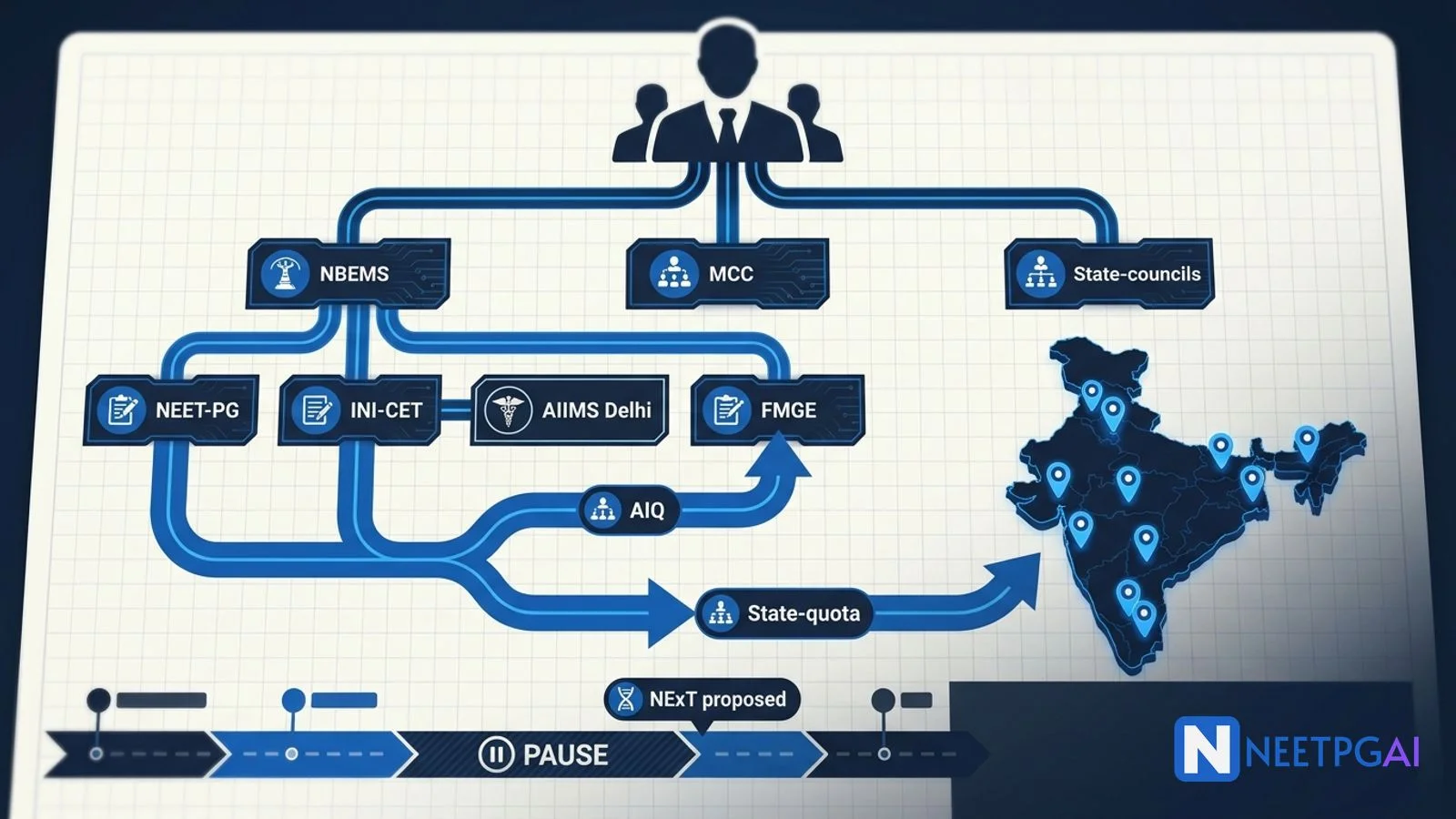
NBEMS vs NMC vs MCC vs DGHS vs AIIMS — Who Runs What in NEET PG and Medical Education (2027 Guide)
Comparison of the authorities that shape NEET PG, INI-CET, FMGE, and Indian medical education: NMC (regulator), NBEMS (exam conductor), MCC (AIQ counseling), DGHS (health services), AIIMS (INI-CET), plus state councils and FMG pathway — clarifies who does what.
Dr. NEETPGAI Editorial TeamPublished 24 Aug 2026Updated 29 Sept 202627 min read
Share this article
Ready to put this into practice?
Start practicing NEET PG MCQs with AI-powered explanations.
Five authority bodies shape NEET PG and Indian medical education. Each does a specific job. Confusion between them costs aspirants weeks of chasing the wrong office. Honest single-line summary:
NMC (National Medical Commission) — top regulator; policy, curriculum, college recognition, physician registration. Website — nmc.org.in
NBEMS (National Board of Examinations in Medical Sciences) — conducts NEET PG, NEET SS, NEET MDS, FMGE, DNB, DrNB. Website — nbe.edu.in
MCC (Medical Counselling Committee) under DGHS — conducts AIQ (50 percent) counselling for MBBS/MS/MD plus 100 percent of Deemed, Central Institute, AFMC seats. Website — mcc.nic.in
State DMEs (Directorate of Medical Education) — conduct state quota (50 percent) counselling plus private colleges under state. Websites vary by state
"INI-CET is same as NEET PG" — WRONG. Separate exam by AIIMS Delhi
"Clearing FMGE gives me a PG seat" — WRONG. FMGE is licensing only; NEET PG for PG seat
"NEXT will replace NEET PG" — DELAYED indefinitely; NEET PG continues for now
This article maps each authority to its function so you know exactly whose website to check, whose grievance portal to file at, and whose notification actually applies to you.
The Indian medical education authority landscape is fragmented across half a dozen bodies, each with a specific narrow function. NEET PG aspirants often lose weeks chasing the wrong office — asking NMC about score corrections that only NBEMS handles, asking MCC about state quota seats that only their state DME manages, asking DGHS about registration questions that only state SMCs answer. This guide clarifies who does what, so notifications, grievances, and applications go to the right place.
Full disclosure — this article is published on the NEETPGAI blog. NEETPGAI's platform is built for NEET PG and INI-CET preparation. We do not have any commercial relationship with any of the authorities described.
NMC — the regulator at the top
What NMC does
National Medical Commission (NMC) is the top regulator of medical education and practice in India, established under the NMC Act 2019 and replacing the Medical Council of India (MCI) in September 2020. Its jurisdiction covers the entire medical education and practice ecosystem.
Four autonomous boards under NMC:
Board
Full name
Function
UGMEB
Undergraduate Medical Education Board
MBBS curriculum, standards, recognition of UG programmes
PGMEB
Postgraduate Medical Education Board
MD/MS/DNB curriculum, standards, recognition of PG programmes
MARB
Medical Assessment and Rating Board
Inspection and rating of medical colleges
EMRB
Ethics and Medical Registration Board
Ethics regulation, National Medical Register, physician registration
What NMC does NOT do
Does NOT conduct NEET PG or any entrance exam — delegated to NBEMS
Does NOT conduct counselling — delegated to MCC (AIQ) and state DMEs (state quota)
Does NOT issue individual physician licences directly — state SMCs do the practical registration under NMR framework
When to contact NMC
Foreign medical qualification recognition queries
Complaints about medical college standards or ratings
National Medical Register queries
Policy questions on curriculum or medical education
Bridge courses and integrated medicine questions
Ethics complaints (through EMRB)
Website — nmc.org.in
NBEMS — the exam conductor
What NBEMS does
National Board of Examinations in Medical Sciences (NBEMS), based in Delhi and previously called simply NBE, is an autonomous body under the Ministry of Health and Family Welfare tasked with conducting standardised examinations in medical sciences. This is the body that actually delivers the exam you sit for.
Exams conducted by NBEMS:
Exam
Purpose
NEET PG
Postgraduate entrance for MD/MS/DNB/Diploma in India
NEET SS
Super-specialty entrance for DM/MCh
NEET MDS
Dental postgraduate entrance
FMGE
Foreign Medical Graduates licensing exam
DNB / DrNB
Diplomate and Doctorate of National Board postgraduate degrees
FNB
Fellowship of National Board (sub-specialty)
Diplomate courses
Various diploma programmes
NBEMS also owns the question bank, exam blueprint, score processing, and result publication for all these exams.
What NBEMS does NOT do
Does NOT recognise medical colleges — NMC does
Does NOT conduct counselling — MCC (AIQ) and state DMEs do
Medical Counselling Committee (MCC) is the counselling authority under the Directorate General of Health Services (DGHS), Ministry of Health and Family Welfare, that conducts the All India Quota (AIQ) counselling for post-NEET PG seat allotment. This is the body that turns your NEET PG rank into a seat at a specific college.
MCC handles:
Category
Details
AIQ 50 percent MBBS seats
Central and state government colleges
AIQ 50 percent MS/MD seats
Central and state government colleges
Deemed Universities
100 percent of PG seats
Central Universities (BHU, AMU, DU)
100 percent of PG seats
ESIC colleges
100 percent (Employee State Insurance Corporation)
AFMC
100 percent (Armed Forces Medical College)
Central Institutes
100 percent of Central government medical college seats
Newer AIIMS PG seats
Through NEET PG-based process (separate from INI-CET for the 8 established INIs)
MCC round structure (typical schedule):
Round 1 — main allotment based on rank preference
Round 2 — vacant seat allotment for candidates who did not get preferred choice in Round 1
Round 3 / Mop-up — remaining vacancies
Stray vacancy round — final leftover seats
What MCC does NOT do
Does NOT handle state quota (50 percent MBBS/MS/MD) — that is state DMEs
Does NOT conduct NEET PG — NBEMS does
Does NOT handle INI seats (AIIMS Delhi + PGIMER + JIPMER + NIMHANS + SCTIMST) — AIIMS Delhi conducts INI-CET separately, though MCC handles Newer AIIMS PG through the NEET PG process
Each Indian state has its own Directorate of Medical Education (DME) or equivalent body responsible for state quota counselling (the 50 percent that MCC does not handle) and private college seats within the state.
Examples of state authorities:
State
Counselling authority
Karnataka
KEA (Karnataka Examinations Authority)
Tamil Nadu
Selection Committee, DME Tamil Nadu / TNMGRMU
Maharashtra
Maharashtra DME
West Bengal
WBUHS / WBMCC
Uttar Pradesh
UPDGME
Delhi
Delhi Medical Counselling
Kerala
CEE Kerala
Andhra Pradesh / Telangana
NTR University / Kaloji University
State DMEs handle:
State quota 50 percent MBBS/MS/MD in state government colleges
Private colleges under state jurisdiction (some states have consortium bodies for private colleges)
Domicile-based counselling with state-specific residence/domicile criteria
State-specific tie-breaking rules and reservation quotas
When to contact state DMEs
State quota counselling registration, choice filling
Websites — vary by state (search "[state name] medical education directorate")
AIIMS New Delhi — the INI-CET conductor
What AIIMS Delhi does for PG entrance
AIIMS New Delhi (specifically the AIIMS Exam Section) conducts INI-CET (Institute of National Importance Combined Entrance Test) twice a year in May and November, for admission to MD/MS/MDS/DM/MCh seats in the 8 Institutes of National Importance:
AIIMS New Delhi
Other AIIMS branches (Bhubaneswar, Bhopal, Jodhpur, Patna, Raipur, Rishikesh, Nagpur, Gorakhpur, Bathinda, Kalyani, Rae Bareli, Deoghar, Bibinagar, Guwahati, Mangalagiri, Vijaypur, Awantipur, Bilaspur — the growing AIIMS network; not all yet run PG programmes)
PGIMER Chandigarh (Postgraduate Institute of Medical Education and Research)
JIPMER Puducherry (Jawaharlal Institute of Postgraduate Medical Education and Research)
NIMHANS Bangalore (National Institute of Mental Health and Neurosciences)
SCTIMST Thiruvananthapuram (Sree Chitra Tirunal Institute for Medical Sciences and Technology)
Note that PGIMER and JIPMER used to run their own separate entrance exams (PGIMER PG exam, JIPMER PG exam) which were merged into INI-CET around 2020, creating a unified INI entrance exam.
INI-CET pattern
Feature
INI-CET
Mode
Computer-based test (CBT)
Duration
3 hours (180 minutes)
Questions
200 MCQs
Blocks
4 blocks of 50 questions x 45 minutes each
Marking (MD/MS)
+1 correct, −1/3 wrong
Marking (MDS)
+1 correct, −1/5 wrong
Frequency
Twice a year (May and November)
INI seats are highly competitive with typical rank cut-offs 50-300 for AIIMS Delhi MD Radiology, MD Dermatology, MD Medicine, and MD Pediatrics.
When to contact AIIMS Exam Section
INI-CET application, admit card, exam schedule
INI-CET result and merit list
INI counselling schedule
INI-specific queries (which is different from NEET PG counselling)
Website — aiimsexams.ac.in
Head-to-head comparison
Authority
Type
Primary function
Website
NMC
Regulator
Policy, curriculum, college recognition, National Medical Register
nmc.org.in
NBEMS
Exam conductor
Conducts NEET PG, FMGE, DNB, etc.
nbe.edu.in
MCC (under DGHS)
Counselling
AIQ 50 percent + Deemed + Central Institutes counselling
mcc.nic.in
State DMEs
Counselling
State quota 50 percent + private colleges
varies by state
AIIMS Delhi
INI exam conductor
Conducts INI-CET for 8 INI seats
aiimsexams.ac.in
DGHS
Umbrella body
Hosts MCC + national health programmes
dghs.gov.in
State Medical Councils
Registration
Physician registration for state practice
varies by state
Recent policy changes affecting the authority landscape (2020-2026)
Three major policy changes have reshaped who does what over the past 5 years.
NMC Act 2019 — replaces MCI
The NMC Act 2019 replaced the Medical Council of India (MCI) with the National Medical Commission (NMC) in September 2020. Key changes — four autonomous boards structure (UGMEB, PGMEB, MARB, EMRB), stricter college inspection framework, and the National Medical Register (NMR) intended to unify state-level physician registration. Continued implementation over 2020-2026.
NEXT (National Exit Test) — introduced but delayed
Introduced in the NMC Act 2019, NEXT is designed to replace both the final MBBS university exam AND the FMGE licensing exam, creating a single common exit test for all MBBS graduates whether trained in India or abroad. NEXT was intended for 2024 rollout — NEXT-1 (theory) and NEXT-2 (practical/clinical) — but has been staggered. Full replacement of FMGE and NEET PG under NEXT is postponed multiple times. Through 2026, FMGE and NEET PG both continue to function under NBEMS. When NEXT is eventually rolled out, it will also be conducted by NBEMS.
NMC 2021 gazette on foreign medical qualifications
Tightened regulations on FMG pathway — minimum 54-month MBBS course plus 12-month internship in the same foreign country from the same university, English medium instruction, and formal recognition by that country's medical regulator. This closed the loophole where students would do MBBS in one country and internship in another. Countries affected — Russia, Ukraine, Philippines, China, Bangladesh, Nepal, Georgia, Kazakhstan. Grandfathering for students who started before 2021 depends on interpretation.
The FMG pathway — authorities in sequence
A foreign medical graduate must interact with multiple authorities in a specific sequence to reach the point of being able to compete for a PG seat.
Step
Authority
Action
1. Foreign MBBS
Foreign university + NMC recognition
Complete 54-month MBBS + 12-month internship in same country per NMC 2021 rules
2. FMGE application
NBEMS
Apply for FMGE (nbe.edu.in), twice a year June and December
3. FMGE exam
NBEMS
300 MCQs over 2 papers; pass at 150/300 (50 percent); no negative marking
4. Provisional registration
State Medical Council
Apply in the state where you plan to intern
5. India internship
State-recognised medical college
Complete mandatory 12-month internship
6. Permanent registration
State Medical Council
Apply for state licence to practice
7. Practice as GP
State SMC (licence)
Legal to practice medicine in India
8. NEET PG (optional)
NBEMS
If pursuing PG seat, apply through nbe.edu.in like any Indian graduate
9. Counselling
MCC or state DME
Based on NEET PG rank and quota preference
This 9-step pathway typically takes 2-3 years post-foreign-MBBS to reach the NEET PG stage. FMGE pass rates have historically been 15-30 percent, so many candidates need multiple attempts. NEET PG is competed for on equal footing with Indian graduates — no FMG-specific reservation.
Recommendations by aspirant profile
Profile 1 — Indian MBBS graduate targeting Indian PG (most common)
Authorities to track:
NBEMS (nbe.edu.in) — NEET PG application, schedule, result
MCC (mcc.nic.in) — AIQ counselling if targeting central/AIQ seats
State DME (search "[your state] DME") — state quota counselling if targeting state seats
AIIMS Delhi (aiimsexams.ac.in) — INI-CET separately if targeting INI seats
State SMC (post-PG completion) — registration for practice
Profile 2 — Foreign medical graduate (FMG) targeting Indian practice + PG
Authorities in sequence:
NMC (nmc.org.in) — verify your foreign university is recognised
NBEMS (nbe.edu.in) — FMGE application, then later NEET PG
State SMC of intended practice state — provisional then permanent registration
State-recognised medical college — India internship placement
MCC or state DME — PG counselling post-NEET PG clearance
Profile 3 — Aspirant targeting AIIMS or PGIMER PG seat
NBEMS (nbe.edu.in) — NEET PG as backup for other government college seats
MCC (mcc.nic.in) — AIQ counselling backup
Profile 4 — State quota candidate (domicile in a specific state)
Authorities to track:
NBEMS (nbe.edu.in) — NEET PG
State DME (varies) — state quota counselling; ensure domicile certificate ready
MCC (mcc.nic.in) — parallel AIQ counselling as backup
Common misconceptions debunked
Six misconceptions appear repeatedly among NEET PG aspirants regarding authorities.
"NEET PG is by NMC"
WRONG. NEET PG is conducted by NBEMS (nbe.edu.in), an autonomous body under the Ministry of Health. NMC sets the syllabus and blueprint framework but does not conduct the exam. Score corrections, result queries, and admit card issues all go to NBEMS, not NMC.
"MCC handles state quota counselling"
WRONG. MCC handles All India Quota (AIQ) 50 percent + Deemed Universities + Central Institutes + ESIC + AFMC. State quota (the other 50 percent MS/MD in state government colleges plus private colleges) is handled by individual state DMEs (Directorate of Medical Education), which vary by state — KEA in Karnataka, DME Tamil Nadu, Maharashtra DME, and so on.
"FMGE is conducted by NMC"
WRONG. FMGE is conducted by NBEMS (nbe.edu.in), like NEET PG. NMC sets the recognition criteria for foreign MBBS programmes but does not conduct FMGE. Application, admit card, result — all through NBEMS.
"INI-CET is same as NEET PG"
WRONG. INI-CET is a separate exam conducted by AIIMS Delhi (aiimsexams.ac.in) for the 8 INI seats — AIIMS + PGIMER + JIPMER + NIMHANS + SCTIMST. Different pattern (200 MCQs / 3 hours / +1/−1/3 marking), different exam sitting, different counselling. A candidate can appear for both — INI-CET in May and NEET PG in June is the classical stack. Confusing them wastes preparation time.
"Clearing FMGE gives me a PG seat"
WRONG. FMGE is a licensing screening exam — it qualifies you for provisional registration with a State Medical Council so you can begin your mandatory 12-month India internship. To then pursue a PG seat in India, you must appear for NEET PG separately (through NBEMS) and compete on equal footing with Indian graduates.
"NEXT has replaced NEET PG"
WRONG. NEXT (National Exit Test) was introduced in the NMC Act 2019 and is intended to eventually replace both the final MBBS university exam and the FMGE licensing exam, with NEXT-PG for PG entrance. However, rollout has been staggered multiple times and as of 2026, NEET PG and FMGE both continue to be conducted by NBEMS. Track NBEMS and NMC websites for eventual NEXT rollout announcements.
Cross-body communication issues
The fragmented authority landscape occasionally produces communication gaps that affect aspirants.
NEET PG result delays → MCC counselling delays → cascading student anxiety. NBEMS typically publishes result 2-3 weeks after exam; MCC counselling schedule announced 1-2 weeks after result.
State DME schedule lag behind MCC — state counselling usually starts after MCC Round 1 or 2 is complete, so candidates must decide whether to accept AIQ Round 1 seat or wait for state quota
Cross-state domicile disputes — Manipur candidate applying for Nagaland state quota has to prove domicile per Nagaland rules; NMC and MCC have no jurisdiction
FMG-specific queries — often bounced between NBEMS (for FMGE) and state SMC (for provisional registration), leaving FMG confused
NEETPGAI publishes tracking pages and notification alerts for all major authority announcements — nbe.edu.in feeds, MCC round-wise updates, state DME schedule aggregations, and INI-CET dates — to reduce the "which website do I check today" fatigue.
Where students should look for authoritative announcements
Bookmark these websites and check them at the specific milestones:
Also worth following — official social media handles of NBEMS, MCC, and NMC (announcements often appear on Twitter/X hours before the official website updates).
Post-clearing strategy — matching authority to next step
After clearing NEET PG
Wait for result on nbe.edu.in (2-3 weeks after exam)
Register with MCC (mcc.nic.in) for AIQ counselling
Register with your state DME for state quota counselling (schedules vary)
Accept seat — you are now allotted a specific college for MD/MS/DNB
After clearing INI-CET
Wait for AIIMS result on aiimsexams.ac.in
Register for INI counselling through the AIIMS Exam Section
Attend INI counselling rounds (much shorter cycle than MCC/state)
Accept seat at INI
After clearing FMGE
Wait for result on nbe.edu.in
Apply for provisional registration with State Medical Council
Complete 12-month India internship in an NMC-recognised medical college
Apply for permanent registration with State SMC
Optionally, apply for NEET PG for PG seat
How to decide today
Bookmark the 4 core websites — nbe.edu.in (exams), mcc.nic.in (AIQ counselling), your state DME (state counselling), nmc.org.in (policy)
Turn on notifications on NBEMS official channels for NEET PG schedule announcements
Verify your state's DME website and understand the state quota counselling calendar
If targeting INI seats, add aiimsexams.ac.in and prepare for INI-CET separately (different pattern)
If FMG, verify your foreign university's NMC recognition first (nmc.org.in)
File grievances at the correct authority — NBEMS for exam-related, MCC for AIQ counselling, state DME for state counselling, NMC for policy
Do NOT hire counselling consultants for standard AIQ/state processes — the official portals are navigable; consultants add cost without significant value for typical cases
Key takeaways
NMC regulates; NBEMS conducts exams; MCC handles AIQ counselling; state DMEs handle state quota; AIIMS Delhi conducts INI-CET
NEET PG is by NBEMS, not NMC
FMGE is by NBEMS, not NMC, and gives licensing only — not a PG seat
INI-CET is separate from NEET PG, conducted by AIIMS Delhi
MCC does not handle state quota; individual state DMEs do
State medical councils register physicians; they are not counselling bodies
NEXT is delayed; NEET PG and FMGE continue for now
Bookmark the 4 core websites and know which handles what
Frequently Asked Questions
What is the difference between NMC and NBEMS and why does the distinction matter?
NMC (National Medical Commission) is the top regulator of medical education and practice in India, established under the NMC Act 2019 and replacing the Medical Council of India (MCI) in September 2020. NMC sets policy, curriculum, standards for medical colleges, recognition of foreign medical qualifications, registration of physicians (through the National Medical Register), and oversight of the entire medical education ecosystem. It has four autonomous boards under it — the Undergraduate Medical Education Board (UGMEB), Postgraduate Medical Education Board (PGMEB), Medical Assessment and Rating Board (MARB), and Ethics and Medical Registration Board (EMRB). NMC does NOT conduct exams — that is delegated to specialised bodies. NBEMS (National Board of Examinations in Medical Sciences), based in Delhi and previously called simply NBE, is an autonomous body under the Ministry of Health and Family Welfare tasked with conducting standardised examinations in medical sciences — NEET PG, NEET SS (super-specialty), NEET MDS (dental PG), FMGE (Foreign Medical Graduates Examination), DNB (Diplomate of National Board), DrNB (Doctorate of National Board super-specialty), FNB (Fellowship of National Board), and Diplomate courses. NBEMS also owns the question bank, exam blueprint, score processing, and result publication for these exams. So NMC sets policy and standards; NBEMS conducts the actual exam. When aspirants say 'NEET PG is by NMC', they are wrong — the exam is by NBEMS under the Ministry of Health, though NMC sets the syllabus and blueprint framework. The distinction matters because notifications, syllabus updates, exam schedules, and score-related grievances go to NBEMS (nbe.edu.in), while policy questions, curriculum changes, and college recognition questions go to NMC (nmc.org.in). Getting this wrong wastes weeks of chasing the wrong authority.
What is MCC and how does it differ from state counseling authorities?
MCC (Medical Counselling Committee) is the counseling authority under the Directorate General of Health Services (DGHS), Ministry of Health and Family Welfare, that conducts the All India Quota (AIQ) counseling for post-NEET PG seat allotment. It handles the 50 percent AIQ MBBS seats plus 50 percent AIQ MS/MD seats in central and state government medical colleges, plus 100 percent of seats in Deemed Universities, Central Universities (BHU, AMU, DU), ESIC (Employee State Insurance Corporation) colleges, AFMC (Armed Forces Medical College), and Central Institutes (Central government medical colleges), and 100 percent of Newer AIIMS PG seats (through a separate NEET PG-based process). MCC does NOT handle the other 50 percent state quota MBBS/MS/MD seats — those are managed by individual State Counselling Authorities (usually the state DME — Directorate of Medical Education — or a state-specific body like the Karnataka Examinations Authority KEA, Maharashtra DME, TNMGRMU, WBUHS, etc.). Each state has its own residence/domicile criteria, its own counselling schedule (often after MCC rounds), and its own tie-breaking rules. Private colleges under state jurisdiction are managed by state authorities, though a few states delegate to consortium bodies. AIIMS New Delhi separately conducts the INI-CET (Institute of National Importance Combined Entrance Test) for the 8 INIs (AIIMS Delhi + AIIMS branches + PGIMER Chandigarh + JIPMER + NIMHANS + SCTIMST); this is a separate exam and separate counselling from NEET PG. The counselling authority landscape is fragmented — a NEET PG-qualified candidate has to track MCC (AIQ round 1, 2, 3, mop-up, stray vacancy) plus their home state DME plus any private consortium plus INI-CET separately if they are competing for INI seats. The common student confusion — 'MCC handles state quota' is WRONG (state authorities do); 'MCC handles AIIMS' is partly wrong (Newer AIIMS PG seats yes, but INI-CET is by AIIMS Delhi separately).
How is INI-CET different from NEET PG and who conducts it?
INI-CET (Institute of National Importance Combined Entrance Test) is a separate PG entrance exam conducted by AIIMS New Delhi (specifically by the AIIMS Exam Section) twice a year in May and November, for admission to MD, MS, MDS, and DM/MCh seats in the 8 Institutes of National Importance — AIIMS New Delhi, other AIIMS branches (Bhubaneswar, Bhopal, Jodhpur, Patna, Raipur, Rishikesh, Nagpur, Gorakhpur, Bathinda, Kalyani, Rae Bareli, Deoghar, Bibinagar, Guwahati, Mangalagiri, Vijaypur, Awantipur, Bilaspur — the 22-college AIIMS network, though not all are yet running PG programmes), PGIMER Chandigarh, JIPMER Puducherry, NIMHANS Bangalore, and SCTIMST Thiruvananthapuram (Sree Chitra Tirunal Institute for Medical Sciences and Technology). Note that PGIMER and JIPMER used to run their own separate entrance exams (PGIMER PG exam, JIPMER PG exam) which were merged into INI-CET around 2020. INI-CET pattern — 200 MCQs over 180 minutes (3 hours), 4 blocks of 50 questions each of 45 minutes, marking is +1 correct and −1/3 for wrong for MD/MS (some subjects −1/5 for MDS), separate paper-based sitting from NEET PG. The exam has a specific INI slot structure and separate merit list; INI seats are highly competitive with typical rank cut-offs 50-300 for AIIMS Delhi MD Radiology, MD Dermatology, MD Medicine. NEET PG is 180 MCQs over 210 minutes (3.5 hours), 5 sections of 36 questions x 42 minutes, +4/−1 marking, maximum 720 marks, conducted by NBEMS not AIIMS. The two exams are separate — a candidate can appear for both (INI-CET in May and NEET PG in June is the classical stack). Application, fees, admit card, result, and counselling are all separate. Notifications appear on aiimsexams.ac.in (INI-CET) and nbe.edu.in (NEET PG) respectively. Common confusion — 'INI-CET is same as NEET PG' is WRONG; they are entirely separate exams with different question banks, different patterns, and different conducting bodies. Serious aspirants appearing for INI seats should prepare specifically for INI-CET (more anatomy-physiology-biochem detail, more research-oriented questions, more image-based).
What is DGHS and what role does the state medical council play?
DGHS (Directorate General of Health Services) is the technical arm of the Ministry of Health and Family Welfare, Government of India, and hosts several important sub-bodies — the MCC (as described above), the Central Bureau of Health Intelligence (CBHI), the National Institute of Health and Family Welfare (NIHFW), and various national health programmes (National TB Elimination Programme, National AIDS Control Organisation, etc.). DGHS also oversees Central Government hospitals (Safdarjung, Lady Hardinge, RML) and technical advisory functions to the Ministry. In the NEET PG context, DGHS matters mainly because MCC (which conducts AIQ counselling) is under DGHS — so DGHS notifications occasionally clarify MCC schedules. State Medical Councils (SMCs) are separate bodies established under state legislation (each state has one — Karnataka Medical Council, Delhi Medical Council, Maharashtra Medical Council, TNMC etc.) and function under the broader oversight of NMC. Their primary roles are (1) registering physicians for practice within that state (the state medical register), (2) handling professional misconduct complaints and disciplinary action, (3) issuing licence renewals and continuing medical education (CME) tracking, and (4) coordinating state-level medical education issues. To practice in a state, you need registration with that state's SMC (some states have reciprocity with other states through NMC's national register). FMGE-cleared foreign medical graduates get provisional registration with a state SMC after clearing FMGE and completing the mandatory 12-month India internship. NMC's National Medical Register (NMR) is intended as a unified national physician registry that supersedes state-by-state registration duplication, though implementation has been staggered. Common confusion — 'DGHS conducts NEET PG counseling' is misleading (MCC does, though MCC is under DGHS); 'state councils handle NEET PG counselling' is WRONG (state DMEs handle state quota counseling, distinct from state medical councils which register physicians).
What is the FMG pathway and how do the authorities interact for foreign medical graduates?
The FMG (Foreign Medical Graduate) pathway involves multiple authorities in sequence. Step 1 — MBBS from a foreign university recognised by NMC (previously MCI). NMC's Foreign Medical Graduates Regulations (2021 gazette) mandate a minimum 54-month MBBS course plus 12-month internship in the same foreign country from the same university, English medium instruction, and formal recognition by that country's medical regulator. Countries previously popular but now scrutinised include Russia, Ukraine, Philippines, China, Bangladesh, Nepal, Georgia, Kazakhstan. Grandfathering for students who started before 2021 depends on interpretation. Step 2 — On return to India, apply for FMGE (Foreign Medical Graduates Examination) conducted by NBEMS twice a year (June and December). FMGE is 300 MCQs over 2 papers (150 per paper) at 150 minutes each, +1 correct, no negative marking, passing at 50 percent (150/300). Pass rates have historically ranged 15-30 percent — low, reflecting the variable quality of foreign MBBS programmes. Step 3 — After clearing FMGE, apply for provisional registration with the State Medical Council of the state where you intend to practice. This is a state-level process, not central. Step 4 — Complete a mandatory 12-month internship in India (in an NMC-recognised medical college hospital in your state). This is an additional internship on top of any foreign internship. Step 5 — After completing the India internship, apply for permanent registration with the state SMC. You are now licensed to practice medicine in India (as a general practitioner). Step 6 — If you want a PG seat in India, apply for NEET PG (through NBEMS, along with all Indian graduates) — the FMG status does not confer any additional benefit or reservation in NEET PG. Counselling through MCC (AIQ) or state DMEs, as for any Indian graduate. This 6-step pathway typically takes 2-3 years post-foreign-MBBS to reach the NEET PG stage. NEXT (National Exit Test) — introduced under NMC Act 2019 and intended to replace both the final MBBS exam and the FMGE licensing exam — has been staggered in rollout, and as of 2026, FMGE and NEET PG both continue to function. The Ukraine war (2022) displaced approximately 20,000 Indian medical students; NMC allowed limited relaxations for continuing MBBS in third countries or returning to India for supplementary training, though FMGE clearance remains mandatory. Common confusion — 'FMGE is by NMC' is WRONG (by NBEMS); 'clearing FMGE gives me a PG seat' is WRONG (only licensing; still need NEET PG for PG seat); 'FMGE gives me instant registration' is WRONG (need to complete 12-month India internship first).
Written by: NEETPGAI Editorial Team
Reviewed by: Pending Editorial Review
Last reviewed: July 2026