Quick Answer
NEET PG 2026's 5 section-locked format creates a specific new psychological load — the irreversibility of each 42-minute section triggers stronger anxiety than the pre-2026 continuous block did. Managing that anxiety is now as important as knowing the content. The playbook:
- The reframe — treat each section as a self-contained mini-exam, not a segment of a longer one; whatever happened in the previous section is done and unchangeable
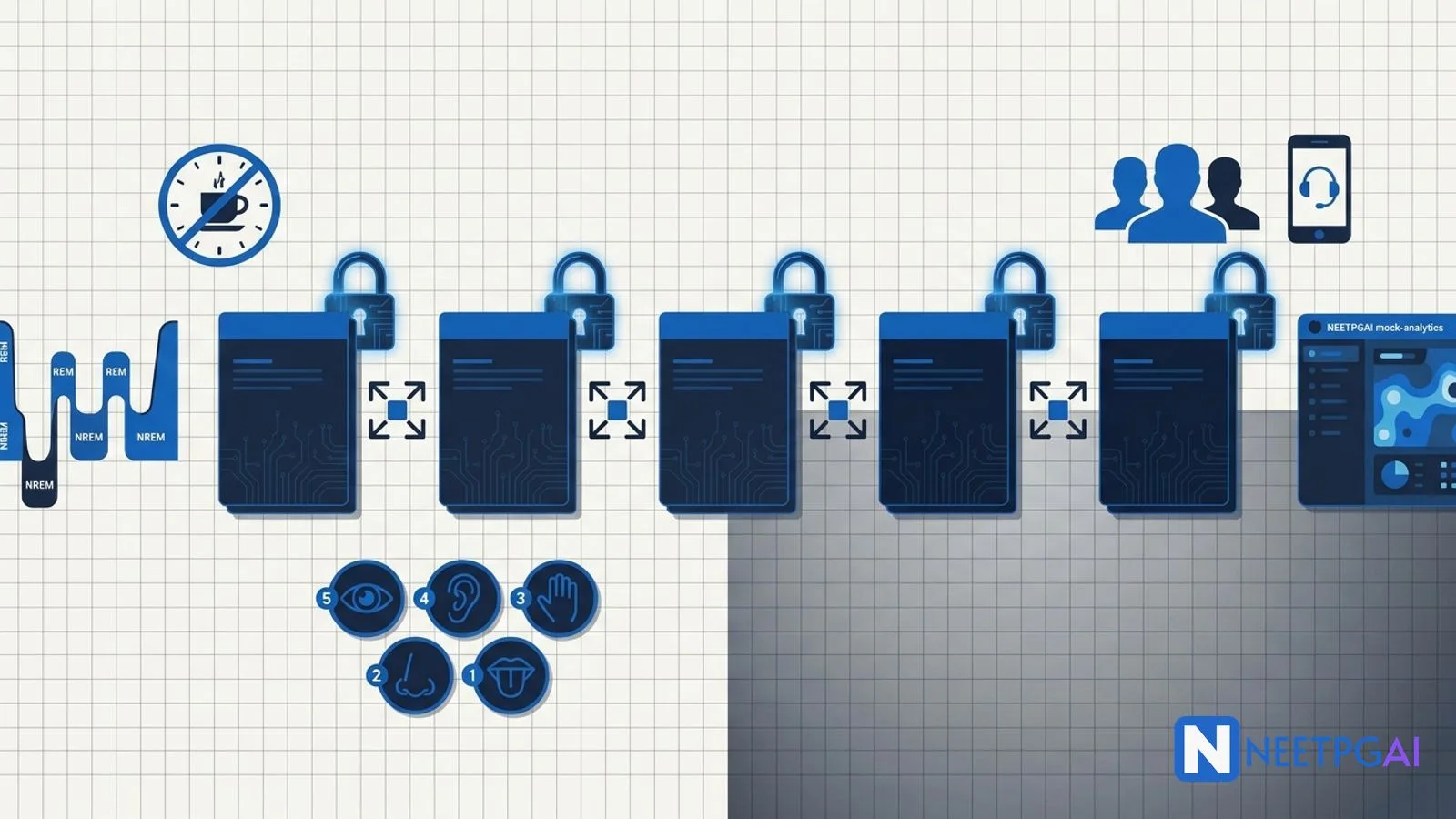
- Section-completion ritual — 15-30 seconds of deep breath + eyes closed + box breathing + affirmation + physical reset + hydration at every section transition
- Panic-recovery protocol — noticing, 5-4-3-2-1 grounding, box breathing, affirmation card, micro-refocus on the current question; used when you catch yourself catastrophising during the exam
- Pre-exam simulation — at least 3 full 5-section-locked mocks in the final month to desensitise to the mechanic and surface your default panic-points
- The 60-second rule — any question that takes more than 60 seconds on the first pass gets flagged and moved; the pull to solve the hard one destroys pacing
- Sleep and nutrition — 7-9 hours in bed the last 2 nights, caffeine cutoff by 2 pm the day before, light breakfast (60 percent carb, 20 percent protein, 20 percent fat), normal hydration, no new sleep aids
- When to seek professional help — if pre-exam anxiety triggers panic attacks or interferes with study 2 or more weeks pre-exam, contact a therapist or NIMHANS, AIIMS, or iCall for short-course intervention
- Between-section rules — do NOT discuss with neighbours if breaks allowed; social comparison spikes anxiety mid-exam
- Physical reset — shoulder roll, blink, brief stretch under desk; interrupts sympathetic loop
- The worst-case redemption frame — even a tanked section leaves 4 remaining sections to compensate; the exam only rewards aggregate marks
The aspirants who consistently outperform their knowledge on exam day are the ones who have built these habits over the final 3 months.
Why the 2026 section-lock format triggers more anxiety
The pre-2026 NEET PG allowed full navigation across all 200 questions for the entire 3.5 hours. That navigation freedom acted as a psychological safety net — even when it was rarely used, its existence reduced perceived stakes at any single moment. The 2026 format removes that safety net.
Section lock introduces irreversibility — when the 42-minute timer on Section N expires, that section permanently closes. You cannot revisit answers, change wrong responses, attempt skipped questions, or use saved time to review. The human brain reads permanent decisions as higher-stakes than reversible ones. Every question and every minute in every section carries the weight of finality.
Three psychological amplifications result:
- Feels final — irreversibility activates a stronger threat response and stress-hormone surge than reversible choices
- Narrows adaptive strategies — the triage window (skip hard, do easy first, return later) is only 42 minutes long and cannot be extended
- Compounding failure fear — a bad first section cannot be compensated in the same way; mental replay of Section 2 during Section 3 creates a downward spiral
Understanding this dynamic is the first step in managing it. Recognise that the format itself creates a psychological load, then use specific techniques to release that load between sections.
The core cognitive reframe — 5 mini-exams, not 1 long one
The single most useful cognitive reframe for the 5-section format is treating each 42-minute section as a self-contained mini-exam rather than as a segment of a longer exam. The mental model — you are sitting for 5 back-to-back 42-minute exams, each with 36 questions, each independently scored.
This reframe does three things:
- Reduces stakes at any single moment — 5 shorter races replace 1 marathon; a bad race does not erase good ones
- Enables clean psychological reset between sections — Section 2 is done and unchangeable, exactly like a previous exam; Section 3 is a fresh exam that has nothing to do with Section 2
- Rewards presence in the current moment — the only section you can affect is the one you are currently in
The mathematical grounding — the exam only rewards or penalises based on aggregate marks; no bonus or penalty attaches to any single section. Even a badly performed section (say 40 out of the possible 144 marks, from 12 correct and 5 wrong) leaves 4 remaining sections at solid performance well above the 50 percent cutoff.
Practise this reframe during mocks. After each section ends in a mock, close your eyes for 5 seconds and say to yourself the previous section is done; the next section is a fresh exam. Do this every time. On exam day it will be automatic.
The section-completion ritual
The 15-30 second sequence you perform at the end of every section that psychologically closes the previous section and opens the next with a fresh mind.
The 7-step sequence
- Final answer commits — as the 42-minute timer approaches zero, take a slow deep breath in for 4 seconds
- Section closes — close your eyes for 5-10 seconds; exhale slowly for 4 seconds
- Box breathing — one round of in for 4, hold for 4, out for 4, hold for 4
- Internal affirmation — the previous section is done and unchangeable; the next section is fresh and the only one that matters
- Physical reset — briefly roll shoulders, blink deliberately, stretch fingers under the desk
- Hydrate briefly — 20-30 mL of water if allowed
- Open the next section with the pre-committed 30-second scan — count image-based, long-vignette, short-recall items
Why the ritual works
- Interrupts rumination (the mental replay of the previous section)
- Triggers parasympathetic activity (deep breath, exhale, box breathing)
- Provides a clear behavioural marker of transition (like an athlete's pre-race routine)
The biggest failure mode — skipping the ritual under time pressure. You feel rushed to just get into the next section, which lets rumination bleed into your Section 3 attention. The ritual takes 15-30 seconds and pays back many minutes of improved focus.
Practise the ritual in every full mock. It should be automatic on exam day.
Pre-exam simulation — desensitise to the mechanic
The 5-section-locked format is unfamiliar to almost everyone in the 2026 batch. Unfamiliarity + high stakes = maximum anxiety. The antidote is repeated exposure to the exact format under mock conditions.
Take at least 3 full 5-section-locked mocks in the last month with strict section-lock enforcement. Use a paper timer if the mock platform does not enforce it. This does three things:
- Desensitises you to the section-lock mechanic — after 3-5 exposures your brain stops treating it as a novel threat
- Reveals your default panic-points — the specific sections, subjects, or question types where you consistently panic; you can then target those in practice
- Builds pacing muscle — the 27-min Pass 1, 10-min Pass 2, 5-min Pass 3 rhythm becomes intuitive
A mock that lets you revisit all 180 questions at the end is worse than useless — it trains a habit that will destroy you on exam day. Verify your mock platform is in 2026 mode.
The panic-recovery protocol
If you catch yourself catastrophising during the exam (my Section 3 tanked, my rank is gone, I have wasted years), the 60-120 second protocol interrupts the cascade.
Step 1 — Noticing
Recognise the catastrophising thought as it arises. I am telling myself my rank is gone; that is a thought, not a fact. This meta-awareness alone often reduces intensity.
Step 2 — 5-4-3-2-1 grounding
Name:
- 5 things you can see (the screen, the mouse, the timer, your hands, the desk)
- 4 things you can hear (the room, your breathing, the AC, keyboard clicks nearby)
- 3 things you can touch (the mouse, the desk, your leg)
- 2 things you can smell (the ambient smell, your skin)
- 1 thing you can taste (whatever residual taste is in your mouth)
This forces attention into the present moment and away from the future-focused catastrophic narrative.
Step 3 — Box breathing
4 rounds of in for 4, hold for 4, out for 4, hold for 4. Activates the parasympathetic nervous system and reduces heart rate, blood pressure, and cortisol.
Step 4 — Affirmation card
Have a pre-memorised affirmation — I have prepared, I trust myself, one question at a time. Repeat 2-3 times internally.
Step 5 — Micro-refocus
Read the current question in front of you slowly and deliberately, one sentence at a time, and answer it. Do not think about the section, the exam, your rank, or your future — only this one question.
If the panic returns, repeat the protocol. This is a skill; skills are automated only with repetition. Practise in mocks.
Physical anxiety symptoms and how to counter them
Anxiety manifests physically — cold hands, racing heart, shallow breathing, tunnel vision. These are not signs of impending failure; they are the body's normal stress response. Counter them with:
- Grounding technique — 5-4-3-2-1 as above
- Slow exhale — long exhalation activates the vagus nerve and calms the heart
- Progressive muscle relaxation — briefly tense and release shoulder muscles under the desk
- Warm hands — briefly rub palms together to redirect blood flow; cold hands correlate with heightened sympathetic tone
- Tongue placement — gently place tongue on the roof of the mouth; interrupts jaw-clench tension
Time-blindness antidote — checkpoint the clock
Constantly watching the timer paradoxically increases anxiety and reduces performance. Glance at the exam clock at fixed checkpoints only:
- Question 9 — 10 minutes elapsed target
- Question 18 — 21 minutes elapsed target
- Question 27 — 31 minutes elapsed target
- Question 36 — 42 minutes (section end)
If you are on pace at each checkpoint, forget the clock and focus on the question. If you are 2 or more questions behind, gently accelerate on short-recall items.
The 60-second rule
Any question that takes more than 60 seconds on the first pass gets flagged and moved. The pull to solve the hard one is what destroys pacing and costs you 3-4 easier questions you could have solved in the same 60 seconds.
The 60-second rule is a decision-making shortcut that removes the emotional debate about whether to keep going or move on. Do NOT negotiate with yourself — 60 seconds passes, you flag and move. Return on Pass 2.
This rule is the single highest-return timing decision. Aspirants who follow it consistently gain 8-15 marks per section over aspirants who dwell.
Between-section rules
If breaks are permitted between sections:
Do
- Stand up if allowed; roll shoulders, brief stretch
- Hydrate — 20-30 mL of water, not more (avoid needing a mid-section bathroom break)
- Close eyes for 15-20 seconds and box-breathe
- Perform the section-completion ritual as detailed above
Do NOT
- Discuss with neighbours — social comparison mid-exam spikes anxiety; other people's confidence or panic distorts your reality
- Look at your phone — spike of stimulation destroys the calm reset
- Second-guess previous answers — the previous section is closed; ruminating destroys the current one
- Cram from a book — no learning happens in 5 minutes; spike of anxiety happens
Sleep architecture pre-exam
The last 2 nights before the exam are the highest-return sleep investment. Full 7-9 hours in bed at your usual sleep time both nights.
- Do not attempt to bank sleep 3 or more nights before — the body does not save sleep this way
- Do not sleep excessively the night before (10+ hours) — this can leave you groggy
- Caffeine cutoff by 2 pm the day before exam (caffeine half-life is 5-6 hours; 4 pm coffee is still active at midnight)
- No new sleep aids the night before — do not try melatonin, alprazolam, or diphenhydramine for the first time the night before; an unexpected reaction destroys sleep and next-day cognition
- If you already use a sleep aid stably, continue as usual
- Avoid screen exposure in the 60 minutes before bed on the night before — blue light disrupts melatonin
- Cool dark room — 18-20 degrees Celsius, blackout curtains
Exam-day nutrition
- Light breakfast the morning of the exam with a mix of complex carbohydrates (60 percent — dosa or roti or bread), moderate protein (20 percent — eggs or paneer or dal), and moderate fat (20 percent — nuts or ghee) to provide sustained glucose without spike-crash
- Hydrate normally (500-750 mL by exam start) but not excessively (avoid mid-section bathroom breaks)
- Avoid heavy meals — full stomach diverts blood from brain to gut and increases post-meal drowsiness
- Avoid sugar spikes — soft drinks, sweets before the exam create a spike-crash pattern
- Avoid any new food the morning of the exam — untested food can cause GI distress
- Take normal medications on time
Reflective post-mock protocol
After every mock (especially in the final 3 months), do a 60-90 minute post-mortem focused on section-by-section performance:
- Per-section accuracy — where did I score highest and lowest?
- Per-section pace — did I finish each section on time or run behind?
- Panic points — did I catastrophise in any section? What triggered it?
- Time-outliers — did any single question take more than 90 seconds on Pass 1? Which types?
- Flag discipline — how many flagged questions did I return to on Pass 2? Did I flag decisively or hesitate?
NEETPGAI's per-section timing and accuracy dashboards make this data visible over 20+ mocks. Objective data beats intuition for identifying weak sections.
The worst-case redemption frame
If Section 3 tanks in the actual exam, the exam is NOT over. The remaining 4 sections determine most of your rank. A great performance in 4 sections compensates significantly for a poor one.
Numerical example — a section with 12 correct and 5 wrong scores 12 × 4 − 5 = 43 marks (out of possible 144). If your remaining 4 sections average 110 marks each, your total is 43 + 440 = 483 out of 720, which is 67 percent — well above the 50 percent cutoff and in the competitive rank zone.
Keep going. The exam rewards aggregate performance, not any single section. Never quit mid-exam.
When to seek professional help
Pre-exam anxiety at low levels is universal and expected. When it crosses into pathological territory, professional intervention meaningfully changes outcome.
Red flags for professional help
- Panic attacks — sudden episodes of severe anxiety with chest pain, palpitations, shortness of breath, sense of doom, lasting minutes
- Sleep disruption — inability to fall asleep or stay asleep more than 3-4 nights per week for 2 or more weeks
- Loss of appetite or overeating consistently over 2 or more weeks
- Anhedonia — loss of interest in things you previously enjoyed
- Persistent hopelessness or suicidal ideation
- Study paralysis — sitting for hours unable to open books or start practice
- Physical symptoms — persistent headaches, GI distress, muscle tension without medical cause
Where to get help
- A qualified therapist for cognitive behavioural therapy (CBT) — brief structured intervention with strong evidence for exam anxiety
- A psychiatrist for short-course anxiolytic (SSRIs for chronic anxiety, benzodiazepines only for very short-term crisis under supervision — dependence risk is real)
- NIMHANS Bengaluru — national institute for mental health, both in-person and telehealth
- AIIMS Mental Health helpline — 011-2657-3777
- iCall (TISS) — 9152987821 — psychosocial helpline
- Vandrevala Foundation — 1860-2662-345 — 24-hour mental health helpline
Seeking help is not weakness. Most aspirants who use short-term intervention see meaningful improvement in 2-4 weeks and go into the exam substantially calmer.
Peer support
2-3 study partners for mutual accountability and shared post-mock discussion (not comparison) can significantly improve morale and reduce isolation. Rules:
- Discuss content and strategy, not scores or ranks
- Rotate strengths — one person explains a topic to another; teaching consolidates learning
- Set boundaries — no doom-spirals, no venting sessions longer than 15 minutes
- Avoid competitive comparison — different people prep differently; comparing daily hours breeds anxiety
- Meet in-person or on video rather than text-only — richer interaction, better support
Mistakes to avoid
Mistake 1 — Winging the section-transition ritual
Not practising the ritual in mocks means it will not be automatic on exam day. Practise every mock.
Mistake 2 — Discussing with neighbours during exam breaks
Social comparison mid-exam is one of the fastest ways to spike anxiety. Do NOT discuss with anyone if any break is available.
Mistake 3 — Cramming the night before
The night before is for sleep, not learning. Nothing you cram in the final 12 hours will materially change your exam performance; disrupted sleep will hurt more than any last-minute review helps.
Mistake 4 — Trying new sleep aids the night before
An unexpected reaction to melatonin, alprazolam, or diphenhydramine destroys sleep and next-day cognition. Stick with what you know.
Mistake 5 — Eating heavy or unfamiliar food on exam day
GI distress mid-exam is catastrophic. Eat what you have tested repeatedly during mocks.
Mistake 6 — Watching the timer constantly
Time-checking every minute increases anxiety without adding useful information. Check at fixed checkpoints (Q9, 18, 27, 36) only.
Mistake 7 — Ignoring early anxiety symptoms
If you are having panic attacks 2 weeks pre-exam, seek help now. Waiting for the anxiety to pass on its own is a losing bet — professional intervention has strong evidence for improvement in 2-4 weeks.
Mistake 8 — Comparing your prep to others on social media
Social media prep content is highly curated and often exaggerated. Do not calibrate your prep against posts. Trust your own study plan.
Conclusion
The NEET PG 2026 section-lock format demands new mental habits. The 42-minute per-section irreversibility triggers a specific anxiety load that did not exist in the pre-2026 continuous block. Manage that load with the cognitive reframe (5 mini-exams, not 1 long one), the section-completion ritual (15-30 seconds at every transition), the panic-recovery protocol (5-4-3-2-1 grounding + box breathing + affirmation + micro-refocus), disciplined pacing (the 60-second rule, checkpoint clock glances only), physiological readiness (sleep, nutrition, hydration), and — when necessary — professional intervention (therapist, psychiatrist, national helplines).
The aspirants who consistently outperform their knowledge on exam day are the ones who have built these habits over the final 3 months. Content mastery gets you to the exam; mental discipline converts that content into marks.
Frequently asked questions
Why does the NEET PG 2026 section-lock format trigger more anxiety than the pre-2026 pattern?
Section lock introduces a specific psychological threat — irreversibility. In the pre-2026 format any answer, any skipped question, any timing mistake could be revisited at the end of the exam; the perception of full navigation freedom acted as a psychological safety net even when it was rarely used. NEET PG 2026 removes that safety net — when the 42-minute timer on a section expires, the section permanently closes. You cannot go back to change an answer, attempt a skipped question, or use saved time to review. This irreversibility triggers three amplifications of anxiety. (1) Feels final — the human brain reads permanent decisions as higher-stakes than reversible ones, activating a stronger threat response and stress-hormone surge. (2) Narrows adaptive strategies — under the old format you could triage aggressively (skip hard, do easy first, return at end); under the new format the triage window is only 42 minutes long and cannot be extended. (3) Compounding failure fear — a bad first section cannot be compensated in the same way; the mental replay of Section 2 during Section 3 creates a downward spiral where anxiety about the closed section destroys performance on the open section. Understanding this dynamic is the first step in managing it — recognise that the format itself creates a psychological load, then use specific techniques (transition rituals, cognitive reframing, panic-recovery protocols) to release that load between sections.
What is the cognitive reframe that helps you treat each section as a self-contained exam?
The single most useful cognitive reframe for the 5-section format is treating each 42-minute section as a self-contained mini-exam rather than as a segment of a longer exam. The mental model — you are sitting for 5 back-to-back 42-minute exams, each with 36 questions, each independently scored. This reframe accomplishes three things. (1) Reduces stakes at any single moment — instead of one high-stakes 3.5-hour marathon, you have 5 shorter races; a bad race does not erase good ones. (2) Enables clean psychological reset between sections — when Section 2 ends, Section 2 is done and unchangeable, exactly like a previous exam is done. Section 3 is a fresh exam that has nothing to do with Section 2. You would not spend the first hour of a new exam replaying an exam from last month; do not do that during NEET PG. (3) Rewards presence in the current moment — the only section you can affect is the one you are currently in; all attention should be there. The mathematical grounding for this reframe — the exam only rewards or penalises based on aggregate marks; no bonus or penalty attaches to any single section. Even a badly performed section (say 40 out of the possible 144 marks, from 12 correct and 5 wrong) leaves the possibility of 400 marks from the remaining 4 sections at solid performance, well above the 50 percent cutoff. Practise this reframe during mocks so it is automatic on exam day — after each section ends in a mock, close your eyes for 5 seconds and say the previous section is done; the next section is a fresh exam before opening the next.
What is the section-completion ritual and how should you use it during the exam?
The section-completion ritual is a 15-30 second sequence you perform at the end of every section (or when the timer expires) that psychologically closes the previous section and opens the next with a fresh mind. The specific sequence — (1) as the 42-minute timer approaches zero, take a slow deep breath in for 4 seconds while your final answer commits; (2) when the section closes, close your eyes for 5-10 seconds and exhale slowly for 4 seconds; (3) do one round of box breathing (in for 4, hold for 4, out for 4, hold for 4); (4) internal affirmation — say to yourself the previous section is done and unchangeable; the next section is fresh and the only one that matters; (5) physical reset — briefly roll shoulders, blink deliberately, stretch fingers under the desk; (6) if breaks are allowed and you are permitted a small sip, hydrate briefly with 20-30 mL of water; (7) open the next section with the pre-committed opening move — the 30-second section scan (flick through all 36 questions, count image-based, long-vignette, short-recall items, and mentally set pace). Do this every section — Section 1 to 2, 2 to 3, 3 to 4, 4 to 5. The ritual works because it interrupts rumination (the mental replay of the previous section), triggers parasympathetic activity (deep breath, exhale), and provides a clear behavioural marker of transition (like an athlete's pre-race routine). Practise it in every full mock so it is automatic on exam day. The biggest failure mode is skipping the ritual under time pressure — you feel rushed to just get into the next section — which lets rumination bleed into your Section 3 attention. The ritual takes 15-30 seconds and pays back many minutes of improved focus.
What is the panic-recovery protocol if you catch yourself catastrophising during the exam?
Catastrophising during a high-stakes exam is a well-documented cognitive pattern where a specific difficulty (a hard section, a run of missed questions, unexpected question types) triggers a cascade of catastrophic thoughts (my rank is gone; I will not get through; I have wasted years) that spike physiological arousal and destroy cognitive performance. The panic-recovery protocol interrupts this cascade in 60-120 seconds. Step 1 — noticing. Recognise the catastrophising thought as it arises — I am telling myself my rank is gone; that is a thought, not a fact. This meta-awareness alone often reduces the intensity. Step 2 — grounding. Use the 5-4-3-2-1 sensory technique — name 5 things you can see (the screen, the mouse, the timer, your hands, the desk), 4 things you can hear (the room, your breathing, the AC, the click of nearby keyboards), 3 things you can touch (the mouse, the desk, your leg), 2 things you can smell (the room's ambient smell, your skin), 1 thing you can taste (whatever residual taste is in your mouth). This forces attention into the present moment and away from the future-focused catastrophic narrative. Step 3 — box breathing. 4 rounds of in for 4, hold for 4, out for 4, hold for 4. This activates the parasympathetic nervous system and reduces heart rate, blood pressure, and cortisol. Step 4 — affirmation card. Have a pre-memorised affirmation you can say to yourself — I have prepared, I trust myself, one question at a time. Step 5 — micro-refocus. Read the current question in front of you slowly and deliberately, one sentence at a time, and answer it. Do not think about the section, the exam, your rank, or your future — only this one question. If the panic returns, repeat the protocol. Practise this in mocks; the protocol is a skill, and skills are automated only with repetition. If pre-exam anxiety triggers panic attacks or interferes with study 2 or more weeks pre-exam, seek professional help — a therapist for CBT or a short-course anxiolytic under psychiatrist supervision (NIMHANS, AIIMS mental health helpline, iCall) can meaningfully change outcome.
What sleep, nutrition, and pre-exam-day protocols support anxiety management on exam day?
Physiological state directly modulates cognitive performance and anxiety threshold — poor sleep, poor nutrition, or dehydration all worsen anxiety and reduce recall. The evidence-based pre-exam protocol — Sleep — the last 2 nights before the exam should be 7-9 hours in bed at your usual sleep time; do not attempt to bank sleep 3 or more nights before (the body's circadian system does not save sleep this way). Caffeine cutoff by 2 pm on the day before exam (caffeine half-life is 5-6 hours; a 4 pm coffee is still active at midnight). No new sleep aids the night before (do not try melatonin, alprazolam, or diphenhydramine for the first time the night before the exam — an unexpected reaction destroys sleep and next-day cognition); if you already use a sleep aid stably, continue as usual. Nutrition — light breakfast the morning of the exam with a mix of complex carbohydrates (60 percent — dosa or roti or bread), moderate protein (20 percent — eggs or paneer or dal), and moderate fat (20 percent — nuts or ghee) to provide sustained glucose without spike-crash. Hydrate normally (500-750 mL by exam start) but not excessively (avoid needing a mid-section bathroom break when possible). Avoid heavy meals, sugar spikes (soft drinks, sweets), and any new food the morning of the exam (untested food can cause GI distress). Take your normal medications on time. Exam-day logistics — arrive at the centre 60-90 minutes early to allow for parking, security check, and a bathroom visit; know the exact route and travel time; have your admit card, ID, and any required documents ready the night before. Wear comfortable layered clothing (exam rooms vary in temperature). Bring only permitted items. Between sections (if breaks are allowed) — stand up, roll shoulders, hydrate 20-30 mL, do NOT discuss with neighbours (social comparison mid-exam spikes anxiety), close eyes for 15-20 seconds. In the 30 minutes before the exam starts — a light snack if it has been over 90 minutes since breakfast; box breathing 4 rounds; a brief mental rehearsal of the exam structure (5 sections of 42 minutes, section-lock, 3-pass method); avoid last-minute cram reading which spikes anxiety without adding learning. The morning-of exam is not the time to learn new content — trust what you have prepared.
Written by: NEETPGAI Editorial Team
Reviewed by: Pending Editorial Review
Last reviewed: September 2026