Quick Answer
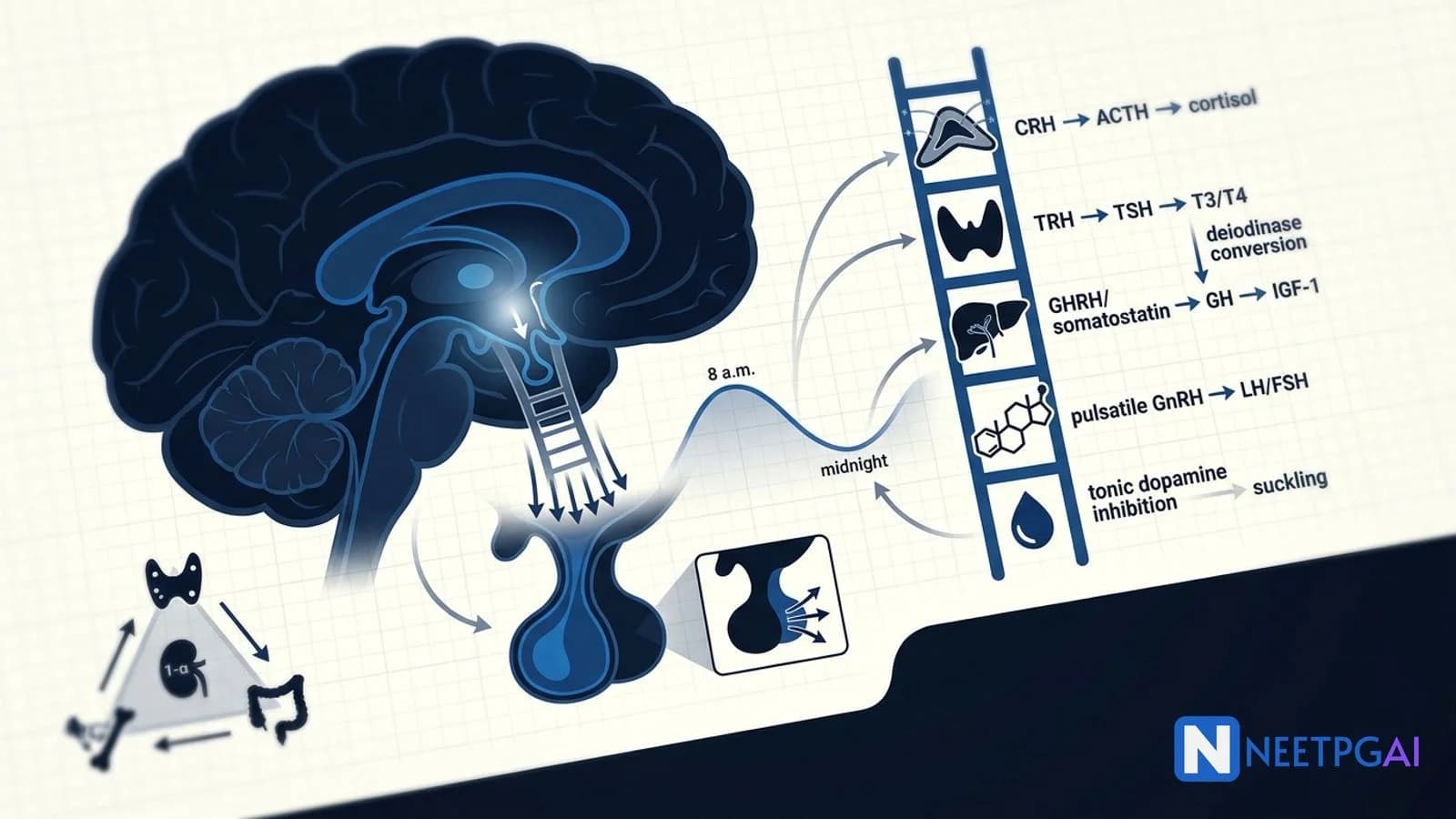
Endocrine physiology delivers 3 to 5 NEET PG questions per paper, straddling Physiology, Medicine and Pharmacology. Anchor these axes:
- HPA axis — CRH → ACTH → cortisol; diurnal peak at 8 a.m.; dexamethasone suppression test.
- HPT axis — TRH → TSH → T4/T3; deiodinases activate T4 to T3; TSH most sensitive marker.
- GH/IGF-1 axis — pulsatile GH, hepatic IGF-1 mediates growth; OGTT for acromegaly.
- Prolactin — dopamine tonic inhibition; rises with stalk lesions and antipsychotics.
- Posterior pituitary — ADH (V2 collecting duct, V1 vessels), oxytocin (milk ejection, uterus).
- HPG axis — pulsatile GnRH → LH/FSH → gonadal steroids; continuous GnRH suppresses.
- Calcium axis — PTH and calcitriol raise calcium; FGF-23 lowers phosphate.
Endocrine physiology rewards students who think in feedback loops rather than tables. Every axis follows the same three-tier template — hypothalamic releasing factor, pituitary trophic hormone, peripheral hormone — with negative feedback at two levels. Mastering that scaffold unlocks not only NEET PG but also INI-CET, FMGE and the medicine clinical vignettes that ride on the same physiology.
This NEETPGAI deep dive walks through each axis, the functional dynamic tests that examiners love (cosyntropin, dexamethasone, OGTT for GH, water deprivation), and the high-yield traps that decide a single mark between an AIIMS seat and an alternative. Pair this guide with the thyroid disorders guide and the diabetes management deep dive for a complete endocrine map.
HPA axis — cortisol and stress
Anatomy of the cascade
Hypothalamic paraventricular nucleus releases CRH (and ADH as a co-secretagogue) into the hypophyseal portal system. CRH binds CRH-R1 on anterior pituitary corticotrophs → POMC is cleaved to ACTH, MSH and beta-endorphin. ACTH binds MC2R on the adrenal zona fasciculata → cortisol synthesis via the steroidogenic cascade (cholesterol → pregnenolone via side-chain cleavage, rate-limiting StAR protein). The zona glomerulosa makes aldosterone under angiotensin II and potassium (not ACTH), and the zona reticularis makes adrenal androgens (DHEA, androstenedione).
Diurnal rhythm and feedback
Cortisol peaks at 6 to 8 a.m. and troughs at midnight. Both cortisol and dexamethasone feed back on the hypothalamus (long loop) and pituitary (short loop). Loss of diurnal variation is the earliest sign of endogenous hypercortisolism.
Dynamic tests
- Low-dose dexamethasone suppression — 1 mg at 11 p.m., measure 8 a.m. cortisol. Fails to suppress (greater than 1.8 mcg/dL) in Cushing syndrome.
- High-dose dexamethasone suppression — 8 mg overnight. Suppresses pituitary Cushing disease (ACTH-dependent), fails to suppress in ectopic ACTH and adrenal Cushing.
- Cosyntropin (250 mcg ACTH) stimulation — tests adrenal reserve. Cortisol rise less than 18 mcg/dL at 60 minutes confirms adrenal insufficiency.
- Insulin tolerance test (gold standard) — hypoglycaemia (glucose less than 40 mg/dL) should drive cortisol over 18 mcg/dL; tests the entire HPA axis.
- CRH stimulation — distinguishes pituitary from ectopic ACTH (pituitary responds, ectopic does not).
Clinical correlates
Cushing syndrome (truncal obesity, moon facies, striae, hyperglycaemia), Addison disease (hyperpigmentation from MSH, hyponatraemia, hyperkalaemia, eosinophilia), congenital adrenal hyperplasia (21-hydroxylase deficiency the commonest, salt-wasting with elevated 17-OHP).
HPT axis — thyroid
The cascade
Hypothalamic TRH → pituitary thyrotrophs release TSH → thyroid follicular cells take up iodide via NIS (Na/I symporter, blocked by perchlorate), oxidise it via thyroid peroxidase (TPO, blocked by methimazole and PTU), iodinate tyrosines on thyroglobulin (MIT and DIT), and couple them to T4 (DIT + DIT) and T3 (MIT + DIT). The thyroid secretes about 90 percent T4 and 10 percent T3.
Deiodinases — the activating step
- D1 (liver, kidney) — converts T4 to T3 for circulating levels.
- D2 (pituitary, brain, brown fat) — local T3 generation; the pituitary "sees" intracellular T3 made by D2.
- D3 (placenta, fetal tissues) — inactivates T4 to reverse T3 (rT3), protective.
In sick euthyroid syndrome, illness shunts T4 toward rT3 (low T3, normal or low TSH) — do not treat.
Thyroid hormone action
Free T3 (the active hormone) crosses cell membranes via MCT8 and binds nuclear TR-alpha and TR-beta receptors. Effects — basal metabolic rate, beta-adrenergic receptor upregulation (explains tachycardia, tremor), gluconeogenesis, lipolysis, brain maturation in fetal life (deficiency causes cretinism with mental retardation, deaf-mutism, short stature).
Tests
TSH is the screening test (logarithmic sensitivity to free T4). Free T4 and free T3 confirm; antibodies (anti-TPO, anti-thyroglobulin in Hashimoto; TSH-receptor antibodies in Graves) clinch aetiology. Radio-iodine uptake distinguishes Graves (diffuse high) from toxic nodule (focal hot) from subacute thyroiditis (suppressed uptake).
GH/IGF-1 axis
The cascade
Hypothalamic GHRH stimulates and somatostatin inhibits anterior pituitary somatotrophs. GH release is pulsatile — largest pulse 1 to 2 hours after sleep onset, augmented by stress, exercise, sleep, hypoglycaemia, arginine, ghrelin. GH binds JAK-STAT receptors on the liver to drive IGF-1 synthesis, which mediates most growth effects (long-bone growth, protein anabolism). IGF-1 feeds back on the pituitary and hypothalamus.
Direct vs indirect effects of GH
- Direct (anti-insulin) — lipolysis, gluconeogenesis, insulin resistance. Excess explains diabetes in acromegaly.
- Indirect (via IGF-1) — chondrocyte proliferation at epiphyses (linear growth before fusion), protein synthesis, organomegaly.
Tests
- IGF-1 — stable integrated marker; screening test for acromegaly and GH deficiency.
- OGTT (75 g glucose) — should suppress GH below 1 ng/mL; failure to suppress confirms acromegaly.
- Insulin tolerance test or arginine + GHRH — confirms GH deficiency in adults (peak GH less than 5 ng/mL).
Clinical correlates
Gigantism (open epiphyses), acromegaly (closed epiphyses — coarse features, prognathism, large hands/feet, sleep apnoea, cardiomyopathy, diabetes, carpal tunnel). Laron dwarfism = GH-receptor defect with high GH and low IGF-1.
Prolactin
The only anterior pituitary hormone under tonic inhibition. Hypothalamic dopamine acting on D2 receptors on lactotrophs suppresses release. Stimuli — TRH (explains hyperprolactinaemia of primary hypothyroidism), suckling, pregnancy oestrogen, stress, sleep, dopamine antagonists (antipsychotics, metoclopramide, methyldopa), oestrogens.
Stalk-section effect — pituitary macroadenomas (any type) compressing the pituitary stalk interrupt dopamine delivery and raise prolactin moderately (less than 200 ng/mL). Prolactin greater than 200 ng/mL almost always means a true prolactinoma.
Treatment of prolactinoma — dopamine agonists (cabergoline first line, bromocriptine in pregnancy) shrink the tumour and normalise prolactin in over 80 percent.
Posterior pituitary — ADH and oxytocin
The posterior pituitary is an extension of the hypothalamus — supraoptic and paraventricular nuclei synthesise ADH (vasopressin) and oxytocin, transport them down axons in neurophysin carriers, and release them from nerve terminals into systemic circulation.
ADH (vasopressin)
- V2 receptors — basolateral membrane of collecting-duct principal cells; activate Gs-cAMP-PKA → aquaporin-2 insertion into apical membrane → water reabsorption.
- V1 receptors — vascular smooth muscle; vasoconstriction.
- Stimuli — increased plasma osmolality (osmoreceptors in OVLT, threshold 280 mOsm/kg), decreased blood volume (baroreceptors, less sensitive), angiotensin II, nausea, nicotine.
- Inhibitors — alcohol, atrial stretch (ANP).
Diabetes insipidus — central (no ADH; treat with desmopressin) or nephrogenic (V2 receptor or AQP2 defect; treat with thiazides, low-salt diet, amiloride if lithium-induced). SIADH — euvolaemic hyponatraemia with concentrated urine; treat fluid restriction, hypertonic saline if severe, tolvaptan (V2 antagonist) for chronic.
Oxytocin
Milk ejection (positive feedback during suckling), uterine contraction (positive feedback during labour — Ferguson reflex). Used clinically for labour induction and postpartum haemorrhage.
Reproductive (HPG) axes
GnRH pulse generator in the arcuate nucleus drives pulsatile (every 60 to 120 minutes) GnRH release, which is essential — continuous GnRH (or long-acting agonists like leuprolide) paradoxically suppress the axis (used in prostate cancer, endometriosis, precocious puberty, IVF down-regulation).
LH and FSH from gonadotrophs drive gonadal steroidogenesis. In males — LH on Leydig cells (testosterone), FSH on Sertoli cells (spermatogenesis, inhibin B). In females — FSH drives follicle growth and granulosa-cell aromatase (oestradiol), LH surges trigger ovulation and luteinise the corpus luteum (progesterone).
Oestradiol exerts negative feedback most of the cycle but switches to positive feedback at the late follicular phase (sustained levels above 200 pg/mL for more than 48 hours), driving the LH surge. Inhibin B selectively suppresses FSH.
Insulin-glucagon counter-regulation
Insulin (beta cells) — anabolic; lowers glucose by GLUT4 insertion in muscle/fat, suppresses hepatic gluconeogenesis, drives glycogen, fat and protein synthesis. Glucagon (alpha cells) — catabolic; raises glucose by glycogenolysis, gluconeogenesis, ketogenesis.
Counter-regulatory hormones to hypoglycaemia (priority order) — glucagon (first), epinephrine, cortisol, GH. Selective glucagon failure (early type 1 diabetes) and adrenergic failure (autonomic neuropathy, beta-blockers) cause hypoglycaemia unawareness.
Incretin effect — oral glucose elicits 2 to 3 times more insulin than IV glucose because of GLP-1 and GIP from gut L and K cells. Exploited by GLP-1 agonists (semaglutide, liraglutide) and DPP-4 inhibitors (sitagliptin).
Calcium-PTH-vitamin D axis
Ionised calcium (45 percent of total, the physiologically active form) is the regulated variable.
- PTH — chief cells sense ionised calcium via calcium-sensing receptor (CaSR, Gq-coupled). Low Ca → less Gq activity → more PTH release within minutes. PTH raises calcium by — bone resorption (RANK-L upregulation), renal distal tubule calcium reabsorption, proximal tubule phosphate excretion, and renal 1-alpha-hydroxylase activation to make calcitriol.
- Calcitriol (1,25-(OH)2-D3) — vitamin D from skin (7-dehydrocholesterol + UVB → cholecalciferol) is 25-hydroxylated in liver and 1-alpha-hydroxylated in proximal tubule. Increases intestinal calcium (via TRPV6 and calbindin) and phosphate absorption; smaller effect on bone.
- FGF-23 — osteocyte-derived; lowers phosphate by inhibiting proximal tubule reabsorption and suppressing 1-alpha-hydroxylase. Elevated in CKD-mineral bone disease.
- Calcitonin — parafollicular C cells; opposes PTH but minor role in adults; tumour marker for medullary thyroid carcinoma.
Primary hyperparathyroidism — high PTH with high Ca and low PO4. Secondary (CKD, vit D deficiency) — high PTH with low/normal Ca and high PO4 (CKD). Familial hypocalciuric hypercalcaemia — inactivating CaSR mutation; mildly high Ca with low urine Ca:Cr ratio (less than 0.01); do NOT operate.
NEET PG MCQ traps
- TSH most sensitive marker of thyroid function — except in central hypothyroidism (TSH low or inappropriately normal).
- Diurnal cortisol loss = earliest sign of Cushing.
- High-dose dexamethasone suppresses pituitary Cushing, not ectopic ACTH or adrenal.
- Cosyntropin test fails to rise in adrenal insufficiency.
- CAH 21-hydroxylase deficiency — elevated 17-OHP, low cortisol and aldosterone, virilisation.
- IGF-1 is the screening test for acromegaly, OGTT confirms.
- Prolactin greater than 200 ng/mL suggests prolactinoma; lower levels = stalk effect or drugs.
- Continuous GnRH (leuprolide) suppresses HPG axis — used in prostate cancer.
- TRH stimulates prolactin — primary hypothyroidism can cause hyperprolactinaemia.
- Water deprivation test — distinguishes central DI (urine osmolality rises after desmopressin) from nephrogenic DI (no rise) from primary polydipsia (concentrates with deprivation).
- Glucagon is the first counter-regulatory hormone to hypoglycaemia.
- Calcium-sensing receptor (CaSR) — Gq-coupled; mutations cause familial hypocalciuric hypercalcaemia (inactivating) or autosomal dominant hypocalcaemia (activating).
- FGF-23 — earliest abnormality in CKD-MBD; lowers phosphate and calcitriol.
- D2 deiodinase — the pituitary "sees" intracellular T3; explains TSH-driven negative feedback.
- Aldosterone is regulated by angiotensin II and potassium, NOT ACTH — explains why aldosterone is preserved in secondary adrenal insufficiency.
Recent updates and Indian context
- NMC Competency-Based UG Curriculum 2024 — emphasises mechanism-based questions on feedback loops, dynamic testing and receptor pharmacology.
- NEXT (foundation phase) — endocrine physiology is paired with medicine vignettes; expect cortisol-dynamic-test interpretation.
- Indian context — iodine deficiency disorders (cretinism, goitre belt in sub-Himalayan tracts) remain on the syllabus; the National Iodine Deficiency Disorders Control Programme (NIDDCP) mandates iodised salt.
- GLP-1 agonists (semaglutide, liraglutide) and SGLT-2 inhibitors are now first-line add-ons in T2DM with cardiovascular or renal disease per ADA-EASD 2024 — NEET PG has begun testing this.
- CKD-MBD — FGF-23 and calcimimetics (cinacalcet) feature in newer questions.
Frequently asked questions
What is the diurnal rhythm of cortisol and which test exploits it?
Cortisol peaks around 6 to 8 a.m. and reaches its nadir around midnight, driven by hypothalamic CRH pulses and ACTH from the anterior pituitary. The low-dose dexamethasone suppression test (1 mg at 11 p.m., measure 8 a.m. cortisol) screens for Cushing syndrome — failure to suppress below 1.8 micrograms per dL is positive. Loss of diurnal variation is one of the earliest features of endogenous hypercortisolism.
Why is TSH the single most useful thyroid test?
Pituitary thyrotrophs are exquisitely sensitive to free T4 via negative feedback — even small changes in circulating thyroid hormone produce a logarithmic change in TSH. A normal TSH essentially excludes primary thyroid dysfunction, making it the screening test of choice. The exception is central (secondary or tertiary) hypothyroidism where both TSH and free T4 are low or inappropriately normal.
How does the GH-IGF-1 axis differ from other axes?
GH secretion from somatotrophs is pulsatile (largest pulse 1 to 2 hours after sleep onset), stimulated by GHRH, inhibited by somatostatin and IGF-1. Most growth effects are mediated by hepatic IGF-1 rather than GH itself — IGF-1 is a stable integrated marker, while a random GH level is uninterpretable. Acromegaly is screened with IGF-1 and confirmed by failure of GH to suppress below 1 ng per mL after a 75 g oral glucose load.
What stimulates and inhibits prolactin release?
Prolactin is the only anterior pituitary hormone under tonic inhibition — hypothalamic dopamine acting on D2 receptors on lactotrophs suppresses release continuously. Stimuli include TRH (explains hyperprolactinaemia in primary hypothyroidism), suckling, pregnancy oestrogen, stress and dopamine antagonists (antipsychotics, metoclopramide). Stalk-section or pituitary macroadenoma compressing the stalk both raise prolactin by interrupting dopamine delivery.
What are the principal regulators of calcium homeostasis?
Parathyroid hormone (from chief cells) raises serum calcium by mobilising bone calcium, increasing distal-tubule reabsorption and stimulating renal 1-alpha-hydroxylase to make calcitriol. Calcitriol (active vitamin D) increases intestinal calcium and phosphate absorption. Calcitonin (parafollicular C cells) opposes PTH but plays a minor role in adults. FGF-23 from osteocytes lowers phosphate. Low ionised calcium activates the calcium-sensing receptor and unleashes PTH within minutes.
This content is for educational purposes for NEET PG exam preparation. It is not a substitute for professional medical advice, diagnosis, or treatment. Clinical information has been reviewed by qualified medical professionals.
Written by: NEETPGAI Editorial Team
Reviewed by: Pending SME Review
Last reviewed: May 2026