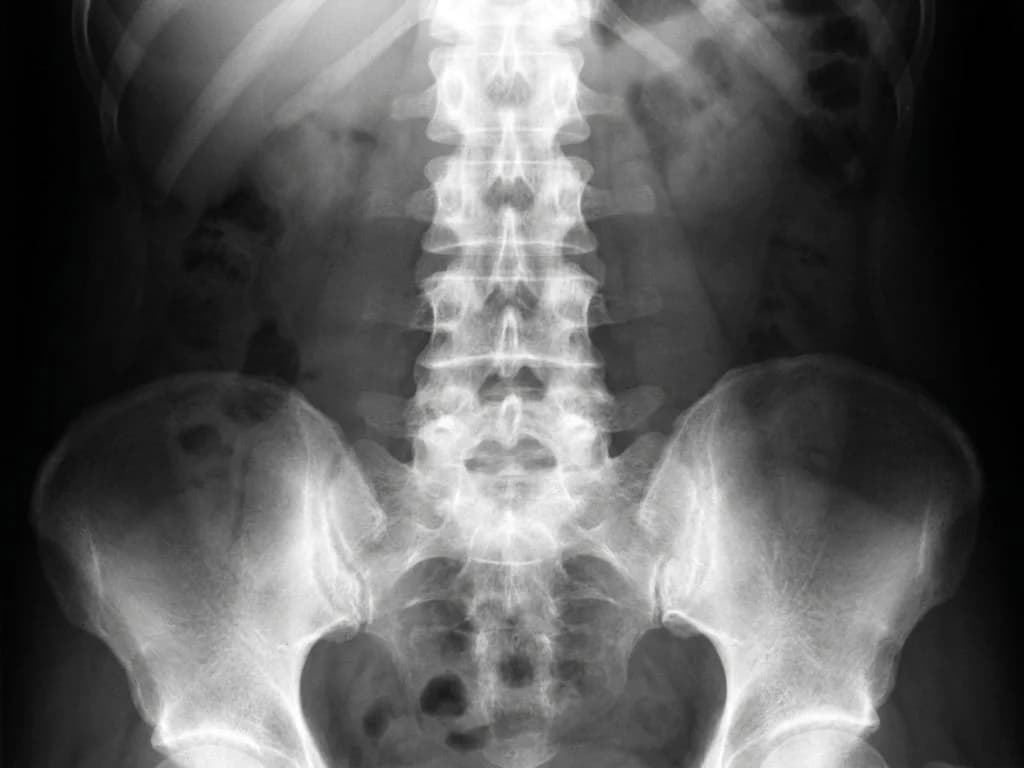
Correct Answer: B. Ankylosing spondylitis
Ankylosing spondylitis (AS) is a seronegative spondyloarthropathy that classically presents with the triad of backache, morning stiffness, and uveitis (eye redness). The X-ray finding in AS is the pathognomonic "bamboo spine" — a result of progressive ossification of the annulus fibrosus and anterior longitudinal ligament, creating a continuous bony bridge across vertebral bodies. This occurs due to chronic inflammation and subsequent fibrosis and ossification of the intervertebral discs and ligaments. AS predominantly affects young males (male:female = 3:1) and is strongly associated with HLA-B27 positivity (>90% of AS patients). The combination of inflammatory back pain (worse in morning, improves with activity), extra-articular manifestations (uveitis, iritis), and the characteristic radiological finding of bamboo spine makes AS the definitive diagnosis. Indian guidelines and epidemiological data show AS prevalence of 0.1–1.9% in the Indian population, making it a common cause of chronic inflammatory back pain in young men presenting to orthopedic clinics.
Why the other options are wrong
A. Paget's disease — Paget's disease causes disorganized bone remodeling with a 'cotton-wool' appearance on X-ray, not bamboo spine. It typically affects older individuals (>40 years) and presents with bone pain, deformity, and pathological fractures — not inflammatory back pain or uveitis. The clinical triad of backache, morning stiffness, and eye involvement is absent in Paget's disease. C. Rheumatoid arthritis — Rheumatoid arthritis is a seropositive polyarticular disease (RF/anti-CCP positive) that primarily affects small joints of hands and feet symmetrically. While it can involve the spine, it does not produce bamboo spine or the characteristic ossification pattern seen in AS. RA is more common in women and does not classically present with uveitis; ocular involvement in RA is limited to episcleritis/scleritis, not uveitis. D. Osteopetrosis — Osteopetrosis is a rare genetic disorder of osteoclast dysfunction causing generalized increased bone density ('marble bone disease'). It presents in infancy/childhood with pathological fractures, hepatosplenomegaly, and cranial nerve compression — not in a 28-year-old with inflammatory back pain. The radiological appearance is diffuse sclerosis, not bamboo spine, and there is no association with uveitis.
High-Yield Facts
- Bamboo spine (continuous ossification of ALL and annulus fibrosus) is pathognomonic for ankylosing spondylitis on X-ray.
- HLA-B27 positivity is present in >90% of AS patients; it is the strongest genetic risk factor for AS in Indian populations.
- Inflammatory back pain triad: morning stiffness >30 minutes, pain improves with activity, pain worse in early morning — classic for AS.
- Extra-articular manifestations of AS include uveitis/iritis (25–40%), enthesitis, aortic regurgitation, and pulmonary fibrosis.
- Male predominance (3:1 ratio) and onset in young adults (20–40 years) are typical demographic features of AS.
- Seronegative spondyloarthropathy: AS is RF-negative and anti-CCP-negative, distinguishing it from seropositive RA.
Mnemonics
AS Clinical Triad BUM — Backache (inflammatory), Uveitis (eye redness), Morning stiffness (>30 min). Use this to recall the classic presentation of ankylosing spondylitis in young males. Bamboo Spine Features FUSE — Fusion of vertebrae, Uniform ossification, Straight spine, Erect posture loss. Helps remember the progressive spinal changes in advanced AS.
NBE Trap
NBE commonly pairs "backache + eye involvement" with rheumatoid arthritis to trap students who confuse seropositive and seronegative spondyloarthropathies. The key discriminator is the bamboo spine radiological finding, which is unique to AS and absent in RA.
Clinical Pearl
In Indian clinical practice, AS is often diagnosed late because young men attribute morning stiffness to "normal aging" or overwork. The Schober's test (measuring lumbar flexion) and HLA-B27 testing are simple bedside tools that should be performed in any young male with >3 months of inflammatory back pain and uveitis — early diagnosis and NSAIDs/TNF-α inhibitors can prevent spinal fusion and disability.
_Reference: Robbins & Cotran Pathologic Basis of Disease, Ch. 26 (Bones and Joints); Harrison's Principles of Internal Medicine, Ch. 328 (Ankylosing Spondylitis); Bailey & Love's Short Practice of Surgery, Ch. 39 (Spine)_