
NEETPGAI
FeaturesBlogComparePricing
Log inStart Free
NEETPGAI

AI-powered NEET PG preparation platform. Master all 19 subjects with adaptive MCQs, AI tutoring, and spaced repetition.

Product

  • Features
  • Subjects
  • Previous Year Questions
  • Compare
  • Pricing
  • Blog

Features

  • Adaptive MCQ Practice
  • AI Tutor
  • Mock Tests
  • Spaced Repetition

Resources

  • Blog
  • Study Guides
  • NEET PG Updates
  • Contact & support

Legal

  • Privacy Policy
  • Terms of Service

Stay updated

© 2026 NEETPGAI. All rights reserved.
    PYQs/2022/Q156
    Verified answer (AI cross-checked + SME reviewed)

    Q156 (2022, Others) — Correct answer: C. Membranous urethra.
    NEET PG 2022
    Q156
    scissors Surgery
    Others
    tier-2 (3/3 verifier agreement)
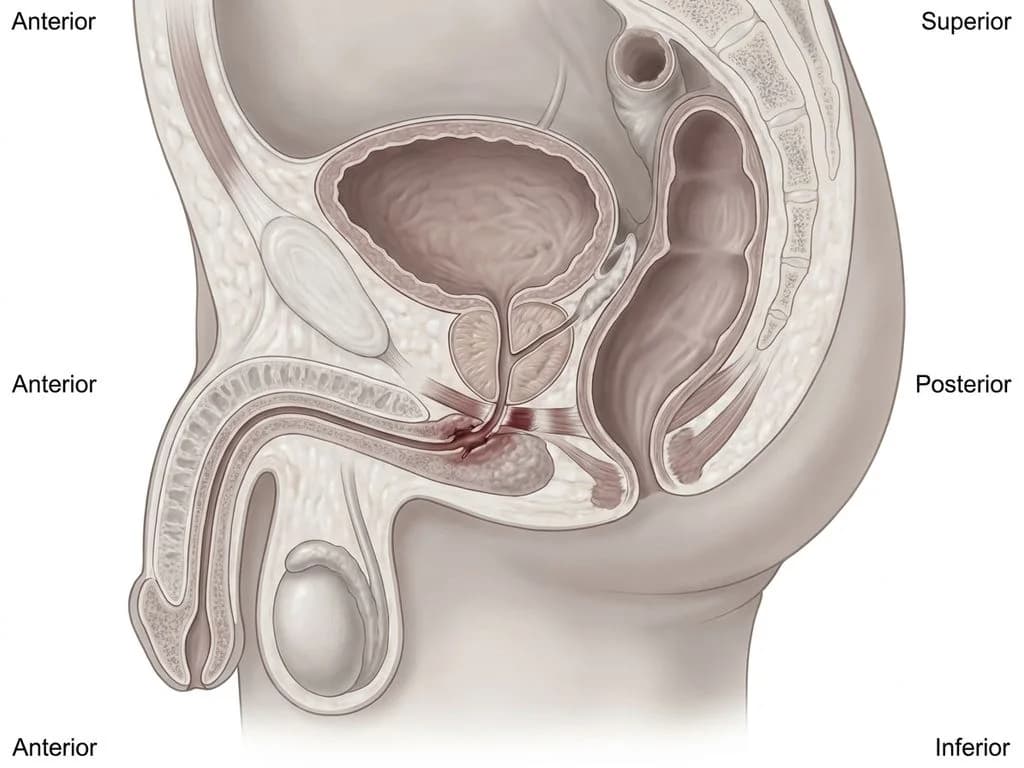
    Clinical image for NEET PG 2022 Q156

    A young male patient with a history of a motor vehicle accident cannot pass urine. Blood is seen at the meatus. What is the most likely site of urethral injury? [image]

    A. Bulbar urethra
    B. Penile urethra
    C. Membranous urethra
    D. Spongy urethra

    Correct Answer: C. Membranous urethra

    The membranous urethra is the most vulnerable segment to traumatic injury following blunt perineal trauma from motor vehicle accidents. This 1–1.5 cm segment lies between the prostatic and bulbar urethra, surrounded by the external urethral sphincter and striated muscle of the urogenital diaphragm. During pelvic fractures or blunt perineal trauma, shearing forces cause the membranous urethra to tear against the rigid pelvic framework. The classic presentation—inability to void (acute urinary retention) with blood at the meatus—indicates anterior urethral injury with disruption of continuity. Membranous urethral injuries are the most common type of posterior urethral trauma in blunt injury settings (unlike penetrating injuries). The mechanism is direct compression and shearing of this fixed, narrow segment. Immediate management involves suprapubic catheterization to decompress the bladder and prevent extravasation of urine into the perineum, followed by delayed urethroplasty (typically 3–6 months post-injury) per Indian urological guidelines. Retrograde urethrography (RUG) confirms the diagnosis by showing contrast extravasation at the membranous level.

    Why the other options are wrong

    A. Bulbar urethra — The bulbar urethra is the most common site of anterior urethral injury (straddle injuries, instrumentation trauma), not blunt pelvic trauma. Bulbar injuries present with blood at meatus but occur with perineal crush injuries (falling on a hard object), not motor vehicle accidents with pelvic fractures. This is the NBE trap—students confuse the most common anterior injury site with the most common posterior injury site in blunt trauma. B. Penile urethra — The penile (spongy) urethra is protected by the corpus spongiosum and is injured only with direct penile trauma or iatrogenic causes (catheterization, instrumentation). Motor vehicle accidents cause pelvic/perineal trauma, not isolated penile injury. Penile urethral injuries are rare in blunt trauma and would not be the expected site in a motor vehicle accident scenario. D. Spongy urethra — The spongy urethra is another term for the penile/bulbar urethra, which is protected by erectile tissue. This option conflates anterior urethral anatomy with the mechanism of blunt pelvic trauma. The spongy tissue acts as a shock absorber, making it less vulnerable to blunt force compared to the fixed, narrow membranous segment.

    High-Yield Facts

    • Membranous urethra is the most common site of posterior urethral injury in blunt pelvic trauma (motor vehicle accidents, pelvic fractures).
    • Blood at meatus + acute retention = anterior urethral injury; blood at meatus + pelvic fracture = posterior (membranous) urethral injury.
    • Suprapubic catheterization is the immediate management for membranous urethral injury; delayed urethroplasty is performed 3–6 months later.
    • Retrograde urethrography (RUG) is the gold standard diagnostic imaging for urethral injury; shows contrast extravasation at the site of disruption.
    • Bulbar urethra is the most common site of anterior urethral injury (straddle injuries, instrumentation), not blunt pelvic trauma.

    Mnemonics

    PUMP for Urethral Injury Sites Pelvic trauma → Posterior (membranous); Anterior trauma (straddle) → Bulbar; Penile trauma → Penile urethra. Use when differentiating injury sites by mechanism. MVA = Membranous (Posterior) Motor Vehicle Accident = Membranous urethra injury. Straddle injury = bulbar (anterior). Quick recall for trauma mechanism.

    NBE Trap

    NBE pairs "blood at meatus" with anterior urethral injury (bulbar) to trap students who memorize the symptom without considering the trauma mechanism. The key discriminator is the motor vehicle accident + pelvic trauma context, which points to posterior (membranous) injury, not anterior.

    Clinical Pearl

    In Indian trauma settings, pelvic fractures from motor vehicle accidents are common; always suspect membranous urethral injury if a patient with pelvic trauma cannot void and has blood at the meatus. Suprapubic catheterization prevents catastrophic urine extravasation and sepsis—a critical bedside decision that prevents morbidity in resource-limited settings.

    _Reference: Bailey & Love Ch. 65 (Urology); Harrison Ch. 279 (Urological Emergencies)_

    Ask AI Tutor about this question

    Stuck on a distractor? Want a worked-through clinical scenario? The AI Tutor is a NEETPGAI Pro feature — sign up free to practice the full question bank, then unlock the AI Tutor when you're ready.

    Explain this concept in plain language
    Why is each wrong option wrong?
    Give me a clinical scenario where this is tested
    Sign up free
    Memory-based reconstruction

    NBE does not officially release NEET PG papers per the 2025 Supreme Court directive. This question was reconstructed from 1 community source: PrepLadder NEET PG 2022 Recall PDF. Cross-verified by Claude Haiku 4.5 + Gemini 2.5 Flash + community-aggregate vote, then reviewed by a practising medical SME.

    ← All NEET PG 2022 questionsPractice with AI Tutor →
    Already have an account? Log in

    Free to start, no credit card required. The 3 prompts/day quota is shared with practice + tutor + deep-dive across NEETPGAI.