Quick Answer
Cranial nerves contribute 4–6 NEET PG questions per paper across Anatomy, Medicine and ENT. The exam-ready framework:
- 12 cranial nerves — function (sensory/motor/mixed) and modality.
- Nuclei locations — midbrain (III, IV), pons (V, VI, VII, VIII), medulla (IX, X, XI, XII).
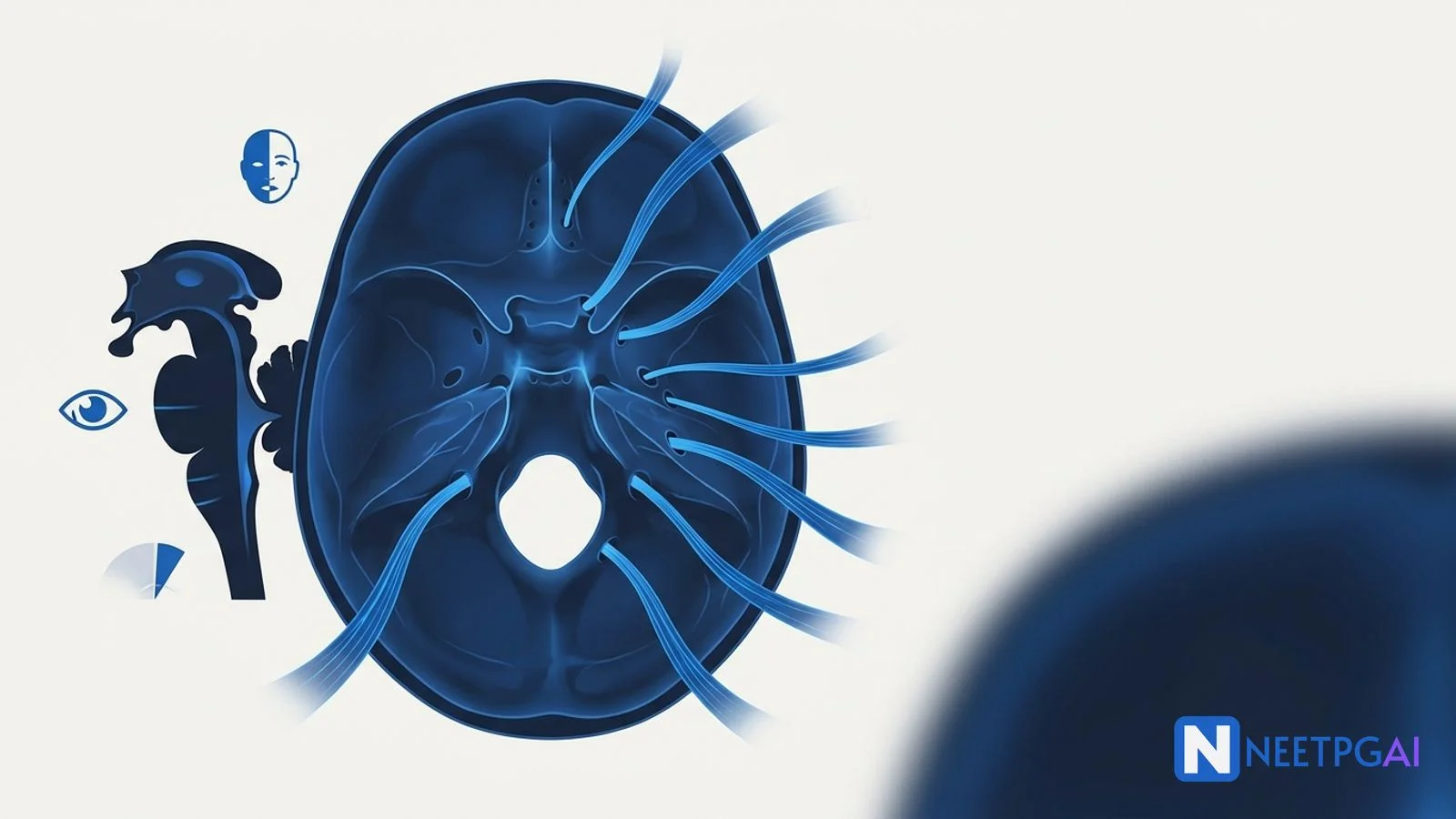
- Foramina of exit — cribriform plate → optic canal → SOF → rotundum → ovale → spinosum (artery) → IAM → jugular foramen → hypoglossal canal.
- Common lesions — CN III palsy (PCA aneurysm), Bell's palsy (LMN VII), trigeminal neuralgia, vestibular schwannoma.
- Brainstem syndromes — Weber (midbrain), Millard-Gubler (pons), Wallenberg (lateral medulla), Medial medullary.
The cranial nerves are NEET PG examiner gold — every nerve has a clean anatomical path, a predictable lesion picture, and a foramen. The trick is to combine three perspectives: brainstem nucleus location (vertical level), foraminal exit (skull base anatomy), and clinical lesion vignette (medicine and surgery). When you can switch between these layers fluently, every cranial nerve MCQ becomes solvable in seconds.
This NEETPGAI deep dive covers all 12 cranial nerves, their nuclei, foramina, branches, common lesions, brainstem syndromes and the exam-favourite clinical tests. Pair this with the brachial plexus complete guide and the common anatomy mistakes primer.
The 12 cranial nerves at a glance
Mnemonic for names: Oh Oh Oh To Touch And Feel Very Good Velvet, Ah Heaven (Olfactory, Optic, Oculomotor, Trochlear, Trigeminal, Abducens, Facial, Vestibulocochlear, Glossopharyngeal, Vagus, Accessory, Hypoglossal).
Mnemonic for modality (Sensory/Motor/Both): Some Say Marry Money But My Brother Says Big Brains Matter More.
| CN | Name | Modality | Function |
|---|
| I | Olfactory | Sensory | Smell |
| II | Optic | Sensory | Vision |
| III | Oculomotor | Motor (+ parasympathetic) | All extraocular muscles except SO and LR; levator palpebrae; pupil constriction; accommodation |
| IV | Trochlear | Motor | Superior oblique (depression in adduction, intorsion) |
| V | Trigeminal | Both | V1 ophthalmic (sensory), V2 maxillary (sensory), V3 mandibular (sensory + muscles of mastication) |
| VI | Abducens | Motor | Lateral rectus |
| VII | Facial | Both | Muscles of facial expression; taste anterior 2/3 tongue (chorda tympani); lacrimation; submandibular/sublingual salivation; stapedius |
| VIII | Vestibulocochlear | Sensory | Hearing (cochlear); balance (vestibular) |
| IX | Glossopharyngeal | Both | Taste posterior 1/3 tongue; carotid body; stylopharyngeus; parotid salivation |
| X | Vagus | Both | Pharynx, larynx, thoracic and abdominal viscera; baroreceptor reflex |
| XI | Accessory | Motor | Sternocleidomastoid, trapezius |
| XII | Hypoglossal | Motor | All intrinsic + extrinsic tongue muscles except palatoglossus (CN X) |
Foramina of exit — skull base anatomy
| Foramen | Cranial fossa | Contents |
|---|
| Cribriform plate (ethmoid) | Anterior | CN I (olfactory filaments) |
| Optic canal (lesser wing of sphenoid) | Middle | CN II + ophthalmic artery |
| Superior orbital fissure (SOF) | Middle | CN III, IV, V1, VI; superior ophthalmic vein |
| Foramen rotundum | Middle | CN V2 (maxillary) |
| Foramen ovale | Middle | CN V3 (mandibular); accessory meningeal artery; lesser petrosal nerve |
| Foramen spinosum | Middle | Middle meningeal artery; meningeal branch of V3 |
| Foramen lacerum | Middle | Internal carotid (passes over, not through) |
| Internal acoustic meatus (IAM) | Posterior | CN VII, VIII; labyrinthine artery |
| Jugular foramen | Posterior | CN IX, X, XI; sigmoid sinus → IJV |
| Hypoglossal canal | Posterior | CN XII |
| Foramen magnum | Posterior | Medulla, vertebral arteries, spinal portion of CN XI |
SOF mnemonic: "Lazy French Tart Lying Flat In Anticipation" (Lacrimal, Frontal, Trochlear, Lateral SOV, Frontal nerve... use whichever sequence you prefer; the key NEET PG mnemonic for SOF contents is simply III, IV, V1, VI + SOV).
Cranial nerve nuclei — vertical layout
- Midbrain: CN III (oculomotor), CN IV (trochlear; only nerve from dorsal aspect; only nerve to cross); Edinger-Westphal (parasympathetic to ciliary ganglion).
- Pons: CN V motor and main sensory, CN VI, CN VII, CN VIII (vestibular and cochlear).
- Medulla: CN IX, CN X, CN XI (cranial portion), CN XII; nucleus ambiguus (motor for IX, X, cranial XI); nucleus solitarius (visceral sensory + taste); dorsal motor nucleus of vagus.
High-yield individual nerves and lesions
CN III (oculomotor)
- Lesion: "Down and out" eye + ptosis + dilated pupil. Loss of medial, superior, inferior recti and inferior oblique; loss of levator palpebrae; loss of parasympathetic pupil constriction.
- Compressive (PCA aneurysm, uncal herniation): parasympathetic fibres on outside affected first → fixed dilated pupil with motor weakness.
- Ischaemic (diabetes): core motor fibres affected; pupil-sparing classic vignette.
CN IV (trochlear)
- Lesion: vertical diplopia worse on looking down (e.g., reading, descending stairs); head tilt away from affected side compensates intorsion loss (Bielschowsky head tilt test).
- Most commonly injured by head trauma (longest intracranial course; only CN exiting dorsally).
CN V (trigeminal)
- Trigeminal neuralgia: unilateral lancinating pain in V2/V3 distribution; trigger points (chewing, brushing, breeze). MRI may show vascular compression by superior cerebellar artery. Carbamazepine first line.
- Corneal reflex: afferent V1, efferent VII.
- Jaw jerk: afferent and efferent V; brisk in UMN lesions (pseudobulbar palsy).
CN VI (abducens)
- Long intracranial course → vulnerable to raised ICP (false localising sign).
- Lesion: failure of abduction; horizontal diplopia worse on lateral gaze.
CN VII (facial)
- Bell's palsy — idiopathic LMN VII palsy (HSV-1 reactivation suspected); affects entire ipsilateral face including forehead. Hyperacusis (stapedius), taste loss anterior 2/3 tongue (chorda tympani), reduced lacrimation depending on lesion site relative to geniculate ganglion.
- Treatment: prednisolone within 72 hours; eye protection; +/- acyclovir.
- UMN lesion (stroke): spares forehead due to bilateral cortical input.
- Ramsay Hunt syndrome — VZV reactivation in geniculate ganglion; vesicles in external auditory canal + facial palsy.
CN VIII (vestibulocochlear)
- Vestibular schwannoma at cerebellopontine angle → progressive SNHL + tinnitus + disequilibrium; large tumour compresses CN V (corneal reflex loss) and CN VII (late).
- Bilateral vestibular schwannomas — pathognomonic of neurofibromatosis type 2 (NF2).
- Rinne and Weber tests — distinguish conductive vs sensorineural hearing loss.
CN IX, X, XI, XII
- CN IX (glossopharyngeal): lost gag reflex (afferent IX, efferent X); loss of taste posterior 1/3 tongue; carotid sinus reflex.
- CN X (vagus): uvular deviation away from affected side; hoarseness (recurrent laryngeal); dysphagia. Recurrent laryngeal nerve injury (thyroid surgery) — most common cause of unilateral vocal cord paralysis.
- CN XI (accessory): weakness of SCM (turning head to opposite side) and trapezius (shoulder shrug). Injured during posterior triangle surgery (lymph node biopsy).
- CN XII (hypoglossal): tongue deviates toward affected side on protrusion (genioglossus weakness); fasciculations and atrophy in LMN lesions.
Brainstem syndromes — high-yield combinations
| Syndrome | Site | Vessel | Features |
|---|
| Weber | Ventral midbrain | Paramedian branches of PCA | Ipsilateral CN III palsy + contralateral hemiplegia (corticospinal tract) |
| Benedikt | Midbrain tegmentum | PCA | Ipsilateral CN III palsy + contralateral involuntary movements (red nucleus) |
| Claude | Dorsal midbrain | PCA | Ipsilateral CN III + contralateral cerebellar ataxia |
| Parinaud | Dorsal midbrain | Pineal lesion | Vertical gaze palsy + light-near dissociation + lid retraction (Collier sign) |
| Millard-Gubler | Ventral pons | Pontine branches of basilar | Ipsilateral CN VI + CN VII + contralateral hemiplegia |
| Foville | Dorsal pons | Pontine branches | Lateral gaze palsy + ipsilateral CN VII + contralateral hemiplegia |
| Wallenberg (lateral medullary) | Lateral medulla | PICA / vertebral | Ipsilateral V (face), Horner, dysphagia (IX/X), ataxia + contralateral body spinothalamic loss |
| Medial medullary (Dejerine) | Medial medulla | Anterior spinal artery | Ipsilateral CN XII (tongue) + contralateral hemiplegia + contralateral medial lemniscus loss |
| Locked-in syndrome | Bilateral ventral pons | Basilar artery | Quadriplegia, anarthria; only vertical eye movement and blinking preserved |
NEET PG memory rule: in brainstem strokes, the cranial nerve sign is ipsilateral to the lesion, and the long-tract signs (motor, sensory) are contralateral.
Cavernous sinus syndrome
- Contents: CN III, IV, V1, V2, VI; internal carotid artery.
- CN VI is most vulnerable (free in the sinus); others run in lateral wall.
- Causes: cavernous sinus thrombosis (often from facial/orbital infections — danger triangle of face), pituitary apoplexy, carotid-cavernous fistula, mucormycosis (especially diabetic ketoacidosis).
- Features: ophthalmoplegia + chemosis + proptosis + V1/V2 sensory loss.
Clinical testing — bedside drills
- CN I: test each nostril separately with non-irritant odour (coffee, vanilla).
- CN II: acuity, fields by confrontation, pupil reflexes (afferent), fundoscopy.
- CN III, IV, VI: "H" pattern; assess for diplopia, ptosis, pupil size and reactivity.
- CN V: light touch in V1/V2/V3; corneal reflex; jaw jerk; muscles of mastication.
- CN VII: facial movements (raise eyebrows, screw eyes shut, smile, puff cheeks); taste anterior 2/3 tongue.
- CN VIII: Rinne, Weber, head impulse, head shaking.
- CN IX, X: uvular elevation, gag reflex, hoarseness, swallowing.
- CN XI: shoulder shrug (trapezius), head turn against resistance (SCM).
- CN XII: tongue protrusion, lateral movements, atrophy/fasciculations.
NEET PG MCQ traps (high-yield list)
- CN IV — only nerve from dorsal aspect of brainstem; only nerve to decussate.
- Foramen spinosum carries middle meningeal artery, NOT a cranial nerve.
- Pupil-sparing CN III palsy = ischaemic (diabetes); pupil-involving = compressive (aneurysm).
- Bell's palsy affects forehead; stroke spares forehead.
- Tongue deviates TOWARDS lesion in LMN CN XII; uvula deviates AWAY from CN X lesion.
- Wallenberg = lateral medullary; Dejerine = medial medullary.
- CN VI is the false localising sign in raised ICP (long course over petrous temporal).
- Acoustic neuroma corneal reflex loss occurs before facial palsy (because CN V is medial to CN VII at the CPA).
- Trigeminal neuralgia — carbamazepine first line; microvascular decompression for refractory.
- Hypoglossal canal = CN XII only; jugular foramen = CN IX, X, XI.
- Sphenopalatine ganglion — parasympathetic for lacrimal gland (via CN VII greater petrosal).
- Otic ganglion — parasympathetic for parotid (via CN IX lesser petrosal).
Recent updates (2025–2026)
- NMC 2024 syllabus reinforces brainstem syndromes and cavernous sinus anatomy as Phase 1 + Phase 3 cross-overs.
- High-resolution 3T MRI has improved detection of vascular compression in trigeminal neuralgia, expanding indications for microvascular decompression.
- Mucor mycosis and cavernous sinus thrombosis in COVID-recovery diabetic patients (especially 2021–2024 Indian outbreak) remain a high-yield modern stem.
- Bilateral acoustic neuromas continue to be diagnostic of NF2 (chromosome 22q12, NF2/merlin gene).
Frequently Asked Questions
What are the foramina of exit for the 12 cranial nerves?
CN I — cribriform plate; CN II — optic canal; CN III, IV, V1, VI — superior orbital fissure; CN V2 — foramen rotundum; CN V3 — foramen ovale; CN VII, VIII — internal acoustic meatus; CN IX, X, XI — jugular foramen; CN XII — hypoglossal canal. The middle meningeal artery (not a cranial nerve) passes through foramen spinosum.
How do you differentiate upper motor neurone facial palsy from Bell's palsy?
UMN (supranuclear, e.g., stroke) facial palsy spares the forehead because the upper face has bilateral cortical innervation. Bell's palsy is a peripheral LMN lesion of CN VII — the entire ipsilateral half of the face, including the forehead, is paralysed. Bell's palsy may also include hyperacusis, taste loss in the anterior 2/3 of the tongue, and reduced lacrimation depending on lesion site.
What is Wallenberg syndrome and what are its features?
Wallenberg (lateral medullary) syndrome is caused by occlusion of the posterior inferior cerebellar artery (PICA) or vertebral artery. Features: ipsilateral facial pain/temperature loss (CN V spinal nucleus), Horner's syndrome (descending sympathetic), dysphagia and hoarseness (CN IX, X — nucleus ambiguus), vertigo and nystagmus (vestibular), ataxia (inferior cerebellar peduncle), and contralateral body pain/temperature loss (spinothalamic tract).
Which cranial nerve is most commonly affected in vestibular schwannoma?
Vestibular schwannoma (acoustic neuroma) arises from the vestibular division of CN VIII at the cerebellopontine angle. It causes progressive sensorineural hearing loss, tinnitus and disequilibrium. Larger tumours compress CN V (facial numbness, loss of corneal reflex) and CN VII (facial weakness — late). Bilateral schwannomas are pathognomonic of neurofibromatosis type 2.
What is the classical pupil finding in CN III palsy and its clinical significance?
A 'down and out' eye with a fixed dilated pupil and ptosis suggests a compressive CN III palsy — the parasympathetic fibres travel on the outside of the nerve and are affected first. Common causes are posterior communicating artery aneurysm and uncal herniation. A pupil-sparing CN III palsy (motor weakness without pupil involvement) suggests ischaemic causes such as diabetes mellitus.
This content is for educational purposes for NEET PG exam preparation. It is not a substitute for professional medical advice, diagnosis, or treatment. Clinical information has been reviewed by qualified medical professionals.
Written by: NEETPGAI Editorial Team
Reviewed by: Pending SME Review
Last reviewed: May 2026