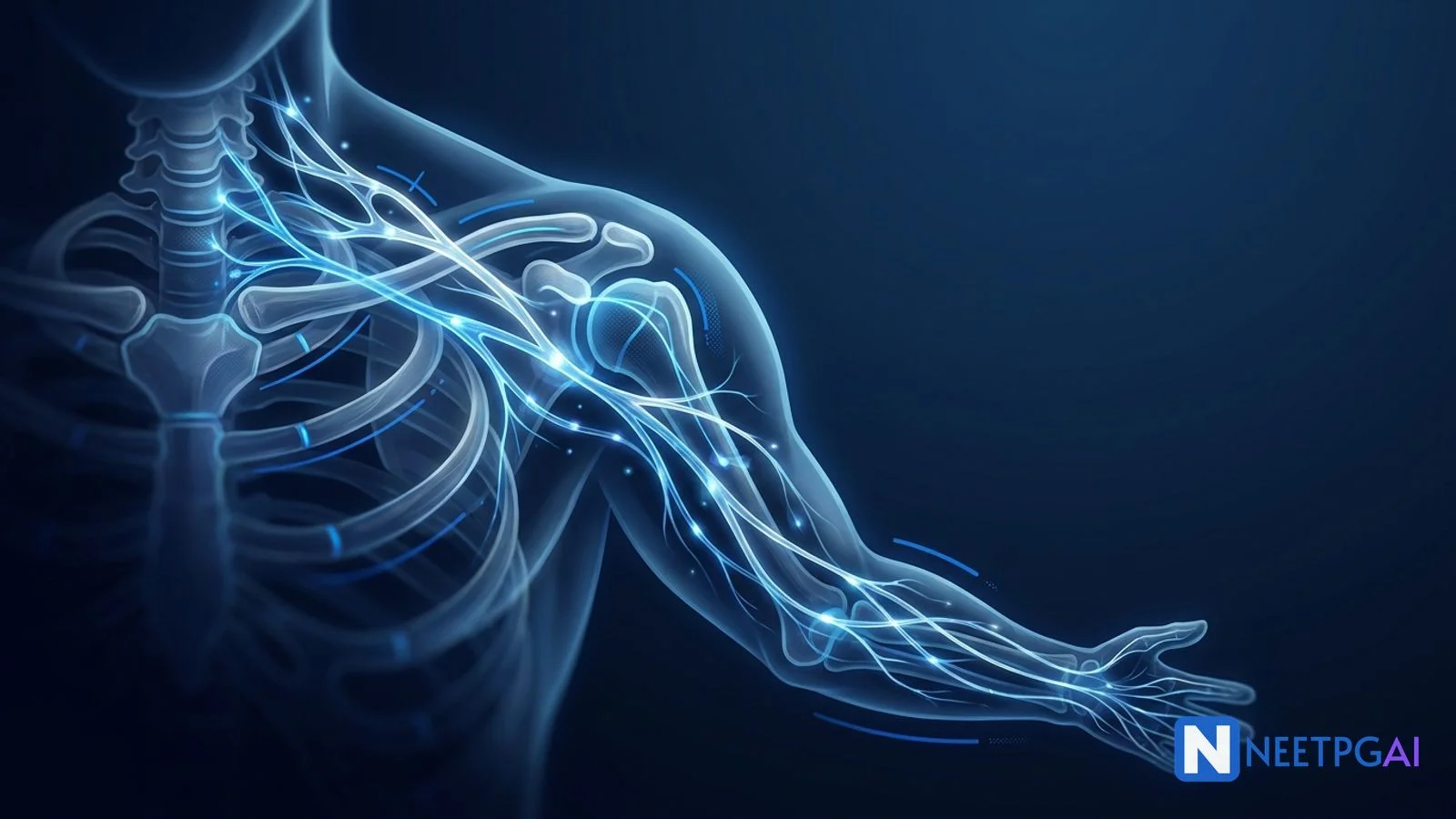
Brachial Plexus — Complete Anatomy Guide for NEET PG
Master brachial plexus anatomy for NEET PG: roots C5-T1, trunks, divisions, cords, terminal branches, injury patterns (Erb-Duchenne, Klumpke, Saturday night palsy), mnemonics, and high-yield clinical correlations.
NEETPGAI EditorialReviewed by SME Agent
Published 13 Nov 2025
33 min read
Version 1.1 — Updated April 2026 (added TOC, references, author attribution)
Quick Answer
The brachial plexus is formed by the ventral rami of C5-T1 and supplies the entire upper limb. Its five structural levels — Roots, Trunks, Divisions, Cords, Branches (mnemonic: Robert Taylor Drinks Cold Beer) — are tested relentlessly in NEET PG. The five terminal branches from the cords follow the MARMU pattern: Musculocutaneous, Axillary, Radial, Median, Ulnar. The three injury patterns you must know cold are Erb-Duchenne palsy (C5-C6, waiter's tip), Klumpke palsy (C8-T1, claw hand with possible Horner syndrome), and Saturday night palsy (radial nerve in the spiral groove, wrist drop). Master the plexus diagram, and you unlock 3-5 direct marks plus cross-subject questions in Surgery and Pediatrics.
The brachial plexus is the single most examined nerve plexus in NEET PG Anatomy. It appears as direct anatomy questions, as nerve-injury identification in Surgery, as birth-injury presentations in Pediatrics, and as sensory-deficit mapping in clinical vignettes across the paper. Yet students consistently underperform on it — not because the anatomy is inherently difficult, but because they memorize fragments instead of building the complete structural logic.
This guide gives you the full architecture: every root, trunk, division, cord, and branch, with the clinical correlations and injury patterns that NBE actually tests. The approach is systematic — understand the structure once, and you can reconstruct any detail under exam pressure. Pair this with dedicated MCQ drilling on the Anatomy subject hub and you will find that brachial plexus questions become some of the easiest marks on the paper.
Why the brachial plexus is the highest-yield anatomy topic for NEET PG
Three reasons. First, frequency. Across recent NEET PG papers and their close analogues, the brachial plexus and its terminal branches contribute 3-5 direct questions per sitting. Add the indirect questions — fracture-associated nerve injuries in Surgery, birth injuries in Pediatrics, nerve-block anatomy in Anesthesia — and the effective count rises to 6-8 questions that require brachial plexus knowledge.
Second, predictability. The question framings repeat. "Which nerve is injured in fracture of the shaft of humerus?" has appeared in some form in nearly every recent paper. "Erb's point is located at?" is a perennial. The injury patterns are finite, and NBE cycles through the same clinical scenarios with minor rewording. Once you know the template, you recognize the question before you finish reading the stem.
Third, cross-subject leverage. A single understanding of the posterior cord's branches lets you answer questions in Anatomy (cord relations to axillary artery), Orthopedics (nerve injuries in humeral fractures), Pediatrics (brachial plexus birth palsy), and even Medicine (peripheral neuropathy localization). No other anatomy topic offers this kind of return across subjects.
Share this article
This content is for educational purposes for NEET PG exam preparation. It is not a substitute for professional medical advice, diagnosis, or treatment. Clinical information has been reviewed by qualified medical professionals.
Ready to put this into practice?
Start practicing NEET PG MCQs with AI-powered explanations.
The trap is superficiality. Students learn "radial nerve — wrist drop" as an isolated fact and miss the structural reasoning that would let them answer any variant. This guide builds the reasoning from the ground up.
The five structural levels: roots to branches
The brachial plexus has five levels, and every NEET PG question can be answered by knowing which level is involved and what passes through it. The mnemonic Robert Taylor Drinks Cold Beer maps the levels: Roots, Trunks, Divisions, Cords, Branches.
Level 1 — Roots (C5, C6, C7, C8, T1)
The ventral rami of spinal nerves C5 through T1 emerge from the intervertebral foramina and pass between the scalenus anterior and scalenus medius muscles. This inter-scalene space is the entry point of the plexus into the neck, and it matters clinically because scalene pathology or a cervical rib can compress the roots here.
Pre-fixed plexus receives a contribution from C4; post-fixed plexus receives a contribution from T2. These variants change the injury pattern slightly but are rarely tested directly. What is tested is the root value of specific nerves — particularly the long thoracic nerve (C5, C6, C7) and the dorsal scapular nerve (C5), both of which arise directly from the roots before the trunks form.
High-yield branches from the roots:
Nerve
Root
Motor supply
Clinical relevance
Dorsal scapular nerve
C5
Rhomboids, levator scapulae
Scapular winging (medial border)
Long thoracic nerve
C5, C6, C7
Serratus anterior
Winged scapula (classic)
Nerve to subclavius
C5, C6
Subclavius
Rarely tested
Phrenic nerve contribution
C5 (partly C3, C4)
Diaphragm
Tested in Physiology, not Anatomy
The long thoracic nerve is the star here. It runs on the superficial surface of serratus anterior along the chest wall, making it vulnerable during axillary lymph node dissection (mastectomy). Injury produces winged scapula — the medial border of the scapula lifts off the chest wall when the patient pushes against a wall. This is one of the most frequently tested clinical correlations in upper limb anatomy.
Level 2 — Trunks
The five roots merge into three trunks in the posterior triangle of the neck:
Upper trunk = C5 + C6
Middle trunk = C7 alone (the only trunk from a single root)
Lower trunk = C8 + T1
The trunks lie in the posterior triangle, superior to the clavicle. Erb's point — the junction of C5 and C6 that forms the upper trunk — is the most commonly tested landmark. It lies about 2-3 cm above the clavicle, roughly at the level where the upper trunk emerges.
High-yield branch from the upper trunk:
Suprascapular nerve (C5, C6) — passes through the suprascapular notch (under the transverse scapular ligament) to supply supraspinatus and infraspinatus. Injury at the suprascapular notch causes difficulty initiating shoulder abduction (supraspinatus, 0-15 degrees) and weakness of lateral rotation (infraspinatus). The suprascapular artery passes over the ligament while the nerve passes under it — a classic NEET PG anatomy question.
Nerve to subclavius (C5, C6) — a minor nerve, rarely tested.
Level 3 — Divisions
Each trunk splits into an anterior and a posterior division, yielding six divisions in total (three anterior, three posterior). The divisions pass behind the clavicle and are the deepest structures of the plexus. They have no named branches of their own.
The conceptual importance of the divisions is functional segregation: anterior divisions supply flexor compartments of the upper limb, and posterior divisions supply extensor compartments. This is the organizing principle that makes the entire plexus logical. If you remember nothing else, remember: anterior = flexion, posterior = extension.
Level 4 — Cords
The six divisions regroup into three cords in the axilla. The cords are named by their relationship to the second part of the axillary artery — this is a guaranteed NEET PG question framing.
Lateral cord = anterior divisions of upper trunk + middle trunk. Lies lateral to the axillary artery.
Posterior cord = all three posterior divisions (upper + middle + lower). Lies posterior to the axillary artery.
Medial cord = anterior division of lower trunk alone. Lies medial to the axillary artery.
Mnemonic for cord formation: "Lateral is LM (Lateral = Lateral and Middle), Posterior is all three, Medial is just the Lower." Some students use "LML-PPP-L" — the anterior divisions of the Lateral (upper), Middle, and Lower trunks contribute to Lateral, Posterior, Posterior, Posterior, and Lower-to-Medial respectively.
Branches from each cord (before terminal branches):
Lateral cord:
Lateral pectoral nerve — pectoralis major (clavicular head)
Lower subscapular nerve — subscapularis (lower part) + teres major
Thoracodorsal nerve — latissimus dorsi
Radial nerve (terminal)
Axillary nerve (terminal)
Medial cord:
Medial pectoral nerve — pectoralis minor (and part of pectoralis major)
Medial cutaneous nerve of arm (medial brachial cutaneous)
Medial cutaneous nerve of forearm (medial antebrachial cutaneous)
The thoracodorsal nerve to latissimus dorsi is clinically important during axillary surgery. The medial pectoral nerve, despite its name, actually enters from the lateral side of pectoralis minor — the "medial" refers to its cord of origin, not its position. This naming confusion is a known exam trap.
Level 5 — Terminal branches
The five terminal branches are the clinical workhorses of the brachial plexus. The mnemonic MARMU lists them from lateral to medial:
Musculocutaneous nerve — from the lateral cord
Axillary nerve — from the posterior cord
Radial nerve — from the posterior cord
Median nerve — from the lateral cord + medial cord (the only terminal branch with dual cord origin)
Ulnar nerve — from the medial cord
Each of these nerves has a characteristic injury pattern that NBE tests repeatedly. The next five sections cover each in detail.
The musculocutaneous nerve pierces the coracobrachialis muscle (a defining relationship — "musculocutaneous pierces coracobrachialis" is a stand-alone MCQ answer). It then runs between biceps brachii and brachialis, supplying all three muscles of the anterior compartment of the arm:
Coracobrachialis — flexion and adduction at shoulder
Biceps brachii — flexion at elbow, supination of forearm
Brachialis — pure elbow flexion (the workhorse flexor)
After supplying these muscles, it continues as the lateral cutaneous nerve of the forearm, providing sensation to the lateral aspect of the forearm. This sensory continuation is frequently tested.
Injury pattern: Loss of elbow flexion (weakened, not abolished — brachioradialis via the radial nerve provides partial compensation) and loss of forearm supination. Sensory loss over the lateral forearm. Isolated musculocutaneous nerve injury is rare; it most commonly occurs with upper trunk injuries or during anterior shoulder surgery.
Axillary nerve (C5, C6) — posterior cord
The axillary nerve exits the axilla through the quadrangular space (bounded by teres minor above, teres major below, long head of triceps medially, and surgical neck of humerus laterally). It wraps around the surgical neck of the humerus — this anatomical relationship is the single most important fact about the axillary nerve for NEET PG.
Motor supply:
Deltoid — abduction of the shoulder (15-90 degrees; supraspinatus initiates 0-15 degrees)
Teres minor — lateral rotation of the shoulder
Sensory supply:
Regimental badge area — a patch of skin over the lateral aspect of the upper arm, corresponding to the area where a military badge would sit
Injury pattern: The axillary nerve is injured in:
Fracture of the surgical neck of the humerus — the most tested scenario
Anterior dislocation of the shoulder — the nerve is stretched over the humeral head
Intramuscular injections placed too low on the deltoid
Clinical presentation: inability to abduct the shoulder beyond 15 degrees (supraspinatus still initiates), flattening of the deltoid contour, and sensory loss over the regimental badge area. The shoulder appears "squared off" because the rounded deltoid contour is lost.
The radial nerve is the largest terminal branch and the most commonly injured nerve of the upper limb. It is the nerve of the extensor compartment — if you remember "radial = extension," you can reconstruct most of its supply.
Course and vulnerable points:
Axilla — runs in the spiral groove (radial groove) on the posterior surface of the humerus, accompanied by the profunda brachii artery
Lateral intermuscular septum — pierces it to enter the anterior compartment
Cubital fossa — divides into superficial (sensory) and deep (posterior interosseous nerve, motor) branches
Posterior interosseous nerve (PIN) — passes through the arcade of Frohse in the supinator muscle
Motor supply (the extensor lineup):
In the arm:
Triceps brachii — elbow extension
Brachioradialis — elbow flexion (the exception — a "flexor" supplied by the radial nerve)
Extensor carpi radialis longus — wrist extension
In the forearm (via posterior interosseous nerve):
Extensor carpi radialis brevis — wrist extension
Supinator — forearm supination
All extensors of the fingers and thumb — extensor digitorum, extensor digiti minimi, extensor carpi ulnaris, abductor pollicis longus, extensor pollicis longus, extensor pollicis brevis, extensor indicis
Sensory supply:
Posterior cutaneous nerve of arm
Lower lateral cutaneous nerve of arm
Posterior cutaneous nerve of forearm
Superficial branch of radial nerve — dorsum of hand (lateral 3.5 digits, proximal phalanges only)
Injury patterns — the NEET PG favorites:
Saturday night palsy (spiral groove injury): The radial nerve is compressed against the humerus when the arm is draped over a chair or a partner's head during sleep (classically after alcohol intoxication — hence "Saturday night"). Presentation: wrist drop (loss of wrist extension), finger drop at MCP joints (loss of finger extension), and sensory loss on the dorsum of the hand. Triceps is spared because its branch arises before the spiral groove. Brachioradialis and ECRL may be spared depending on exact injury level.
Fracture of the shaft of the humerus: The radial nerve lies directly on bone in the spiral groove, making it the most vulnerable nerve in humeral shaft fractures. The presentation is identical to Saturday night palsy. This is among the most frequently repeated questions in NEET PG — "nerve injured in fracture of shaft of humerus" has appeared in virtually every recent paper.
Posterior interosseous nerve syndrome: Compression at the arcade of Frohse causes finger drop without wrist drop (ECRL is spared, so wrist extension is preserved but deviates radially) and without sensory loss (the PIN is pure motor). This is a subtler presentation that differentiates it from spiral groove lesions.
Median nerve (C5, C6, C7, C8, T1) — lateral and medial cords
The median nerve has the broadest root value of any terminal branch (all five roots contribute). It is formed by the union of a lateral root (from the lateral cord) and a medial root (from the medial cord), which join anterior to the axillary artery — the two roots form a "fork" around the artery, another classic exam image.
Course:
Runs alongside the brachial artery in the arm (no motor branches in the arm — a frequently tested negative)
Enters the cubital fossa medial to the brachial artery and the biceps tendon
Passes between the two heads of pronator teres (first compression point)
Gives off the anterior interosseous nerve (purely motor)
Enters the hand through the carpal tunnel under the flexor retinaculum
Motor supply:
In the forearm:
Pronator teres — forearm pronation
Flexor carpi radialis — wrist flexion
Palmaris longus — wrist flexion (absent in ~14% of population)
Flexor digitorum superficialis — flexion at PIP joints of all fingers
Lateral half of flexor digitorum profundus (index and middle fingers) — via anterior interosseous nerve
Flexor pollicis longus — via anterior interosseous nerve
Pronator quadratus — via anterior interosseous nerve
In the hand (the LOAF muscles — a critical mnemonic):
Lumbrical 1 and 2 (lateral two lumbricals)
Opponens pollicis
Abductor pollicis brevis
Flexor pollicis brevis (superficial head)
Sensory supply:
Palmar cutaneous branch (skin over thenar eminence — branches before the carpal tunnel, so spared in carpal tunnel syndrome)
Digital branches to lateral 3.5 fingers (palmar surface and dorsal fingertips)
Injury patterns:
Carpal tunnel syndrome: Compression of the median nerve under the flexor retinaculum. Presentation: nocturnal pain and paresthesia in the lateral 3.5 fingers (palmar surface), thenar muscle wasting (ape hand deformity) in chronic cases, positive Phalen test and Tinel sign. The palmar cutaneous branch is spared because it passes superficial to the retinaculum — this preservation of thenar skin sensation with loss of digital sensation is a pathognomonic pattern.
Ape hand (hand of benediction): Loss of thenar muscles, particularly opponens pollicis. The thumb cannot oppose and lies in the same plane as the other digits, resembling an ape's hand. When the patient attempts to make a fist, the index and middle fingers cannot flex (if the injury is above the wrist, affecting FDS and lateral FDP too), producing the hand of benediction — a distinct presentation from the claw hand of ulnar injury.
Anterior interosseous syndrome: Pure motor deficit — loss of FPL, lateral FDP, and pronator quadratus. The patient cannot make an "OK" sign (cannot flex DIP of index finger and IP of thumb). No sensory loss. This is a subtle but frequently tested presentation.
High median nerve injury (above elbow): All median nerve functions lost. Pronation weak (only pronator quadratus via AIN), loss of wrist flexion (only FCU via ulnar nerve remains, so wrist deviates ulnarly), loss of opposition and precision grip. The hand becomes functionally useless for fine movements.
Ulnar nerve (C8, T1) — medial cord
The ulnar nerve is the "nerve of fine movements" — it supplies most of the intrinsic muscles of the hand. It is also the most commonly injured nerve at the elbow.
Course (and why it is called the "funny bone" nerve):
Runs posterior to the medial epicondyle of the humerus in the cubital tunnel — this superficial position makes it vulnerable to trauma (the "funny bone" sensation when you hit your elbow)
Enters the forearm between the two heads of flexor carpi ulnaris
Runs on FDP in the forearm
Enters the hand through Guyon's canal (between the pisiform and hook of hamate, superficial to the flexor retinaculum — not through the carpal tunnel)
Medial half of flexor digitorum profundus (ring and little fingers)
In the hand (most intrinsic muscles):
Hypothenar muscles — abductor digiti minimi, flexor digiti minimi brevis, opponens digiti minimi
Lumbricals 3 and 4 (medial two)
All interossei (dorsal and palmar) — the interossei are crucial for finger abduction/adduction and MCP flexion with IP extension
Adductor pollicis
Flexor pollicis brevis (deep head)
Palmaris brevis
Sensory supply:
Dorsal cutaneous branch — dorsum of medial 1.5 fingers (branches in the forearm, 5 cm above the wrist)
Palmar digital branches — palmar surface of medial 1.5 fingers
Injury patterns:
Claw hand: The hallmark of ulnar nerve injury. The ring and little fingers are hyperextended at the MCP joints (due to unopposed action of extensors, since the interossei and medial lumbricals are paralyzed) and flexed at the IP joints (due to unopposed FDP action). The index and middle fingers are spared because their lumbricals (1 and 2) are supplied by the median nerve.
The ulnar paradox: This is one of the most tested concepts. Ulnar nerve injury at the wrist produces a more obvious claw than injury at the elbow. Why? At the wrist, the FDP to ring and little fingers is intact (its ulnar nerve supply branches off in the forearm), so those fingers can flex powerfully at the DIP, creating a dramatic claw. At the elbow, the FDP is also paralyzed, so the fingers cannot flex at the DIP, and the claw is flatter — "paradoxically" less deformed despite being a worse injury.
Froment sign: When asked to grip a piece of paper between the thumb and index finger, the patient with ulnar nerve palsy flexes the IP joint of the thumb (using FPL, a median nerve muscle) to compensate for the paralyzed adductor pollicis. This is Froment sign — a pathognomonic test for ulnar nerve injury.
Guyon's canal syndrome: Compression at the wrist in the canal between the pisiform and hook of hamate. Commonly caused by cycling (handlebar palsy) or ganglion cysts. Motor and sensory deficits in the hand, but forearm muscles are spared. Differentiate from cubital tunnel syndrome (elbow) where FCU and FDP to ring/little fingers are also affected.
Cubital tunnel syndrome: Compression behind the medial epicondyle. Most common site of ulnar nerve entrapment. All ulnar nerve functions distal to the elbow are affected.
High-yield injury patterns: the clinical correlation table
This table consolidates every nerve injury that NBE tests. Print it, memorize it, and you will handle any clinical vignette on the brachial plexus.
Injury
Nerve/Root
Mechanism
Clinical sign
Motor loss
Sensory loss
Erb-Duchenne palsy
Upper trunk (C5-C6)
Shoulder dystocia, forceful separation of head and shoulder
Waiter's tip: arm adducted, medially rotated, forearm pronated
Medial border of scapula protrudes when pushing against wall
Serratus anterior
None significant
Wrist drop
Radial nerve (spiral groove)
Humeral shaft fracture, Saturday night palsy
Wrist drop, finger drop at MCP, loss of grip
All extensors (triceps spared)
Dorsum of hand, lateral 3.5 digits (dorsal)
Ape hand
Median nerve (at wrist)
Carpal tunnel syndrome, wrist laceration
Thenar wasting, loss of opposition
LOAF muscles
Lateral 3.5 fingers (palmar)
Claw hand
Ulnar nerve (at wrist)
Guyon's canal compression, wrist laceration
Clawing of ring and little fingers, Froment sign
All interossei, medial 2 lumbricals, hypothenar muscles
Medial 1.5 fingers
Hand of benediction
Median nerve (above elbow)
Supracondylar fracture of humerus
Index and middle fingers remain extended when attempting to make a fist
FDS, lateral FDP, LOAF muscles
Lateral 3.5 fingers (palmar)
Finger drop (no wrist drop)
Posterior interosseous nerve
Monteggia fracture, arcade of Frohse compression
Finger extension lost, wrist extension preserved but radially deviated
Finger extensors, thumb extensors, ECU
None (pure motor nerve)
Erb-Duchenne palsy (C5-C6): the waiter's tip deformity
Erb-Duchenne palsy results from injury to the upper trunk at Erb's point — the junction of C5 and C6. It is the most common brachial plexus birth injury, and its clinical presentation is among the most frequently tested vignettes in NEET PG.
Causes:
Birth injury — shoulder dystocia during delivery, where excessive lateral flexion of the head away from the shoulder stretches the upper trunk
Motorcycle accidents — same mechanism of forceful head-shoulder separation
Fall on the shoulder with the head forced to the opposite side
Muscles paralyzed (C5-C6 supply):
Deltoid and supraspinatus — loss of shoulder abduction
Infraspinatus and teres minor — loss of lateral rotation
Biceps and brachialis — loss of elbow flexion
Brachioradialis — loss of elbow flexion (supplementary)
Supinator — loss of forearm supination
The "waiter's tip" position: The arm hangs by the side, adducted (loss of deltoid), medially rotated (loss of infraspinatus), with the forearm pronated (loss of biceps and supinator) and the wrist slightly flexed. The hand can still grip because C8-T1 is intact. The posture resembles a waiter expecting a tip with the palm facing backward and upward.
Associated findings:
Loss of biceps reflex (C5-C6)
Loss of sensation over the lateral aspect of the arm and forearm (C5-C6 dermatomes)
In neonates, the affected arm is limp with an asymmetric Moro reflex (the affected side does not abduct)
Klumpke palsy (C8-T1): claw hand and Horner syndrome
Klumpke palsy results from injury to the lower trunk (C8-T1). It is less common than Erb-Duchenne palsy but carries a distinctive clinical picture that makes it highly testable.
Causes:
Birth injury — traction on the abducted arm during breech delivery (the arm is pulled upward, stretching the lower trunk)
Clutching at an object during a fall (hyperabduction injury)
Pancoast tumor — apical lung tumor invading the lower trunk
Cervical rib compression
Muscles paralyzed (C8-T1 supply):
All intrinsic muscles of the hand (interossei, lumbricals 3 and 4, thenar and hypothenar muscles)
Long flexors of the fingers and wrist (FDP, FDS, FCU)
Forearm pronators are partially affected
Clinical presentation:
Claw hand deformity — hyperextension at MCP joints with flexion at IP joints (though the claw is less dramatic than in isolated ulnar nerve injury at the wrist, because the FDP is also affected)
Loss of fine movements — cannot write, button clothes, or pick up small objects
Wasting of all intrinsic hand muscles — the hand appears flattened with visible interosseous hollows
Horner syndrome: If the T1 root is injured proximal enough to affect the sympathetic fibers that travel with T1 before joining the sympathetic chain, the patient develops ipsilateral Horner syndrome: ptosis (drooping eyelid), miosis (constricted pupil), anhidrosis (loss of sweating on the face), and enophthalmos (apparent sunken eye). The combination of claw hand + Horner syndrome is virtually pathognomonic for Klumpke palsy — if you see this combination in a stem, you have the answer.
Winged scapula: the long thoracic nerve injury
The long thoracic nerve (C5, C6, C7) arises directly from the roots — not from the trunks or cords. It runs superficially along the chest wall on the surface of serratus anterior, making it vulnerable during surgery.
Causes:
Axillary lymph node dissection during mastectomy — the most tested cause
Stab wounds to the posterior triangle of the neck
Direct trauma or compression (heavy backpacks, repetitive overhead movements)
Viral neuritis (Parsonage-Turner syndrome)
Clinical test: Ask the patient to push against a wall with arms outstretched. The medial border of the scapula lifts away from the chest wall on the affected side, producing a "wing-like" protrusion. This is because serratus anterior normally holds the scapula against the thorax and protracts it; when paralyzed, the scapula rotates and its medial border protrudes.
Differentiation from dorsal scapular nerve injury: Dorsal scapular nerve (C5) supplies rhomboids. Injury also causes scapular winging, but the medial border protrudes less dramatically, and the weakness is in scapular retraction rather than protraction. In practice, long thoracic nerve winging is far more commonly tested.
Essential mnemonics for the brachial plexus
Mnemonics are the scaffolding — not the house. Use them to build rapid recall, then replace them with structural understanding through repeated diagram drawing.
Robert Taylor Drinks Cold Beer — the five levels: Roots, Trunks, Divisions, Cords, Branches.
MARMU — the five terminal branches from lateral to medial: Musculocutaneous, Axillary, Radial, Median, Ulnar.
ULTRA — branches of the posterior cord: Upper subscapular, Lower subscapular, Thoracodorsal, Radial, Axillary.
LOAF — muscles supplied by the median nerve in the hand: Lumbricals 1 and 2, Opponens pollicis, Abductor pollicis brevis, Flexor pollicis brevis (superficial head).
"Lateral cord gives Lateral pectoral nerve and Lateral root of median nerve" — the alliteration is the mnemonic. Similarly: "Medial cord gives Medial pectoral nerve, Medial cutaneous nerves, and Medial root of median nerve."
"All Posterior divisions go Posterior" — all three posterior divisions (from all three trunks) form the posterior cord. This is the simplest cord to remember, and the posterior cord has the most branches.
"C5-C6-C7 — the three roots of the long thoracic nerve" — remember the longest root value for this clinically important nerve.
How to study the brachial plexus: the diagram-first method
Reading about the brachial plexus is inefficient. Drawing it is the only method that reliably produces exam-ready recall. Here is the protocol that works for NEET PG candidates.
Step 1 — Draw the full plexus from memory, daily. Start with five horizontal lines for C5-T1. Merge into three trunks. Split into six divisions. Regroup into three cords (label their relation to the axillary artery). Draw the five terminal branches. Time yourself. Target: under 90 seconds by Day 5, under 60 seconds by Day 10.
Step 2 — Add one clinical correlation per branch per day. On Day 1, label the injury pattern for the upper trunk (Erb). On Day 2, add Klumpke for the lower trunk. By Day 7, your diagram should have every injury pattern, every motor deficit, and every sensory territory annotated.
Step 3 — Drill clinical vignettes. Once the diagram is automatic, switch to MCQ-based practice. For every question, trace the answer on your mental diagram before looking at the options. "Fracture shaft of humerus — which nerve?" Trace: shaft of humerus = spiral groove = radial nerve. "Wrist drop" confirms.
Step 4 — Cross-link with Surgery and Pediatrics. The brachial plexus is tested across subjects. Read the Surgery high-yield topics guide for fracture-nerve injury correlations. Review Erb palsy in the Pediatrics section for birth injury presentations. Use spaced repetition to maintain recall across the prep cycle.
Step 5 — Time-pressure simulation. In the final week before the exam, solve brachial plexus questions under strict timing — 60 seconds per question. The plexus is a speed topic: if you know the diagram, you should answer in under 30 seconds. If you need to reason it out, you are not ready.
Common NEET PG question patterns on the brachial plexus
After analyzing multiple years of NEET PG papers, the question patterns cluster into seven repeating templates. Knowing the template lets you identify the answer before you finish reading the stem.
Pattern 1 — "Which nerve is injured in fracture of X?"
Surgical neck of humerus → axillary nerve
Shaft of humerus (mid-shaft/spiral groove) → radial nerve
Medial epicondyle of humerus → ulnar nerve
Supracondylar fracture of humerus → median nerve (and brachial artery)
Neck of fibula → common peroneal nerve (lower limb, but the template is identical)
Pattern 2 — "Identify the injury from the clinical description"
Waiter's tip in newborn → Erb-Duchenne palsy (C5-C6)
Claw hand + Horner syndrome → Klumpke palsy (C8-T1)
Wrist drop after sleeping with arm over chair → Saturday night palsy (radial nerve)
Winged scapula after mastectomy → long thoracic nerve injury
Loss of thumb opposition + thenar wasting → median nerve injury (carpal tunnel)
Pattern 3 — "Which cord/structure is related to the axillary artery?"
Lateral cord → lateral to axillary artery
Posterior cord → posterior to axillary artery
Medial cord → medial to axillary artery
These relations are to the second part of the axillary artery (behind pectoralis minor)
Pattern 4 — "Erb's point is located at..."
Answer: junction of C5 and C6 (upper trunk formation point)
In the posterior triangle of the neck
Pattern 5 — "Which nerve passes through structure X?"
Quadrangular space → axillary nerve (and posterior circumflex humeral artery)
Pattern 6 — "All are supplied by nerve X EXCEPT..."
These require you to know one exception in a list. Common traps:
"All muscles of the anterior compartment of the forearm are supplied by the median nerve EXCEPT FCU and medial half of FDP" (ulnar nerve)
"All interossei are supplied by the ulnar nerve" (true — no exception, but students second-guess this)
"All lumbricals are supplied by the ulnar nerve EXCEPT lumbricals 1 and 2" (median nerve)
Pattern 7 — "Which is true/false about the brachial plexus?"
These test structural facts:
The middle trunk is formed by C7 alone (true)
The lateral cord is formed by posterior divisions (false — anterior divisions)
The median nerve has no branches in the arm (true)
The radial nerve supplies brachioradialis (true — despite brachioradialis being an anatomical "flexor")
The axillary artery and its relationship to the brachial plexus
The brachial plexus and the axillary artery travel together through the axilla, and their relationship is tested from both the Anatomy and Surgery perspectives. The axillary artery is divided into three parts by pectoralis minor:
First part (medial to pectoralis minor) — cords are forming, not yet fully organized around the artery
Second part (behind pectoralis minor) — the three cords are named by their relationship to this part: lateral cord lateral, posterior cord posterior, medial cord medial
Third part (lateral to pectoralis minor) — the terminal branches emerge here
The axillary vein lies medial to the artery throughout. This arterial relationship is the reason the cords are named as they are — it is not arbitrary, it is anatomical. If the question asks "the lateral cord lies lateral to which artery," the answer is the second part of the axillary artery.
Putting it all together: a 10-day brachial plexus mastery plan
Days 1-2: Draw the plexus diagram from memory 5 times. Label all five levels and the formation pattern (which roots form which trunks, which divisions form which cords).
Days 3-4: Add all branches — root branches (long thoracic, dorsal scapular), trunk branches (suprascapular), cord branches (ULTRA for posterior, pectoral nerves for lateral and medial), and all five terminal branches.
Days 5-6: Memorize the motor supply and sensory territory of each terminal branch. Use the tables in this article as your reference. Draw the hand showing LOAF (median) versus interossei and medial lumbricals (ulnar).
Days 7-8: Study all injury patterns. For each nerve, know the mechanism, the clinical sign, and the examination test. Link each fracture to its nerve injury.
Days 9-10: Drill 50 MCQs on the brachial plexus under timed conditions. Every wrong answer goes back to the diagram — trace where your knowledge broke down. Practice on the Anatomy subject page for AI-graded questions with detailed explanations.
Sources and references
B.D. Chaurasia, Human Anatomy, Volume 1 (Upper Limb and Thorax), 8th Edition, 2019 — standard Indian anatomy textbook for brachial plexus regional anatomy.
Gray's Anatomy, 42nd Edition (Standring, 2020) — comprehensive anatomical reference for plexus variation and clinical correlation.
Richard L. Drake et al., Gray's Anatomy for Students, 4th Edition, 2020 — student-focused anatomy with clinical boxes on nerve injuries.
Netter, F.H., Atlas of Human Anatomy, 7th Edition, 2019 — gold-standard anatomical illustrations for plexus visualization.
Hoppenfeld, S. & deBoer, P., Surgical Exposures in Orthopaedics, 5th Edition, 2017 — clinical anatomy of nerve injuries in fracture context.
Frequently asked questions
How many questions on the brachial plexus appear in NEET PG?
The brachial plexus and its terminal branches typically contribute 3-5 direct questions per NEET PG paper, with additional indirect questions in Surgery (fracture-related nerve injuries) and Pediatrics (birth injuries). The topic punches above its weight because a single piece of knowledge — which cord gives which nerve — answers questions across multiple subjects.
What is the best mnemonic to remember the brachial plexus?
Robert Taylor Drinks Cold Beer maps the five structural levels: Roots, Trunks, Divisions, Cords, Branches. For terminal branches from the cords, use MARMU: Musculocutaneous (lateral cord), Axillary (posterior cord), Radial (posterior cord), Median (lateral + medial cords), Ulnar (medial cord). For the branches of the posterior cord specifically, use ULTRA: Upper subscapular, Lower subscapular, Thoracodorsal, Radial, Axillary.
How do I distinguish Erb-Duchenne palsy from Klumpke palsy in an MCQ?
Look at the root level and the clinical picture. Erb-Duchenne is C5-C6 (upper trunk), presenting as waiter's tip — arm adducted, medially rotated, forearm pronated, wrist flexed. Klumpke is C8-T1 (lower trunk), presenting as claw hand with loss of intrinsic hand muscles and possible Horner syndrome. If the stem mentions shoulder dystocia or newborn with limp arm, think Erb. If it mentions upward traction on arm or Horner syndrome, think Klumpke.
Which nerve is injured in fracture of the surgical neck of the humerus?
The axillary nerve. It wraps around the surgical neck of the humerus through the quadrangular space and is vulnerable to fractures at that level or anterior shoulder dislocations. The clinical presentation is loss of shoulder abduction beyond 15 degrees (deltoid paralysis) and a patch of sensory loss over the regimental badge area on the lateral aspect of the upper arm.
Why does radial nerve injury cause wrist drop but not finger drop?
Radial nerve injury in the spiral groove paralyzes all wrist extensors and finger extensors at the MCP joints. The apparent finger extension that persists is through the lumbricals and interossei (median and ulnar nerve) acting on the interphalangeal joints. The wrist drop is the dominant sign because gravity pulls the unsupported wrist into flexion, and without wrist extension, grip strength collapses due to loss of the tenodesis effect.
What is the difference between claw hand in ulnar nerve injury at the wrist versus at the elbow?
The ulnar paradox: ulnar nerve injury at the wrist produces a more obvious claw hand than injury at the elbow. At the wrist, the FDP to the ring and little fingers is intact (its motor supply from the ulnar nerve branches off in the forearm), so those fingers flex powerfully at the DIP while the lumbricals are paralyzed, creating a dramatic claw. At the elbow, the FDP is also paralyzed, so the DIP cannot flex and the claw is less pronounced — the hand is flatter but functionally worse.
How should I draw the brachial plexus for quick revision?
Start with five horizontal lines on the left for roots C5-T1. Merge C5-C6 into the upper trunk, keep C7 as the middle trunk, and merge C8-T1 into the lower trunk. Each trunk splits into anterior and posterior divisions — draw a Y at each trunk. The three posterior divisions merge into the posterior cord. The anterior divisions of upper and middle trunks merge into the lateral cord. The anterior division of the lower trunk continues as the medial cord. From the cords, draw the five terminal branches. Practice this diagram daily until you can reproduce it in under 60 seconds.
Can AI-based practice help me master brachial plexus anatomy for NEET PG?
Yes, but with a specific workflow. Use AI-generated MCQs to drill clinical scenarios — nerve injury identification from fracture patterns, birth injury presentations, and sensory-motor deficit mapping. AI tutors excel at generating novel vignettes that force you to reason through the plexus rather than memorize static diagrams. Where AI falls short is in rare anatomical variants and surgical approaches. Use it for volume drilling and verify anatomical specifics against a standard text like Chaurasia or Gray's. Start practicing with AI-graded anatomy MCQs now.
The brachial plexus rewards structured study over brute memorization. Draw the diagram daily, link every branch to its clinical injury, and drill until the pattern recognition is automatic. Start today — the plexus is one of the few topics where a week of focused work translates directly into guaranteed marks on exam day.
Written by: NEETPGAI Editorial Team
Reviewed by: Dr. SME Agent, NEETPGAI Medical Advisory Board
Last reviewed: April 2026
This article is reviewed by qualified medical professionals for clinical accuracy and exam relevance. For corrections or updates, contact the editorial team.