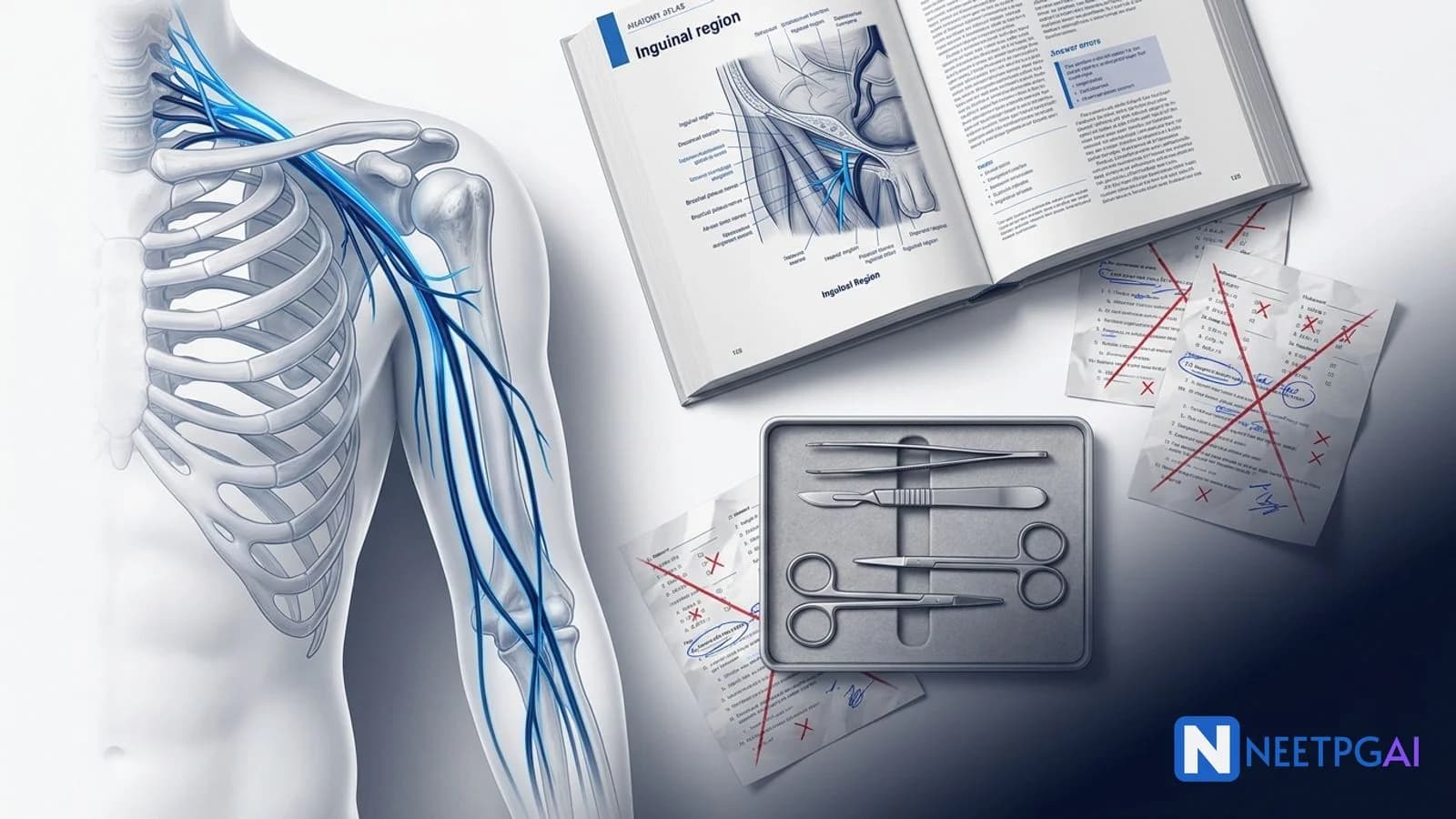
10 Common Mistakes in Anatomy NEET PG — And How to Avoid Them | NEETPGAI
anatomymistake guideneet pg 2027
10 Common Mistakes in Anatomy NEET PG — And How to Avoid Them
Avoid the 10 costliest anatomy mistakes in NEET PG 2027: confused brachial plexus roots, mixed-up inguinal canal walls, wrong nerve injury patterns, embryological derivative errors, and more. Each mistake includes an example MCQ and the correct approach.
NEETPGAI EditorialPublished 5 Dec 2025Updated 29 Sept 202623 min read
Share this article
This content is for educational purposes for NEET PG exam preparation. It is not a substitute for professional medical advice, diagnosis, or treatment. Clinical information has been reviewed by qualified medical professionals.
Ready to put this into practice?
Start practicing NEET PG MCQs with AI-powered explanations.
Comparison of the authorities that shape NEET PG, INI-CET, FMGE, and Indian medical education: NMC (regulator), NBEMS (exam conductor), MCC (AIQ counseling), DGHS (health services), AIIMS (INI-CET), plus state councils and FMG pathway — clarifies who does what.
The single costliest anatomy mistake in NEET PG is confusing nerve roots of brachial plexus branches — this error alone can cost you 2-3 questions per paper. To protect your 12-18 anatomy marks:
Draw the brachial plexus from memory — roots (C5-T1), trunks, divisions, cords, terminal branches. If you cannot draw it in 2 minutes, you are not exam-ready.
Learn nerve injuries by fracture site, not by nerve name — Saturday night palsy = radial nerve at spiral groove = wrist drop is faster recall than listing all radial nerve functions.
Use tables for embryology derivatives — pharyngeal arches, neural crest derivatives, and gut artery territories are pattern-recognition questions, not reasoning questions.
Why anatomy mistakes are costly
Anatomy contributes 12-18 questions to NEET PG (2021-2024 pattern analysis), making it the second highest-weighted pre-clinical subject after pharmacology. Unlike subjects where you can reason through the answer, anatomy is predominantly recall-based — you either know the nerve root or you do not. A single confusion point — say, mixing up the anterior and posterior walls of the inguinal canal — cascades into wrong answers on hernia anatomy, surgical approach questions, and clinical scenario stems.
The ten mistakes below are the patterns that anatomy faculty across AIIMS, PGI, and leading coaching institutes identify as the most frequent mark-losers. Each mistake includes what students typically do, why it fails, the correct approach, and an example MCQ that demonstrates the trap.
Mistake 1: Confusing nerve roots of brachial plexus branches
What students do: Memorize the brachial plexus as a flat list of nerve names without understanding the spatial organization of roots, trunks, divisions, cords, and branches. When the exam asks "Which nerve root is affected if Erb-Duchenne palsy is present?" they cannot trace back from the clinical picture to the root level.
Why it is wrong: The brachial plexus is a systematic branching tree, not a random list. Erb-Duchenne palsy affects the upper trunk (C5, C6), causing the "waiter's tip" position — arm adducted, internally rotated, forearm pronated, wrist flexed. If you memorize "Erb = C5, C6" as an isolated fact without understanding it is the upper trunk, you will fail questions that ask about other upper trunk derivatives (suprascapular nerve, musculocutaneous nerve).
Correct approach: Draw the plexus from memory using the 5-3-6-3-5 rule: 5 roots (C5-T1), 3 trunks (upper C5-C6, middle C7, lower C8-T1), 6 divisions (3 anterior + 3 posterior), 3 cords (lateral, posterior, medial — named by their relation to the axillary artery), 5 terminal branches (musculocutaneous, median, ulnar, axillary, radial).
Cord
Terminal branches
Key nerve roots
Lateral cord
Musculocutaneous nerve, lateral root of median nerve
C5, C6, C7
Posterior cord
Axillary nerve, radial nerve
C5-T1
Medial cord
Ulnar nerve, medial root of median nerve, medial cutaneous nerves of arm and forearm
C8, T1
Example MCQ:A newborn delivered by shoulder dystocia presents with the arm adducted, internally rotated, forearm pronated, and wrist flexed. The nerve roots involved are:
(a) C5, C6
(b) C7
(c) C8, T1
(d) C5-T1
Answer: (a). This is Erb-Duchenne palsy (upper trunk injury). C8, T1 injury causes Klumpke palsy (claw hand). C7 alone causes wrist drop. C5-T1 causes total plexus palsy.
Mistake 2: Mixing up inguinal canal boundaries
What students do: Confuse the anterior wall with the posterior wall of the inguinal canal — specifically, they place the conjoint tendon in the anterior wall or the external oblique aponeurosis in the posterior wall.
Why it is wrong: The inguinal canal boundaries determine the surgical anatomy of hernia repair and the differentiation of direct from indirect hernias. If you place the conjoint tendon anteriorly, you cannot explain why direct hernias emerge through Hesselbach triangle (a posterior wall defect).
Correct approach: Memorize using the mnemonic "2 MALT" for walls:
Example MCQ:The posterior wall of the inguinal canal in its medial one-third is formed by:
(a) External oblique aponeurosis
(b) Internal oblique
(c) Conjoint tendon
(d) Inguinal ligament
Answer: (c). The conjoint tendon (fused aponeuroses of internal oblique and transversus abdominis) forms the medial 1/3 of the posterior wall. This is exactly where direct hernias push through when the transversalis fascia is weak.
Mistake 3: Confusing direct vs indirect hernia landmarks
What students do: Cannot reliably identify Hesselbach triangle or use the inferior epigastric artery as the anatomical landmark to differentiate direct from indirect inguinal hernias.
Why it is wrong: The inferior epigastric artery is the key landmark. An indirect hernia enters the deep inguinal ring lateral to the inferior epigastric artery and passes through the entire inguinal canal. A direct hernia pushes through Hesselbach triangle medial to the inferior epigastric artery, through the posterior wall, and does not traverse the deep ring.
Correct approach: Memorize Hesselbach triangle boundaries (the "triangle of direct hernia"):
Medial: Lateral border of rectus abdominis
Lateral: Inferior epigastric artery
Inferior: Inguinal ligament
Feature
Indirect hernia
Direct hernia
Relation to inf. epigastric artery
Lateral
Medial
Enters deep ring?
Yes
No
Passes through canal?
Entire length
Pushes through posterior wall
Enters scrotum?
Can descend into scrotum
Rarely reaches scrotum
Controlled by deep ring pressure?
Yes
No
Age group
Young (congenital patency of processus vaginalis)
Elderly (posterior wall weakness)
Example MCQ:During inguinal hernia repair, the surgeon finds the hernial sac lateral to the inferior epigastric artery emerging through the deep inguinal ring. This is:
(a) Direct inguinal hernia
(b) Indirect inguinal hernia
(c) Femoral hernia
(d) Spigelian hernia
Answer: (b). Lateral to the inferior epigastric artery + through the deep ring = indirect inguinal hernia. Direct hernias are medial to the IEA and do not pass through the deep ring.
What students do: Memorize nerve names without linking them to the specific fracture or injury site and the resulting clinical deficit. When the stem says "fracture shaft of humerus," they cannot predict "radial nerve injury" and the resulting "wrist drop."
Why it is wrong: NEET PG tests nerve injuries through clinical vignettes, not isolated anatomy questions. The stem describes a fracture or compression scenario, and you must identify the nerve and predict the deficit. Without the fracture-nerve-deficit chain, you guess.
Correct approach: Build the fracture-nerve-deficit table:
Fracture / Injury site
Nerve injured
Clinical deficit
Eponymous association
Surgical neck of humerus
Axillary nerve (C5, C6)
Loss of abduction 15-90 degrees, regimental badge anesthesia
—
Shaft of humerus (spiral groove)
Radial nerve (C5-T1)
Wrist drop, finger drop, loss of supination
Saturday night palsy
Medial epicondyle of humerus
Ulnar nerve (C8, T1)
Claw hand (4th and 5th fingers), Froment sign positive
—
Supracondylar fracture of humerus
Median nerve (anterior interosseous)
Loss of precision pinch (cannot make an "OK" sign)
—
Neck of fibula
Common peroneal nerve (L4-S2)
Foot drop, loss of eversion, sensory loss over dorsum of foot
—
Fracture neck of radius
Posterior interosseous nerve (branch of radial)
Loss of finger extension, wrist extension preserved
—
Example MCQ:A patient who fell asleep with the arm hanging over the back of a chair wakes up unable to extend the wrist and fingers. The nerve injured is:
(a) Ulnar nerve
(b) Median nerve
(c) Radial nerve
(d) Musculocutaneous nerve
Answer: (c). This is Saturday night palsy — radial nerve compression at the spiral groove of the humerus. Wrist drop (loss of wrist and finger extension) is the hallmark. The patient can still flex the wrist (median nerve) and has intact finger abduction/adduction (ulnar nerve).
Mistake 5: Mixing up blood supply territories
What students do: Cannot reliably assign organs to their arterial supply from the celiac trunk, superior mesenteric artery (SMA), or inferior mesenteric artery (IMA). The most common confusion: "Does the splenic flexure get blood from SMA or IMA?"
Why it is wrong: The gut blood supply follows embryological derivation (foregut/midgut/hindgut), and this determines the watershed zones, surgical ligation safety, and ischemia patterns. The splenic flexure is a watershed area between SMA and IMA (Griffith point) — it is the most vulnerable segment during hypotension-induced colonic ischemia.
Correct approach: Map the three arteries to their embryological gut segments:
Example MCQ:The most common site of ischemic colitis in an elderly patient with hypotension is:
(a) Cecum
(b) Hepatic flexure
(c) Splenic flexure
(d) Sigmoid colon
Answer: (c). The splenic flexure is the watershed zone between SMA and IMA territories (Griffith point). During systemic hypotension, watershed zones receive the least perfusion and are most vulnerable to ischemia.
What students do: Cannot correctly locate cranial nerve nuclei within the brainstem levels (midbrain, pons, medulla). When a stem describes a brainstem stroke with specific cranial nerve and tract findings, they cannot localize the lesion.
Why it is wrong: Cranial nerve nucleus localization determines stroke territory identification. If a patient has ipsilateral facial palsy (CN VII — pons) plus contralateral hemiplegia (corticospinal tract), the lesion is in the pons. Mislocating CN VII to the medulla leads to the wrong diagnosis.
Correct approach: Group nuclei by brainstem level:
Brainstem level
Cranial nerve nuclei
Classic associated syndrome
Midbrain
III (oculomotor), IV (trochlear)
Weber syndrome (CN III palsy + contralateral hemiplegia)
Pons
V (trigeminal — motor + sensory), VI (abducens), VII (facial)
Millard-Gubler syndrome (CN VI + VII palsy + contralateral hemiplegia)
Medulla
IX (glossopharyngeal), X (vagus), XI (accessory — cranial root), XII (hypoglossal)
Memory trick: "3-4 in the midbrain, 5-6-7 in the pons, 8-9-10-11-12 in the medulla." The CN VIII (vestibulocochlear) nuclei span the pontomedullary junction.
Example MCQ:A patient presents with ipsilateral CN III palsy (ptosis, dilated pupil, eye down and out) and contralateral hemiplegia. The lesion is in the:
(a) Midbrain
(b) Pons
(c) Medulla
(d) Internal capsule
Answer: (a). This is Weber syndrome — midbrain lesion affecting the CN III nucleus/fascicle (ipsilateral) and the cerebral peduncle (contralateral hemiplegia). CN III nuclei are in the midbrain.
Mistake 7: Wrong muscle actions at joints
What students do: Confuse which muscles perform which actions at the shoulder and hip — particularly mixing up medial and lateral rotators, or confusing abductors with adductors.
Why it is wrong: The exam tests muscle actions through clinical scenarios (nerve injury causing loss of specific movement) and direct action questions. If you think subscapularis laterally rotates (it medially rotates), you will misidentify the clinical deficit of a subscapular nerve injury.
Correct approach: Build an action-based table for high-yield joints:
Shoulder rotators (frequently tested):
Action
Muscles
Nerve supply
Medial rotation
Subscapularis, pectoralis major, latissimus dorsi, teres major
Upper and lower subscapular, pectoral nerves, thoracodorsal
Nerve to piriformis, nerve to obturator internus, nerve to QF
Example MCQ:A patient with injury to the superior gluteal nerve will have difficulty in:
(a) Extension of the hip
(b) Flexion of the hip
(c) Abduction of the hip
(d) Adduction of the hip
Answer: (c). The superior gluteal nerve supplies gluteus medius and minimus — the primary hip abductors. Injury causes Trendelenburg sign (pelvis drops on the opposite side during single-leg stance). Extension is gluteus maximus (inferior gluteal nerve). Adduction is obturator nerve.
Mistake 8: Mixing up embryological derivatives
What students do: Cannot correctly assign structures to their pharyngeal arch of origin. The most common confusion: "Is the recurrent laryngeal nerve from the 4th or 6th arch?" and "Which arch gives the facial nerve?"
Why it is wrong: Pharyngeal arch derivatives are tested as direct recall questions (1-2 per paper) and as the embryological basis for congenital anomalies. If you mix up arches, you cannot predict which nerve is at risk during surgery on arch-derived structures.
Correct approach: Master the four arches tested in NEET PG:
Arch
Nerve
Muscles
Skeletal/cartilage
Artery
1st
CN V (trigeminal) — mandibular division
Muscles of mastication, mylohyoid, ant. belly of digastric, tensor tympani, tensor veli palatini
Meckel cartilage (mandible, malleus, incus)
Maxillary artery
2nd
CN VII (facial)
Muscles of facial expression, stapedius, stylohyoid, post. belly of digastric
4th: right subclavian, arch of aorta. 6th: ductus arteriosus (left), pulmonary arteries
Neural crest derivatives (the other embryology favorite): Melanocytes, Schwann cells, adrenal medulla, enteric ganglia, craniofacial bones (frontal, nasal), dental papilla, C cells of thyroid, aorticopulmonary septum.
Example MCQ:The muscle derived from the third pharyngeal arch is:
(a) Tensor veli palatini
(b) Stylopharyngeus
(c) Cricothyroid
(d) Posterior belly of digastric
Answer: (b). Stylopharyngeus is the only muscle from the 3rd arch, supplied by CN IX (glossopharyngeal). Tensor veli palatini is 1st arch (CN V). Posterior belly of digastric is 2nd arch (CN VII). Cricothyroid is 4th arch (CN X — superior laryngeal nerve).
Mistake 9: Confusing surface anatomy landmarks for procedures
What students do: Cannot reliably identify surface landmarks for common clinical procedures — specifically, the landmark for lumbar puncture, subclavian vein catheterization, and pleural tap.
Why it is wrong: Surface anatomy questions test applied knowledge. The exam asks "At which vertebral level is a lumbar puncture performed in an adult?" — and students who memorize "L3-L4" without understanding why (the spinal cord ends at L1-L2 in adults, so the needle must go below this level) may pick L1-L2 and cause a cord injury in the exam answer.
Correct approach: Build a procedure-landmark table:
Procedure
Surface landmark
Vertebral level
Critical anatomy
Lumbar puncture (adult)
Supracristal line (line joining iliac crests)
L3-L4 or L4-L5
Cord ends at L1-L2 in adults; needle enters subarachnoid space in the cauda equina
Lumbar puncture (newborn)
Same landmark
L4-L5
Cord extends to L3 in neonates
Subclavian vein
Junction of medial 1/3 and lateral 2/3 of clavicle
—
Subclavian vein is anterior and inferior to subclavian artery; separated by anterior scalene
Internal jugular vein
Triangle between two heads of sternocleidomastoid
C6 level
IJV is lateral to common carotid artery
Pleural tap
Upper border of the rib (to avoid neurovascular bundle)
7th-9th intercostal space, mid-axillary line
Neurovascular bundle runs in costal groove along lower border of rib
Cricothyroidotomy
Gap between thyroid and cricoid cartilage
C5-C6
Avoids thyroid gland and major vessels
Example MCQ:During lumbar puncture in an adult, the needle is inserted at the L3-L4 interspace because:
(a) The spinal cord ends at L3 in adults
(b) The spinal cord ends at L1-L2 in adults
(c) The dural sac ends at L3-L4
(d) The filum terminale starts at L3-L4
Answer: (b). The spinal cord ends at the lower border of L1 (or upper border of L2) in adults, forming the conus medullaris. Below this level, only the cauda equina (nerve roots floating in CSF) is present. Inserting the needle at L3-L4 enters the subarachnoid space without risking cord injury. The dural sac extends to S2.
Mistake 10: Wrong relations of structures through foramina
What students do: Cannot list the structures passing through specific skull base foramina — particularly the jugular foramen, superior orbital fissure, and foramen ovale. They mix up which cranial nerves exit through which openings.
Why it is wrong: Foramen anatomy determines clinical presentations of skull base pathology (tumors, fractures, thrombosis). A glomus jugulare tumor compresses CN IX, X, XI in the jugular foramen — if you think CN XII exits through the jugular foramen, you will predict the wrong clinical deficit.
Correct approach: Group foramina by cranial fossa and contents:
Foramen
Cranial fossa
Key contents
Cribriform plate
Anterior
CN I (olfactory nerves)
Optic canal
Middle
CN II, ophthalmic artery
Superior orbital fissure
Middle
CN III, IV, V1 (ophthalmic division), VI, ophthalmic veins
Memory trick for the jugular foramen: "9-10-11 go out the jugular" — glossopharyngeal (IX), vagus (X), and accessory (XI). CN XII has its own separate canal (hypoglossal canal).
Example MCQ:A patient with a glomus jugulare tumor presents with hoarseness, difficulty swallowing, and shoulder weakness. The foramen involved is:
(a) Foramen ovale
(b) Foramen magnum
(c) Jugular foramen
(d) Hypoglossal canal
Answer: (c). Hoarseness (CN X — vagus), dysphagia (CN IX — glossopharyngeal), and shoulder weakness (CN XI — accessory nerve) localize to the jugular foramen. All three cranial nerves exit through the jugular foramen. CN XII (tongue deviation) exits through the hypoglossal canal separately.
Comparison table: mistake vs correct approach
Mistake
What students do
Correct approach
Brachial plexus confusion
Memorize nerve names as a flat list
Draw the plexus from memory using 5-3-6-3-5 structure
Before your next anatomy revision session, verify you can answer each of these without looking:
Draw the brachial plexus from memory (roots to terminal branches) in under 2 minutes
Name all 4 walls of the inguinal canal with their structures
Differentiate direct from indirect hernia using the inferior epigastric artery landmark
Match 6 fracture sites to their specific nerve injuries and clinical deficits
Assign all gut organs to celiac trunk, SMA, or IMA territories
Locate CN III-XII nuclei by brainstem level (midbrain, pons, medulla)
List all structures passing through the jugular foramen, superior orbital fissure, and foramen ovale
If you hesitate on more than 2 items, revisit the corresponding mistake section above.
Frequently asked questions
How many anatomy questions appear in NEET PG?
Anatomy contributes 12-18 questions in NEET PG (2021-2024 analysis), making it the second highest-weighted pre-clinical subject after pharmacology. Of these, 4-6 test nerve supply and injury patterns, 3-4 test regional anatomy (inguinal canal, triangles, foramina), 2-3 test embryology, and the remainder test surface anatomy and clinical correlations. Getting 3-4 anatomy questions wrong due to avoidable confusion costs 9-12 marks.
What is the most common anatomy mistake in NEET PG?
Confusing nerve roots of brachial plexus branches is the single costliest anatomy mistake. Students mix up which roots form which trunk, cord, and terminal branch — leading to errors in nerve injury localization questions. For example, confusing the nerve root of the axillary nerve (C5, C6) with the musculocutaneous nerve (C5, C6, C7) changes the predicted clinical deficit. The brachial plexus contributes 2-3 questions per paper.
How should I study anatomy for NEET PG?
Focus on clinical anatomy, not descriptive anatomy. NEET PG does not ask "Name the attachments of the deltoid." It asks "A patient cannot abduct the arm beyond 15 degrees. Which nerve is injured?" Study anatomy through clinical scenarios: nerve injuries, surface landmarks for procedures, hernia anatomy, blood supply territories. Use diagrams (not text) for spatial relationships. BD Chaurasia for regional anatomy, Vishram Singh for clinical correlations, and Netter's Atlas for visual learning.
Is embryology tested frequently in NEET PG?
Yes, 2-3 embryology questions appear in most NEET PG papers. The highest-yield topics are pharyngeal arch derivatives (which arch gives which nerve, muscle, and artery), neural crest cell derivatives, and congenital anomalies with their embryological basis (cleft palate, Meckel diverticulum, branchial cyst/fistula, horseshoe kidney). Students lose marks by confusing which pharyngeal arch gives rise to which cranial nerve.
How do I remember which structures pass through which foramina?
Group foramina by function, not by random lists. Cranial fossa approach: anterior fossa has the cribriform plate (CN I); middle fossa has the superior orbital fissure (CN III, IV, V1, VI), foramen rotundum (V2), foramen ovale (V3, lesser petrosal nerve), foramen spinosum (middle meningeal artery); posterior fossa has the jugular foramen (CN IX, X, XI), hypoglossal canal (CN XII), foramen magnum (medulla, vertebral arteries, CN XI spinal root). Build a single diagram with all foramina and drill it weekly.
What are the most tested nerve injuries in NEET PG?
The top five tested nerve injuries are: radial nerve (wrist drop, Saturday night palsy, fracture shaft of humerus), ulnar nerve (claw hand, Froment sign, medial epicondyle fracture), median nerve (ape hand, carpal tunnel syndrome), axillary nerve (loss of shoulder abduction beyond 15 degrees and regimental badge anesthesia, surgical neck fracture), and common peroneal nerve (foot drop, fibular neck fracture). Each injury has a specific fracture or compression site association that the exam tests.
This content is for educational purposes for NEET PG exam preparation. It is not a substitute for professional medical advice, diagnosis, or treatment. Clinical information has been reviewed by qualified medical professionals.
Sources and references
Gray's Anatomy, 42nd Edition (Standring, 2020) — comprehensive anatomical reference for all regional and clinical anatomy topics, nerve supply, and vascular territories.
BD Chaurasia's Human Anatomy, 8th Edition (2019) — standard Indian anatomy textbook for regional anatomy and clinical correlations tested in NEET PG.
Netter's Atlas of Human Anatomy, 8th Edition (Netter, 2022) — visual reference for spatial relationships, brachial plexus organization, and skull base foramina.
Vishram Singh, Textbook of Anatomy, 3rd Edition (2018) — clinical anatomy with emphasis on NEET PG-tested topics and surgical applications.
Build your personalized study plan with the AI planner — it identifies your weak anatomy topics and schedules targeted revision using spaced repetition techniques.
Written by: NEETPGAI Editorial Team
Reviewed by: Pending SME Review
Last reviewed: April 2026
This article is reviewed by qualified medical professionals for clinical accuracy and exam relevance. For corrections or updates, contact the editorial team.