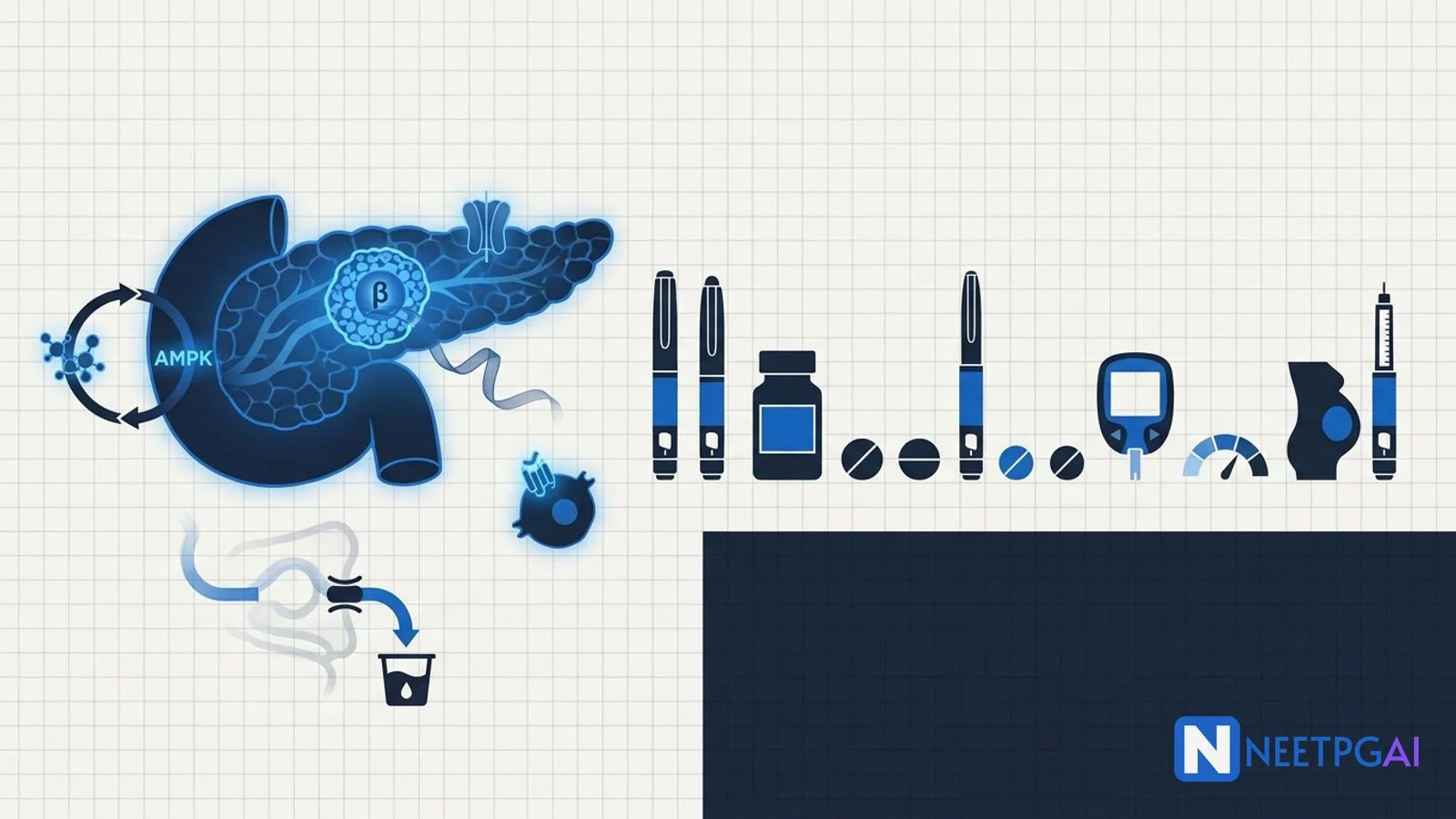
Renal cut-offs — stop metformin if eGFR under 30; SGLT2i can be initiated down to eGFR 20 for cardio-renal protection.
Type 2 diabetes prevalence in India crossed 10.1 crore adults in the ICMR-INDIAB 2023 census, and the antidiabetic block is correspondingly one of the densest NEET PG Pharmacology chapters. Examiners reach for it because the ADA 2025 algorithm rewards class-to-comorbidity reasoning, India-specific PMJAY subsidies have changed real-world prescribing, and each class has signature ADRs that map cleanly onto vignettes.
This NEETPGAI deep dive walks through every insulin formulation, every oral hypoglycaemic class, every injectable non-insulin therapy, drug-of-choice scenarios, and India-specific cost and availability notes. Pair this guide with the gestational diabetes mellitus deep dive and the dyslipidemia and statins guide for a complete cardiometabolic pharmacology map.
Insulin preparations
Insulin remains the most powerful glucose-lowering agent and the only therapy that universally works regardless of beta-cell reserve. Indian residents must know onset, peak, and duration cold.
Onset 5 to 15 minutes; peak 30 to 90 minutes; duration 3 to 5 hours.
Indication — prandial coverage; given just before or with meals. Preferred for insulin pumps.
Short-acting (regular) insulin
Onset 30 minutes; peak 2 to 3 hours; duration 5 to 8 hours.
Indications — prandial coverage when rapid analogs unavailable, IV use in DKA and hyperkalaemia, sliding scale (now discouraged for routine ward use).
Intermediate-acting (NPH / Isophane)
Onset 1 to 2 hours; peak 4 to 12 hours; duration 12 to 18 hours.
NPH is the most affordable basal insulin in India (PMJAY-subsidised) but the broad peak creates nocturnal hypoglycaemia and explains the dawn phenomenon when dosed at dinner.
Onset 1 to 2 hours; peakless; duration 20 to 42 hours (degludec longest).
Indications — basal insulin in basal-bolus or basal-plus regimens. Degludec has the lowest nocturnal hypoglycaemia rate (DEVOTE trial).
Premixed insulins
70/30 NPH-regular, 75/25 lispro-protamine-lispro, 70/30 aspart-protamine-aspart. Convenient (twice-daily injections) but inflexible — meals must match insulin timing. Still the workhorse in resource-limited Indian settings.
Insulin regimens
Basal-bolus — long-acting basal once daily plus rapid-acting at each meal. Most physiologic. Standard for type 1 diabetes.
Basal-plus — basal plus rapid-acting at the largest meal only. A stepwise intensification when basal alone is inadequate.
Biphasic (premix) — twice-daily premixed insulin before breakfast and dinner.
Continuous subcutaneous insulin infusion (CSII / pump) — rapid analog only; basal plus bolus programmable. Useful in hypoglycaemia-prone type 1 diabetes.
ADRs — hypoglycaemia (commonest), weight gain, lipodystrophy at injection sites (rotate), rare allergy.
Biguanides
Metformin
Mechanism — activates AMP-activated protein kinase (AMPK), inhibits hepatic gluconeogenesis, improves peripheral insulin sensitivity, and reduces intestinal glucose absorption. Recent evidence implicates inhibition of mitochondrial glycerol-3-phosphate dehydrogenase.
Indications — first-line in type 2 diabetes, polycystic ovary syndrome (anovulation), prediabetes (DPP trial showed 31 percent risk reduction), gestational diabetes (off-label but increasingly accepted in India).
ADRs — GI upset (diarrhoea, nausea, metallic taste — minimised with extended-release at bedtime), vitamin B12 deficiency on long-term use (check annually), lactic acidosis (rare but feared — see "Renal dosing" below). No hypoglycaemia as monotherapy. Weight-neutral or modest loss.
Renal dosing — full dose if eGFR above 60 mL/min; halve to 1 g/day if eGFR 30 to 60; stop if eGFR below 30. Hold 48 hours before iodinated contrast if eGFR below 60.
Sulfonylureas
Mechanism — bind SUR1 subunit of pancreatic beta-cell K-ATP channel, close it, depolarise the cell, open voltage-gated calcium channels, and trigger insulin release.
Indications — type 2 diabetes when metformin alone fails and cost or insurance precludes SGLT2i/GLP-1 RA (a common Indian scenario).
ADRs — hypoglycaemia (severe, prolonged with glibenclamide due to active metabolite; safest among them is gliclazide MR), weight gain, skin rash, disulfiram-like reaction with chlorpropamide, SIADH.
NEET PG trap — gliclazide and glipizide are preferred in elderly and CKD because of shorter half-lives and lack of active metabolites. Avoid glibenclamide in CKD and the elderly.
Meglitinides
Examples — repaglinide, nateglinide.
Mechanism — bind a different site on SUR1, with faster on-off kinetics — short-duration insulin release timed to meals.
ADRs — hypoglycaemia (less than sulfonylureas), weight gain.
Thiazolidinediones (glitazones)
Examples — pioglitazone (rosiglitazone withdrawn over CV concerns).
Mechanism — PPAR-gamma agonists; increase insulin sensitivity in adipose, muscle, and liver. Slow onset (4 to 8 weeks).
Indications — type 2 diabetes with severe insulin resistance, NAFLD (only oral antidiabetic with proven NASH benefit).
ADRs — weight gain, fluid retention (worsens HF — contraindicated in NYHA III-IV), fractures in postmenopausal women (osteoporosis), bladder cancer (mild signal — avoid in history of bladder cancer), macular oedema.
Alpha-glucosidase inhibitors
Examples — acarbose, miglitol, voglibose (widely used in India and Japan).
Mechanism — competitive inhibition of intestinal brush-border alpha-glucosidases, delaying carbohydrate absorption. Lowers postprandial glucose without affecting fasting.
Indications — Indian and East-Asian diets rich in complex carbs (rice, roti) where postprandial spikes dominate.
NEET PG trap — if hypoglycaemia occurs on combination therapy, treat with oral glucose (dextrose) not sucrose, because acarbose blocks sucrose breakdown.
Mechanism — inhibit dipeptidyl peptidase 4, the enzyme that degrades GLP-1 and GIP, raising incretin levels and enhancing glucose-dependent insulin secretion plus suppressing glucagon.
Indications — type 2 diabetes when weight gain or hypoglycaemia must be avoided; useful in elderly.
ADRs — pancreatitis (small signal — discontinue if confirmed), severe joint pain, bullous pemphigoid. Saxagliptin and alogliptin increase HF hospitalisation (SAVOR-TIMI) — avoid in HFrEF. Linagliptin needs no renal dose adjustment (hepatobiliary excretion).
Mechanism — block sodium-glucose cotransporter 2 in the proximal convoluted tubule, causing glucosuria (60 to 80 g/day), natriuresis, mild osmotic diuresis, and weight loss of 2 to 3 kg.
Indications — type 2 diabetes (especially with ASCVD, HFrEF/HFpEF, or CKD), HFrEF and HFpEF irrespective of diabetes (DAPA-HF, EMPEROR-Reduced, DELIVER, EMPEROR-Preserved), CKD with proteinuria (DAPA-CKD, EMPA-KIDNEY).
ADRs — genital mycotic infections (commonest, especially women), UTIs, euglycaemic DKA (hold during acute illness, surgery, fasting; check ketones if symptomatic with normal glucose), volume depletion and AKI (hold with diuretics during dehydration), Fournier gangrene (rare), lower-extremity amputation signal with canagliflozin (CANVAS — controversial).
Renal threshold — initiation down to eGFR 20 mL/min for cardio-renal indications; discontinue at dialysis initiation.
Indications — type 2 diabetes (especially with obesity, ASCVD), obesity without diabetes (liraglutide Saxenda, semaglutide Wegovy, tirzepatide Zepbound — Indian launch ongoing).
ADRs — nausea, vomiting, diarrhoea (dose-titrate to minimise), pancreatitis (small signal), gallstones (rapid weight loss), medullary thyroid carcinoma signal in rodents (contraindicated in MEN 2A/2B and personal/family history of medullary thyroid cancer), injection-site reactions.
NEET PG trap — LEADER, SUSTAIN-6, REWIND trials proved CV benefit for liraglutide, semaglutide, dulaglutide. Exenatide and lixisenatide showed CV safety but not superiority.
Amylin analog
Pramlintide — synthetic amylin co-secreted with insulin from beta cells. Slows gastric emptying, suppresses glucagon, increases satiety. Adjunct to mealtime insulin in type 1 or insulin-dependent type 2. Severe hypoglycaemia when combined with prandial insulin — reduce prandial dose by 50 percent at initiation. Limited use in India.
ADA 2025 algorithm — the decision tree
Lifestyle plus metformin in all patients without contraindications.
ASCVD or high CV risk → add GLP-1 RA with proven benefit or SGLT2i with proven benefit independent of HbA1c.
HFrEF / HFpEF → add SGLT2i.
CKD (eGFR 20 to 60 or proteinuria) → add SGLT2i; second choice GLP-1 RA.
Need significant weight loss → GLP-1 RA (semaglutide or tirzepatide).
Cost is the dominant constraint → sulfonylurea (gliclazide MR) or pioglitazone after metformin.
HbA1c remains above target on dual therapy → triple therapy; consider basal insulin once HbA1c above 9 percent or symptomatic hyperglycaemia.
Drug-of-choice tables
Scenario
First-line
New T2DM, no comorbidities
Metformin
T2DM plus ASCVD
GLP-1 RA (liraglutide / semaglutide / dulaglutide) or SGLT2i (empagliflozin / canagliflozin)
Insulin, linagliptin, gliclazide MR (cautious), GLP-1 RA
NEET PG MCQ traps
Glibenclamide in elderly / CKD — never; risk of prolonged hypoglycaemia.
Pioglitazone in HF or osteoporosis — contraindicated.
Metformin pre-contrast — hold 48 hours if eGFR below 60.
Euglycaemic DKA on SGLT2i — high index of suspicion when ketones positive but glucose normal.
Acarbose hypoglycaemia treatment — pure glucose (dextrose), not sucrose.
GLP-1 RA in MEN 2 / medullary thyroid cancer — absolutely contraindicated.
Saxagliptin and alogliptin in HF — avoid (heart failure hospitalisation signal).
Insulin glargine peak — peakless; do not confuse with NPH which peaks at 4 to 12 hours.
DPP-4 inhibitor plus GLP-1 RA — never combine (redundant incretin pathway).
Pramlintide plus prandial insulin — halve the insulin dose.
B12 deficiency on long-term metformin — annual check, supplement if low.
Empagliflozin renal cut-off — initiate down to eGFR 20 for CKD/HF indications, even though glucose-lowering effect weakens below eGFR 45.
Recent updates and Indian context
ADA 2025 — cardio-renal benefits drive class selection over HbA1c alone. SGLT2i and GLP-1 RA are co-first-line whenever ASCVD, HF, or CKD coexists.
EMPA-KIDNEY (2023) — empagliflozin slows CKD progression even without diabetes.
SURPASS / SURMOUNT trials — tirzepatide delivers HbA1c reduction of 2 to 2.5 percent and weight loss of 15 to 22 percent, surpassing semaglutide.
Indian generic landscape — teneligliptin (DPP-4) is widely prescribed because it costs under 10 rupees per tablet; PMJAY covers metformin, sulfonylureas, NPH, and regular insulin. SGLT2i and GLP-1 RA generics from Indian pharma (Sun Pharma, Cipla) launched 2024-25 and prices have dropped 70 percent.
RSSDI and ICMR 2023 guidelines — endorse ADA-style algorithm; emphasise metformin plus SGLT2i for resource-conscious cardio-renal protection in India.
NMC and FMGE alignment — pregnancy DOC (insulin), HbA1c targets, lactic acidosis red flags, and SGLT2i euglycaemic DKA are perennial favourites.
Frequently asked questions
What is the first-line oral antidiabetic in type 2 diabetes?
Metformin remains first-line for newly diagnosed type 2 diabetes in patients without atherosclerotic cardiovascular disease, heart failure, or chronic kidney disease. It improves insulin sensitivity, is weight-neutral, has near-zero hypoglycaemia risk, and costs under 5 rupees per day in India. SGLT2 inhibitors or GLP-1 analogs are co-first-line when ASCVD, HFrEF, or CKD coexist.
Which antidiabetic drugs reduce cardiovascular mortality?
Three SGLT2 inhibitors (empagliflozin, canagliflozin, dapagliflozin) and three GLP-1 analogs (liraglutide, semaglutide, dulaglutide) have proven cardiovascular mortality benefit in landmark trials (EMPA-REG, LEADER, SUSTAIN-6). SGLT2 inhibitors also reduce heart failure hospitalisation and slow CKD progression. The ADA 2025 algorithm prioritises these classes whenever ASCVD, HF, or CKD coexists with type 2 diabetes.
What is the HbA1c target for most adults with diabetes?
ADA 2025 recommends HbA1c below 7 percent for most non-pregnant adults, with individualisation. Tighter targets (below 6.5 percent) suit young patients with short disease duration and no comorbidities; looser targets (below 8 percent) suit elderly patients with limited life expectancy, severe hypoglycaemia, or extensive comorbidities. In pregnancy, target HbA1c below 6.5 percent and fasting glucose below 95 mg/dL.
Which antidiabetic causes lactic acidosis?
Metformin can cause metformin-associated lactic acidosis (MALA), particularly in patients with eGFR below 30 mL/min, acute kidney injury, sepsis, heart failure decompensation, or alcohol misuse. The mechanism is inhibition of mitochondrial complex I and impaired hepatic gluconeogenesis. Hold metformin 48 hours before contrast imaging if eGFR is below 60 mL/min and restart only after renal function is confirmed stable.
Which antidiabetics are safe in pregnancy?
Insulin remains the gold standard in pregnancy. Metformin is increasingly used in gestational diabetes after trials showed no foetal harm, though it does cross the placenta. Glyburide was previously used but is now avoided due to higher neonatal hypoglycaemia and macrosomia. All other oral agents (DPP-4, SGLT2, sulfonylureas other than glyburide) and GLP-1 analogs are not recommended in pregnancy due to insufficient safety data.
This content is for educational purposes for NEET PG exam preparation. It is not a substitute for professional medical advice, diagnosis, or treatment. Clinical information has been reviewed by qualified medical professionals.
Written by: NEETPGAI Editorial Team
Reviewed by: Pending SME Review
Last reviewed: May 2026