Quick Answer
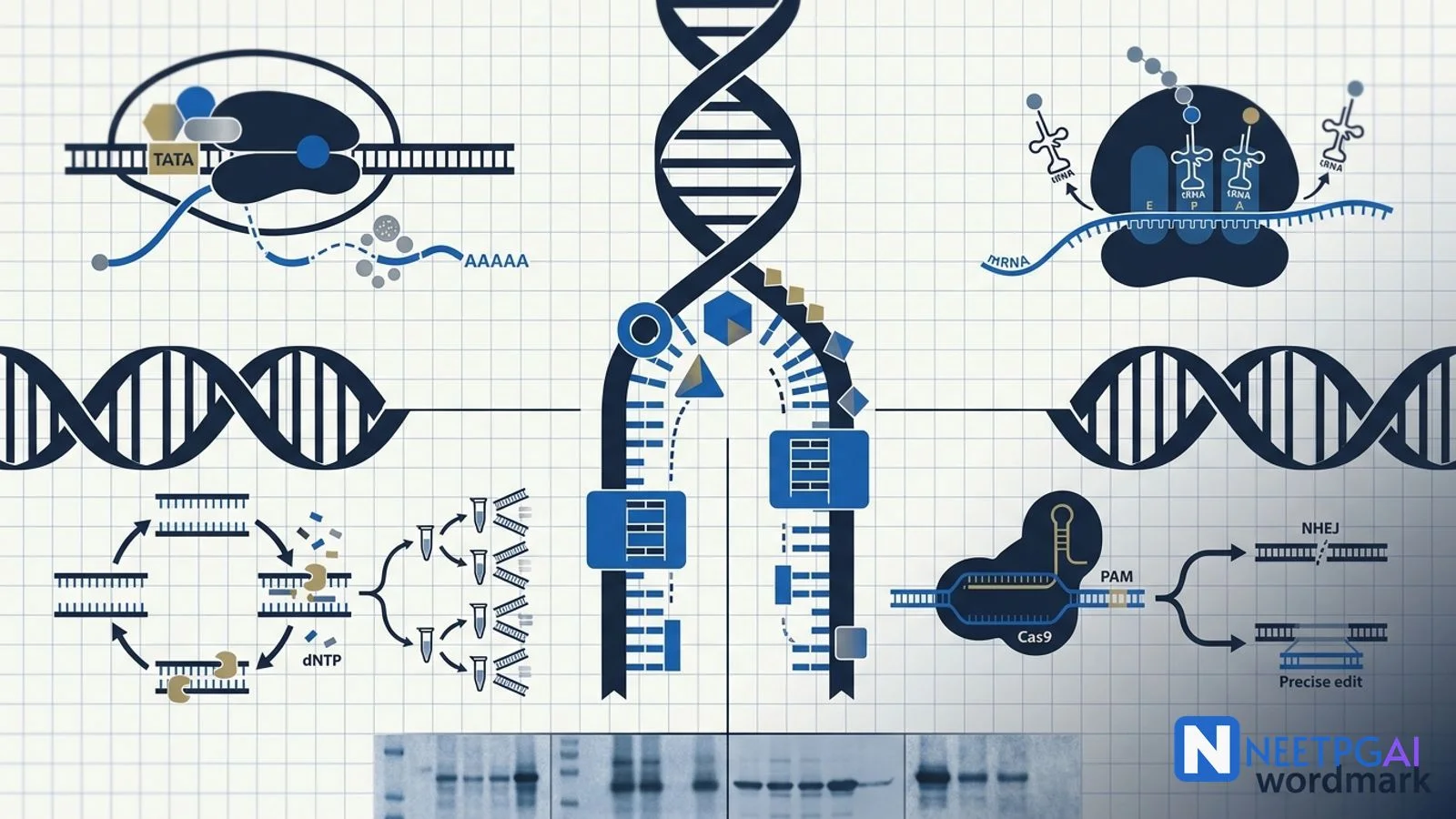
Molecular biology delivers 3 to 5 NEET PG questions per year across biochemistry, pathology and microbiology. Lock these anchors:
- DNA replication — semiconservative; leading strand continuous, lagging strand Okazaki fragments (need RNA primers).
- Telomerase — reverse transcriptase; active in stem cells and cancers (replicative immortality).
- Transcription — RNA pol II makes mRNA; capping, splicing, polyadenylation are post-transcriptional.
- Translation — initiation (Met), elongation, termination (stop codon); wobble hypothesis at 3rd base.
- PCR — denaturation → annealing → extension × 30 cycles; Taq polymerase; RT-PCR for RNA; qPCR quantitates.
- Blotting — Southern (DNA), Northern (RNA), Western (protein), Southwestern (DNA-binding proteins).
- CRISPR-Cas9 — gRNA + PAM (5-NGG-3); NHEJ (knockout) vs HDR (precise edit); Casgevy approved for sickle cell (2023).
Molecular biology used to feel like a "read once, pray you remember it" chapter. In the NEET PG era it is anything but — CRISPR gene therapy is now FDA-approved, PCR runs every COVID test, next-generation sequencing directs cancer therapy, and molecular diagnostics dominate India's tuberculosis and viral hepatitis programmes.
This NEETPGAI deep dive walks through every high-yield molecular biology mechanism you will meet on NEET PG 2027 — from the primer-swapping choreography at a replication fork to the CRISPR-Cas9 double-strand-break repair choice. Pair this with the neurophysiology guide for the cell-physiology backbone.
DNA replication
DNA replication is semiconservative — each daughter molecule has one parental and one newly synthesised strand (Meselson-Stahl, 1958). It happens once per cell cycle in S phase.
Origin, fork, and enzymes
- Origins of replication — bacteria have one (oriC); eukaryotes have thousands.
- Helicase — unwinds the double helix (5-prime to 3-prime in eukaryotes).
- Single-strand binding proteins (SSB / RPA) — prevent re-annealing.
- Topoisomerase — relieves supercoiling ahead of the fork. DNA gyrase (bacteria; target of fluoroquinolones) is a topoisomerase II.
- Primase — synthesises a short (about 10 nt) RNA primer that provides the 3-prime OH for DNA polymerase.
- DNA polymerase — synthesises 5-prime to 3-prime only. Bacterial Pol III does most bulk synthesis; Pol I removes primers and fills gaps. Eukaryotic Pol α primes, Pol δ synthesises lagging, Pol ε synthesises leading strand.
- DNA ligase — seals nicks between Okazaki fragments (uses ATP in eukaryotes, NAD+ in bacteria).
Leading vs lagging strand
- Leading strand — synthesised continuously in the direction of the fork.
- Lagging strand — synthesised discontinuously as Okazaki fragments (about 1000-2000 nt in bacteria, 100-200 nt in eukaryotes) joined by ligase.
Proofreading and fidelity
- Pol III (bacteria) and Pol δ / ε (eukaryotes) have 3-prime to 5-prime exonuclease proofreading.
- Mismatch repair (MSH2, MLH1) fixes post-replication errors; germline mutations cause Lynch syndrome (HNPCC).
Telomeres and telomerase
- Telomeres are repetitive TTAGGG sequences at chromosome ends that shorten with each replication (end-replication problem).
- Telomerase is a reverse transcriptase carrying its own RNA template. Active in stem cells and germ cells; silent in most somatic cells.
- Reactivated in ~85 percent of cancers — replicative immortality is a hallmark of cancer.
- Dyskeratosis congenita — inherited telomere-maintenance defects; bone marrow failure and premature ageing.
Transcription (DNA → RNA)
Transcription is catalysed by RNA polymerases:
| Enzyme | Makes | Sensitivity |
|---|
| RNA polymerase I | rRNA (in nucleolus) | Resistant to α-amanitin |
| RNA polymerase II | mRNA (and most snRNAs) | Highly sensitive to α-amanitin (death cap mushroom) |
| RNA polymerase III | tRNA, 5S rRNA | Moderately sensitive |
Promoter elements
- TATA box at -25 (eukaryotes) — binds TBP within TFIID.
- CAAT box at -80, GC box further upstream.
- Enhancers can act at long distance in either orientation.
Post-transcriptional modifications (eukaryotic mRNA only)
- 5-prime capping — 7-methylguanosine cap; needed for ribosome loading.
- Splicing — spliceosome (snRNPs) removes introns at GU...AG boundaries. Alternative splicing generates protein diversity.
- 3-prime polyadenylation — poly-A tail (about 200 As) added after the AAUAAA signal; stabilises mRNA.
Defects in spliceosome components cause diseases such as retinitis pigmentosa and myelodysplastic syndromes.
Translation (mRNA → protein)
Ribosomes read mRNA in triplet codons; tRNAs with matching anticodons deliver amino acids.
Ribosomal subunits
- Prokaryote — 70S = 50S + 30S (contains 16S rRNA — target of aminoglycosides).
- Eukaryote — 80S = 60S + 40S.
Steps
- Initiation — starts at AUG (Met in eukaryotes, formyl-Met in bacteria). eIF2 delivers Met-tRNA to the 40S; 60S joins after AUG recognition.
- Elongation — aminoacyl-tRNA enters the A site (needs GTP + eEF1α), peptide bond forms (peptidyl transferase — a ribozyme in the 23S rRNA), translocation (eEF2 + GTP; target of diphtheria toxin's ADP-ribosylation).
- Termination — stop codons (UAA, UAG, UGA) recognised by release factors.
Wobble hypothesis
The third codon base pairs less strictly with the tRNA anticodon — one tRNA can read multiple codons. This is why the genetic code is degenerate (multiple codons per amino acid).
Antibiotic targets (high-yield)
- Aminoglycosides (gentamicin) — 30S; misreading.
- Tetracyclines — 30S; block A-site.
- Macrolides, clindamycin, linezolid, chloramphenicol — 50S; block peptidyl transferase or translocation.
- Diphtheria toxin, exotoxin A — inhibit eEF2 (host).
Post-translational modification
- Cleavage (proinsulin → insulin + C peptide).
- Glycosylation (N-linked in ER, O-linked in Golgi).
- Phosphorylation, methylation, acetylation, ubiquitination.
- Chaperones (HSPs) fold nascent proteins.
Prion diseases represent post-translational misfolding (α-helix → β-sheet, PrPc → PrPsc).
Polymerase chain reaction (PCR)
PCR amplifies a defined DNA target through repeated temperature cycles.
Steps (one cycle)
- Denaturation at 94-96 degC — separates the double helix.
- Annealing at 50-65 degC — primers (18-25 nt) bind their complementary flanking sequences.
- Extension at 72 degC — Taq polymerase (from Thermus aquaticus, heat-stable) synthesises new strands using dNTPs.
30 cycles gives about 2^30 = a billion copies of the target.
Variants
| Variant | Purpose | Example |
|---|
| RT-PCR | Reverse transcribes RNA to cDNA first (RT enzyme + Taq) | HCV/HIV/SARS-CoV-2 viral load; BCR-ABL fusion transcripts in CML |
| qPCR (real-time PCR) | Quantitates as amplification happens (fluorescence via SYBR Green or TaqMan probes) | TB (GeneXpert MTB/RIF), viral load monitoring |
| Digital PCR (dPCR) | Partitions into thousands of nano-reactions; absolute quantitation without a standard curve | Minimal residual disease, rare mutations, circulating tumour DNA |
| Multiplex PCR | Multiple primer pairs in one tube | Respiratory viral panel, syndromic diagnostics |
| Nested PCR | Two rounds with inner and outer primers | Ultra-low copy templates (mycobacteria in CSF) |
GeneXpert — India TB relevance
CBNAAT / GeneXpert MTB/RIF uses hemi-nested real-time PCR to detect M. tuberculosis + rifampicin resistance (rpoB gene) in under 2 hours from sputum. Rolled out nationally under the NTEP; a favourite MCQ.
DNA sequencing
- Sanger dideoxy sequencing — chain-termination with fluorescent ddNTPs; the gold standard for single-gene analysis; used in confirmatory testing.
- Next-generation sequencing (NGS) — massively parallel short-read sequencing (Illumina); whole-genome, whole-exome, targeted panels; the backbone of cancer molecular profiling and rare-disease diagnosis.
- Long-read sequencing (Oxford Nanopore, PacBio) — 10-100 kb reads; useful for structural variants, methylation, epidemiological outbreak tracing.
Blotting techniques
| Blot | Molecule detected | Probe |
|---|
| Southern | DNA | Labelled DNA probe |
| Northern | RNA | Labelled DNA/RNA probe |
| Western | Protein | Labelled antibody |
| Southwestern | DNA-binding protein | Labelled DNA |
Mnemonic — SNoW DRoP → Southern-DNA, Northern-RNA, Western-Protein.
Western blot is the confirmatory test for HIV (now largely replaced by 4th-generation Ag/Ab combo + RNA), variant Creutzfeldt-Jakob disease, and Lyme disease.
Gene cloning (recombinant DNA)
- Restriction endonucleases cut at specific palindromic sequences (EcoRI at GAATTC, produces sticky ends).
- The fragment is ligated into a vector (plasmid, phage, BAC, viral vector) with DNA ligase.
- The recombinant vector is introduced into a host (E. coli for plasmids; yeast for larger constructs) — transformation.
- Selection uses antibiotic resistance markers.
- Recombinant insulin (Humulin), human growth hormone, factor VIII and hepatitis B vaccine (recombinant HBsAg) are all products of this technology.
CRISPR-Cas9
CRISPR-Cas9 is a bacterial adaptive immune system repurposed as a precision genome editor.
Mechanism
- A guide RNA (gRNA) with a 20-nt spacer complementary to the target DNA loads onto Cas9.
- Cas9 scans the genome for a PAM sequence (5-NGG-3 for S. pyogenes Cas9).
- Cas9 creates a blunt double-strand break 3 bp upstream of the PAM.
- The cell repairs the break by:
- Non-homologous end joining (NHEJ) — introduces small indels; good for gene knockout.
- Homology-directed repair (HDR) — uses a template; good for precise editing (needs an S/G2-phase cell).
Clinical applications
- Casgevy (exagamglogene autotemcel) — FDA-approved December 2023 for sickle cell disease and beta-thalassemia. Ex vivo CRISPR editing of the BCL11A enhancer in autologous HSCs reactivates fetal haemoglobin. First approved CRISPR therapy.
- In vivo trials for transthyretin amyloidosis (Intellia NTLA-2001), Duchenne muscular dystrophy, hereditary angioedema.
- Prime editing and base editing (Cas9 nickase fused to reverse transcriptase or deaminase) — single-base precision without double-strand breaks.
India relevance — the GenomeIndia project (launched 2020, DBT-funded) sequenced 10,000 whole genomes across 99 tribal and non-tribal groups by 2025, building an Indian reference genome for pharmacogenomics and rare disease diagnosis. AIIMS-CDFD-CCMB consortia are running CRISPR sickle-cell trials in central Indian tribal populations where the sickle cell burden is highest.
NEET PG MCQ traps
- Semiconservative replication — Meselson-Stahl proved it.
- DNA gyrase = bacterial topoisomerase II; target of fluoroquinolones.
- Primase makes RNA primers (not DNA) — because DNA pol cannot initiate de novo.
- Okazaki fragments — lagging strand; joined by DNA ligase.
- Telomerase = reverse transcriptase with its own RNA template.
- α-amanitin (death cap) — potent RNA polymerase II inhibitor → hepatic failure.
- 5-prime cap and 3-prime poly-A — eukaryotic mRNA only.
- Peptidyl transferase is a ribozyme — catalytic RNA (23S rRNA).
- Diphtheria toxin — inactivates eEF2 by ADP-ribosylation.
- Aminoglycosides target 30S; macrolides target 50S.
- Wobble hypothesis — degeneracy at the 3rd codon position.
- Taq polymerase — from Thermus aquaticus, heat-stable; the workhorse of PCR.
- RT-PCR for RNA templates (HCV, HIV, SARS-CoV-2); qPCR quantitates.
- GeneXpert / CBNAAT — rifampicin resistance via rpoB gene; India NTEP standard.
- Southern = DNA, Northern = RNA, Western = protein (SNoW DRoP).
- Sanger sequencing — chain-termination with ddNTPs; single-gene gold standard.
- CRISPR-Cas9 PAM = 5-NGG-3 for S. pyogenes Cas9.
- NHEJ — error-prone → gene knockout; HDR — template-directed → precise edit.
- Casgevy — first approved CRISPR therapy (sickle cell + β-thalassemia, Dec 2023).
- Restriction endonucleases cut palindromic sequences; EcoRI cuts at GAATTC.
- Recombinant insulin (Humulin) — first FDA-approved recombinant therapeutic (1982).
- Hepatitis B vaccine — recombinant HBsAg expressed in yeast.
Recent updates and India context
- GenomeIndia project (DBT, launched 2020; 10,000 whole genomes across 99 populations completed by 2025) — building an Indian reference genome for pharmacogenomics and rare disease.
- Casgevy in India — ex vivo CRISPR for sickle cell disease is now in translational trials at AIIMS Delhi, CDFD Hyderabad, and CMC Vellore with public-private partnership funding; the sickle cell burden is highest in central Indian tribal populations (Chhattisgarh, Madhya Pradesh, Odisha, Maharashtra Vidarbha).
- India's PM-JAY-linked sickle cell mission (Feb 2023 Union Budget) targets screening 70 million tribal individuals below age 40 by 2027; molecular confirmation uses PCR-based HbS detection.
- NTEP molecular diagnostics — GeneXpert MTB/RIF Ultra and Truenat MTB (Molbio Diagnostics, Goa — made in India) are now the first-line pulmonary and extra-pulmonary TB diagnostics under the National TB Elimination Programme.
- HIV viral load monitoring — routine at ART centres via RT-PCR; treatment failure threshold is 1000 copies/mL.
- NIPT (non-invasive prenatal testing) — cell-free fetal DNA in maternal plasma via massively parallel sequencing; increasingly used in Indian antenatal practice for trisomy 21, 18, 13 screening.
- CAR-T cells — NexCAR19 (IIT Bombay + Tata Memorial + ImmunoACT), India's first indigenous CAR-T therapy for B-cell lymphoma/ALL, received CDSCO approval in 2023 — a molecular-biology triumph combining lentiviral gene transfer and adoptive cell therapy.
Frequently asked questions
Why is DNA replication called semiconservative?
Meselson and Stahl proved in 1958 that each new DNA molecule contains one parental strand and one newly synthesised strand — semiconservative. Replication starts at origins of replication where helicase unwinds the double helix, single-strand binding proteins prevent re-annealing, topoisomerase (DNA gyrase in bacteria) relieves supercoiling ahead of the fork, and DNA polymerase III (bacteria) or δ and ε (eukaryotes) synthesises the leading strand continuously and the lagging strand as Okazaki fragments (100-200 bp in eukaryotes, 1000-2000 bp in bacteria) joined by DNA ligase.
Why do lagging strand Okazaki fragments need RNA primers?
DNA polymerase cannot initiate synthesis de novo — it can only add nucleotides to an existing 3-prime OH end. Primase (an RNA polymerase) synthesises short 10-nucleotide RNA primers that provide this 3-prime OH. DNA polymerase then extends. On the lagging strand, because replication runs 5-prime to 3-prime but the fork moves in the opposite direction, each Okazaki fragment needs its own primer. Later, RNase H removes the RNA primers, DNA polymerase I (bacteria) or δ (eukaryotes) fills in the gap, and DNA ligase seals the nick.
What is the role of telomerase and why does it matter clinically?
Telomeres — repetitive TTAGGG sequences at chromosome ends — shorten with every replication (the end-replication problem). Telomerase, a reverse transcriptase carrying its own RNA template, extends telomeres. It is active in stem cells and germ cells but silent in most somatic cells. Reactivation in about 85 percent of cancers enables replicative immortality — one of the hallmarks of cancer. Clinically, telomerase inhibitors are being explored as anti-cancer targets, and dyskeratosis congenita (mutations in telomere-maintenance genes) is a bone-marrow-failure syndrome with premature ageing features.
How does PCR amplify a target DNA sequence?
PCR uses three temperature-cycled steps repeated 25 to 40 times. Denaturation at 94 to 96 degC separates the double helix. Annealing at 50 to 65 degC lets primers bind their complementary sequences (primer design determines specificity). Extension at 72 degC allows Taq polymerase (from Thermus aquaticus, heat-stable) to synthesise new strands using dNTPs. Each cycle doubles the target, giving 2^n amplification — 30 cycles yields about a billion copies. Variants — RT-PCR (reverse transcribes RNA to cDNA first; used for HCV, HIV viral load), qPCR (real-time quantitation via SYBR Green or TaqMan probes), digital PCR (partitions into thousands of nano-reactions for absolute quantitation of low-copy targets like minimal residual disease).
How does CRISPR-Cas9 edit the genome and what disease has it cured?
CRISPR-Cas9 is an adapted bacterial adaptive immune system. A guide RNA (gRNA) with a 20-nucleotide spacer complementary to the target DNA loads onto the Cas9 nuclease, which creates a blunt double-strand break 3 bp upstream of a PAM sequence (5-NGG-3 for Streptococcus pyogenes Cas9). The cell repairs the break by non-homologous end joining (introduces indels — good for gene knockout) or homology-directed repair (uses a template — good for precise editing). In December 2023, the FDA approved Casgevy (exagamglogene autotemcel) for sickle cell disease and beta-thalassemia — ex vivo CRISPR editing of the BCL11A enhancer in autologous HSCs reactivates fetal haemoglobin. This is the first approved CRISPR therapy.
This content is for educational purposes for NEET PG exam preparation. It is not a substitute for professional medical advice, diagnosis, or treatment. Clinical information has been reviewed by qualified medical professionals.
Written by: NEETPGAI Editorial Team
Reviewed by: Pending SME Review
Last reviewed: July 2026