Quick Answer
Paediatric status epilepticus (SE) is a top NEET PG paediatric-emergency case — the modern 5-minute definition, ESETT-guided second-line, pyridoxine indication, India-specific causes and the PICU ladder recur every year.
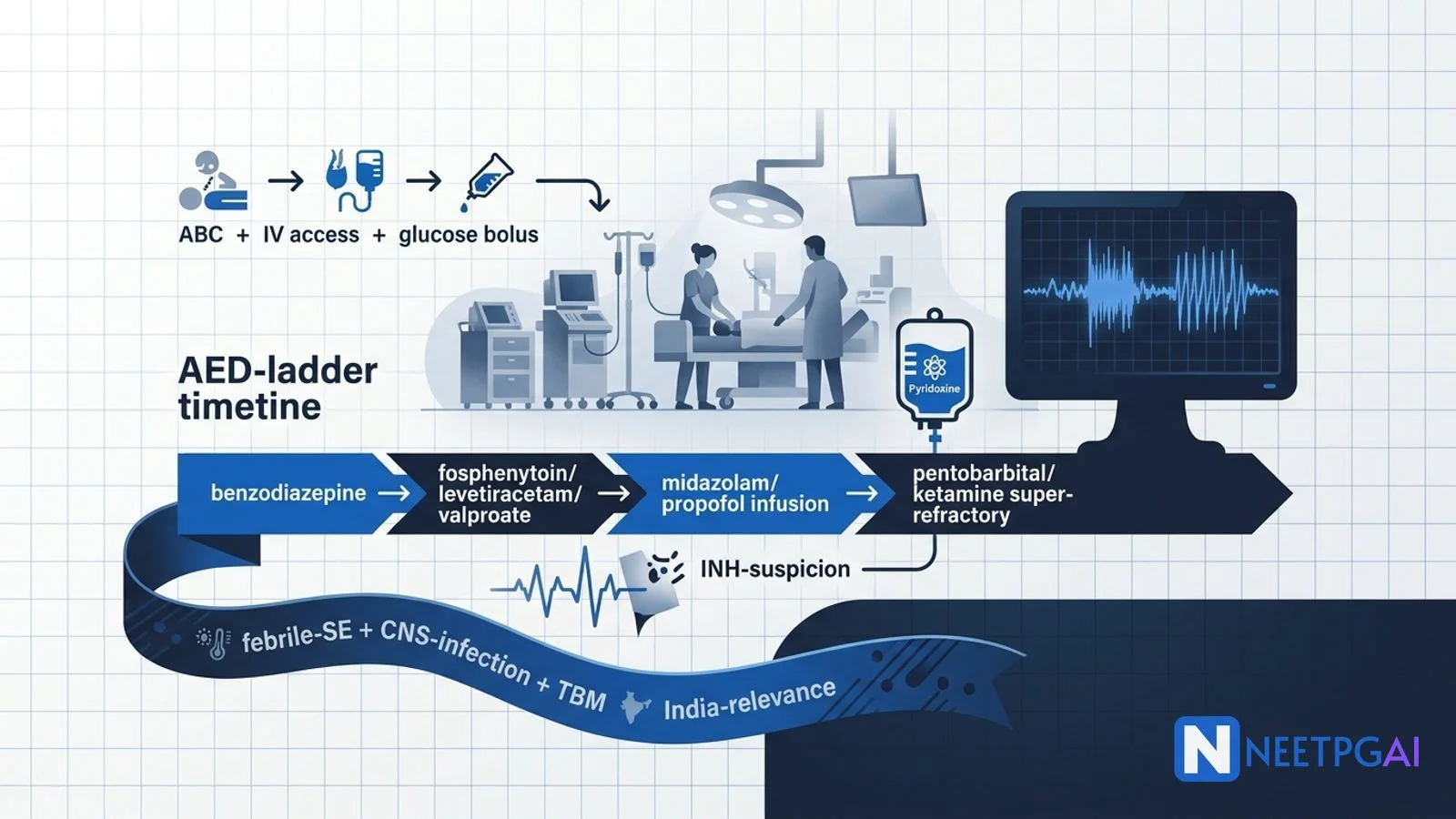
- Definition (2015 ILAE) — GTCS lasting 5 minutes or more OR two or more seizures without recovery of consciousness between them; refractory SE = fails 2 AEDs; super-refractory = greater than 24 hours despite anaesthesia.
- Ladder — benzodiazepine at 5 min, non-benzo second-line at 20 min, anaesthesia at 40 min.
- First-line benzodiazepine — lorazepam 0.1 mg/kg IV OR midazolam 0.2 mg/kg IN/IM/buccal OR diazepam 0.3 mg/kg IV.
- Second-line (ESETT trial) — fosphenytoin, valproate and levetiracetam are equivalent (approximately 45-50 percent success); pick by patient factor — levetiracetam increasingly preferred for its safety profile.
- Third-line (PICU) — midazolam infusion → propofol (watch infusion syndrome) → ketamine (super-refractory) → pentobarbital.
- Empirical pyridoxine 100 mg IV — pyridoxine-dependent epilepsy in neonates/infants; isoniazid toxicity in a child with GI upset + refractory seizures.
- India-specific causes — neurocysticercosis (commonest new-onset seizure cause in Indian children), TBM, Japanese encephalitis, HSV encephalitis (empirical acyclovir).
- Workup — bedside glucose first, CT then MRI when stable, LP with CSF PCRs, EEG, targeted metabolic and autoimmune panel.
The case
A 3-year-old boy, previously well, is brought to the paediatric emergency of a district hospital in Lucknow by his parents at 8 pm. He has been convulsing continuously for 25 minutes with generalised tonic-clonic movements. The father administered intranasal midazolam 5 mg (0.4 mg/kg) from a school-supplied first-aid kit at home 15 minutes into the seizure, without effect.
Presenting complaint timeline:
- 6 pm — sudden onset of high-grade fever (39 degrees C), coryza, one episode of vomiting
- 7:30 pm — sudden generalised tonic-clonic seizure at home; eyes rolled up, teeth clenched, cyanosis
- 7:45 pm — parents administered intranasal midazolam 5 mg (father is a schoolteacher trained through a Rotary CPR camp)
- 8:00 pm — arrived at hospital, seizure ongoing, drooling, cyanosis
Past medical history:
- Previous febrile seizures × 2 at ages 18 months and 27 months, both simple (less than 5 minutes, no focal features, no post-ictal deficit)
- No prior neurological deficit; developmentally normal milestones
- Fully immunised per Universal Immunisation Programme (BCG, HepB, Pentavalent, OPV, IPV, MMR, JE in endemic districts)
- No prior AED
- Term birth, normal delivery, birth weight 3.1 kg
- No family history of epilepsy or febrile seizures
- No traditional healer visits, no herbal medications
- No obvious exposure to isoniazid or other prescription medications; both parents deny ingestion accident
On arrival examination:
- Continued generalised tonic-clonic activity, eyes rolled up, jaw clenched, cyanotic lips and nailbeds, RR 8, SpO2 82 percent on room air
- HR 168 sinus, BP 110/70, capillary refill 3 seconds, warm peripheries
- Temperature 39.4 degrees C rectal
- Drooling saliva, tongue bitten
- Pupils 4 mm, sluggish reaction bilaterally
- No focal neurological asymmetry noted during ongoing seizure
- No obvious head injury, no skin rash, no petechiae, no eschar, no obvious ingestion evidence
- Fontanelles closed, no meningism testable during seizure
- No hepatosplenomegaly, no obvious congenital markers
The paediatric team recognises paediatric refractory status epilepticus (failed intranasal midazolam) and immediately activates the SE protocol.
Initial assessment and the time-critical principle
The single most important principle in this case is that every minute of ongoing seizure activity beyond 5 minutes increases the probability of neuronal injury, treatment resistance and mortality. The 2015 ILAE operational definition treats a 5-minute GTCS as SE precisely to force early pharmacological intervention.
The ABC of paediatric SE
A — Airway: at risk — obtund from ongoing seizure, drooling; left lateral recovery position, chin lift, gentle suction, oropharyngeal airway if needed; prepare for intubation if seizure persists after second-line AED or if SpO2 remains low or GCS is not recovering.
B — Breathing: 100 percent oxygen by non-rebreather mask or bag-mask ventilation if hypoventilating; monitor SpO2 continuously.
C — Circulation: two IV access lines (large-bore); if IV access fails after 2 attempts or 90 seconds — intraosseous access without hesitation.
D — Disability and Dextrose: bedside glucose FIRST — hypoglycaemia mimics or worsens SE; if less than 60 mg/dL → 2 mL/kg of 10 percent dextrose IV bolus (never adult 50 percent — hypertonic risk to paediatric veins); check pupils and posturing.
E — Exposure and Emergency drugs: rectal temperature (fever suggests febrile SE, CNS infection); check for skin rash (purpura → meningococcal), eschar (scrub typhus with encephalitis), any injection marks or ingestion clues.
Tier 1 investigations (immediate)
- Bedside glucose — 68 mg/dL (normal)
- VBG — pH 7.25, HCO3 15, pCO2 45 (mixed acidosis from seizure lactate + hypoventilation), lactate 6
- CBC — Hb 11.2 g/dL, WBC 14,200 with neutrophilia, platelets 260,000
- Electrolytes — Na 138, K 4.2, Ca 9.4, ionised Ca 4.7, Mg 2.0, phosphate 4.0
- Renal + LFT — creatinine 0.4, urea 32, AST 92, ALT 45 (mild rise, likely from seizure-induced hepatic ischaemia)
- Ammonia — 65 micromol/L (mildly raised, likely seizure-related)
- Blood culture — sent
- CRP — 45 mg/L
- Toxicology screen — sent (opiates, benzodiazepines, TCA, INH)
- Coagulation — INR 1.1, aPTT 30 s, fibrinogen 280
- ECG — sinus tachycardia 168, normal QT, no U wave
- Chest X-ray — no aspiration consolidation visible currently
Once seizure aborts, plan for:
- CT head if focal deficit persists or level of consciousness fails to recover
- MRI brain when stable
- Lumbar puncture if no focal deficit or raised ICP — CSF cell count, protein, glucose, Gram + culture, HSV PCR, JE IgM in endemic season, Xpert MTB/RIF Ultra, cryptococcal antigen if immunocompromised
- EEG — continuous EEG monitoring for suspected non-convulsive SE
- Targeted metabolic screen — ammonia, lactate, urine organic acids, plasma amino acids, acylcarnitine profile
- Autoimmune panel — anti-NMDA receptor, anti-VGKC-complex, anti-GAD antibodies in refractory or unexplained SE
Working diagnosis for this patient
Febrile refractory status epilepticus in a 3-year-old with 2 previous simple febrile seizures — must consider febrile SE (a well-recognised subset of febrile seizures), but the 25-minute duration and failure of intranasal midazolam mandate a full CNS infection workup (bacterial meningitis, viral encephalitis, TBM, JE), and after stabilisation a structural, metabolic and autoimmune workup.
The diagnostic and classification workflow
NEET PG tests SE definitions, escalation ladder timing, drug choice by patient factor and India-specific causes heavily.
2015 ILAE definition — the 5-minute rule
The 2015 ILAE definition replaced the older 30-minute definition:
- t1 (5 minutes) — the point at which pharmacological treatment must begin; self-terminating seizures nearly always stop before this
- t2 (30 minutes) — the point beyond which long-term neuronal injury becomes likely
Applies to both convulsive and non-convulsive SE.
Classification by seizure duration and treatment response
| Category | Definition |
|---|
| Impending SE | Continuous seizure activity 5-10 minutes |
| Established SE | Continuous seizure activity greater than 30 minutes OR two or more seizures without recovery between |
| Refractory SE (RSE) | Persistent seizure despite two adequately dosed AEDs (one benzodiazepine + one non-benzodiazepine) |
| Super-refractory SE (SRSE) | Persistent seizure greater than 24 hours despite general anaesthesia |
Aetiology in the Indian paediatric population
| Category | Examples |
|---|
| Acute symptomatic (fever-related) | Febrile SE (commonest in less than 5 years); CNS infection — bacterial meningitis, viral encephalitis (HSV, JE), TBM |
| Structural | Trauma, stroke, cortical dysplasia, tuberous sclerosis, tumour, neurocysticercosis (commonest cause of new-onset seizures in Indian children) |
| Metabolic | Hypoglycaemia, hyponatraemia, hypocalcaemia, hypomagnesaemia, hepatic failure, uraemia, inborn errors (organic acidurias, urea cycle defects, mitochondrial) |
| Toxic | Isoniazid (accidental paediatric ingestion or adult overdose; pyridoxine-responsive), theophylline, TCA, salicylate, organophosphate, envenomation |
| Non-adherence | Missed doses in a known child with epilepsy |
| Autoimmune | Anti-NMDA receptor encephalitis, ADEM, other autoimmune encephalitides |
| Idiopathic epileptic syndrome | Dravet syndrome, Lennox-Gastaut, West syndrome |
Febrile SE vs symptomatic SE from CNS infection
- Febrile SE — otherwise well child, fever from a benign extracranial focus (URTI, otitis, gastroenteritis), no meningism, no altered sensorium once seizure aborts, normal CSF
- CNS infection — depressed sensorium persists post-ictally, meningism, focal deficit, abnormal CSF; empirical acyclovir for HSV encephalitis is time-critical
The Indian must-consider trio in a febrile child
- Neurocysticercosis — solitary cysticercus granuloma on contrast MRI with eccentric scolex; treat with albendazole 15 mg/kg per day for 10-14 days + corticosteroid + AED for at least 6 months
- Tuberculous meningitis — subacute fever, cranial nerve palsies (VI most common), basal exudates and hydrocephalus on contrast imaging, CSF with lymphocytic pleocytosis, high protein, low glucose, positive Xpert MTB/RIF Ultra; treat with anti-tubercular therapy (12 months) + adjunctive dexamethasone (tapered over 6-8 weeks)
- Japanese encephalitis — endemic in Assam, Uttar Pradesh, Bihar and Andhra during and after monsoon; presents with high fever, altered sensorium, seizures, extrapyramidal signs; JE IgM positive in CSF; supportive care; JE vaccine now in the Universal Immunisation Programme in endemic districts
Diagnosis
Refractory febrile status epilepticus in a 3-year-old with 2 previous simple febrile seizures — currently 25 minutes into a GTCS unresponsive to home intranasal midazolam — presumptive febrile SE with a broad differential including bacterial meningitis, viral encephalitis (HSV — empirical acyclovir mandatory), Japanese encephalitis (endemic season), and metabolic derangement — for immediate ABC stabilisation, IV benzodiazepine, ESETT-guided second-line AED (levetiracetam 60 mg/kg IV preferred as first choice given unknown cause), PICU escalation with intubation and continuous-EEG-guided anaesthesia if seizure persists, empirical broad-spectrum antibiotics + acyclovir, and post-stabilisation CT/MRI + LP + targeted metabolic and autoimmune panel.
Management — the time-boxed AED ladder
Stage 1 — Impending SE (0-5 minutes) — supportive plus first-line benzodiazepine
If seizure lasts beyond 5 minutes, treat as SE. Choose one benzodiazepine:
- Lorazepam 0.1 mg/kg IV (max 4 mg per dose) — longer duration of anti-seizure effect than diazepam; preferred if IV access available
- Midazolam 0.2 mg/kg intranasal, buccal or IM (max 10 mg) — preferred when IV access delayed; intranasal is the household and school-first-aid option (as in this case)
- Diazepam 0.3 mg/kg IV (max 10 mg) or 0.5 mg/kg per rectum (max 20 mg) — short duration of anti-seizure effect
Repeat benzodiazepine once at 5 minutes if seizure persists. Do not exceed two doses of benzodiazepine — respiratory depression risk without added efficacy.
Stage 2 — Established SE (10-30 minutes) — second-line AED (ESETT-guided)
If seizure persists 10-20 minutes after the second benzodiazepine dose, escalate to a non-benzodiazepine AED. The ESETT trial showed fosphenytoin, valproate and levetiracetam are equivalent — pick by patient factors:
| Drug | Dose | Advantages | Cautions |
|---|
| Levetiracetam | 60 mg/kg IV over 10 min (max 4.5 g) | No cardiovascular, hepatic or drug-interaction issues; safe in unknown cause and metabolic disease | Behavioural adverse effects long-term |
| Fosphenytoin | 20 mg/kg PE IV over 10 min (max 1.5 g) | Phenytoin efficacy without propylene glycol vehicle; less tissue injury than phenytoin | Cardiovascular monitoring — hypotension, bradycardia; contraindicated in AV block, Stokes-Adams |
| Valproate | 40 mg/kg IV over 10 min (max 3 g) | Fast onset; no cardiac effects | AVOID in liver disease, suspected metabolic or mitochondrial disease (can precipitate hepatic failure), pancreatitis history |
Preferred first choice — increasingly levetiracetam given its unmatched safety profile and equivalent efficacy in ESETT.
Stage 3 — Refractory SE (greater than 40-60 minutes) — PICU escalation with anaesthesia
If seizure persists despite adequate benzodiazepine + one second-line AED:
- Transfer to PICU, intubate, start continuous EEG monitoring
- Midazolam continuous infusion — 0.2 mg/kg loading bolus, then 0.05-2 mg/kg per hour titrated to seizure control or burst-suppression pattern on EEG
- Propofol — second choice; AVOID infusion rates greater than 4 mg/kg per hour for more than 48 hours (propofol infusion syndrome — metabolic acidosis, rhabdomyolysis, cardiac failure); avoid in children with prolonged need
- Pentobarbital or thiopentone — 5-10 mg/kg loading, 1-5 mg/kg per hour; high risk of hypotension needing inotropes and prolonged ventilation
- Ketamine — 2-5 mg/kg bolus, 0.5-5 mg/kg per hour infusion; reserved for super-refractory SE (greater than 24 hours); works on the upregulated NMDA receptor and provides haemodynamic support
Continue anaesthesia for 24-48 hours of seizure freedom, then slowly wean under continuous EEG guidance to detect breakthrough.
Stage 4 — Super-refractory SE (greater than 24 hours despite anaesthesia)
- Additional AEDs — topiramate, lacosamide, phenobarbital, oxcarbazepine
- Ketogenic diet — induction over 3-5 days in PICU with monitoring
- Therapeutic hypothermia (32-35 degrees C)
- Immunotherapy — steroids, IVIG, plasmapheresis, rituximab for suspected autoimmune encephalitis (anti-NMDA receptor)
- Vagal nerve stimulator — last resort
- Surgical resection — for identifiable cortical dysplasia or tumour
Empirical pyridoxine — the two settings
- Pyridoxine-dependent epilepsy — refractory neonatal/young-infant SE; pyridoxine 100 mg IV in a monitored setting (may cause apnoea) then oral maintenance 15-30 mg/kg per day for life
- Isoniazid toxicity — pyridoxine 1 gram IV per gram of INH ingested; empirical 5 g IV in an adult or 70 mg/kg in a child if amount unknown; plus benzodiazepines and supportive care
Empirical antibiotics and acyclovir
- Third-generation cephalosporin (ceftriaxone 100 mg/kg per day) + vancomycin — bacterial meningitis cover
- Acyclovir 20 mg/kg IV every 8 hours — HSV encephalitis empirical cover; do NOT delay while awaiting PCR
- Anti-tubercular therapy — pending TBM workup in endemic areas
- Anti-JE — supportive care only
Fever and seizure precautions
- Rectal paracetamol 15-20 mg/kg for hyperthermia
- Cooling — remove clothing, tepid sponging; avoid rapid cooling in the paediatric patient
- Airway suction, protect from injury, remove hard objects nearby
Complications — acute, sub-acute and long-term
Acute
- Hypoxia and cerebral injury from prolonged seizure
- Aspiration pneumonia — commonest post-SE respiratory complication
- Cardiovascular — arrhythmia, hypotension from AED (fosphenytoin, propofol, pentobarbital)
- Metabolic — lactic acidosis, hyperkalaemia from rhabdomyolysis
- Hyperthermia from prolonged tonic-clonic activity
- AKI from rhabdomyolysis
- Pulmonary oedema — neurogenic
Sub-acute
- Delirium and cognitive slowing in the first 2-4 weeks
- Aspiration pneumonia
- Deep vein thrombosis (if PICU-immobilised)
- Ventilator-associated pneumonia
Long-term
- Post-SE epilepsy — approximately 30 percent develop chronic epilepsy after SE
- Cognitive impairment — attention, memory, executive function
- Behavioural problems — commoner in preschool-onset SE
- Motor deficits if focal structural lesion
- Mortality — 3-10 percent in paediatric SE overall; higher in refractory and super-refractory
- Neuronal loss — mesial temporal sclerosis after prolonged temporal-lobe SE
India-specific considerations
- Neurocysticercosis is the commonest cause of new-onset paediatric seizures in India (Solitary Cysticercus Granuloma); solitary lesion on CT/MRI with eccentric scolex; albendazole 15 mg/kg per day for 10-14 days + corticosteroid + AED
- Tuberculous meningitis — high burden across India; presents subacutely with cranial nerve palsies, basal exudates on imaging, hydrocephalus, CSF with lymphocytic pleocytosis + low glucose + high protein + Xpert MTB/RIF Ultra positive
- Japanese encephalitis — endemic in Assam, UP, Bihar, Andhra Pradesh, Karnataka; peak monsoon; JE vaccine incorporated into UIP in endemic districts
- Cerebral malaria — falciparum in endemic areas; child with fever + coma + seizures; treat with IV artesunate + supportive care
- HSV encephalitis — empirical acyclovir is time-critical and cheap; must not wait for PCR
- Iron deficiency anaemia and first febrile seizure — well-documented Indian association
- AED availability — levetiracetam and lacosamide widely available now; access to fosphenytoin variable; parenteral phenytoin still used in many district hospitals due to cost
- PICU access — limited outside tertiary centres in tier-2 and tier-3 cities; early transfer is critical
- Vaccination — Hib, pneumococcal, MMR, JE (endemic areas), and hepatitis A/B under UIP have reduced bacterial meningitis and viral encephalitis burden
- PMJAY coverage — variable for PICU stay and prolonged ventilation
- Traditional-healer delay — cultural belief that seizures are supernatural can delay presentation; community IEC crucial
- Home first-aid — intranasal midazolam scripts and school-based training are expanding under state paediatric emergency programmes
How NEET PG tests paediatric status epilepticus
Eight recurring patterns.
Pattern 1 — The definition question: 2015 ILAE definition — GTCS lasting 5 minutes or more, OR 2 or more seizures without recovery of consciousness between them.
Pattern 2 — The first-line question: First AED for a child in SE with IV access? Lorazepam 0.1 mg/kg IV. Without IV access? Intranasal or buccal midazolam 0.2 mg/kg.
Pattern 3 — The ESETT question: Second-line AED after failed benzodiazepines in paediatric SE — evidence says? Fosphenytoin, valproate and levetiracetam are equivalent; choice is patient-driven.
Pattern 4 — The valproate contraindication question: Which second-line AED should you AVOID in a child with suspected metabolic or mitochondrial disease? Valproate — can precipitate hepatic failure, particularly in POLG mutations.
Pattern 5 — The pyridoxine question: Refractory neonatal SE — always give pyridoxine 100 mg IV. Adolescent with GI upset + refractory seizure + hypotension = isoniazid toxicity — pyridoxine 1 g per gram INH ingested.
Pattern 6 — The refractory-SE question: First-line PICU anaesthetic? Midazolam continuous infusion with continuous EEG to burst-suppression.
Pattern 7 — The propofol question: Which paediatric anaesthetic carries risk of propofol infusion syndrome (metabolic acidosis, rhabdomyolysis, cardiac failure)? Propofol — limit rate to less than 4 mg/kg per hour and duration to less than 48 hours.
Pattern 8 — The Indian aetiology question: Commonest cause of new-onset seizures in Indian children? Neurocysticercosis (solitary cysticercus granuloma). Best treatment? Albendazole + corticosteroid + AED.
High-yield one-liners:
- Modern SE definition — 5 minutes (not 30)
- Refractory SE — fails 2 AEDs
- Super-refractory SE — greater than 24 hours despite anaesthesia
- Check bedside glucose FIRST — hypoglycaemia mimics SE
- Lorazepam is the IV first-line benzodiazepine; midazolam intranasal without IV access
- ESETT — fosphenytoin, valproate, levetiracetam equivalent
- Levetiracetam is the safest second-line in unknown cause or metabolic disease
- Fosphenytoin — cardiac contraindications (AV block, Stokes-Adams)
- Valproate — avoid in liver and mitochondrial disease
- Propofol — limit rate to less than 4 mg/kg per hour and duration to less than 48 hours
- Pyridoxine — 100 mg IV for pyridoxine-dependent epilepsy; 1 g per gram INH for isoniazid toxicity
- Ketamine — reserved for super-refractory SE (NMDA target)
- Empirical acyclovir for HSV encephalitis — do not delay
- Neurocysticercosis is the commonest cause of new-onset seizures in Indian children
- JE and TBM are the endemic India-specific must-considers
- Post-SE epilepsy risk approximately 30 percent
Frequently Asked Questions
How is status epilepticus defined in current guidelines and how do you time the escalation ladder?
The operational definition of status epilepticus was updated by the International League Against Epilepsy in 2015 to reflect the fact that self-terminating seizures usually stop within 5 minutes and that neuronal injury and treatment resistance begin thereafter. Convulsive status epilepticus is now defined as any generalised tonic-clonic seizure lasting 5 minutes or more, or two or more seizures without recovery of consciousness between them. The 5-minute threshold (t1) marks the point at which pharmacological treatment must begin; the 30-minute threshold (t2) marks the point at which long-term neuronal injury becomes likely. Refractory SE is failure of two adequately dosed antiepileptics; super-refractory SE is continued seizure activity beyond 24 hours despite anaesthesia. The escalation ladder is time-boxed — benzodiazepine at 5 minutes, non-benzodiazepine second-line at 20 minutes, general anaesthesia at 40 minutes. Every minute of delay increases the risk of morbidity and mortality.
How do you choose between fosphenytoin, valproate and levetiracetam as second-line AED in paediatric status epilepticus?
The ESETT trial (Established Status Epilepticus Treatment Trial, NEJM 2019) compared fosphenytoin, valproate and levetiracetam as second-line agents after failed benzodiazepines in children and adults and found NO significant difference in seizure cessation (approximately 45-50 percent for each). This means the choice is driven by patient factors and centre availability rather than efficacy. Fosphenytoin (20 mg/kg PE IV over 10 minutes) is a phenytoin prodrug that avoids the propylene glycol vehicle of parenteral phenytoin — safer for cardiovascular effects (hypotension, bradycardia) and less likely to cause tissue extravasation injury; it is contraindicated in second- or third-degree heart block, sinus bradycardia and Stokes-Adams syndrome. Valproate (40 mg/kg IV) has a fast onset and no cardiac effects but must be avoided in liver dysfunction and in suspected metabolic or mitochondrial disease (can precipitate hepatic failure and pancreatitis, and in POLG mutations can be catastrophic). Levetiracetam (60 mg/kg IV) has an excellent safety profile — no cardiovascular, hepatic or drug-interaction issues — and is increasingly the preferred first-choice second-line agent in paediatric SE, especially where the cause is unknown, in metabolic disease, or in cardiac patients.
When is pyridoxine indicated in paediatric status epilepticus and how do you recognise pyridoxine-dependent epilepsy and isoniazid toxicity?
Pyridoxine (vitamin B6) is a mandatory empirical trial in refractory status epilepticus in two specific clinical settings. First, pyridoxine-dependent epilepsy — an autosomal recessive disorder caused by ALDH7A1 mutations, presents in the neonate or young infant with refractory seizures often within the first 3 months of life, typically unresponsive to standard AEDs; dose is 100 mg IV in a monitored setting (may cause apnoea), then oral maintenance 15-30 mg/kg per day for life. Second, isoniazid toxicity — INH is a common cause of drug-induced SE in India (accidental paediatric ingestion, adult overdose in psychiatric context), acts by depleting pyridoxal phosphate and inhibiting GABA synthesis; give pyridoxine 1 gram IV for every gram of INH ingested, empirically 5 g IV in an adult or 70 mg/kg in a child if amount unknown, along with benzodiazepines and supportive care. Metabolic encephalopathies (biotinidase deficiency responds to biotin; folinic acid-responsive epilepsy responds to folinic acid) are other rare empirical trials in refractory neonatal SE.
What is the AED-escalation ladder from third-line to refractory and super-refractory status epilepticus in a paediatric intensive care setting?
When second-line AEDs (fosphenytoin, valproate, or levetiracetam) fail to abort SE, the child is defined as being in refractory status epilepticus (RSE) and must be transferred to a paediatric intensive care unit, intubated, and started on a continuous IV anaesthetic infusion with continuous EEG monitoring. Midazolam continuous infusion is usually the first choice — 0.2 mg/kg bolus followed by 0.05-2 mg/kg per hour titrated to seizure control or burst-suppression on EEG. Propofol is the second choice but is used cautiously in children because of propofol infusion syndrome (metabolic acidosis, rhabdomyolysis, cardiac failure) — avoid infusion rates greater than 4 mg/kg per hour for longer than 48 hours. Pentobarbital or thiopentone at 5-10 mg/kg loading followed by 1-5 mg/kg per hour is a third option but carries a high risk of hypotension requiring inotropes and prolonged mechanical ventilation. Ketamine (2-5 mg/kg bolus, 0.5-5 mg/kg per hour infusion) has emerged as a valuable option in super-refractory SE (persistent seizure beyond 24 hours of anaesthesia) because it targets the NMDA receptor, which is upregulated in prolonged SE, and provides haemodynamic support. Adjuncts include ketogenic diet, hypothermia, immunotherapy (steroids, IVIG, plasmapheresis, rituximab) for suspected autoimmune encephalitis, and vagal nerve stimulation as a last resort.
What are the important India-specific causes of paediatric status epilepticus and what workup is needed beyond first stabilisation?
India-specific causes of paediatric status epilepticus that surface repeatedly in AIIMS and PGI-style vignettes include neurocysticercosis (the single most common cause of new-onset seizures in Indian children — solitary cysticercus granuloma on contrast CT/MRI with an eccentric scolex; treat with albendazole plus corticosteroid plus AED), tuberculous meningitis (subacute fever, cranial nerve palsies, basal exudates on contrast imaging, high protein and low glucose on CSF with lymphocytic pleocytosis; treat with anti-tubercular therapy plus corticosteroid), Japanese encephalitis (endemic in Assam, Uttar Pradesh, Bihar and Andhra during and after monsoon; high seasonal peak; JE IgM in CSF; supportive care), bacterial meningitis (pneumococcal, meningococcal, H influenzae type b — Hib vaccine coverage is now under Universal Immunisation Programme), viral encephalitis (HSV — the treatable one with acyclovir; empirical acyclovir must not be delayed while awaiting PCR), enteric fever encephalopathy, iron deficiency-associated first febrile seizure, and inborn errors of metabolism (organic acidurias, urea cycle defects). Workup after stabilisation includes bedside glucose, calcium, sodium, magnesium, ammonia and toxicology on the first venesection; CT then MRI of the brain when stable; lumbar puncture with CSF culture, Gram, viral PCRs (HSV, JE), TB (Xpert MTB/RIF Ultra) once no focal deficits or contraindications; EEG; and targeted metabolic screen and autoimmune panel based on clinical clues.
This content is for educational purposes for NEET PG exam preparation. It is not a substitute for professional medical advice, diagnosis, or treatment. Clinical information has been reviewed by qualified medical professionals.
Written by: NEETPGAI Editorial Team
Reviewed by: Pending SME Review
Last reviewed: July 2026