head and neck cancer
oral cancer
laryngeal cancer
nasopharyngeal cancer
ENT
COTPA
NEET PG 2026

Master oral, laryngeal, nasopharyngeal, oropharyngeal, salivary and thyroid cancer with India NCRP data, COTPA Act and AJCC TNM 8 for NEET PG 2026 ENT MCQs.
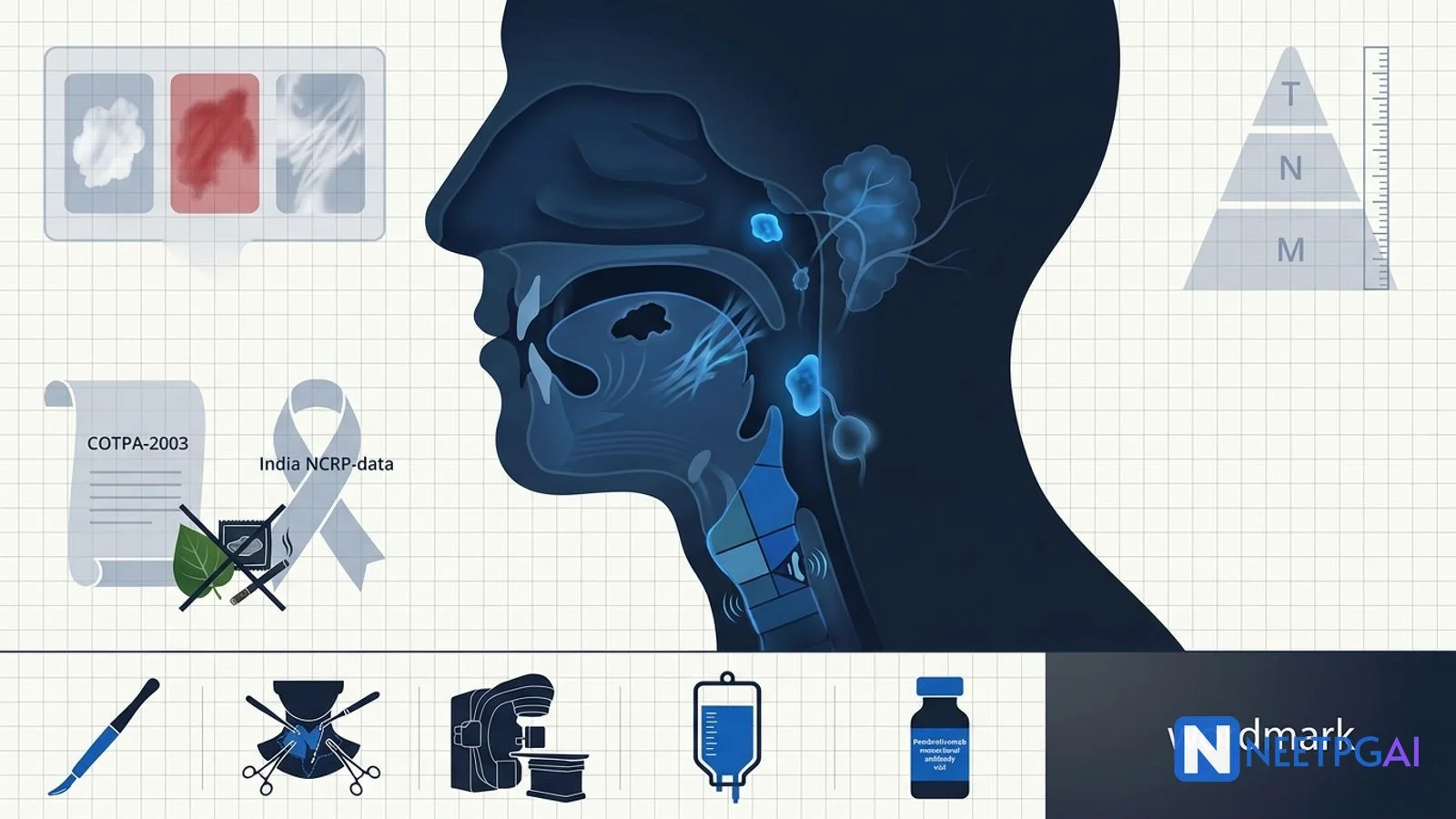
Head and neck cancer is a 2 to 4 question topic per NEET PG paper with disproportionate India relevance. Lock these:
Head and neck cancer is uniquely Indian in epidemiology — oral cancer alone accounts for about 30 percent of all cancers in Indian males, the highest national share globally. The reason is the South Asian-specific habit of chewing tobacco-areca-nut quids (paan, gutka, khaini, mishri), reinforced by bidi smoking. The Cigarettes and Other Tobacco Products Act (COTPA, 2003), the National Tobacco Control Programme (NTCP), and the National Cancer Registry Programme (NCRP) are the policy responses you need to know.
This NEETPGAI deep dive walks through oral, laryngeal, nasopharyngeal, oropharyngeal, salivary gland, and thyroid cancer — with AJCC TNM 8 staging, management principles, and Indian programmatic context. Pair this with the autonomic pharmacology guide and the otitis media and sinusitis ENT guide for full ENT coverage.
The most common cancer in Indian males. NCRP 2020 reports — male age-adjusted incidence 11 to 13 per 100,000; tongue and buccal mucosa are the leading subsites (vs floor-of-mouth in the West).
Start practicing NEET PG MCQs with AI-powered explanations.
Start Free PracticeMaster GI secretions, digestion, absorption transporters, motility patterns, and gut hormones with high-yield NEET PG 2026 traps and India-context examples.
Master labor stages, Friedman vs Zhang curves, WHO partograph, AMTSL, episiotomy and India JSY/LaQshya policies for NEET PG 2026 OBG MCQs.
5 anterior segment ophthalmology image MCQs for NEET PG: hypopyon and Behcet, Kayser-Fleischer ring in Wilson, Brushfield spots in Down, corneal arcus, and pterygium vs pinguecula.
Daily MCQs, study tips, and topper strategies on Telegram.
Join on Telegram →| Lesion | Appearance | Malignant transformation |
|---|---|---|
| Leukoplakia | White patch that cannot be wiped off, not explained by other disease | 5 to 10 percent (higher if non-homogeneous, dysplastic) |
| Erythroplakia | Red velvety patch | 50 percent or higher (highest risk) |
| Oral submucous fibrosis (OSMF) | Fibrous bands, trismus, blanching | 7 to 13 percent over 10 years |
| Speckled leukoplakia | Mixed white and red | Higher than pure leukoplakia |
| Lichen planus (erosive) | Wickham striae | 1 to 2 percent |
Oral squamous cell carcinoma (OSCC) dominates (over 90 percent). Indian subsite distribution: tongue (lateral border most common), buccal mucosa, gingiva, floor of mouth, hard palate, lip.
Non-healing ulcer > 2 weeks, indurated edges, fixity to deep tissues, cervical lymphadenopathy (levels I-II first), referred otalgia (via auriculotemporal nerve), trismus, dysphagia, weight loss.
| Subsite | Lymphatics | Presentation | Prognosis |
|---|---|---|---|
| Supraglottic (above cords) | Rich bilateral | Late: dysphagia, otalgia, neck mass | Worst (5-year survival 50 to 60%) |
| Glottic (cords) | Sparse | Early: hoarseness | Best (5-year survival up to 90% in T1) |
| Subglottic | Bilateral paratracheal | Late: stridor | Intermediate |
Risk factors — smoking (bidi, cigarette) + alcohol synergistic; GERD; HPV (rare in larynx). All glottic cancers are HPV-negative.
Investigations — flexible nasolaryngoscopy with biopsy; CT/MRI; CT chest for distant metastasis.
Treatment — T1-T2 glottic: transoral laser microsurgery (TLM) or radiotherapy (preserves voice). T3-T4: total laryngectomy + neck dissection + adjuvant chemoradiation OR organ-preservation chemoradiation. Speech rehabilitation with tracheoesophageal prosthesis (TEP) or electrolarynx after total laryngectomy.
Strong EBV association (over 95 percent of undifferentiated NPC). High incidence in southern China, Hong Kong, North Africa, and a notable cluster in Northeast India (Nagaland, Mizoram, Manipur).
EBV, salt-cured (Cantonese-style) fish, genetic (HLA-A2, certain Asian haplotypes), family history, smoking.
| Feature | HPV-positive | HPV-negative |
|---|---|---|
| Subsites | Tonsil, base of tongue | All oropharyngeal sites |
| Patient | Younger, non-smoker, often male | Older, smoker, alcohol |
| Geography | Rising in West; lower in India | Common globally including India |
| Histology | Non-keratinising | Keratinising |
| Stage at presentation | Cystic nodal involvement common | Variable |
| Prognosis | Better (5-year OS over 80%) | Worse (5-year OS 50 to 60%) |
| AJCC TNM 8 | Separate staging system | Standard HNSCC staging |
| Treatment | De-escalation trials active | Concurrent chemoradiation, surgery |
p16 IHC is the surrogate marker for HPV in clinical practice.
Surgery is mainstay — superficial or total parotidectomy with facial-nerve preservation if possible; adjuvant RT for high-grade tumours, ENE, perineural invasion, positive margins.
| Type | Frequency | Cell of origin | Key features |
|---|---|---|---|
| Papillary | 70 to 80% | Follicular | Lymphatic spread; "Orphan Annie" nuclei, psammoma bodies; best prognosis |
| Follicular | 10 to 15% | Follicular | Haematogenous spread (lung, bone); needs capsular/vascular invasion to diagnose |
| Medullary | 5% | Parafollicular C cells | Calcitonin marker; MEN-2A and 2B (RET); amyloid stroma |
| Anaplastic | 1 to 2% | Dedifferentiated | Worst prognosis (months); elderly |
| Lymphoma | < 1% | B cell | Hashimoto association |
Management — total thyroidectomy ± central neck dissection + radioactive iodine ablation (papillary, follicular); levothyroxine TSH suppression. Medullary — total thyroidectomy + central neck dissection; screen for pheo (MEN 2). Anaplastic — multimodality; lenvatinib for advanced.
Oral cancer accounts for about 30 percent of all cancers in Indian males, the highest national share in the world. The driver is the unique South Asian habit of chewing tobacco-containing products — paan, gutka, khaini, mawa, mishri, and the betel quid (paan masala) — which combine tobacco, areca nut, slaked lime, and catechu. These deliver carcinogens (nitrosamines, polycyclic aromatic hydrocarbons) directly to the oral mucosa for prolonged dwell times. Bidi and cigarette smoking add to risk. Pre-cancerous lesions (leukoplakia, erythroplakia, oral submucous fibrosis from areca nut) are common precursors.
Oral submucous fibrosis is a chronic, progressive, fibrosing pre-malignant condition of the oral mucosa caused by areca (betel) nut chewing. Features include burning sensation, restricted mouth opening (trismus), blanching and fibrous bands of the buccal mucosa, palate and tongue. Histology shows juxtaepithelial inflammation, atrophic epithelium, and dense submucosal collagen deposition. Malignant transformation rate is 7 to 13 percent over 10 years. Management — areca nut cessation (absolute), intralesional steroids and hyaluronidase, mouth-opening exercises; severe trismus may need surgical release.
Glottic carcinoma (true vocal cords) has the best prognosis among laryngeal cancers because (1) the cords have sparse lymphatics — nodal metastases are rare until disease becomes advanced (T3-T4); (2) hoarseness occurs early, prompting earlier presentation and diagnosis; (3) the cords are well-visualised on laryngoscopy. T1 glottic cancer has 90 percent 5-year survival with radiotherapy or transoral laser microsurgery. In contrast, supraglottic cancer (above the cords) has rich bilateral lymphatic drainage, presents late with referred otalgia or dysphagia, and has 50 to 60 percent 5-year survival.
Nasopharyngeal carcinoma (NPC) has a unique strong association with Epstein-Barr virus (EBV) — over 95 percent of undifferentiated, non-keratinising NPC cases carry EBV DNA. Other risk factors include consumption of Cantonese-style salt-cured fish (nitrosamines), genetic susceptibility (HLA-A2 haplotype), and family history. NPC has high incidence in Southern China, Hong Kong, North Africa, and a notable cluster in Northeast India (Nagaland, Mizoram, Manipur). Plasma EBV-DNA is used for screening and monitoring response. NPC is highly radiosensitive — concurrent chemoradiotherapy (cisplatin) is the standard of care.
HPV-positive (especially HPV-16) oropharyngeal squamous cell carcinoma — primarily of the tonsil and base of tongue — is a biologically and clinically distinct disease from HPV-negative tobacco-driven cancer. Patients are younger, often non-smokers, present with cystic cervical nodes, and have markedly better treatment response and overall survival. AJCC TNM 8 (2017) created a separate staging system for HPV-positive oropharyngeal cancer (p16-positive on IHC) reflecting this better prognosis — what would be Stage IV in HPV-negative disease is often Stage I in HPV-positive. Treatment de-escalation trials are active.
This content is for educational purposes for NEET PG exam preparation. It is not a substitute for professional medical advice, diagnosis, or treatment. Clinical information has been reviewed by qualified medical professionals.
Written by: NEETPGAI Editorial Team Reviewed by: Pending SME Review Last reviewed: May 2026