Version 1.0 — Published March 2026
Quick Answer
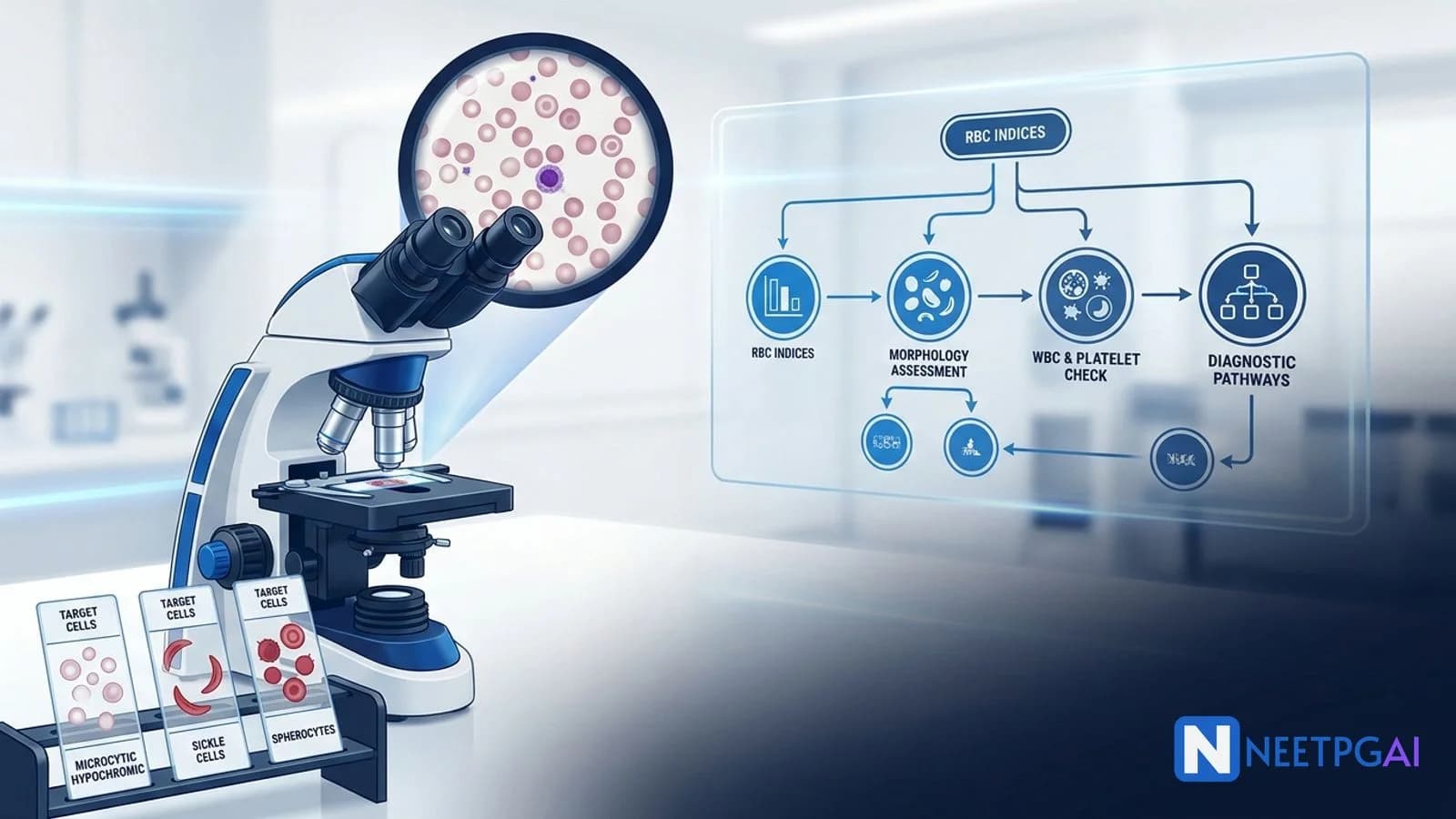
A peripheral blood smear is a drop of blood spread on a glass slide and stained (usually Wright-Giemsa) to visualize red cells, white cells, and platelets under a microscope. To correctly interpret smear-based NEET PG image MCQs, follow this 5-step approach:
- Assess size — compare RBCs to a small lymphocyte (diameter ~7-8 micrometers); smaller = microcytic, larger = macrocytic
- Assess shape — identify diagnostic cells: spherocytes (HS/AIHA), sickle cells (HbSS), schistocytes (MAHA — TTP/HUS/DIC), target cells (thalassemia, liver disease), teardrop cells (myelofibrosis)
- Assess color — central pallor > 1/3 of cell diameter = hypochromic (iron deficiency, thalassemia); loss of pallor = spherocyte or polychromasia
- Check inclusions — Howell-Jolly bodies (asplenia), basophilic stippling (thalassemia, lead poisoning), Heinz bodies (G6PD deficiency), Pappenheimer bodies (sideroblastic anemia)
- Correlate with WBC and platelet morphology — hypersegmented neutrophils (megaloblastic), schistocytes with thrombocytopenia (TTP/HUS), teardrop cells with leuko-erythroblastic picture (myelofibrosis)
Clinical image presentation
A 28-year-old woman presents with a 3-month history of progressive fatigue, exertional dyspnea, and pallor. She is vegetarian, has heavy menstrual bleeding (menorrhagia with clots), and reports mild pica (chewing ice). On examination, she is pale with koilonychia (spoon-shaped nails) and angular cheilitis. A complete blood count shows hemoglobin 7.8 g/dL, MCV 68 fL (low), MCH 22 pg (low), RDW 18% (high), and platelet count 480 x 10^9/L (mildly raised).
A peripheral blood smear (Wright-Giemsa stain, oil-immersion magnification at 100x) is performed. A student should systematically identify these findings:
Low-power survey (10x):
- Reduced overall red cell density (anemia)
- No obvious clumping or rouleaux
- Normal white cell and platelet distribution at low power
Medium-power detail (40x):
- Red cells appear smaller than neighboring small lymphocytes (microcytosis)
- Prominent central pallor — more than one-third of cell diameter (hypochromia)
- Marked variation in size (anisocytosis) and shape (poikilocytosis)
High-power confirmation (100x oil):
- Pencil cells (elongated thin red cells) — characteristic of iron deficiency
- Target cells — occasional, not prominent
- Microcytes with expanded central pallor
- Normal WBC and platelet morphology
MCQ question as it appears in NEET PG
A 28-year-old vegetarian woman with menorrhagia presents with fatigue and pica (ice chewing). Hb 7.8 g/dL, MCV 68 fL, RDW 18%. Peripheral blood smear shows microcytic hypochromic red cells, pencil cells, and marked anisopoikilocytosis. Platelets are 480 x 10^9/L. Which of the following is the most likely diagnosis?
- (a) Beta-thalassemia trait
- (b) Iron deficiency anemia
- (c) Anemia of chronic disease
- (d) Sideroblastic anemia
Take a moment to work through this before reading the analysis below.
Step-by-step visual analysis
A systematic reading protocol is critical — jumping to one feature and ignoring the overall pattern is the reason students confuse iron deficiency with thalassemia trait or miss a megaloblastic pattern. Use this protocol every time you see a smear on an NEET PG image MCQ:
Step 1: Low-power survey (scan the entire slide)
Begin at 10x magnification:
- Is the red cell density reduced? Reduced density with normal distribution confirms anemia rather than a dilution artefact.
- Is there clumping, rouleaux, or agglutination? Rouleaux (stacked-coin appearance) suggests multiple myeloma or chronic inflammation. Agglutination (large clumps) suggests cold agglutinin disease.
- Is the distribution uniform? Uneven distribution may indicate a poor smear rather than true pathology.
Step 2: Assess RBC size (the defining step for classification)
Compare the RBC diameter to a small lymphocyte on the same slide — the lymphocyte's nucleus is approximately 7-8 micrometers, a reliable internal ruler.
- Microcytic (MCV < 80 fL) — RBCs smaller than the lymphocyte nucleus. Think: iron deficiency, thalassemia, anemia of chronic disease (advanced), sideroblastic anemia. Mnemonic: TAILS (Thalassemia, Anemia of chronic disease, Iron deficiency, Lead poisoning, Sideroblastic).
- Normocytic (MCV 80-100 fL) — RBCs similar in size to the lymphocyte nucleus. Think: acute blood loss, hemolysis (early), chronic kidney disease, anemia of chronic disease (early), aplastic anemia.
- Macrocytic (MCV > 100 fL) — RBCs larger than the lymphocyte nucleus. Think: megaloblastic (B12, folate deficiency) vs non-megaloblastic (alcohol, liver disease, hypothyroidism, reticulocytosis).
In this patient: RBCs are clearly smaller than adjacent small lymphocytes — microcytic.
Step 3: Assess RBC shape (the pattern-recognition step)
Shape changes point to specific diagnoses:
- Spherocytes — small, densely staining red cells without central pallor. Think hereditary spherocytosis (HS) or autoimmune hemolytic anemia (AIHA). Differentiate with direct Coombs test (positive in AIHA, negative in HS).
- Sickle cells (drepanocytes) — elongated crescent-shaped cells with pointed ends. Pathognomonic of sickle cell disease (HbSS).
- Schistocytes (fragmented cells, helmet cells) — red cells broken into fragments by shear stress in small vessels. Think microangiopathic hemolytic anemia (TTP, HUS, DIC, HELLP, malignant hypertension, prosthetic valve hemolysis).
- Target cells (codocytes) — red cells with central bullseye of hemoglobin, ring of pallor, peripheral rim of hemoglobin. Think thalassemia, hemoglobinopathies (HbC, HbE, HbS), liver disease, post-splenectomy, iron deficiency.
- Teardrop cells (dacrocytes) — red cells with a pointed tail. Think primary myelofibrosis, bone marrow infiltration (metastatic carcinoma), myelophthisic anemia, thalassemia major.
- Pencil cells / elliptocytes — elongated thin or oval red cells. Pencil cells are classic for iron deficiency; hereditary elliptocytosis shows > 25% elliptocytes.
- Acanthocytes (spur cells) — red cells with irregular spiky projections. Think liver disease, abetalipoproteinemia.
- Echinocytes (burr cells) — red cells with uniform small spiny projections. Think uremia, pyruvate kinase deficiency, or artefact.
- Bite cells (degmocytes) — red cells with a "bite" taken out. Think G6PD deficiency with oxidative hemolysis.
In this patient: pencil cells are prominent with mild poikilocytosis — favoring iron deficiency.
Step 4: Assess RBC color and inclusions
- Hypochromic cells — central pallor > 1/3 of cell diameter (normal pallor is < 1/3). Think iron deficiency, thalassemia, sideroblastic anemia.
- Polychromasia — bluish-pink cells that are larger than mature RBCs (these are reticulocytes). Indicates active erythropoiesis — hemolysis, blood loss, response to treatment.
- Howell-Jolly bodies — single round basophilic nuclear remnants in RBCs. Indicate functional asplenia (post-splenectomy, sickle cell disease, celiac disease).
- Basophilic stippling — fine or coarse basophilic granules scattered throughout RBC cytoplasm. Think thalassemia, lead poisoning, sideroblastic anemia.
- Heinz bodies — refractile inclusions visible only on supravital stain (crystal violet). Indicate denatured hemoglobin — G6PD deficiency, unstable hemoglobin variants.
- Pappenheimer bodies — iron-containing siderotic granules in RBCs. Indicate sideroblastic anemia, post-splenectomy.
- Cabot rings — figure-of-eight or ring-shaped basophilic inclusions. Rare; indicate severe dyserythropoiesis (megaloblastic anemia, lead poisoning).
In this patient: prominent hypochromia with central pallor > 50% of cell diameter — consistent with iron deficiency.
Step 5: Review WBCs and platelets
- Hypersegmented neutrophils (> 5 lobes in more than 5% of neutrophils, or any neutrophil with 6+ lobes) — pathognomonic of megaloblastic anemia.
- Neutrophilic leukocytosis with left shift — infection, inflammation.
- Lymphocytosis with smudge cells — chronic lymphocytic leukemia.
- Thrombocytopenia with schistocytes — TTP/HUS/DIC (the thrombotic microangiopathies).
- Giant platelets — immune thrombocytopenia, myeloproliferative disorders.
- Reactive thrombocytosis — iron deficiency, chronic inflammation, post-splenectomy.
In this patient: reactive thrombocytosis (platelet count 480 x 10^9/L) is a classic accompaniment of iron deficiency anemia — a high-yield pairing frequently tested.
Answer and detailed explanation
Correct answer: (b) Iron deficiency anemia
The combination of microcytic hypochromic red cells + pencil cells + high RDW (18%) + reactive thrombocytosis in a vegetarian woman with menorrhagia and pica is the textbook presentation of iron deficiency anemia. Koilonychia and angular cheilitis on clinical examination are supportive mucocutaneous signs.
Why each distractor is wrong:
| Option | Why incorrect |
|---|
| (a) Beta-thalassemia trait | Thalassemia trait shows microcytic hypochromic cells but with prominent target cells, basophilic stippling, normal RDW, and disproportionately high RBC count. Mentzer index (MCV divided by RBC count) < 13 in thalassemia, > 13 here favors iron deficiency. Pica and koilonychia are NOT features of thalassemia. |
| (c) Anemia of chronic disease | Classically normocytic normochromic (microcytic only in advanced stages). Serum iron and TIBC both low; ferritin normal or high. Associated with chronic inflammation/infection/malignancy — no such history here. |
| (d) Sideroblastic anemia | Microcytic hypochromic cells may be present, but smear shows dimorphic population (both normocytic and hypochromic cells) with Pappenheimer bodies. Bone marrow shows ringed sideroblasts on Prussian blue staining. Reactive thrombocytosis and pencil cells are NOT features. |
NEET PG trap alert: Iron deficiency vs thalassemia trait is the most tested differential in microcytic anemia smear questions. Both are microcytic hypochromic. The distinguishing features: RDW (high in iron deficiency, normal in thalassemia), RBC count (low in iron deficiency, high in thalassemia), and Mentzer index. Serum ferritin is the best single confirmatory test — low in iron deficiency, normal/high in thalassemia.
Practice hematology MCQs with AI-powered explanations to build smear pattern recognition. For a full review, see our NEET PG pathology high-yield topics and the anemias classification and diagnosis guide.
Similar patterns comparison table
The six anemia patterns most commonly tested in NEET PG image-based MCQs — memorize this table, it covers approximately 80% of smear questions:
| Smear finding | Diagnosis | Confirmatory test |
|---|
| Microcytic hypochromic + pencil cells + high RDW + reactive thrombocytosis | Iron deficiency anemia | Serum ferritin (low); serum iron low, TIBC high |
| Microcytic hypochromic + target cells + basophilic stippling + high RBC count + normal RDW | Beta-thalassemia trait | HbA2 > 3.5% on hemoglobin electrophoresis |
| Macro-ovalocytes + hypersegmented neutrophils | Megaloblastic anemia (B12 or folate deficiency) | Serum B12 and folate levels; Schilling test (historical) |
| Spherocytes (no central pallor, densely stained) | Hereditary spherocytosis OR autoimmune hemolytic anemia | Direct Coombs (positive in AIHA, negative in HS); EMA flow cytometry (specific for HS); osmotic fragility |
| Sickle cells + target cells + Howell-Jolly bodies | Sickle cell disease (HbSS) | Hemoglobin electrophoresis (HbS band at pH 8.6); sickling test / solubility test |
| Schistocytes (>1%) + thrombocytopenia | Microangiopathic hemolytic anemia (TTP, HUS, DIC) | ADAMTS13 activity (TTP); stool culture for Shiga toxin (HUS); PT/aPTT, D-dimer, fibrinogen (DIC) |
| Teardrop cells + nucleated RBCs + immature WBCs (leuko-erythroblastic) | Primary myelofibrosis | Bone marrow biopsy (dry tap, reticulin fibrosis); JAK2 mutation |
| Bite cells + Heinz bodies (on supravital stain) | G6PD deficiency with oxidative hemolysis | G6PD enzyme assay (avoid during acute hemolysis — may be falsely normal) |
| Acanthocytes (spur cells) + target cells | Liver disease, abetalipoproteinemia | LFTs, lipid profile, clinical context |
| Echinocytes (burr cells) + schistocytes | Uremia | Serum creatinine, urea |
Clinical application: how this differs from thalassemia
This patient's smear and clinical picture are classic iron deficiency. If the same patient were a young adult with microcytic hypochromic cells but a family history of anemia, Mediterranean or South Asian ancestry, and RBC count above 5 x 10^12/L, the differential would shift toward thalassemia trait.
The discriminating features at a glance:
| Feature | Iron deficiency anemia | Beta-thalassemia trait |
|---|
| MCV | Low (often < 70 fL in severe cases) | Low (typically 65-75 fL) |
| RBC count | Low or normal | High (often > 5.5 x 10^12/L) |
| RDW | High (> 15%) | Normal (< 14.5%) |
| Mentzer index (MCV/RBC) | > 13 | < 13 |
| Pencil cells | Prominent | Absent or rare |
| Target cells | Occasional | Prominent |
| Basophilic stippling | Absent | Present |
| Serum ferritin | Low | Normal or high |
| HbA2 | Normal (< 3.5%) | Elevated (> 3.5%) |
Frequently asked questions
What is the systematic approach to reading a peripheral blood smear in NEET PG?
Use the 5-step RBC-WBC-platelet protocol. First, scan the smear at low power (10x) for distribution and overall cellularity. Second, examine RBC size (normocytic, microcytic, macrocytic) against a small lymphocyte (7-8 micrometers). Third, assess RBC shape (spherocytes, sickle, target, teardrop, schistocyte). Fourth, check RBC color (hypochromic pale center more than one-third of diameter = iron deficiency). Fifth, review WBCs and platelets for associated changes. This 5-step method prevents missing diagnostic cells that cluster at the feathered edge.
How do you distinguish iron deficiency anemia from thalassemia on smear?
Both show microcytic hypochromic red cells, but the pattern differs. Iron deficiency shows pencil cells, target cells (occasional), and anisopoikilocytosis with RDW > 15%. Thalassemia shows prominent target cells, basophilic stippling, nucleated RBCs, and normal RDW. Mentzer index (MCV divided by RBC count) < 13 suggests thalassemia trait; > 13 suggests iron deficiency. Serum ferritin is the single best differentiating test — low in iron deficiency, normal or high in thalassemia.
What is the difference between macrocytic oval cells and round macrocytes?
Macro-ovalocytes (oval macrocytes) are characteristic of megaloblastic anemia (B12 or folate deficiency) and are accompanied by hypersegmented neutrophils (more than 5 lobes in >5% of neutrophils, or any neutrophil with 6+ lobes). Round macrocytes without hypersegmented neutrophils suggest non-megaloblastic causes — alcoholism, liver disease, hypothyroidism, reticulocytosis. The presence of hypersegmented neutrophils is the single best smear feature to confirm megaloblastic etiology.
When should I suspect microangiopathic hemolytic anemia on a smear?
Schistocytes (fragmented red cells, helmet cells, bite cells) more than 1% of red cells on smear indicate microangiopathic hemolytic anemia (MAHA). The classic causes are thrombotic thrombocytopenic purpura (TTP), hemolytic uremic syndrome (HUS), disseminated intravascular coagulation (DIC), HELLP syndrome, and malignant hypertension. Always check platelet count — thrombocytopenia with schistocytes in a febrile patient is TTP until proven otherwise; with renal failure and diarrhea, it is HUS.
What are teardrop cells and what do they indicate?
Teardrop cells (dacrocytes) are red cells with a pointed projection resembling a teardrop, formed when red cells squeeze through abnormal bone marrow. They indicate bone marrow infiltration — primary myelofibrosis is the classic cause. Other causes include metastatic carcinoma to bone marrow, myelophthisic anemia, and thalassemia major. Teardrop cells with a leuko-erythroblastic picture (nucleated RBCs plus immature WBCs in peripheral blood) is pathognomonic of myelofibrosis in NEET PG stems.
What is the difference between spherocytes seen in HS and AIHA?
Hereditary spherocytosis (HS) and autoimmune hemolytic anemia (AIHA) both show spherocytes — round, dense, small red cells without central pallor. The distinguishing features: HS has a positive osmotic fragility test (spherocytes lyse in hypotonic saline) and negative direct Coombs test; AIHA has a positive direct Coombs test and positive EMA (eosin-5-maleimide) flow cytometry dye test is specific for HS. Family history supports HS; onset in adulthood with positive Coombs supports AIHA.
What are target cells and in which conditions do they appear?
Target cells (codocytes) are red cells with a central bullseye of hemoglobin surrounded by a ring of pallor and a peripheral rim of hemoglobin — resembling a shooting target. They appear when there is excess red cell membrane relative to cytoplasm. Causes include thalassemia (most classic), hemoglobinopathies (HbC, HbS, HbE), liver disease (especially obstructive jaundice), post-splenectomy, iron deficiency anemia, and lecithin-cholesterol acyltransferase (LCAT) deficiency.
How are sickle cells recognized and what confirmatory test is used?
Sickle cells (drepanocytes) are elongated, crescent-shaped red cells with pointed ends, seen in sickle cell disease (homozygous HbSS). The smear also shows target cells, nucleated RBCs, Howell-Jolly bodies (functional asplenia), and polychromasia. Sickle cell trait typically does NOT show sickle cells on routine smear — only under low oxygen conditions. Confirmatory tests: sickling test (sodium metabisulfite), solubility test, and definitively hemoglobin electrophoresis (HbS band at pH 8.6).
This content is for educational purposes for NEET PG exam preparation. It is not a substitute for professional medical advice, diagnosis, or treatment. Clinical information has been reviewed by qualified medical professionals.
Sources and references
- Robbins and Cotran Pathologic Basis of Disease, 10th Edition (Kumar, Abbas, Aster, 2021) — Red Cell Disorders chapter; morphological classification of anemia and peripheral smear findings.
- Wintrobe's Clinical Hematology, 14th Edition (Greer JP et al., 2018) — comprehensive reference for peripheral blood smear interpretation and anemia classification.
- Harrison's Principles of Internal Medicine, 21st Edition (Loscalzo et al., 2022) — Hematology section, approach to anemia and laboratory investigations.
Strengthen your pathology subject coverage by working through hematology smear vignettes. Build deeper pattern recognition with the anemias classification and diagnosis guide and the broader NEET PG pathology high-yield topics. Ready for unlimited AI-powered MCQs with detailed explanations? Explore NEETPGAI Pro.
For personalized study guidance on pathology and hematology, try the AI Tutor — it adapts to your weak areas and explains concepts the way a senior resident would.
Written by: NEETPGAI Editorial Team
Reviewed by: Pending SME Review
Last reviewed: March 2026
This article is reviewed by qualified medical professionals for clinical accuracy and exam relevance. For corrections or updates, contact the editorial team.