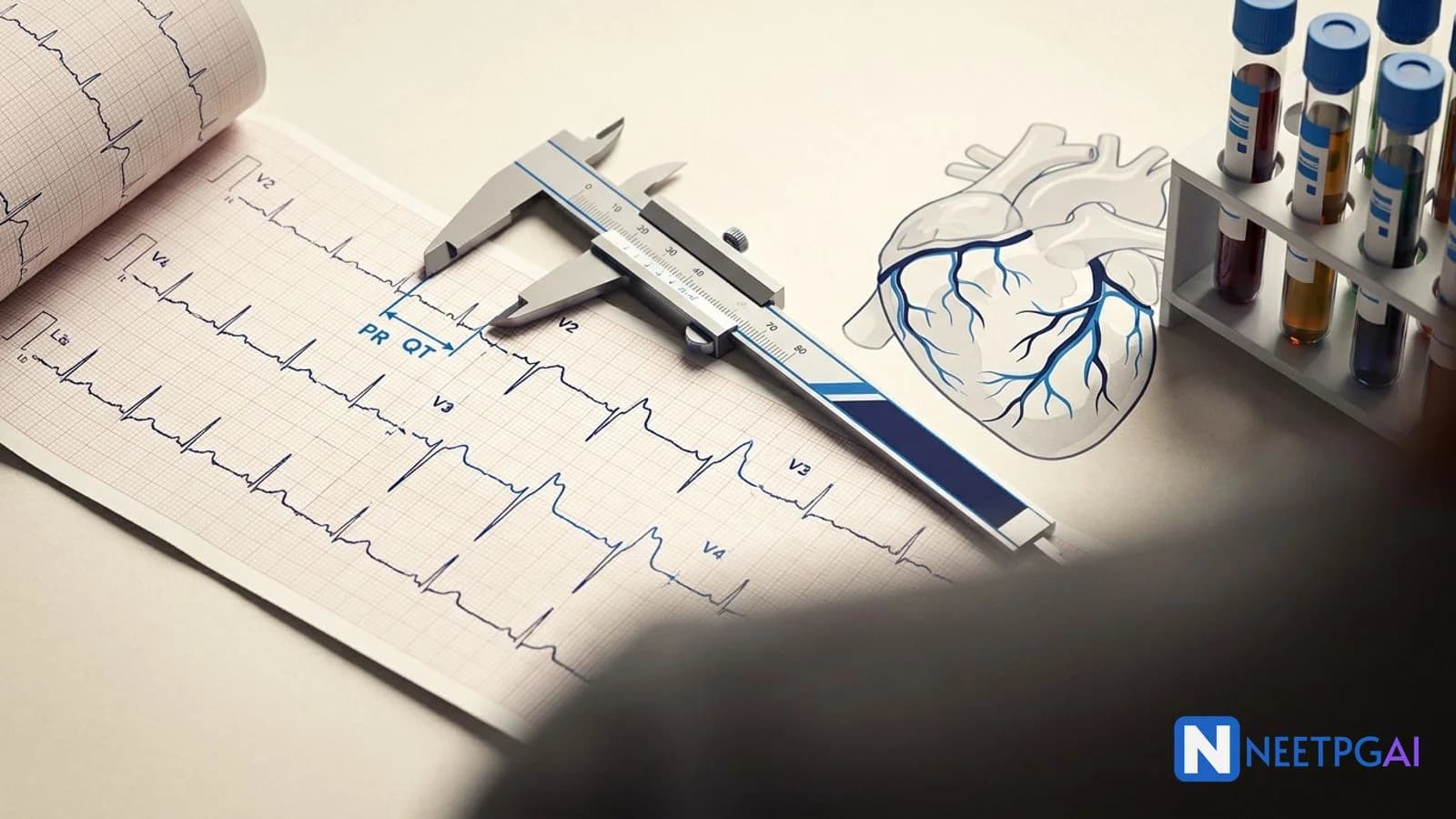
Image MCQ Walkthrough: ECG Showing ST Elevation in II, III, aVF — Inferior STEMI | NEETPGAI
radiologyimage mcqcardiology
Image MCQ Walkthrough: ECG Showing ST Elevation in II, III, aVF — Inferior STEMI
Step-by-step ECG interpretation for NEET PG: systematic approach to reading a 12-lead ECG showing ST elevation in inferior leads, identifying inferior STEMI, culprit artery, reciprocal changes, and management with practice MCQs.
NEETPGAI EditorialPublished 9 Dec 202512 min read
Share this article
This content is for educational purposes for NEET PG exam preparation. It is not a substitute for professional medical advice, diagnosis, or treatment. Clinical information has been reviewed by qualified medical professionals.
Ready to put this into practice?
Start practicing NEET PG MCQs with AI-powered explanations.
5 dermoscopy and clinical image MCQs on skin cancer for NEET PG: superficial spreading melanoma ABCDE, nodular melanoma, acral lentiginous with Hutchinson sign, nodular BCC with rolled border, and squamous cell carcinoma with Marjolin ulcer.
ST elevation in leads II, III, and aVF on a 12-lead ECG indicates inferior STEMI, most commonly caused by right coronary artery (RCA) occlusion. To correctly interpret this pattern in NEET PG:
Identify the territory — leads II, III, aVF = inferior wall; supplied by RCA in 85% of patients
Check reciprocal changes — ST depression in leads I and aVL confirms acute MI and rules out pericarditis
Order right-sided leads (V4R) — ST elevation in V4R indicates RV involvement (changes management: no nitrates, give IV fluids)
Clinical image presentation
A 55-year-old male smoker with a history of type 2 diabetes and dyslipidemia presents to the emergency department with sudden-onset crushing retrosternal chest pain radiating to the jaw and left arm for 45 minutes. He is diaphoretic, anxious, and nauseated. Vital signs: pulse 56 bpm (sinus bradycardia), BP 100/70 mmHg, SpO2 96% on room air.
A 12-lead ECG is obtained within 5 minutes of arrival and shows the following findings:
ST segment changes:
ST elevation of 3-4 mm in leads II, III, and aVF — tall, convex-upward (dome-shaped) ST segments merging with the T wave
Reciprocal ST depression of 1-2 mm in leads I and aVL — horizontal/downsloping ST segments
ST elevation of 1 mm in V5-V6 — suggesting lateral extension (posterolateral wall involvement)
Other ECG findings:
Rate: approximately 56 bpm (sinus bradycardia — common in inferior MI because the RCA supplies the SA node in 60% and AV node in 85-90% of patients)
Rhythm: sinus with regular P-P intervals
Axis: normal (positive QRS in I and aVF)
PR interval: 240 ms (first-degree AV block — also common in inferior MI due to AV nodal ischemia)
No pathological Q waves yet (early presentation, under 6 hours)
T waves: hyperacute (tall, broad-based T waves in II, III, aVF preceding the ST elevation)
MCQ question as it appears in NEET PG
A 55-year-old diabetic male presents with crushing chest pain for 45 minutes. ECG shows ST elevation in leads II, III, aVF with reciprocal ST depression in I and aVL. Heart rate is 56 bpm with a PR interval of 240 ms. The most likely culprit artery is:
(a) Left anterior descending artery
(b) Right coronary artery
(c) Left circumflex artery
(d) Left main coronary artery
Take a moment to work through this before reading the analysis below.
Step-by-step ECG analysis
Systematic ECG reading is the foundation for answering any ECG-based image MCQ in NEET PG. Jumping directly to ST changes without assessing rate, rhythm, and axis is the most common reason students misinterpret ECGs under exam pressure.
Step 1: Rate
Heart rate can be calculated by dividing 300 by the number of large boxes between two consecutive R waves. In this ECG, the R-R interval spans approximately 5.4 large boxes: 300 / 5.4 = approximately 56 bpm. This is sinus bradycardia.
Clinical significance: Sinus bradycardia in inferior STEMI is expected and often benign. The SA node receives its blood supply from the RCA in 60% of patients. Ischemia of the SA nodal artery causes sinus bradycardia. Vagal tone (Bezold-Jarisch reflex) triggered by inferior wall ischemia also contributes. Treatment: atropine only if the patient is hemodynamically unstable.
Step 2: Rhythm
P waves are present, upright in lead II, with a regular P-P interval. Each P wave is followed by a QRS complex with a constant (though prolonged) PR interval. This is sinus rhythm with first-degree AV block — not Mobitz type I or type II.
Clinical significance: First-degree AV block (PR >200 ms) in inferior STEMI occurs because the AV node is supplied by the posterior descending artery (a branch of the RCA in 85% of people). AV nodal ischemia prolongs conduction. First-degree block alone does not require treatment, but the patient should be monitored for progression to second-degree (Mobitz type I/Wenckebach is common and usually transient; Mobitz type II is rare in inferior MI and more ominous).
Step 3: Axis
The QRS complex is positive (upright) in both lead I and lead aVF, placing the axis in the normal range (0 to +90 degrees). No axis deviation.
Step 4: Intervals
PR interval: 240 ms (prolonged; normal 120-200 ms) — first-degree AV block as discussed
QRS duration: 80 ms (normal; <120 ms) — no bundle branch block
QT interval: Difficult to assess accurately in the setting of acute ST elevation; will be monitored during treatment
Step 5: P wave morphology
P waves are normal in morphology — upright in II, biphasic in V1. No P-mitrale (left atrial enlargement) or P-pulmonale (right atrial enlargement). This is an acute presentation without prior structural heart disease.
Step 6: QRS morphology
No pathological Q waves in any leads — this is consistent with an acute STEMI less than 6 hours old. Q waves develop over 6-12 hours as myocardial necrosis progresses.
No bundle branch block pattern (QRS <120 ms, no RSR' in V1, no slurred S in V6)
Normal R wave progression in precordial leads (R wave height increases from V1 to V5)
Step 7: ST-T changes (the diagnostic findings)
This is the critical step that clinches the diagnosis:
Leads II, III, aVF: ST elevation of 3-4 mm with convex-upward morphology. The ST segments are dome-shaped (sometimes called "tombstone" when very pronounced), merging with tall T waves. This pattern localizes to the inferior wall.
Leads I, aVL: Reciprocal ST depression of 1-2 mm — mirror-image changes that confirm the diagnosis of acute MI and differentiate it from pericarditis.
Leads V5, V6: ST elevation of 1 mm — suggesting lateral wall involvement (inferolateral MI)
Leads V1-V4: No significant ST changes — the anterior wall is not involved
Use the NEETPGAI practice platform to work through ECG interpretation MCQs with AI-powered explanations that reinforce the systematic 7-step approach.
Answer and detailed explanation
Correct answer: (b) Right coronary artery
Why (b) is correct: ST elevation in leads II, III, and aVF localizes to the inferior wall of the heart. The inferior wall is supplied by the posterior descending artery (PDA), which arises from the RCA in 85% of patients (right-dominant circulation). The associated findings — sinus bradycardia (SA nodal ischemia) and first-degree AV block (AV nodal ischemia) — further confirm RCA involvement because the RCA supplies both the SA node (60%) and AV node (85-90%). The reciprocal changes in I and aVL are classic for inferior STEMI.
Why (a) LAD is wrong: The left anterior descending artery supplies the anterior wall and interventricular septum. LAD occlusion causes ST elevation in V1-V4 (anterior leads), not in II, III, aVF. An LAD lesion would show reciprocal ST depression in inferior leads, which is the opposite of this ECG.
Why (c) LCx is wrong: The left circumflex artery can cause inferior STEMI in patients with left-dominant circulation (15% of population). However, LCx-related inferior MI typically does NOT cause sinus bradycardia or AV block (because the LCx does not supply the SA or AV node in right-dominant hearts). The combination of inferior ST elevation + bradycardia + first-degree AV block strongly favors RCA over LCx.
Why (d) Left main is wrong: Left main coronary artery occlusion causes massive ST elevation in anterolateral leads (I, aVL, V1-V6) with hemodynamic collapse (cardiogenic shock). It does not present with isolated inferior ST elevation. Left main disease is typically fatal without immediate intervention.
Similar patterns: STEMI by territory
Recognizing which leads map to which coronary territory is the single most tested ECG concept in NEET PG:
STEMI territory
Leads with ST elevation
Reciprocal ST depression
Culprit artery
Associated findings
Inferior
II, III, aVF
I, aVL
RCA (85%) or LCx (15%)
Bradycardia, AV block, RV involvement
Anterior
V1-V4
II, III, aVF
LAD
LV failure, tachycardia, cardiogenic shock
Lateral
I, aVL, V5-V6
II, III, aVF
LCx or LAD diagonal
May be subtle; check V5-V6 carefully
Anteroseptal
V1-V3
None or II, III, aVF
LAD (proximal)
Septal rupture risk if extensive
Extensive anterior
V1-V6, I, aVL
II, III, aVF
Proximal LAD
Worst prognosis, highest LV dysfunction
Posterior
V7-V9 (if recorded); tall R in V1-V2 (mirror image)
ST elevation (convex upward), reciprocal depression
Hours (6-24)
Q waves begin to appear, ST elevation persists, T wave inversion begins
Days (1-7)
ST elevation resolves, deep symmetric T wave inversion, pathological Q waves established
Weeks-months
T waves may normalize, Q waves persist (permanent marker of transmural infarction)
Frequently asked questions
Which leads show ST elevation in inferior STEMI?
Inferior STEMI shows ST elevation in leads II, III, and aVF. These leads look at the inferior surface of the heart, which is supplied by the right coronary artery (RCA) in 85% of patients and the left circumflex artery (LCx) in 15%. Reciprocal ST depression appears in leads I and aVL (lateral leads viewing the opposite wall). The presence of reciprocal changes increases diagnostic specificity for true STEMI versus pericarditis, which shows diffuse ST elevation without reciprocal depression.
What is the culprit artery in inferior STEMI?
The right coronary artery (RCA) is the culprit in approximately 85% of inferior STEMIs, because the RCA supplies the inferior wall via the posterior descending artery (PDA) in patients with right-dominant circulation (85% of the population). The left circumflex (LCx) is the culprit in the remaining 15% (left-dominant circulation). To differentiate: RCA occlusion often shows right ventricular involvement (ST elevation in V3R, V4R), while LCx occlusion may show lateral involvement (ST elevation in V5, V6).
Why are reciprocal changes important in STEMI diagnosis?
Reciprocal ST depression in leads opposite to the ST elevation wall confirms acute myocardial infarction and helps differentiate STEMI from pericarditis. In inferior STEMI, reciprocal depression appears in I and aVL. In anterior STEMI, reciprocal depression appears in II, III, aVF. Pericarditis causes diffuse ST elevation in multiple vascular territories without reciprocal changes (except aVR, which shows ST depression in pericarditis). Reciprocal changes also increase sensitivity for MI diagnosis from 70% to over 90%.
How do I differentiate STEMI from pericarditis on ECG?
Three key differences: First, STEMI shows ST elevation in a vascular territory (inferior OR anterior OR lateral), while pericarditis shows diffuse ST elevation across multiple territories. Second, STEMI has reciprocal ST depression (e.g., I, aVL in inferior MI), while pericarditis typically has no reciprocal changes except PR depression and ST elevation in all leads except aVR. Third, STEMI ST segments are convex upward (tombstone or dome-shaped), while pericarditis ST segments are concave upward (saddle-shaped). Also check PR segment: diffuse PR depression suggests pericarditis.
What is the systematic approach to reading an ECG in NEET PG?
Use the 7-step approach: 1) Rate (300 divided by R-R interval in large boxes, or count QRS in 6 seconds and multiply by 10); 2) Rhythm (regular/irregular, P waves present and upright in II); 3) Axis (normal if QRS positive in I and aVF); 4) Intervals (PR 120-200 ms, QRS under 120 ms, QTc under 440 ms men / 460 ms women); 5) P wave morphology (P-mitrale, P-pulmonale); 6) QRS morphology (bundle branch blocks, Q waves); 7) ST-T changes (elevation, depression, T wave inversion). This structured approach prevents the common error of jumping to ST changes without checking rate and rhythm first.
When should right-sided ECG leads be recorded in inferior STEMI?
Right-sided leads (V3R, V4R) should be recorded in every patient with inferior STEMI to assess for right ventricular involvement. ST elevation of 1 mm or more in V4R is 90% sensitive and 80% specific for RV infarction. RV involvement occurs in 30-50% of inferior STEMIs and changes management: nitrates and diuretics are contraindicated (they reduce preload, worsening RV failure), and fluid loading is the initial treatment. This is a high-yield NEET PG management trap.
This content is for educational purposes for NEET PG exam preparation. It is not a substitute for professional medical advice, diagnosis, or treatment. Clinical information has been reviewed by qualified medical professionals.
Sources and references
Braunwald's Heart Disease, 12th Edition (Libby et al., 2022) — Chapter on ST-Elevation Myocardial Infarction, ECG interpretation, coronary anatomy, and management.
ACC/AHA 2013 STEMI Guidelines (O'Gara et al., Circulation 2013) — standard reference for STEMI diagnosis, management, and reperfusion timelines.
Goldberger's Clinical Electrocardiography, 10th Edition (Goldberger et al., 2018) — comprehensive ECG interpretation reference for systematic approach and STEMI patterns.
For personalized guidance on cardiology and ECG interpretation, try the AI Tutor — it adapts explanations to your learning style and tracks your weak areas.
Written by: NEETPGAI Editorial Team
Reviewed by: Pending SME Review
Last reviewed: April 2026
This article is reviewed by qualified medical professionals for clinical accuracy and exam relevance. For corrections or updates, contact the editorial team.