Version 1.0 - Published October 2026
Quick Answer
Fifty drugs account for roughly 70% of INI-CET and NEET PG pharmacology output. Group them by system, revise MOA plus one adverse effect plus one exam one-liner for each. One disciplined 60-minute pass covers 9-11 of the 12-13 pharmacology marks on INI-CET Nov 2026 and 11-14 of the 18-20 pharmacology marks on NEET PG.
Why This Matters for NEET PG & INI-CET
Pharmacology is the single highest marks-per-hour subject in INI-CET for the final 14 days. Average weightage is 12-13 questions per paper, repeat density is 25% (10-11% direct, 11-14% near-direct), and the question format is overwhelmingly MOA, adverse-effect, or drug-interaction recall - formats that reward tabular revision rather than deep conceptual study. On NEET PG 2026, pharmacology climbs to 18-20 questions, with a tilt toward clinical scenarios where the examiner asks for the drug that fits a vignette rather than the MOA of a drug named in the stem.
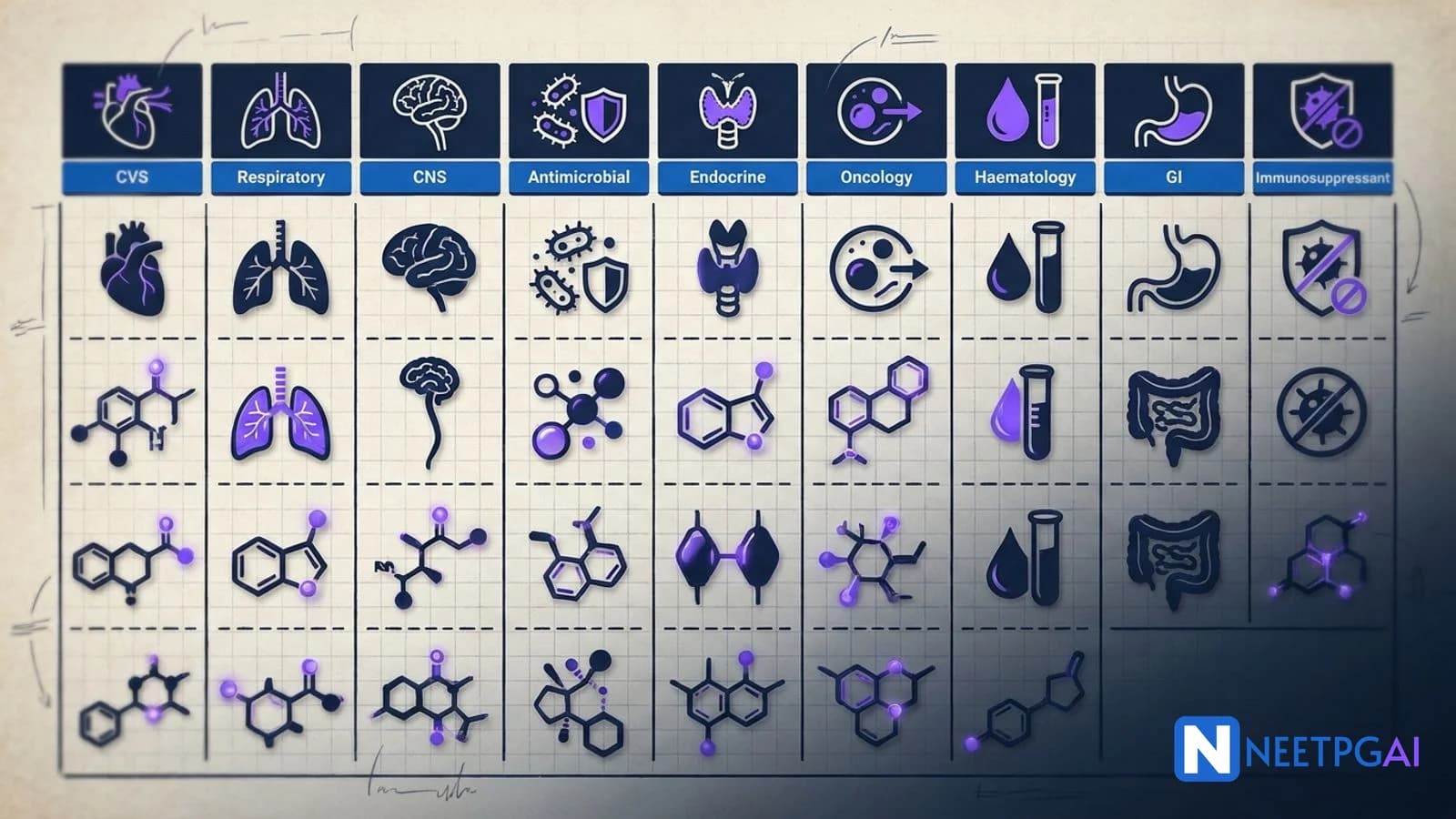
Across Nov 2023, May 2024, Nov 2024, and May 2025 INI-CET papers, nine drug clusters dominated - antimicrobials (3-4 Q per paper), antihypertensives and heart failure (1-2 Q), antidiabetics (1-2 Q), antiepileptics and antipsychotics (1-2 Q), antineoplastics (1-2 Q), immunosuppressants (1 Q), antimicrobial resistance mechanisms (1 Q), and recent-advances biologics (1-2 Q). The remaining 1-2 Q come from pharmacokinetics or autonomic pharmacology. This article compresses the 50 highest-yield drugs into one printable table organised by system, with one adverse effect and one exam one-liner per row.
Read the table as a flashcard set. Cover the right columns, read the drug name, and recite MOA plus adverse effect plus one-liner before uncovering. Three passes - once the morning before, once the night before, once in the exam hall waiting bay - is the pattern used by every AIIMS Delhi topper interviewed in the 2023-2025 post-exam series.
System 1 - Cardiovascular (CVS) Drugs
| Drug | MOA | Adverse Effect | One-Liner |
|---|
| Enalapril | ACE inhibition reduces angiotensin II formation | Cough, hyperkalaemia, teratogenic | First-line in HFrEF and diabetic nephropathy; stop in bilateral renal artery stenosis |
| Losartan | Angiotensin II receptor type 1 blockade | Hyperkalaemia, no cough, teratogenic | Switch to ARB when ACE cough is intolerable |
| Sacubitril-valsartan (ARNI) | Neprilysin inhibition plus ARB | Angioedema, hypotension | Replaces ACE/ARB in HFrEF; needs 36 h washout from ACE |
| Amlodipine | Dihydropyridine L-type calcium channel block | Pedal oedema, flushing | First-line in Indian hypertension guideline |
| Metoprolol | Beta-1 selective adrenergic blockade | Bradycardia, bronchospasm (mild), fatigue | Preferred beta-blocker in HFrEF with asthma |
| Carvedilol | Non-selective beta plus alpha-1 blockade | Hypotension, dizziness | Mortality benefit in HFrEF; preferred in post-MI |
| Dapagliflozin | SGLT2 inhibition in proximal tubule | Euglycaemic DKA, UTI, Fournier gangrene | HFrEF, HFpEF, CKD, and T2DM - four indications |
| Empagliflozin | SGLT2 inhibition | Same as dapagliflozin | EMPA-REG and EMPEROR trials - landmark cardiovascular benefit |
| Ivabradine | If current blockade in SA node | Luminous phenomena, bradycardia | Second-line in HFrEF with HR >70 on max beta-blocker |
| Bempedoic acid | ATP-citrate lyase inhibition upstream of HMG-CoA reductase | Gout, tendon rupture (rare), elevated uric acid | Statin-intolerant primary hypercholesterolaemia; 2024 approved |
System 2 - Respiratory Drugs
| Drug | MOA | Adverse Effect | One-Liner |
|---|
| Salbutamol | Short-acting beta-2 agonist | Tremor, tachycardia, hypokalaemia | Rescue inhaler; LABAs are maintenance only |
| Tiotropium | Long-acting muscarinic antagonist | Dry mouth, urinary retention | First-line maintenance in COPD |
| Montelukast | Leukotriene receptor antagonist (CysLT1) | Neuropsychiatric effects, insomnia | 2020 FDA black-box for mood changes |
| Omalizumab | Anti-IgE monoclonal | Anaphylaxis (rare), injection reaction | Severe allergic asthma; serum IgE 30-700 IU/mL |
| Dupilumab | IL-4 receptor alpha blockade (blocks IL-4 and IL-13) | Conjunctivitis, injection reaction | Type-2 severe asthma, atopic dermatitis, nasal polyps, EoE |
| Mepolizumab | Anti-IL-5 monoclonal | Headache, injection reaction | Eosinophilic asthma with eosinophils >300/mcL |
System 3 - Central Nervous System (CNS) Drugs
| Drug | MOA | Adverse Effect | One-Liner |
|---|
| Sodium valproate | Enhances GABA, Na and T-type Ca channel block | Hepatotoxicity, teratogenic (neural tube defects), weight gain | First-line generalised epilepsy; contraindicated in pregnancy |
| Lamotrigine | Na channel block, inhibits glutamate release | Stevens-Johnson (slow titration mandatory) | Preferred antiepileptic in pregnancy and in bipolar depression |
| Levetiracetam | SV2A binding modulates neurotransmitter release | Behavioural changes, irritability | Preferred for status epilepticus and partial seizures; no interactions |
| Sertraline | Selective serotonin reuptake inhibition | GI upset, sexual dysfunction, hyponatraemia (SIADH) | First-line in major depression; preferred in post-MI |
| Clozapine | Multireceptor atypical antipsychotic (D2, 5HT2A, M1 block) | Agranulocytosis, myocarditis, seizures | Last-line schizophrenia; mandatory WBC monitoring |
| Lithium | Inositol monophosphatase inhibition (second messenger) | Nephrogenic DI, hypothyroidism, teratogenic (Ebstein) | Mood stabiliser; narrow therapeutic index 0.6-1.2 mEq/L |
| Lecanemab | Anti-amyloid-beta protofibril monoclonal | Amyloid-related imaging abnormalities (ARIA), infusion reaction | Early Alzheimer disease; approved 2024 |
| Zuranolone | GABA-A positive allosteric modulator (oral neurosteroid) | Sedation, dizziness | First oral postpartum depression drug; 14-day course |
System 4 - Antimicrobial Drugs
| Drug | MOA | Adverse Effect | One-Liner |
|---|
| Amoxicillin-clavulanate | Beta-lactam plus beta-lactamase inhibitor | Diarrhoea, cholestatic hepatitis | First-line otitis media and CABP in adults |
| Meropenem | Carbapenem - PBP binding, broad gram-negative cover | Seizures (rare), eosinophilia | Reserve for severe sepsis and ESBL producers |
| Vancomycin | D-ala-D-ala binding blocks cell wall transpeptidation | Red man (histamine), nephrotoxicity, ototoxicity | MRSA bacteraemia; trough 15-20 mcg/mL |
| Linezolid | 50S ribosomal binding blocks initiation | Serotonin syndrome (MAOI), bone marrow suppression (prolonged) | Oral MRSA option; XDR-TB BPaL regimen |
| Daptomycin | Membrane depolarisation of gram-positives | Rhabdomyolysis, eosinophilic pneumonia | Alternative to vancomycin; inactivated by surfactant - never for pneumonia |
| Ceftaroline | Fifth-gen cephalosporin binds PBP2a of MRSA | Hypersensitivity, Clostridioides | Only cephalosporin with MRSA activity |
| Cefiderocol | Siderophore cephalosporin uses bacterial iron transport | Elevated LFT, diarrhoea | Carbapenem-resistant Pseudomonas, Acinetobacter, NDM-active |
| Ceftazidime-avibactam | Beta-lactam plus novel beta-lactamase inhibitor | Diarrhoea, elevated LFT | KPC and OXA-48 carbapenemase producers |
| Delafloxacin | DNA gyrase and topoisomerase IV inhibition (fluoroquinolone) | QT prolongation, tendon rupture | MRSA respiratory and skin infections |
| Isoniazid | Catalase-peroxidase (KatG) activates; inhibits mycolic acid synthesis | Peripheral neuritis (prevent with B6), hepatotoxicity | TB first-line; B6 20 mg daily prophylaxis mandatory |
| Rifampicin | Bacterial RNA polymerase inhibition | Orange secretions, hepatotoxicity, CYP3A4 induction | TB first-line; fails OCP, warfarin, tacrolimus |
| Pyrazinamide | Pyrazinoic acid at acid pH disrupts membrane | Hyperuricaemia, hepatotoxicity | TB intensive phase; stop if gout flare |
| Ethambutol | Arabinosyl transferase inhibition - cell wall | Optic neuritis (dose-dependent) | TB first-line; test colour vision at baseline |
| Bedaquiline | ATP synthase inhibition in M. tuberculosis | QT prolongation, hepatotoxicity |
System 5 - Endocrine Drugs
| Drug | MOA | Adverse Effect | One-Liner |
|---|
| Metformin | AMPK activation, decreased hepatic gluconeogenesis | Lactic acidosis in renal failure, B12 deficiency | First-line T2DM; stop if eGFR <30 |
| Semaglutide | GLP-1 agonist increases insulin, decreases glucagon, slows gastric emptying | Nausea, pancreatitis (rare), medullary thyroid risk (contraindicated in MEN2) | Weekly SC 2.4 mg; 15% weight loss in STEP trials |
| Tirzepatide | Dual GIP plus GLP-1 agonist | Nausea, pancreatitis | Weekly SC; 21% weight loss in SURMOUNT trials |
| Teplizumab | Anti-CD3 monoclonal preserves beta-cell function | Lymphopenia, cytokine release | Delays T1DM onset in stage 2 by at least 2 years |
| Levothyroxine | Synthetic T4 converted to T3 peripherally | Over-replacement causes AF and osteoporosis | 1.6 mcg/kg/day; TSH target 0.5-2.5 for primary hypothyroid |
| Resmetirom | Liver-selective thyroid hormone receptor beta agonist | Diarrhoea, nausea, elevated LFT (early) | First FDA-approved for MASH (NASH); 2024 approved |
System 6 - Oncology Drugs
| Drug | MOA | Adverse Effect | One-Liner |
|---|
| Methotrexate | DHFR inhibition blocks folate reduction | Mucositis, hepatotoxicity, pneumonitis, teratogenic | Give folinic acid rescue high-dose; weekly dose in RA |
| Cyclophosphamide | DNA alkylation after hepatic activation | Haemorrhagic cystitis (prevent with MESNA), bladder cancer | Lupus nephritis, severe vasculitis, lymphoma |
| Cisplatin | DNA cross-linking | Nephrotoxicity, ototoxicity, severe emesis | Testicular, ovarian, bladder, lung; aggressive hydration |
| Doxorubicin | Topoisomerase II inhibition plus free radicals | Dose-dependent cardiomyopathy (lifetime 450 mg/m2) | Dexrazoxane cardioprotection |
| Bleomycin | DNA strand break by free radicals | Pulmonary fibrosis (dose-related), skin changes | Lymphoma, germ cell; stop if DLCO drops |
| Imatinib | BCR-ABL tyrosine kinase inhibition | Oedema, cytopenias, hepatotoxicity | CML Philadelphia chromosome positive; first targeted therapy |
| Trastuzumab | HER2 extracellular domain monoclonal | Cardiomyopathy (reversible), infusion reaction | HER2-positive breast and gastric cancer |
| Nivolumab | PD-1 checkpoint blockade | Immune-related colitis, pneumonitis, thyroiditis | Melanoma, NSCLC, RCC; manage immune-related AE with steroids |
| Osimertinib | Third-gen EGFR TKI (T790M mutation active) | QT prolongation, pneumonitis | First-line EGFR-mutated NSCLC; also crosses blood-brain barrier |
System 7 - Haematology Drugs
| Drug | MOA | Adverse Effect | One-Liner |
|---|
| Warfarin | Vitamin K epoxide reductase inhibition (VKORC1) | Bleeding, warfarin skin necrosis (protein C depletion), teratogenic | Target INR 2-3 for AF and VTE, 2.5-3.5 for mechanical mitral valve |
| Apixaban | Direct factor Xa inhibition | Bleeding (less intracranial than warfarin) | Preferred DOAC in non-valvular AF with CKD |
| Dabigatran | Direct thrombin (factor IIa) inhibition | Dyspepsia, bleeding | Reversal with idarucizumab |
| Rivaroxaban | Direct factor Xa inhibition | Bleeding | Once-daily DOAC; preferred in cancer-associated VTE in some settings |
| Enoxaparin | Antithrombin activation blocks factor Xa predominantly | Bleeding, HIT (less than UFH), hyperkalaemia | VTE prophylaxis; adjust in renal failure |
System 8 - GI Drugs
| Drug | MOA | Adverse Effect | One-Liner |
|---|
| Pantoprazole | Irreversible H-K-ATPase inhibition in parietal cell | Hypomagnesaemia, osteoporosis, C. difficile (long-term) | Needs acid activation; take 30 min before meal |
| Vonoprazan | Potassium-competitive acid blocker (PCAB) | Diarrhoea, hypergastrinaemia | Faster onset, acid stability independent; H. pylori and GERD |
| Infliximab | Anti-TNF-alpha monoclonal | Reactivation of latent TB (screen before start), lymphoma risk | IBD, RA, psoriasis; screen with QuantiFERON before start |
| Vedolizumab | Alpha-4-beta-7 integrin blockade (gut-specific) | Nasopharyngitis, infusion reaction | IBD; preferred over anti-TNF when infection risk is high |
| Risankizumab | Anti-IL-23 monoclonal | Upper respiratory infection, injection reaction | Psoriasis and Crohn disease |
System 9 - Immunosuppressants
| Drug | MOA | Adverse Effect | One-Liner |
|---|
| Cyclosporine | Calcineurin inhibition via cyclophilin | Nephrotoxicity, gum hyperplasia, hirsutism, HTN | Narrow therapeutic index; CYP3A4 substrate |
| Tacrolimus | Calcineurin inhibition via FKBP-12 | Nephrotoxicity, diabetes, tremor, hyperkalaemia | More potent than cyclosporine; also topical for atopic dermatitis |
| Mycophenolate mofetil | IMPDH inhibition blocks de novo purine synthesis | Diarrhoea, bone marrow suppression, teratogenic | Replaced azathioprine in most solid organ transplants |
| Azathioprine | 6-mercaptopurine prodrug blocks purine synthesis | Bone marrow suppression, hepatotoxicity, pancreatitis | Check TPMT genotype before start |
| Rituximab | Anti-CD20 monoclonal depletes B cells | PML (rare), infusion reaction, reactivation of hepatitis B | Lymphoma, RA, ANCA vasculitis, membranous nephropathy |
High-Trap Drug Callouts
Trap 1 - Vonoprazan versus PPI. Vonoprazan is a potassium-competitive acid blocker (PCAB), not a PPI. It does not need acid activation, achieves peak effect from the first dose, and works regardless of meal timing. PPIs need acid activation, must be taken 30 minutes before a meal, and require 3-5 days for steady state. On INI-CET, the stem that mentions "acid-stable, meal-independent, rapid-onset acid suppression" is vonoprazan.
Trap 2 - Bempedoic acid versus statin. Bempedoic acid inhibits ATP-citrate lyase, two enzymatic steps upstream of HMG-CoA reductase. It is a prodrug activated only in the liver (hepatic activation by ACSVL1 enzyme not present in skeletal muscle), so it does not cause statin-associated myalgia. Approved for statin-intolerant primary hypercholesterolaemia and ASCVD risk reduction (CLEAR Outcomes trial 2023). It raises uric acid and may precipitate gout.
Trap 3 - Dapagliflozin and empagliflozin indications. SGLT2 inhibitors now have four approved indications - T2DM, HFrEF, HFpEF, and CKD (both with and without diabetes). The classic adverse effect is euglycaemic DKA, which examiners trap by giving a diabetic patient on SGLT2 inhibitor with normal glucose but severe acidosis. Also know Fournier gangrene, a rare but serious necrotising perineal infection warning.
Trap 4 - Lithium narrow therapeutic index. Therapeutic range 0.6-1.2 mEq/L; toxicity above 1.5. Toxicity is precipitated by dehydration, NSAIDs, thiazides, and ACE inhibitors (all reduce lithium excretion). Levels of 2.5+ warrant haemodialysis. The classic Ebstein anomaly teratogenic risk and the dose-dependent nephrogenic diabetes insipidus are the two reproductive and chronic complications.
High-Yield One-Liners
- GLP-1 agonists cause nausea early, pancreatitis rarely, and are contraindicated in medullary thyroid carcinoma and MEN2
- Bempedoic acid is activated only in the liver - no muscle toxicity, no statin-type myalgia
- Vonoprazan is a PCAB, not a PPI - no acid activation needed, no meal-timing dependence
- Cefiderocol is the only beta-lactam active against NDM-producing Enterobacterales
- Teplizumab is the first disease-modifying therapy for T1DM - 14-day anti-CD3 course delays onset by 2 years
- Nirsevimab is a single-dose seasonal RSV prophylaxis for neonates and young infants
- Linezolid plus pretomanid plus bedaquiline is BPaL - 6 months for XDR-TB, 90% cure
- Clozapine mandates weekly WBC monitoring for the first 6 months, then every 2-4 weeks
- Lamotrigine is the preferred antiepileptic in pregnancy and in bipolar depression
- Methotrexate rescue is folinic acid (leucovorin), not folic acid - the DHFR step is bypassed
- Rituximab reactivates hepatitis B - screen HBsAg and anti-HBc before first dose
- Resmetirom is the first FDA-approved MASH drug - selective THR-beta agonist
- Lecanemab warning is ARIA (amyloid-related imaging abnormalities) with cerebral oedema and microhaemorrhages
- Imatinib is the prototype BCR-ABL tyrosine kinase inhibitor for Philadelphia-positive CML
- Dupilumab blocks IL-4 receptor alpha - works on IL-4 and IL-13 - type-2 inflammation diseases
Common Mistakes
- Calling vonoprazan a PPI. It is a PCAB - different mechanism, different kinetics, acid-stable.
- Giving daptomycin for pneumonia. It is inactivated by surfactant - never use for lower respiratory infections.
- Forgetting folinic acid rescue after high-dose methotrexate. Folinic acid bypasses the DHFR block; folic acid does not.
- Treating lithium toxicity as a drug-level issue only. Dehydration and renal dose adjustments matter; levels >2.5 need haemodialysis.
- Mislabelling SGLT2 inhibitors as diabetes-only drugs. They treat HFrEF, HFpEF, CKD, and T2DM - four separate indications.
Related Topics on NEETPGAI
Practice This on NEETPGAI
Stop reading, start answering. NEETPGAI's open question bank includes 3,400+ pharmacology MCQs across the 19 subject taxonomy, all SME-reviewed with explanations that include drug class, MOA, adverse effect profile, and the exam one-liner. Free for every registered aspirant - no daily cap on the question bank, mock tests, real PYQs, or revision. Pro features (AI Tutor, AI MCQ Generator, Clinical Case Simulator, AI Study Planner) layer on top. Sign up free and run your first 50-question pharmacology mock in 60 seconds.