Quick Answer
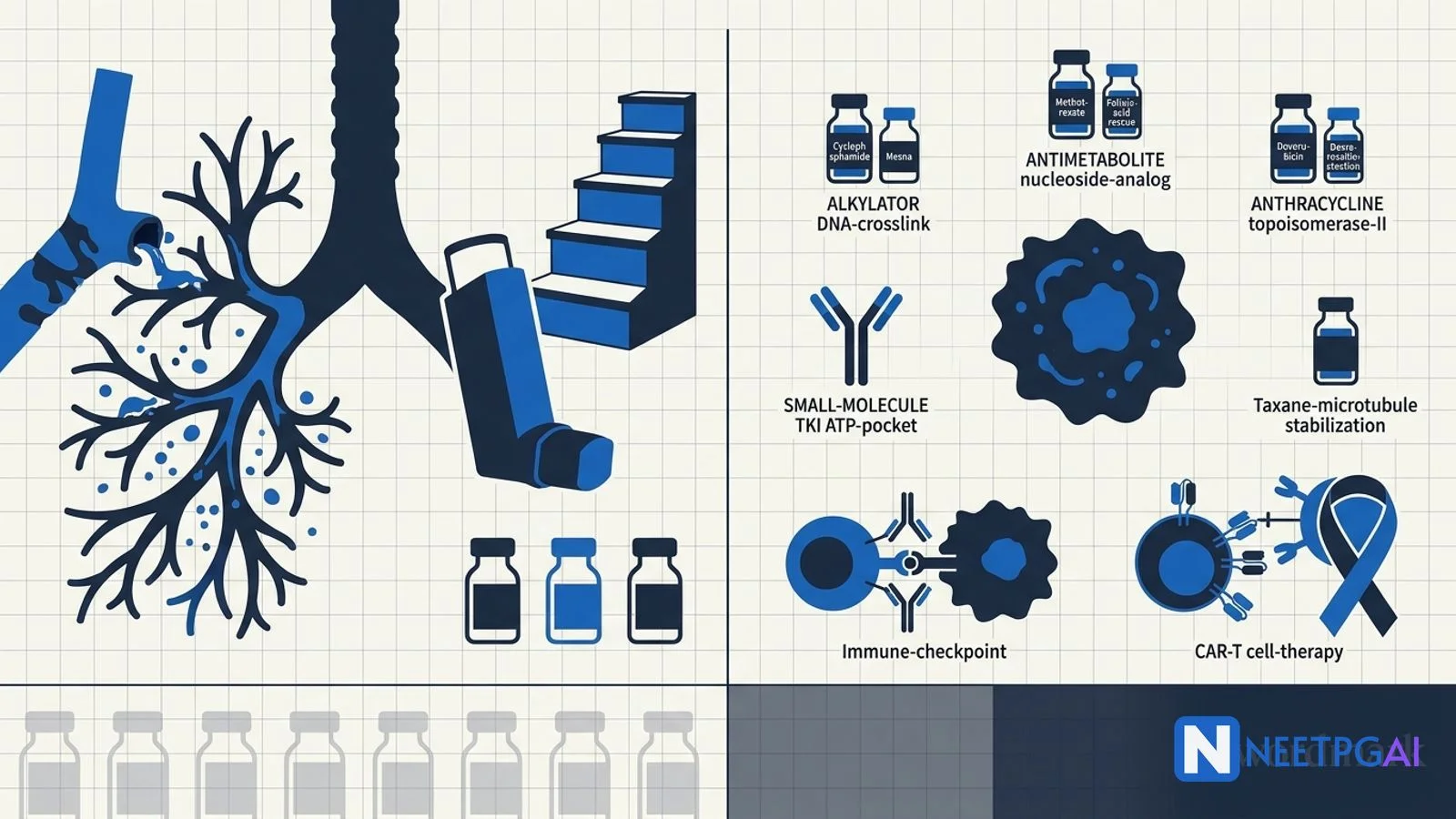
Anti-asthmatic and anticancer pharmacology together deliver 4 to 6 NEET PG questions per paper. Lock these anchors:
- Asthma reliever — SABA (albuterol) for rescue; never LABA monotherapy per GINA.
- Asthma controller — ICS is the foundation; combined ICS + formoterol (MART / SMART) is the GINA 2024 preferred approach for step 1-5.
- Biologics — omalizumab (anti-IgE), mepolizumab (anti-IL-5), dupilumab (anti-IL-4Rα).
- Alkylators — cyclophosphamide → hemorrhagic cystitis (mesna prophylaxis); cisplatin → nephrotoxicity + ototoxicity.
- Anthracyclines — doxorubicin → cardiotoxicity (dexrazoxane cardioprotection).
- TKIs — imatinib for CML BCR-ABL; osimertinib for NSCLC EGFR T790M.
- Monoclonals — trastuzumab (HER2), rituximab (CD20), bevacizumab (VEGF).
- Checkpoint inhibitors — pembrolizumab/nivolumab (PD-1), atezolizumab (PD-L1), ipilimumab (CTLA-4).
- India-made — NexCAR19 (Oct 2023, CDSCO) — first indigenous CAR-T; 30 lakh vs 3-4 crore imported.
Pharmacology is where memorisation meets mechanism, and no chapter tests that better than asthma and cancer. Asthma pharmacology has been quietly rewritten by GINA 2024's MART protocol; oncology pharmacology has been rewritten by targeted therapy, immune checkpoint inhibitors and CAR-T. This NEETPGAI deep dive walks through the mechanisms, adverse effects and India-programmatic context you need for NEET PG 2027.
Pair this with the autonomic pharmacology guide for the receptor-level foundation and with the HCC guide for how systemic therapy fits into staged treatment.
Anti-asthmatic pharmacology
Asthma is chronic Th2-driven airway inflammation with bronchoconstriction, mucus hypersecretion, and airway remodeling. Two arms — reliever (bronchodilate acutely) and controller (suppress inflammation long-term).
Beta-2 agonists (bronchodilators)
| Class | Examples | Onset | Duration | Use |
|---|
| SABA | Salbutamol (albuterol), terbutaline, levosalbutamol | 5 min | 4-6 h | Acute rescue; not for chronic control |
| LABA | Salmeterol, formoterol, vilanterol, indacaterol | Salmeterol 30 min; formoterol 5 min | 12-24 h | Controller — always combined with ICS in asthma |
Mechanism — β2 agonism activates Gs → adenylate cyclase → cAMP → PKA → smooth muscle relaxation.
Adverse effects — tremor (β2 skeletal muscle), tachycardia (β1 cross-reactivity), hypokalaemia, hyperglycaemia, paradoxical bronchospasm.
GINA warning — LABA monotherapy in asthma increases exacerbations and deaths (SMART, SNS trials). Always combine with ICS.
Inhaled corticosteroids (ICS)
- Examples — budesonide, fluticasone (propionate, furoate), beclomethasone, ciclesonide, mometasone.
- Mechanism — bind glucocorticoid receptor → transrepress NF-κB and AP-1 → suppress cytokine (IL-4, IL-5, IL-13) and chemokine production; reduce eosinophilic infiltration and airway remodeling.
- The foundation of asthma controller therapy — start early, even in mild asthma.
- Adverse effects — oral candidiasis (rinse mouth), dysphonia, systemic effects only at high doses (adrenal suppression, growth suppression in children, osteoporosis).
Leukotriene modifiers
- LTRAs (montelukast, zafirlukast, pranlukast) — competitive CysLT1 receptor antagonists.
- Zileuton — 5-lipoxygenase inhibitor (hepatotoxicity limits use).
- Used as add-on or in aspirin-exacerbated respiratory disease (AERD, Samter triad).
- Montelukast — FDA boxed warning (2020) for neuropsychiatric adverse effects (agitation, depression, suicidal ideation).
Methylxanthines
- Theophylline, aminophylline — non-selective PDE inhibitors; adenosine antagonism.
- Narrow therapeutic index — target 10-20 mg/L; toxicity above 20 (nausea, seizures, arrhythmias).
- Multiple drug interactions — CYP1A2 substrate; cimetidine, ciprofloxacin and erythromycin raise levels; smoking and rifampicin lower levels.
- Largely superseded by β2 agonists and ICS.
Anticholinergics
- SAMA (ipratropium) — used in acute exacerbations, less in chronic asthma.
- LAMA (tiotropium, umeclidinium) — as add-on to ICS-LABA in severe uncontrolled asthma (triple therapy).
Biologics (severe uncontrolled asthma)
| Biologic | Target | Indication |
|---|
| Omalizumab | IgE (Fc portion) | Allergic asthma; total IgE 30-1500 IU/mL |
| Mepolizumab, reslizumab | IL-5 | Eosinophilic asthma (blood eos >= 150-300/μL) |
| Benralizumab | IL-5Rα | Eosinophilic asthma; also depletes eosinophils via ADCC |
| Dupilumab | IL-4Rα (blocks IL-4 and IL-13) | Type 2 asthma; also atopic dermatitis, EoE, CRSwNP |
| Tezepelumab | TSLP | Broader mechanism; type 2 and type 2-low asthma |
GINA 2024 SMART / MART protocol
The Global Initiative for Asthma 2024 update preferred approach:
- Track 1 — ICS-formoterol used as both maintenance AND reliever (single-inhaler MART).
- Track 2 — traditional ICS + SABA reliever (alternative).
- Step 1 — as-needed ICS-formoterol (replacing SABA-only).
- Steps 2-5 — regular ICS-formoterol + as-needed ICS-formoterol; add LAMA (step 4); add biologic (step 5).
Key shift — SABA-only reliever is no longer recommended even in mild asthma; every reliever puff should also deliver ICS.
Anticancer pharmacology — overview
Anticancer drugs fall into six major mechanism categories.
1. Alkylating agents
Cross-link DNA (typically at N7 of guanine) → strand breaks → apoptosis. Cell-cycle non-specific.
| Drug | Class | Toxicity |
|---|
| Cyclophosphamide | Nitrogen mustard (needs hepatic activation) | Hemorrhagic cystitis (acrolein) → mesna prophylaxis; SIADH; myelosuppression |
| Ifosfamide | Nitrogen mustard | Hemorrhagic cystitis (mesna mandatory); Fanconi syndrome; neurotoxicity (encephalopathy — methylene blue) |
| Cisplatin | Platinum | Nephrotoxicity (hydration + magnesium; amifostine); ototoxicity; peripheral neuropathy; nausea (5-HT3 antagonists + NK1 + steroids) |
| Carboplatin | Platinum | Myelosuppression (thrombocytopenia); less nephro/oto/emetic |
| Oxaliplatin | Platinum | Acute cold-induced neuropathy; peripheral neuropathy |
| Busulfan | Sulfonate | Pulmonary fibrosis; conditioning for HSCT |
| Procarbazine | MAOI | Disulfiram-like reaction with alcohol; ABVD in Hodgkin |
| Dacarbazine, temozolomide | Triazenes | Alkylates via methyl group; temozolomide for glioblastoma (Stupp protocol) |
2. Antimetabolites
Mimic natural nucleosides/bases; interfere with DNA/RNA synthesis. S-phase specific.
| Drug | Mechanism | Toxicity |
|---|
| Methotrexate | Dihydrofolate reductase inhibitor | Myelosuppression, mucositis, hepatotoxicity, pulmonary fibrosis; rescue with folinic acid (leucovorin) |
| 5-Fluorouracil (5-FU) | Thymidylate synthase inhibitor | Mucositis, myelosuppression, hand-foot syndrome; rescue with uridine triacetate (vistogard) |
| Capecitabine | Oral 5-FU prodrug | Hand-foot syndrome; CRC, breast |
| Gemcitabine | dCTP analog | Myelosuppression, flu-like syndrome; pancreatic cancer, cholangiocarcinoma |
| Cytarabine (Ara-C) | dCTP analog | Cerebellar toxicity (high-dose); AML induction (7+3) |
| 6-Mercaptopurine, 6-thioguanine | Purine analogs | Hepatotoxicity; ALL maintenance; TPMT polymorphism |
| Hydroxyurea | Ribonucleotide reductase inhibitor | CML (historic); sickle cell (raises HbF) |
| Cladribine, fludarabine | Purine analogs | Hairy cell leukaemia (cladribine); CLL (fludarabine) |
3. Antitumour antibiotics
| Drug | Mechanism | Toxicity |
|---|
| Doxorubicin, daunorubicin, epirubicin (anthracyclines) | Topoisomerase II inhibition; free radicals | Cardiotoxicity (cumulative dose-related; dexrazoxane cardioprotection); myelosuppression |
| Bleomycin | DNA strand breaks | Pulmonary fibrosis (dose-related; increased in high FiO2); ABVD Hodgkin |
| Actinomycin D (dactinomycin) | DNA intercalation | Wilms tumour, rhabdomyosarcoma |
| Mitomycin C | Alkylator | HUS; local bladder instillation for superficial urothelial cancer |
4. Mitotic spindle inhibitors
| Drug | Mechanism | Toxicity |
|---|
| Vincristine | Prevents microtubule assembly | Peripheral neuropathy (dose-limiting); paralytic ileus; NOT bone marrow suppressive |
| Vinblastine | Prevents microtubule assembly | Myelosuppression (dose-limiting) |
| Paclitaxel, docetaxel (taxanes) | Stabilise microtubules → prevent disassembly | Hypersensitivity (paclitaxel — premedication with steroids + H1/H2); peripheral neuropathy |
| Nab-paclitaxel | Albumin-bound paclitaxel | No solvent-related hypersensitivity |
5. Topoisomerase inhibitors
| Drug | Enzyme | Toxicity |
|---|
| Etoposide, teniposide | Topo II | Secondary AML (MLL rearrangement); testicular cancer, SCLC |
| Irinotecan, topotecan | Topo I | Irinotecan — cholinergic diarrhoea (early — atropine); delayed diarrhoea (late — loperamide); UGT1A1 polymorphism |
6. Targeted therapy (small-molecule TKIs and monoclonal antibodies)
| Target | Small-molecule TKI | Monoclonal antibody |
|---|
| BCR-ABL | Imatinib, dasatinib, nilotinib, bosutinib, ponatinib (T315I) | — |
| EGFR | Erlotinib, gefitinib, afatinib, osimertinib (T790M) | Cetuximab, panitumumab |
| HER2 | Lapatinib, neratinib, tucatinib | Trastuzumab, pertuzumab, ado-trastuzumab emtansine (T-DM1), trastuzumab-deruxtecan (T-DXd) |
| VEGF / VEGFR | Sunitinib, sorafenib, pazopanib, cabozantinib, lenvatinib, regorafenib, axitinib | Bevacizumab, ramucirumab |
| BRAF V600E | Vemurafenib, dabrafenib, encorafenib | — |
| MEK | Trametinib, cobimetinib, binimetinib | — |
| ALK | Crizotinib, alectinib, brigatinib, lorlatinib | — |
| CD20 | — | Rituximab, obinutuzumab, ofatumumab |
| CD30 | — | Brentuximab vedotin (ADC) |
| CD52 | — | Alemtuzumab |
| CDK4/6 | Palbociclib, ribociclib, abemaciclib | — |
| PARP | Olaparib, niraparib, rucaparib, talazoparib | — |
| mTOR | Everolimus, temsirolimus | — |
| BTK | Ibrutinib, acalabrutinib, zanubrutinib | — |
| BCL-2 | Venetoclax | — |
| FLT3 | Midostaurin, gilteritinib | — |
| IDH1/2 | Ivosidenib, enasidenib | — |
| JAK1/2 | Ruxolitinib | — |
| FGFR2 | Pemigatinib, futibatinib | — |
7. Immune checkpoint inhibitors
| Target | Agents | Key indications |
|---|
| PD-1 | Pembrolizumab, nivolumab, cemiplimab, dostarlimab | Melanoma, NSCLC, RCC, HCC, urothelial, Hodgkin, MSI-high (tissue agnostic) |
| PD-L1 | Atezolizumab, durvalumab, avelumab | NSCLC, RCC, HCC (atezo + bev), urothelial, SCLC (atezo + platinum) |
| CTLA-4 | Ipilimumab, tremelimumab | Melanoma (combo with nivolumab); RCC; HCC (with durvalumab) |
| LAG-3 | Relatlimab | Melanoma (combo with nivolumab; Opdualag) |
Immune-related adverse effects (irAEs) — pneumonitis, colitis, hepatitis, endocrinopathies (thyroid, adrenal, pituitary, T1DM), dermatitis. Treated with high-dose corticosteroids ± infliximab/mycophenolate.
8. Cell therapy — CAR-T
Autologous T cells engineered to express a chimeric antigen receptor (scFv + CD3-zeta + CD28 or 4-1BB co-stim) targeting CD19 (B-cell malignancies) or BCMA (multiple myeloma).
- Tisagenlecleucel (Kymriah) — CD19 CAR-T for r/r ALL (pediatric/young adult), DLBCL.
- Axicabtagene ciloleucel (Yescarta) — CD19 CAR-T for r/r DLBCL.
- Lisocabtagene, brexucabtagene — CD19 variants.
- Idecabtagene, ciltacabtagene — BCMA CAR-T for multiple myeloma.
India — NexCAR19 (ImmunoACT) — CDSCO approved October 2023; developed by IIT Bombay, Tata Memorial, BRIC-inStem. Cost ~30 lakh INR (vs 3-4 crore for imported product).
Toxicities — cytokine release syndrome (CRS) — fever, hypotension, hypoxia; managed with tocilizumab (anti-IL-6R). ICANS (immune effector cell-associated neurotoxicity) — encephalopathy; managed with steroids.
NEET PG MCQ traps
- LABA monotherapy in asthma is contraindicated (SMART trial) — must always combine with ICS.
- GINA 2024 — ICS-formoterol MART is the preferred track for steps 1-5.
- SABA-only reliever is no longer recommended even in mild asthma.
- Omalizumab — anti-IgE; requires total IgE 30-1500 IU/mL.
- Mepolizumab/reslizumab — anti-IL-5; eosinophilic asthma.
- Dupilumab — anti-IL-4Rα; also atopic dermatitis, EoE, CRSwNP.
- Montelukast — FDA boxed warning (2020) for neuropsychiatric AEs.
- Theophylline — narrow therapeutic index (10-20 mg/L); CYP1A2 substrate.
- Cyclophosphamide/ifosfamide → acrolein → hemorrhagic cystitis — mesna prophylaxis.
- Cisplatin — nephrotoxicity + ototoxicity + peripheral neuropathy; hydration + magnesium.
- Doxorubicin — cumulative cardiotoxicity; dexrazoxane cardioprotection.
- Bleomycin — pulmonary fibrosis (dose-related; watch high FiO2 during anaesthesia).
- Methotrexate rescue = folinic acid (leucovorin) — NOT folic acid.
- Vincristine = peripheral neuropathy (NO myelosuppression); vinblastine = myelosuppression.
- Paclitaxel hypersensitivity — premedicate with steroids + H1 + H2 antihistamines.
- Irinotecan — acute cholinergic diarrhoea (atropine) vs delayed (loperamide); UGT1A1 polymorphism.
- Etoposide — secondary AML (MLL rearrangement).
- Imatinib — first-line CML BCR-ABL; also c-KIT (GIST) and PDGFR.
- Ponatinib — T315I resistance mutation in CML.
- Osimertinib — 3rd-generation EGFR TKI for T790M-mutant NSCLC.
- Trastuzumab — HER2+ breast; cardiotoxicity (echo at baseline and Q3M).
- Rituximab — CD20; NHL, CLL, RA, ITP, TTP; infusion reactions; HBV reactivation risk.
- Bevacizumab — VEGF; hypertension, proteinuria, bleeding, delayed wound healing, GI perforation.
- Palbociclib — CDK4/6; ER+/HER2- metastatic breast (with letrozole or fulvestrant).
- Olaparib — PARP inhibitor; BRCA-mutant ovarian and breast cancer.
- Pembrolizumab / nivolumab — anti-PD-1; MSI-high tumours (tissue agnostic).
- Ipilimumab — anti-CTLA-4; hypophysitis is characteristic irAE.
- irAE management — high-dose steroids; add infliximab or MMF if steroid-refractory.
Recent updates and India context
- GINA 2024 update — MART/SMART with ICS-formoterol is preferred across steps 1-5; SABA-only reliever obsolete.
- India availability — budesonide-formoterol combinations (Symbicort, Duova, Foracort) widely available; Cipla and Sun Pharma dominate generic ICS-LABA production.
- Biologics (omalizumab, mepolizumab, dupilumab) — available in India via specialty centres (Medanta, Apollo, AIIMS); PMJAY coverage limited; ImmunoTherapy Society of India runs patient-support programmes.
- NexCAR19 (ImmunoACT) — India's first indigenous CAR-T; developed by IIT Bombay + Tata Memorial + BRIC-inStem; CDSCO approval October 2023; treatment cost approximately 30 lakh INR (vs 3-4 crore imported); administered at Tata Memorial Mumbai, CMC Vellore, AIIMS Delhi.
- Generic TKIs — imatinib generics (Veenat, Natco), erlotinib (Erlonat), sorafenib (Nexavar generic), sunitinib available at 5-10 percent of imported innovator cost; enabling PMJAY-panelled treatment.
- Biosimilars — Reditux (rituximab, Dr Reddy's) was the world's first mAb biosimilar (2007); trastuzumab biosimilars (CanMab, Biocon; Herclon; Trastumab), bevacizumab biosimilars (Cizumab, Bevex) — India is a global biosimilar manufacturing hub.
- PMJAY oncology package — covers chemotherapy for the top 10 cancers plus surgery and radiation at empanelled hospitals; ceiling of 5 lakh INR per family per year.
- NPPA (National Pharmaceutical Pricing Authority) — ceiling-priced 42 cancer drugs (2019 order) to improve affordability.
- HPV, hepatitis B, cervical, HCC — prevention pharmacology (vaccination + antivirals) increasingly features on the NEET PG paper; pair with the cervical cancer and HCC guides.
Frequently asked questions
Why is LABA monotherapy contraindicated in asthma per GINA?
The SMART and SNS trials showed that regular use of long-acting beta-2 agonists (salmeterol, formoterol) alone in asthma increased the risk of severe exacerbations and asthma deaths. LABA masks worsening inflammation without treating it, delaying escalation of inhaled corticosteroids. GINA 2024 mandates that LABA always be combined with an ICS in the same inhaler for asthma. In contrast, LABA monotherapy is acceptable in COPD (where inflammation is neutrophilic and less steroid-responsive). The GINA 2024 SMART/MART protocol uses a single ICS-formoterol inhaler for both maintenance and reliever therapy — replacing the old SABA-plus-ICS approach that led to over-reliance on rescue inhalers.
How does cyclophosphamide cause hemorrhagic cystitis and how is it prevented?
Cyclophosphamide, an alkylating oxazaphosphorine, is metabolised by hepatic cytochrome P450 to 4-hydroxycyclophosphamide and phosphoramide mustard (the active alkylator that cross-links DNA at N7 of guanine). A byproduct, acrolein, is excreted in urine and is directly toxic to bladder urothelium — causing hemorrhagic cystitis with hematuria, frequency and urgency, and a long-term risk of bladder cancer. Mesna (2-mercaptoethane sulfonate sodium) neutralises acrolein in the bladder lumen by forming a stable thioether adduct and is given prophylactically with ifosfamide (mandatory) and high-dose cyclophosphamide, along with aggressive hydration and forced diuresis.
What is the mechanism and clinical utility of imatinib?
Imatinib is a small-molecule tyrosine kinase inhibitor that binds the ATP-binding pocket of the BCR-ABL fusion kinase (the product of the Philadelphia t(9;22) translocation that defines chronic myeloid leukaemia). By blocking ATP binding, imatinib prevents phosphorylation of downstream substrates, halting the pro-proliferative and anti-apoptotic signalling that drives CML. Imatinib also inhibits c-KIT (used in gastrointestinal stromal tumours or GIST) and PDGFR (used in hypereosinophilic syndrome and dermatofibrosarcoma protuberans). CML response is monitored by BCR-ABL transcript quantification via RT-qPCR; a 3-log reduction (major molecular response) predicts durable remission. Second-line TKIs (dasatinib, nilotinib, bosutinib) and third-generation ponatinib address resistance mutations (T315I).
How do PD-1/PD-L1 checkpoint inhibitors work in cancer?
Tumour cells often upregulate PD-L1 to bind the PD-1 receptor on cytotoxic T cells, sending an inhibitory signal that switches off the anti-tumour immune response — an immune escape mechanism. Monoclonal antibodies against PD-1 (pembrolizumab, nivolumab, cemiplimab) or PD-L1 (atezolizumab, durvalumab, avelumab) block this interaction, restoring T-cell activity against the tumour. CTLA-4 inhibitors (ipilimumab) act earlier in T-cell priming in lymph nodes. Approved uses span melanoma, non-small cell lung cancer (NSCLC), renal cell carcinoma, urothelial cancer, Hodgkin lymphoma, MSI-high tumours (tissue-agnostic) and now cervical, hepatocellular and triple-negative breast cancer. Immune-related adverse effects (irAEs) — pneumonitis, colitis, hepatitis, endocrinopathies (hypothyroidism, adrenal insufficiency, hypophysitis, T1DM) — reflect off-target immune activation and are managed with corticosteroids or biologic immunosuppressants.
What is the mechanism of CAR-T cell therapy and what has India delivered?
Chimeric antigen receptor T (CAR-T) cell therapy uses autologous T cells collected from the patient, genetically engineered ex vivo (via lentiviral or retroviral vector) to express a chimeric receptor that combines a tumour-antigen-binding single-chain antibody fragment (targeting CD19 for B-cell malignancies) fused to intracellular T-cell signalling domains (CD3-zeta plus co-stimulatory CD28 or 4-1BB). After lymphodepleting chemotherapy, the engineered T cells are re-infused; they expand, seek out CD19+ malignant B cells and destroy them. Approved products (tisagenlecleucel, axicabtagene ciloleucel) target relapsed/refractory ALL and diffuse large B-cell lymphoma. India delivered its first indigenous CAR-T therapy — NexCAR19 (ImmunoACT, developed by IIT Bombay, Tata Memorial and BRIC-inStem) — with CDSCO approval in October 2023, at about 30 lakh INR per treatment (vs 3-4 crore for imported products). Cytokine release syndrome (managed with tocilizumab) and neurotoxicity are the key adverse effects.
This content is for educational purposes for NEET PG exam preparation. It is not a substitute for professional medical advice, diagnosis, or treatment. Clinical information has been reviewed by qualified medical professionals.
Written by: NEETPGAI Editorial Team
Reviewed by: Pending SME Review
Last reviewed: July 2026