Quick Answer
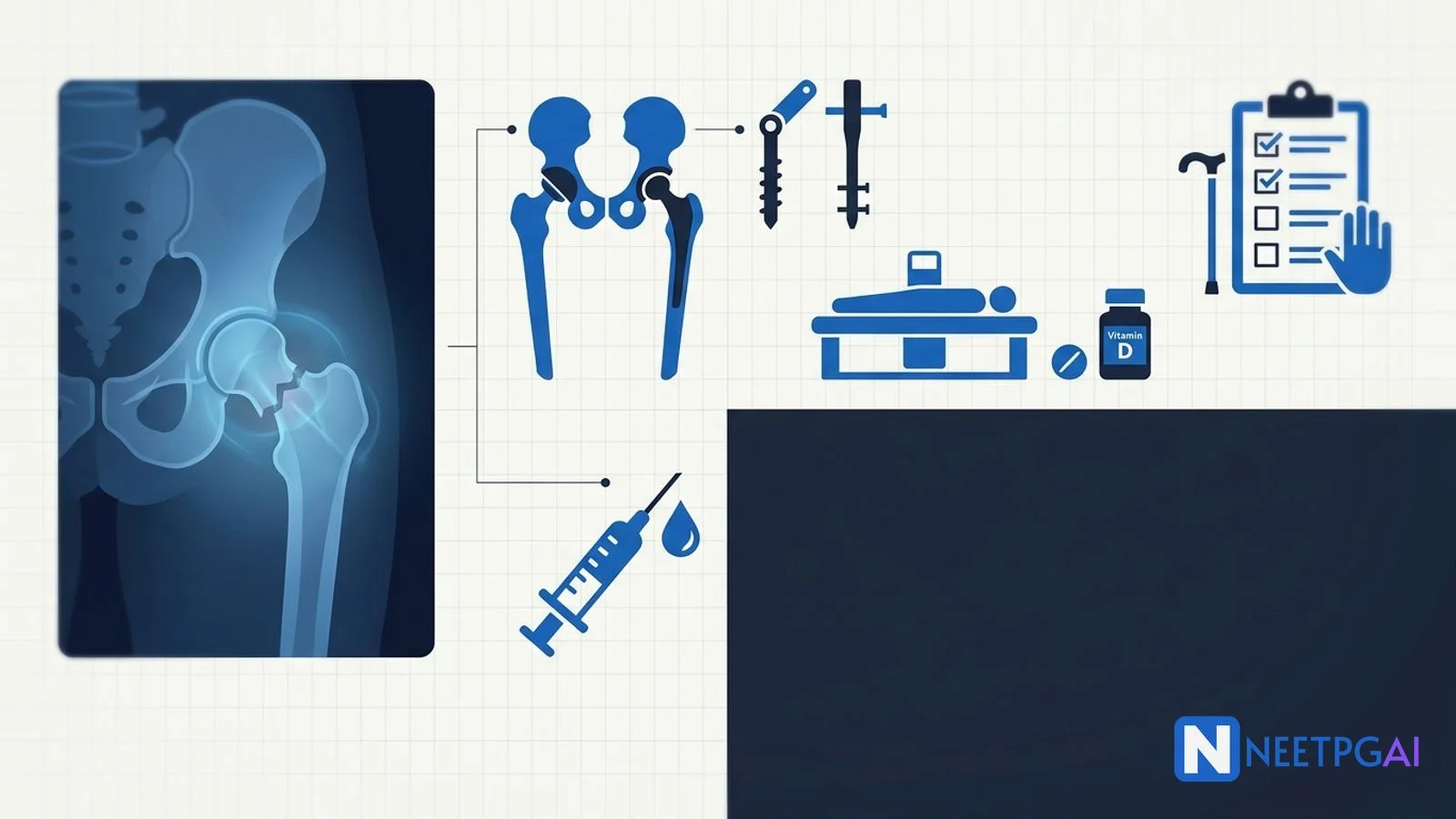
Elderly hip fracture is a high-yield NEET PG orthopaedic-emergency case — Garden classification, 48-hour surgery target, hemiarthroplasty vs THR, DHS vs PFN, and post-fracture osteoporosis workup recur across every paper.
- Recognise — shortened, externally rotated, adducted leg after a low-energy fall in an elderly patient = neck of femur fracture until X-ray proves otherwise.
- Classify — intracapsular (Garden I-IV) vs extracapsular (intertrochanteric — Boyd-Griffin, Evans; subtrochanteric — Seinsheimer).
- 48-hour surgery — reduces 30-day and 1-year mortality; delay only for correctable medical issues.
- Analgesia — fascia iliaca or femoral nerve block; opioid-sparing to prevent delirium.
- Surgical choice — displaced intracapsular in fit independent patient → THR (HEALTH trial); frail cognitively-impaired → hemiarthroplasty; undisplaced (Garden I/II) → cannulated screws.
- Extracapsular — stable intertrochanteric → DHS; unstable/reverse oblique/subtrochanteric → cephalomedullary nail (PFN/PFNA).
- Post-op — VTE prophylaxis 28-35 days, early mobilisation day 1, delirium prevention, pressure-ulcer care.
- Anti-osteoporosis — vitamin D + calcium correction + bisphosphonate (zoledronate 5 mg IV yearly — HORIZON-RFT showed 28 percent mortality reduction).
The case
A 78-year-old woman, previously living independently with her son's family in a two-storey house in Pune, is brought to the orthopaedic emergency by her son at 9 am. She slipped in the bathroom while getting up from the Indian-style toilet an hour ago, landed on her right hip, and has been unable to bear weight since. She is complaining of severe right hip pain radiating to the groin, worse on any movement, and cannot roll onto her side.
Past medical history:
- Known osteoporosis on irregular calcium and vitamin D supplementation (adherence poor)
- Hypertension on amlodipine 5 mg
- Well-controlled type 2 diabetes on metformin 500 mg twice daily
- Hypothyroidism on levothyroxine 50 microgram
- One previous Colles fracture 4 years ago after a stumble in the garden — treated conservatively
- No prior hip surgery
- Cognitively intact, ambulates independently around the house without a stick
- Cataract surgery 3 years ago; wears distance spectacles
Medications: amlodipine, metformin, levothyroxine, atorvastatin 10 mg, occasional paracetamol; no aspirin, no anticoagulants, no bisphosphonates (she stopped alendronate after "acidity" 2 years ago).
Social history: widowed, lives with her son, daughter-in-law and 2 grandchildren; previously did all her own household chores including cooking; no smoking, no alcohol.
On examination — conscious, oriented, in distress from pain. BP 140/85, HR 92 regular, RR 18, SpO2 97 percent on room air, T 36.8, capillary refill less than 2 seconds.
Right lower limb:
- Shortened by approximately 2 cm, externally rotated by 45-60 degrees, adducted
- Tenderness over the greater trochanter and inguinal ligament, without ecchymosis
- Any active or passive movement of the hip is intensely painful
- Neurovascular examination distal to the injury — dorsalis pedis and posterior tibial pulses palpable and symmetric, capillary refill in the toes less than 2 seconds, sensation intact over the sural, saphenous, deep peroneal, superficial peroneal and tibial nerve territories, active dorsiflexion and plantarflexion of the ankle preserved, all toes moving
Systemic examination:
- Cardiovascular — normal S1 S2, no murmurs, JVP not raised
- Respiratory — clear bilaterally, no crackles, no wheeze
- Abdomen — soft, non-tender, no organomegaly
- CNS — GCS 15, no meningism, no focal deficit; 4AT delirium screen 0 (alert, no cognitive deficit, no acute change)
Skin — intact over the injured side, no pressure areas developing yet, dry mucosa suggesting mild dehydration.
The admitting orthopaedic resident recognises the classic pattern, orders urgent imaging, starts IV fluids, sends baseline labs and requests a fascia iliaca block for pre-operative analgesia.
Initial assessment and the time-critical principle
The single most important principle in this case is that surgical fixation within 48 hours of injury reduces 30-day and one-year mortality and every complication of prolonged immobilisation (pneumonia, PE, pressure ulcer, delirium, deconditioning). The Indian AIIMS orthogeriatric protocol, the UK National Hip Fracture Database and the Australian and New Zealand Hip Fracture Registry all converge on 48 hours as the target.
A — Airway: patent, protecting.
B — Breathing: RR 18, SpO2 97 percent, chest clear.
C — Circulation: BP 140/85 (relative to her chronic hypertension baseline this is her normal), HR 92, capillary refill less than 2 seconds, mild dehydration on mucosal exam; no clinical shock but needs volume repletion.
D — Disability: GCS 15, 4AT 0.
E — Exposure: injured limb assessed; skin intact; log-rolled to inspect back and sacrum — no pressure area, no midline spinal tenderness.
Tier 1 investigations (immediate)
- X-ray pelvis AP + lateral hip (Lauenstein view) — displaced intracapsular fracture of the right femoral neck, subcapital, Garden IV (complete displacement, trabeculae rotated out of alignment)
- CBC — Hb 10.5 g/dL (baseline 11.2), WBC 8,400 with neutrophilia, platelets 210,000
- Renal — urea 45, creatinine 1.1 (baseline 0.9 — pre-renal from dehydration), Na 138, K 4.0
- LFT — normal
- Coagulation — PT 12 s, INR 1.1, aPTT 30 s
- Blood glucose — 148 mg/dL (fasting), HbA1c documented 6.9 percent
- Blood group and crossmatch — B positive, 2 units PRBC on standby
- ECG — sinus rhythm, rate 90, no ischaemic changes, LVH by voltage
- Chest X-ray — no consolidation, no cardiomegaly, no pleural effusion
- Urine dipstick — normal, no infection
Interpretation: Right displaced Garden IV intracapsular femoral neck fracture in an independently ambulant, cognitively intact 78-year-old with mild anaemia and mild pre-renal AKI on top of chronic controlled hypertension, diabetes and hypothyroidism. No contraindication to surgery within 48 hours after optimisation (IV fluid, no bleeding source, no acute cardiac event).
The diagnostic and classification workflow
NEET PG tests hip fracture classification, surgical decision-making and pre-operative optimisation heavily.
Anatomy of the proximal femur
The femoral head receives blood supply predominantly from the medial and lateral femoral circumflex arteries (branches of the profunda femoris), which give off retinacular arteries running along the femoral neck under the capsule. A small contribution comes from the artery of ligamentum teres. Displaced intracapsular fractures disrupt the retinacular vessels and are the reason for high avascular necrosis rates.
Intracapsular vs extracapsular
| Type | Location | Blood supply implications | Standard surgical approach |
|---|
| Intracapsular (subcapital, transcervical, basicervical) | Within the joint capsule, proximal to intertrochanteric line | Retinacular vessels at risk — high AVN rate if displaced | Undisplaced → cannulated screws; displaced → arthroplasty |
| Extracapsular (intertrochanteric, subtrochanteric) | Distal to intertrochanteric line | Blood supply preserved — heals well | DHS (stable pattern) or PFN (unstable, reverse oblique, subtrochanteric) |
Garden classification (intracapsular)
| Grade | Definition | AVN risk | Non-union risk |
|---|
| Garden I | Incomplete, impacted valgus fracture; medial calcar trabeculae intact | 5-10 percent | Low |
| Garden II | Complete fracture, undisplaced; trabecular alignment preserved | 5-10 percent | Low |
| Garden III | Complete fracture, partial displacement; trabeculae partially aligned | 20-30 percent | 20 percent |
| Garden IV | Complete fracture, complete displacement; total trabecular disruption | 30-40 percent | 20-30 percent |
The modern operative simplification collapses Garden I/II ("undisplaced" — fix with cannulated screws) and Garden III/IV ("displaced" — arthroplasty in patients older than about 65).
Pauwels classification (based on fracture line angle)
- Type I — angle less than 30 degrees to horizontal (favourable, compressive forces)
- Type II — 30-50 degrees
- Type III — greater than 50 degrees (unfavourable, shear forces; higher non-union)
Extracapsular — intertrochanteric fractures
AO/OTA 31-A classification and Boyd-Griffin and Evans all divide these into stable and unstable patterns:
- Stable (AO 31-A1) — two-part fracture along the intertrochanteric line — DHS is the workhorse (allows controlled collapse into a stable configuration)
- Unstable (AO 31-A2) — multi-fragmentary with posteromedial comminution — cephalomedullary nail (PFN, PFNA) resists varus collapse
- Reverse oblique (AO 31-A3) — fracture line runs from proximal-medial to distal-lateral — DHS FAILS because of shear; always use a cephalomedullary nail
Subtrochanteric fractures
Fractures within 5 cm distal to the lesser trochanter. High mechanical stress. Long cephalomedullary nail is the standard. Seinsheimer classification is the descriptive system.
Working diagnosis for this patient
Right displaced (Garden IV) intracapsular subcapital femoral neck fracture in a fit, independently ambulant, cognitively intact 78-year-old — appropriate for total hip replacement rather than hemiarthroplasty based on HEALTH trial data.
Diagnosis
Right displaced Garden IV intracapsular subcapital femoral neck fracture in a 78-year-old previously independent ambulatory woman with underlying osteoporosis and mild pre-renal AKI on chronic controlled hypertension, diabetes and hypothyroidism — for pre-operative optimisation with IV fluid, fascia iliaca block analgesia, VTE prophylaxis initiation, group and crossmatch, and surgical fixation with cementless total hip replacement within 48 hours followed by orthogeriatric co-management, early mobilisation, extended VTE prophylaxis, DEXA + osteoporosis workup and bisphosphonate initiation.
Management — the 48-hour pathway
The Indian orthogeriatric hip-fracture pathway mirrors the NHFD standards.
Pre-operative optimisation (hours 0-24)
- IV isotonic fluid — correct dehydration cautiously (500 mL bolus, then maintenance); avoid overload in the elderly
- Analgesia — fascia iliaca compartment block at admission (single-shot ropivacaine 0.375 percent 30 mL); paracetamol 1 g IV every 6 hours; minimise opioids to prevent delirium
- VTE prophylaxis — enoxaparin 40 mg subcutaneously started at admission (skip the dose 12 hours before surgery); mechanical prophylaxis with sequential compression device on the uninjured leg
- Anaemia correction — if Hb less than 8 (or less than 10 with cardiac disease) transfuse one unit PRBC pre-operatively
- Glycaemic control — hold metformin, sliding-scale insulin; target 140-180 mg/dL
- Medication review — hold aspirin, warfarin (reverse with vitamin K or PCC if urgent), and DOACs (24-48 hours based on renal function); continue beta-blockers and statins; hold ACE inhibitors and ARBs the morning of surgery
- Delirium prevention — orient the patient, ensure hearing aids and glasses are used, avoid tethering (catheter only if essential), hydrate, treat pain, avoid benzodiazepines
- Skin protection — pressure-relieving mattress, 2-hourly repositioning
- Anaesthetic assessment — ASA grade, airway, echo only if new murmur, cardiac decompensation or unexplained dyspnoea
- Cognition baseline — 4AT or AMT documented pre-operatively to detect post-op delirium
- NPO — clear fluids up to 2 hours pre-op, solids stopped 6 hours pre-op
Surgical management by fracture type
| Fracture | Standard operation | Rationale |
|---|
| Undisplaced intracapsular (Garden I/II) | Cannulated screws | Preserve native head; low AVN risk |
| Displaced intracapsular (Garden III/IV) — fit independent ambulator | Total hip replacement (THR) | HEALTH trial — better long-term function than hemi |
| Displaced intracapsular — frail, cognitively impaired, non-ambulatory | Hemiarthroplasty (uni- or bipolar) | Shorter operation, lower dislocation rate, adequate for demand |
| Stable intertrochanteric (AO 31-A1) | Dynamic hip screw (DHS) | Allows controlled collapse; extramedullary construct |
| Unstable intertrochanteric (AO 31-A2), reverse oblique (A3), subtrochanteric extension | Cephalomedullary nail (PFN, PFNA) | Resists varus collapse; intramedullary construct |
| Subtrochanteric | Long cephalomedullary nail | High shear stress |
| Pathological hip fracture | Endoprosthetic replacement or long nail | Depends on prognosis and lesion location |
Post-operative care
- Day 1 mobilisation — physiotherapy at the bedside, sit-out-of-bed, weight bearing as tolerated for arthroplasty (partial for internal fixation)
- Extended VTE prophylaxis — LMWH for 28-35 days (NICE and AAOS both endorse extended prophylaxis; DOAC alternative acceptable)
- Analgesia — paracetamol scheduled, opioid rescue only
- Delirium screening — 4AT daily
- Bowel and bladder — remove catheter as soon as possible; laxative regimen for opioid-induced constipation
- Nutrition — protein-rich diet, oral nutritional supplements
- Physiotherapy — daily; gait aid provided
- Discharge planning — rehabilitation facility or home with domiciliary physio; falls-prevention advice
Osteoporosis workup and pharmacotherapy
A fragility hip fracture is diagnostic of osteoporosis and mandates treatment.
- Baseline labs — calcium, phosphate, 25-OH vitamin D, PTH, TSH, testosterone in men, protein electrophoresis, LFT, renal function
- DEXA — baseline for monitoring
- Vitamin D correction — cholecalciferol 60,000 IU weekly for 8 weeks, then monthly
- Calcium — 1000-1200 mg elemental daily (diet plus supplement)
- First-line bisphosphonate — oral alendronate 70 mg weekly or risedronate 35 mg weekly, or IV zoledronate 5 mg once yearly
- Zoledronate is preferred post-hip-fracture — the HORIZON-RFT trial showed a 28 percent reduction in mortality when started within 90 days of surgery
- Cautions before bisphosphonate — ensure eGFR greater than 35, correct vitamin D and calcium first, complete any pending dental extractions (osteonecrosis of the jaw risk)
- Alternatives — denosumab (RANK-L inhibitor; safe in renal impairment; must not miss doses); teriparatide or abaloparatide (anabolic PTH analogues) for severe osteoporosis with multiple vertebral fractures; romosozumab (sclerostin inhibitor) for very-high-risk with cardiovascular caution
- Lifestyle — protein-rich diet, weight-bearing exercise, resistance training, fall-prevention home modifications (grab-rails in bathroom, adequate lighting, remove loose rugs, non-slip mats, Western toilet or raised toilet seat), review psychotropics that contribute to falls, screen for postural hypotension
Complications — acute, sub-acute and long-term
Acute (hours to days)
- Deep vein thrombosis and pulmonary embolism — highest risk in the peri-operative window
- Pneumonia — aspiration in delirium, hypoventilation from pain
- Delirium — 30-50 percent incidence; pain, opioids, sleep disturbance, dehydration, infection
- Acute kidney injury — hypovolaemia, contrast, NSAIDs
- Cardiac events — MI, arrhythmia, acute heart failure
- Wound infection, haematoma, dislocation of prosthesis (posterior approach 4 percent risk)
- Fat embolism syndrome — rare with modern nailing technique
Sub-acute (weeks to months)
- Pressure ulcers if immobilised
- Non-union or malunion — fixation constructs
- Prosthetic dislocation — especially posterior approach
- Deep prosthetic infection — devastating; may need staged revision
- Persistent pain — chronic groin or thigh pain from prosthesis
- Constipation and urinary retention
Long-term
- Avascular necrosis (AVN) — after internal fixation of displaced intracapsular fracture — 30-40 percent risk
- Non-union — 20-30 percent for displaced intracapsular
- Chronic Kidney Disease — after AKI
- Second fragility fracture — up to 20 percent within one year without anti-osteoporosis therapy
- Reduced mobility and independence — only a minority regain pre-fracture function
- Institutionalisation — up to 20 percent
One-year mortality is 20-30 percent — comparable to many cancers — driven by pneumonia, PE, cardiac events, delirium and functional decline.
India-specific considerations
- Rising burden — India's greying population is increasing hip-fracture incidence sharply; ICMR-INDIAB has documented osteoporosis prevalence of 20-40 percent in postmenopausal Indian women
- Vitamin D deficiency — pervasive across urban and rural India (up to 70-90 percent) due to indoor lifestyles, air pollution, skin pigmentation and dietary calcium deficiency
- Delayed presentation — many patients present after 24-72 hours from rural areas, missing the 48-hour surgery window
- Public-hospital surgical backlog — theatre time, implant availability and blood banking are common bottlenecks
- PMJAY orthopaedic coverage — hemiarthroplasty and DHS covered; THR coverage variable by state and empanelled hospital
- Bisphosphonate access — oral alendronate and risedronate are affordable and available in Jan Aushadhi; IV zoledronate cost has fallen but adherence to yearly infusion is still low
- Rehabilitation infrastructure — dedicated hip-fracture rehabilitation units are rare outside tertiary centres; domiciliary physiotherapy access is limited
- Home hazards — Indian-style toilets (squatting posture is a high fall-risk manoeuvre for the elderly), unlit staircases, uneven floors, monsoon-wet bathrooms; simple home modifications are hugely impactful
- Cultural factors — reluctance to accept walking aids ("shame of ageing"), family caregiver burden, financial constraints for prostheses
- AIIMS orthogeriatric pathway — increasingly adopted at tertiary centres to standardise care
How NEET PG tests hip fracture
Eight recurring patterns.
Pattern 1 — The clinical exam question: Classic sign of neck of femur fracture on inspection? Shortened, externally rotated, adducted limb.
Pattern 2 — The classification question: Which Garden grade is complete but undisplaced? Garden II. Which is completely displaced? Garden IV. Which needs arthroplasty? III and IV.
Pattern 3 — The blood supply question: Which arteries supply the femoral head? Medial and lateral femoral circumflex (branches of profunda femoris) via retinacular vessels; small contribution from the artery of ligamentum teres.
Pattern 4 — The surgical decision question: 72-year-old independent ambulator with displaced Garden IV fracture — best operation? Total hip replacement (HEALTH trial). Same fracture in a demented, wheelchair-bound patient — hemiarthroplasty.
Pattern 5 — The extracapsular question: Unstable intertrochanteric fracture with reverse oblique pattern — best implant? Cephalomedullary nail (PFN or PFNA), NOT DHS.
Pattern 6 — The timing question: Ideal time to surgery in elderly hip fracture? Within 48 hours — reduces mortality and complications.
Pattern 7 — The osteoporosis question: Best anti-osteoporosis drug post-hip-fracture? IV zoledronate 5 mg once yearly — HORIZON-RFT showed 28 percent mortality reduction when started within 90 days.
Pattern 8 — The complications question: Highest complication of displaced intracapsular fracture treated with internal fixation? Avascular necrosis of the femoral head (30-40 percent).
High-yield one-liners:
- Shortened + externally rotated + adducted = neck of femur fracture
- Garden I-II undisplaced; III-IV displaced
- Displaced intracapsular in a fit ambulator → THR (HEALTH trial)
- Frail cognitively impaired → hemiarthroplasty
- Stable intertrochanteric → DHS
- Unstable, reverse oblique or subtrochanteric → cephalomedullary nail
- 48-hour surgery target
- Fascia iliaca or femoral nerve block for pre-op analgesia
- Extended VTE prophylaxis for 28-35 days
- Zoledronate 5 mg IV yearly reduces post-fracture mortality
- 4AT is the delirium screen of choice
- One-year mortality 20-30 percent
Frequently Asked Questions
How is the Garden classification used to guide surgical decision-making in intracapsular neck of femur fracture?
The Garden classification stages intracapsular femoral neck fracture on an AP radiograph by displacement — Garden I is an incomplete, impacted valgus fracture with intact medial calcar trabeculae, Garden II is complete but undisplaced, Garden III is complete with partial displacement (Ward's triangle disrupted but retinacular vessels partially preserved), and Garden IV is completely displaced with total loss of trabecular alignment. Undisplaced fractures (Garden I and II) preserve the retinacular blood supply and are usually fixed with cannulated screws to maintain the native femoral head; the AVN rate is around 5-10 percent. Displaced fractures (Garden III and IV) disrupt the retinacular vessels and carry a 20-40 percent AVN rate and a 20-30 percent non-union rate with fixation alone, so the modern standard in patients older than about 65 is arthroplasty rather than fixation. The choice between hemiarthroplasty and total hip replacement is driven by pre-fracture activity and cognition — THR gives better long-term function in independent, cognitively intact patients (HEALTH trial), while hemiarthroplasty is faster, cheaper and safer for frail or cognitively impaired patients.
Why is the 48-hour surgery target so important in elderly hip fracture and how do you optimise the patient pre-operatively?
Delay to surgery beyond 48 hours in elderly hip fracture is independently associated with higher 30-day and one-year mortality, more pneumonia, more pressure ulcers, more delirium and worse functional recovery — the UK National Hip Fracture Database, the Australian and New Zealand Registry, and Indian AIIMS data all converge on this figure. The 48 hours are for medical optimisation, not scheduling — delay only for correctable issues such as electrolyte derangement, uncontrolled arrhythmia, active heart failure, sepsis, INR reversal in a warfarinised patient, or symptomatic anaemia. Pre-operative workup includes ECG and echo only if a new murmur or acute decompensation, a full metabolic panel, coagulation panel, group and crossmatch, and a delirium and cognition baseline (Abbreviated Mental Test or 4AT). Anaemia is aggressively corrected (target Hb at least 8 or at least 10 with active cardiac disease). Medications are reviewed — stop aspirin if bleeding risk is prohibitive, bridge warfarin with LMWH if thromboembolic risk is high, hold DOACs for 24-48 hours depending on renal function, and continue beta-blockers and statins. Analgesia is regional (fascia iliaca or femoral nerve block) with opioid sparing to reduce delirium.
When do you choose hemiarthroplasty over total hip replacement in an elderly hip fracture, and which extracapsular fractures need a dynamic hip screw versus a cephalomedullary nail?
Choice of arthroplasty is driven by the patient rather than the fracture. Hemiarthroplasty (unipolar or bipolar) is chosen for frail, cognitively impaired, or non-ambulatory patients where the priority is a short operation with a low dislocation rate — the FAITH trial showed no functional advantage of internal fixation over hemiarthroplasty in this cohort. Total hip replacement is preferred for independent, cognitively intact, ambulatory patients where long-term function matters — the HEALTH trial (2019) confirmed that THR delivers better patient-reported function than hemiarthroplasty at two years in this group, at the cost of a slightly higher dislocation rate. For extracapsular intertrochanteric fractures the dynamic hip screw (DHS) remains the workhorse for stable two-part patterns (AO 31-A1) because it allows controlled collapse into a stable configuration; a cephalomedullary nail (PFN or PFNA) is used for unstable patterns (AO 31-A2, reverse oblique, subtrochanteric extension) because the intramedullary construct resists the varus collapse forces that fail a DHS. Subtrochanteric fractures below the lesser trochanter almost always need a long cephalomedullary nail.
What is the standard post-fracture osteoporosis workup and pharmacotherapy for an elderly patient?
A fragility hip fracture is diagnostic of osteoporosis regardless of DEXA and mandates immediate treatment initiation to prevent the well-documented second fragility fracture (up to 20 percent within one year). Workup includes DEXA to establish a baseline for monitoring, serum calcium, 25-hydroxyvitamin D, phosphate, alkaline phosphatase, PTH, TSH, testosterone in men, protein electrophoresis to exclude myeloma, LFT and renal function. Correct vitamin D deficiency first — a common Indian problem — with cholecalciferol 60,000 IU weekly for 8 weeks then monthly, and daily calcium 1000-1200 mg. First-line pharmacotherapy is a bisphosphonate — oral alendronate 70 mg weekly or risedronate 35 mg weekly, or IV zoledronate 5 mg once yearly. Zoledronate is often preferred in the post-hip-fracture population because adherence with oral bisphosphonates is poor and IV dosing bypasses the GI absorption problems in the very old; the landmark HORIZON-RFT trial showed a 28 percent reduction in mortality with zoledronate started within 90 days of surgery. Check dental status before starting to reduce osteonecrosis of the jaw risk, ensure eGFR is above 35 mL/min and correct vitamin D and calcium first. Denosumab is an alternative in renal impairment, and teriparatide or abaloparatide (anabolic PTH analogues) are used for severe osteoporosis with multiple vertebral fractures.
What is the one-year mortality of hip fracture in the elderly and what programme-level interventions reduce it?
One-year mortality after hip fracture in the elderly is 20-30 percent, comparable to or worse than many cancers, and the excess mortality is driven mostly by pneumonia, pulmonary embolism, cardiac events, delirium and functional decline in the first 90 days. Only a minority of survivors regain their pre-fracture mobility. Programme-level interventions that have consistently reduced mortality include the Orthogeriatric Co-management Model (joint care by orthopaedics and geriatric medicine from admission), a 48-hour time-to-surgery target, standardised pre-operative fascia iliaca or femoral nerve block, extended VTE prophylaxis for 28-35 days with LMWH, early mobilisation on day 1 post-op, aggressive delirium prevention (avoid benzodiazepines, minimise opioids, orient the patient, treat pain, hydrate), routine anti-osteoporosis therapy initiated before discharge, and structured rehabilitation with fall-prevention counselling. Indian tertiary centres are increasingly adopting hip-fracture pathways modelled on the UK NHFD and the AIIMS orthogeriatric protocol.
This content is for educational purposes for NEET PG exam preparation. It is not a substitute for professional medical advice, diagnosis, or treatment. Clinical information has been reviewed by qualified medical professionals.
Written by: NEETPGAI Editorial Team
Reviewed by: Pending SME Review
Last reviewed: July 2026