contraception
family planning
IUD
emergency contraception
WHO MEC
OBG
NEET PG 2026

Master barrier, hormonal, IUD, emergency and permanent contraception with India FP-LMIS, Antara, Saheli, Mala N and WHO MEC for NEET PG 2026.
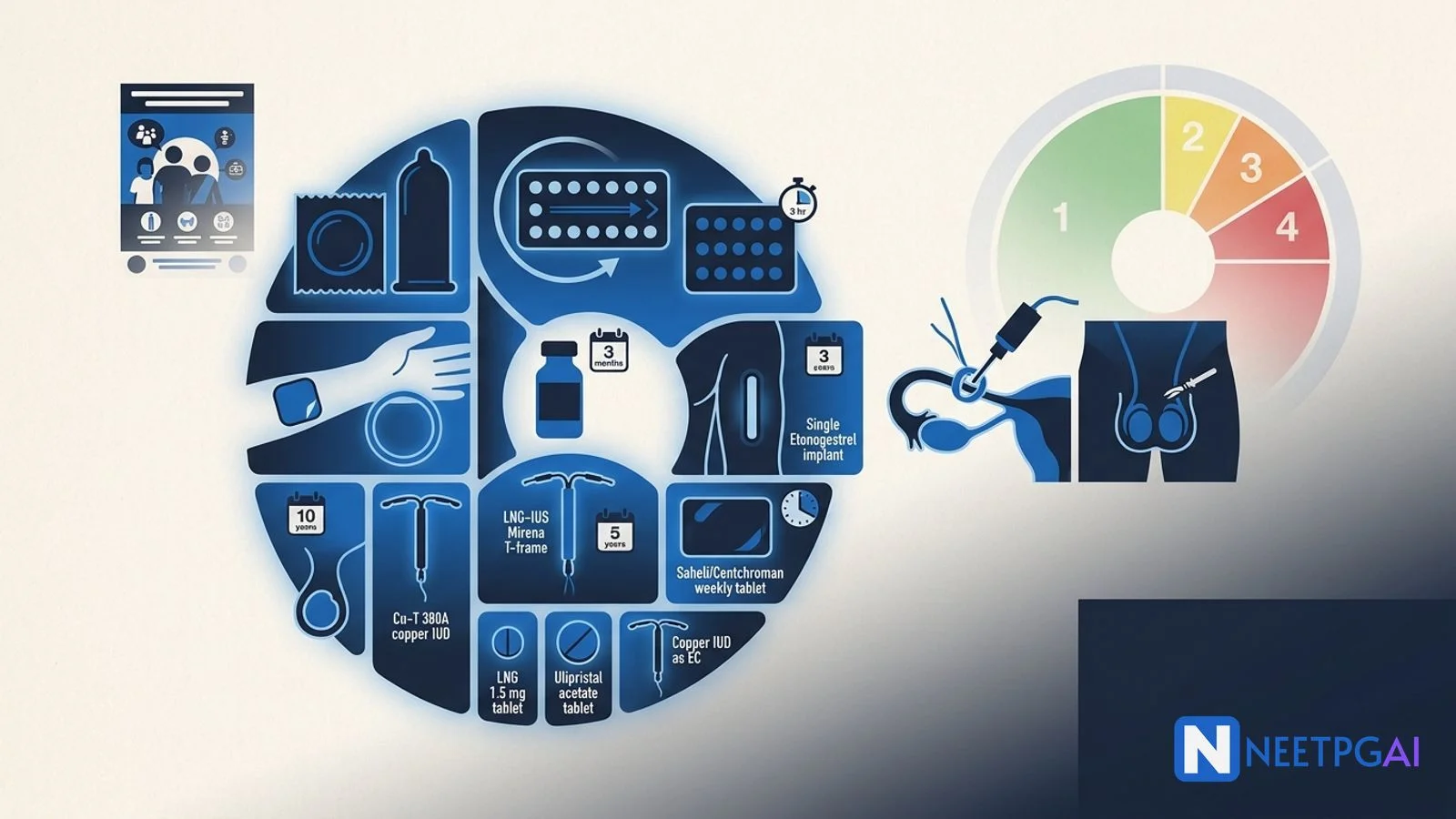
Contraception is a 3 to 5 question topic per NEET PG paper across OBG, PSM and Pharmacology. Lock these:
Contraception is the highest-yield single PSM-OBG overlap topic in NEET PG, and India's national Family Planning Programme provides several methods (Antara, Saheli, Mala N) that are uniquely Indian and routinely tested. The 2021 MTP Act Amendment and the 2020 WHO MEC update mean a few historically standard answers have shifted. Counselling is now an examinable competency — vignettes increasingly ask "which method is most appropriate for this patient" rather than "what is the mechanism of action".
This NEETPGAI deep dive covers the full method portfolio (barrier, hormonal, IUD, implant, emergency, permanent), the WHO MEC categories, the India National Family Planning Programme, and the MTP Act 2021 amendments. Pair this with the menopause and HRT management guide and the obstetric ultrasound image MCQ guide for full OBG core coverage.
The Pearl Index is the number of pregnancies per 100 woman-years of use. Two figures are reported — perfect use (theoretical, ideal compliance) and typical use (real-world). Lower is better.
| Method | Perfect use | Typical use |
|---|---|---|
| No method | 85 | 85 |
| Male condom | 2 | 13 to 18 |
| Female condom | 5 | 21 |
| Combined oral pill | 0.3 | 7 to 9 |
| Progestin-only pill | 0.3 | 7 |
| DMPA injection | 0.2 | 4 |
| Implanon (etonogestrel implant) | 0.05 | 0.05 |
| Copper IUD (Cu-T 380A) | 0.6 |
Start practicing INI-CET MCQs with AI-powered explanations.
Start Free PracticeMaster GI secretions, digestion, absorption transporters, motility patterns, and gut hormones with high-yield NEET PG 2026 traps and India-context examples.
Master labor stages, Friedman vs Zhang curves, WHO partograph, AMTSL, episiotomy and India JSY/LaQshya policies for NEET PG 2026 OBG MCQs.
5 anterior segment ophthalmology image MCQs for NEET PG: hypopyon and Behcet, Kayser-Fleischer ring in Wilson, Brushfield spots in Down, corneal arcus, and pterygium vs pinguecula.
Daily MCQs, study tips, and topper strategies on Telegram.
Join on Telegram →| 0.8 |
| LNG-IUS (Mirena) | 0.2 | 0.2 |
| Tubectomy | 0.5 | 0.5 |
| Vasectomy | 0.1 | 0.15 |
Implants, IUDs and sterilisation are categorised as LARC (long-acting reversible contraception) or permanent — they have nearly identical perfect and typical use rates because they remove user compliance from the equation.
Ethinyl oestradiol (20 to 35 micrograms) plus a progestin. Available formulations:
Mechanism — primary effect is suppression of ovulation (oestrogen suppresses FSH preventing follicle development; progestin suppresses LH surge); secondary effects on cervical mucus (thickened) and endometrium (atrophic).
Non-contraceptive benefits — reduced dysmenorrhoea, lighter menses, reduced ovarian and endometrial cancer risk, improved acne, treatment of PCOS hyperandrogenism.
Absolute contraindications (WHO MEC 4):
Norethisterone or levonorgestrel; taken continuously without a pill-free interval. Strict timing — must be taken within a 3-hour window of the usual time each day (newer drospirenone-only pill has a 24-hour window).
Primarily acts by thickening cervical mucus and rendering the endometrium atrophic; ovulation suppression is incomplete (50 percent of cycles).
Ideal for — breastfeeding (no oestrogen interference with milk supply), women with COC contraindications.
Weekly patch (releases ethinyl oestradiol and norelgestromin) or monthly vaginal ring (releases ethinyl oestradiol and etonogestrel). Same mechanisms and contraindications as COCs.
150 mg IM every 13 weeks (or 104 mg subcutaneous DMPA-SC every 13 weeks). Marketed in India as Antara under the FP-LMIS national programme — free at government facilities.
Single etonogestrel rod (4 cm × 2 mm) inserted in the upper inner arm; effective for 3 years. Pearl Index 0.05 (lowest of any reversible method). Side effects — irregular bleeding, return to fertility within days of removal.
T-shaped polyethylene frame with 380 mm² of copper wire. Effective for 10 years. Available free under the National FP Programme.
Releases 20 micrograms of LNG/day; effective for 5 to 8 years (label updated). Pearl Index 0.2.
Mala N — free oral contraceptive pill distributed through ASHAs and public health centres under the National Family Planning Programme; contains levonorgestrel 0.15 mg plus ethinyl oestradiol 0.03 mg. Mala D — socially marketed (subsidised) version sold through pharmacies and depot holders.
Used after unprotected intercourse, condom failure, missed pills, or sexual assault.
| Method | Window | Mechanism | Efficacy |
|---|---|---|---|
| Levonorgestrel 1.5 mg | Within 72 hours (best within 24) | Inhibits/delays ovulation | 85 percent reduction in pregnancy |
| Ulipristal acetate 30 mg | Within 120 hours (5 days) | Selective progesterone receptor modulator; delays ovulation even at LH peak | More effective than LNG, especially after 72 h |
| Copper IUD | Within 120 hours (5 days) | Inhibits fertilisation and implantation | Most effective (failure under 1 percent) |
| Yuzpe regimen | Within 72 hours | Combined estrogen-progestin pills | Less effective than LNG; more nausea |
LNG is the standard in India — sold over-the-counter as i-Pill, Unwanted-72, Pill-72. It does NOT disrupt an established pregnancy and is not an abortifacient. Mifepristone-misoprostol is used for medical abortion (under MTP Act), not emergency contraception.
Failure rate — 0.5 percent over 10 years (Pearl Index 0.5). Failure may result in ectopic pregnancy (suspect if pregnant after tubectomy).
Failure rate — 0.1 percent. Effective only after 3 months or 20 ejaculations (azoospermia must be confirmed by semen analysis). Complications — haematoma, infection, chronic pain (post-vasectomy pain syndrome).
The WHO MEC matches a contraceptive method against a clinical condition:
Common high-yield MEC categorisations:
The Family Planning Logistics Management Information System (FP-LMIS) provides free contraceptives across India under the National Health Mission. The basket of choice includes:
Mission Parivar Vikas (launched 2017) targets 146 high-fertility districts in 7 high-burden states (Bihar, UP, MP, Rajasthan, Jharkhand, Chhattisgarh, Assam).
The Medical Termination of Pregnancy (Amendment) Act 2021:
The WHO MEC classifies any contraceptive method against a clinical condition into four categories. Category 1 — no restriction; method can be used. Category 2 — advantages generally outweigh risks; can be used with follow-up. Category 3 — risks usually outweigh advantages; avoid unless other methods are not available, with careful clinical follow-up. Category 4 — unacceptable health risk; method must NOT be used. For example, combined oral contraceptives are category 4 in migraine with aura, smokers over 35, history of VTE, and current breast cancer.
Levonorgestrel 1.5 mg (single dose or two 0.75 mg tablets 12 hours apart) is the standard emergency contraceptive in India, marketed as i-Pill and Unwanted-72. Effective up to 72 hours after unprotected intercourse, with declining efficacy beyond. Primary mechanism is inhibition or delay of ovulation; it does NOT disrupt an established pregnancy. Ulipristal acetate (UPA) 30 mg extends the window to 120 hours and is more effective in the late follicular phase. The copper IUD inserted within 5 days post-coitus is the most effective emergency method (failure under 1 percent).
Antara is depot medroxyprogesterone acetate (DMPA) 150 mg, a progestin-only injectable contraceptive provided free under the Indian Family Planning Logistics Management Information System (FP-LMIS). One intramuscular injection every 13 weeks (3 months) provides over 99 percent efficacy. Side effects include menstrual irregularity (initial spotting, eventual amenorrhoea in over 50 percent at 12 months), bone mineral density loss (reversible, mostly recovers after discontinuation), weight gain, and delayed return to fertility (median 10 months). Excellent for breastfeeding women (no oestrogen effect on milk supply).
The Medical Termination of Pregnancy (Amendment) Act 2021 extended the upper gestational limit for legal abortion from 20 to 24 weeks for special categories of women — survivors of sexual assault or incest, minors, women with disabilities, those whose marital status changed during pregnancy (divorce, widowhood), fetal malformations, and women in disaster or emergency situations. Beyond 24 weeks, a state-level Medical Board can permit termination for substantial fetal abnormalities. Provider confidentiality is now legally protected. Only one provider opinion is needed up to 20 weeks; two are required between 20 and 24 weeks.
Saheli (Centchroman, ormeloxifene) is a non-hormonal, non-steroidal selective oestrogen receptor modulator (SERM) developed by CDRI Lucknow and marketed as Saheli or Chhaya. It is taken twice weekly for the first 3 months and once weekly thereafter. Mechanism — asynchrony between ovulation and endometrial maturation; the endometrium remains underdeveloped and unreceptive to implantation. Efficacy around 95 to 98 percent. No oestrogen-related risks; safe in lactation; advantages in PCOS and DUB. Unique to India and rare in the world's contraceptive armamentarium.
This content is for educational purposes for NEET PG exam preparation. It is not a substitute for professional medical advice, diagnosis, or treatment. Clinical information has been reviewed by qualified medical professionals.
Written by: NEETPGAI Editorial Team Reviewed by: Pending SME Review Last reviewed: May 2026