Version 1.0 - Published October 2026
Quick Answer
Cause of death is the anatomical lesion or disease that initiated the fatal chain (stab wound, MI, head injury), manner is the medicolegal classification (natural, accident, suicide, homicide, undetermined), and mechanism is the terminal physiological derangement (shock, tamponade, arrhythmia). Only cause and contributory conditions go on Form 4/4A - never write "cardiorespiratory arrest" as the cause. Postmortem interval is bracketed by hypostasis (visible 1-2 h, fixed 6-12 h), rigor mortis (onset 2-4 h, full 6-12 h, pass 24-36 h), decomposition (24 h plus), entomological succession (days to weeks), and vitreous potassium kinetics.
Why This Matters for NEET PG and INI-CET
Forensic Medicine routinely contributes 4-6 direct questions to NEET PG, and the "three Ms" (cause-manner-mechanism) plus postmortem timing cluster together as the single highest-yield block in the subject. INI-CET and FMGE both lean on this material because it crosses with Medicine (death certification on wards), Surgery (operating-room deaths and medicolegal reporting), and Community Medicine (ICD-10 coding of underlying cause). Every intern will fill out at least one Form 4A in their first posting, so understanding the WHO cause-of-death framework is also a direct patient-safety and medicolegal competence.
Recent trend analysis of the Supreme Court mandated 1 October 2026 NBEMS answer key for the 30 August 2026 NEET PG paper confirms at least one timing question (lividity fixation) and one certification question appeared, matching INI-CET 2026's heavy emphasis on autopsy classification and Section 176 CrPC. Expect clinical vignettes that ask you to classify a death scenario (manner), identify the correct line on Form 4, estimate postmortem interval from a mix of findings, or spot the diagnostic significance of lividity colour.
Beyond the exam, this material is practical: as a junior doctor you will be asked to certify natural deaths, to identify suspicious deaths and refuse certification, to preserve forensic evidence on patients who die in the ED, and to interact with police and executive magistrates. A clean mental model of the three Ms is the fastest path to doing all of these without being caught out.
The Three Ms of Death
Cause of Death
The cause of death is the specific anatomical or pathological lesion or disease that initiated the chain of events leading to death. It must be a diagnostic entity - either a disease (acute myocardial infarction, metastatic bronchogenic carcinoma, tuberculous meningitis) or an injury (penetrating stab wound of left ventricle, severe traumatic brain injury from fall).
Underlying cause of death is the specific condition at the start of the chain. In a patient who died of aspiration pneumonia complicating prolonged coma after a severe head injury from a road traffic collision, the underlying cause is the head injury - this is what the registrar codes using ICD-10 for mortality statistics.
Immediate cause is the final condition that directly produced death - aspiration pneumonia in the example above. Between the two sit any intermediate antecedent causes.
Manner of Death
The medicolegal classification. Five standard categories (NASH-U):
| Manner | Definition | Example |
|---|
| Natural | Death from disease or old age with no external cause | MI, stroke, cancer, pneumonia |
| Accident | Unintentional external injury or poisoning | RTA, drowning, electrocution, accidental overdose |
| Suicide | Self-inflicted intentional death | Hanging, OP poisoning, firearm to self |
| Homicide | Death caused by another person's actions | Stab, firearm, strangulation, battering |
| Undetermined | Insufficient evidence to classify | Unwitnessed, decomposed, missing information |
Manner is set by medicolegal authorities - forensic pathologists, coroners where they exist, or magistrates - not by a treating physician.
Mechanism of Death
The physiological derangement that terminated life:
- Hypovolaemic shock
- Cardiogenic shock
- Septic shock
- Cardiac tamponade
- Tension pneumothorax
- Cerebral herniation (uncal, tonsillar, subfalcine)
- Arrhythmia (ventricular fibrillation)
- Acute respiratory failure
- DIC and multi-organ failure
Mechanism is NEVER written as the sole cause of death. "Cardiorespiratory arrest" is a mechanism and marks a certificate as technically incompetent.
Death Certification in India - Form 4 and Form 4A
The Registration of Births and Deaths Act 1969 mandates death registration within 21 days. Two medical certificate forms exist under the Act:
| Form | Applicability |
|---|
| Form 4 | Deaths in a hospital, nursing home, or other institution |
| Form 4A | Deaths outside an institution, certified by an attending private practitioner |
Both forms follow the WHO International Form of Medical Certificate of Cause of Death structure.
How to Fill Part I and Part II
Part I - Chain of events, each specific disease or injury on a separate line:
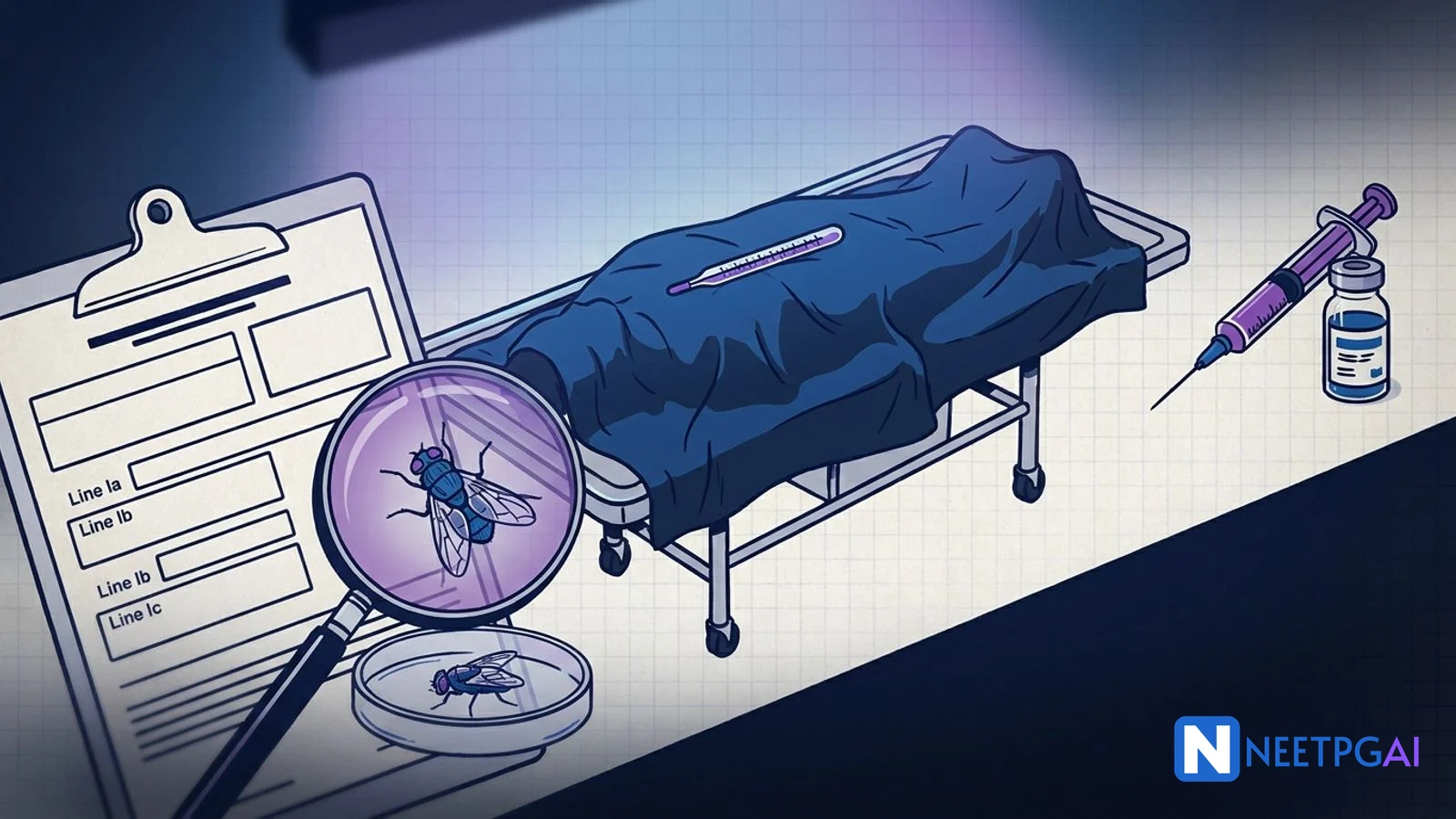
- Line Ia: Immediate cause of death - the final disease, condition or complication that directly caused death
- Line Ib: Antecedent cause that gave rise to Line Ia
- Line Ic: Underlying cause of death - the condition that initiated the entire sequence
Part II - Significant conditions contributing to the death but not part of the direct chain:
For example, diabetes, hypertension, chronic kidney disease, obesity.
Add approximate interval between onset and death for each line (hours, days, weeks).
Worked Example
A 54-year-old man with a 30-year history of smoking and 10 years of hypertension developed left hemispheric infarct 10 days ago. He was bed-bound and aspirated his feed, developing right lower lobe pneumonia. He died of septic shock 2 days later.
| Line | Entry | Interval |
|---|
| Ia | Septic shock | 2 days |
| Ib | Aspiration pneumonia | 2 days |
| Ic | Ischaemic stroke (left middle cerebral artery territory) | 10 days |
| Part II | Essential hypertension, chronic cigarette smoking | 10 and 30 years |
The underlying cause coded for mortality statistics is ischaemic stroke.
Deaths That Must NOT Be Certified by the Treating Doctor
Any death that is medicolegal must be referred for autopsy and inquest - do not sign Form 4A. These include:
- Death from an injury (RTA, fall, assault, burns, drowning, electrocution, firearm, poisoning)
- Death during or within 24 hours of surgery or anaesthesia
- Death of a woman within 7 years of marriage from unnatural causes
- Death in police or judicial custody
- Death of a child under suspicious circumstances
- Death with insufficient medical records to establish a natural cause
- Death from occupational disease
- Death from quack treatment or criminal abortion
- Unidentified bodies
Postmortem Changes - Early (First 24 Hours)
Hypostasis (Postmortem Lividity, Livor Mortis)
Mechanism - gravitational settling of blood through dilated postmortem capillaries and venules.
Timeline - appears 20-30 minutes after death, visible by 1-2 hours, confluent by 4-6 hours, fixed by 6-12 hours (will not blanch on firm pressure, will not shift if body is turned).
Features - bluish-purple, in dependent parts, pressure areas spared (contact pallor).
Colour clues:
| Colour | Likely cause |
|---|
| Cherry-pink | Carbon monoxide poisoning, cold exposure, cyanide poisoning |
| Chocolate-brown | Methaemoglobinaemia (nitrites, phenacetin, aniline, chlorates) |
| Bluish | Asphyxia, cardiac failure, most natural deaths |
| Pale | Massive haemorrhage, anaemia |
| Deep purple | Normal in cold environment |
Double lividity (two sets at different levels) proves the body was moved during the fixation window.
Rigor Mortis
Mechanism - ATP depletion prevents dissociation of actin-myosin cross-bridges; muscle stiffens in whatever position it finds itself.
Timeline (temperate conditions, India):
- Onset: 2-4 hours after death
- Fully developed: 6-12 hours
- Remains: 12-18 further hours
- Passes off: 24-36 hours total
Nysten's rule - rigor develops top-down and proximal-to-distal in order: eyelids, jaw, neck, upper limbs, trunk, lower limbs. It passes off in the same order.
Accelerated rigor - high ambient temperature, muscular build, exercise immediately before death, sepsis, strychnine and cyanide poisoning, children.
Delayed rigor - cold, cachexia, debilitated and elderly patients.
Variants:
- Cadaveric spasm (instantaneous rigor): never passes through flaccid stage; locks the body in its last voluntary position (grass in a drowning victim's hand, firearm in a suicide victim's grip). Almost pathognomonic of violent emotional death.
- Heat stiffening: temperatures greater than 65 degrees C coagulate proteins; produces the flexed pugilistic posture in burn victims. Irreversible.
- Cold stiffening: frozen tissue; reverses on thawing.
Algor Mortis (Body Cooling)
Body temperature falls after death. Rate approximately 1 degree C per hour in the first 6-8 hours (temperate conditions), then slower until equilibrium with environment. Use the Henssge nomogram for more accurate PMI estimation. Rate is affected by body size, clothing, environment, ambient temperature.
Postmortem Changes - Late (After 24 Hours)
Decomposition and Putrefaction
Begins with greenish discolouration of right iliac fossa within 12-18 hours in warm conditions (bacterial action on caecal contents - mostly Clostridium welchii). Spreads centrally. Features over the first week:
- Marbling (visible blood vessels under skin, 24-36 h)
- Bloating from gas (36-72 h)
- Skin slippage, blister formation
- Purge fluid from mouth and nostrils
- Protrusion of tongue and eyes
- Adipocere formation in wet environments (weeks)
- Mummification in dry hot environments (weeks to months)
- Skeletonisation (weeks to years)
Forensic Entomology
Insect succession on a body is predictable and extends PMI estimation into weeks.
| Phase | Insects | Timing |
|---|
| 1. Fresh (minutes to days) | Blowflies (Calliphora, Lucilia, Chrysomya) lay eggs in orifices | 0 h to 72 h |
| 2. Bloat and active decay | First-instar larvae | 12-24 h after egg laying |
| 3. Advanced decay | Second and third instar maggots | 4-7 days |
| 4. Dry remains | Dermestid beetles, Silphidae, mites, moths | 2 weeks plus |
Calculate accumulated degree-days (ADD) from local temperature records plus maggot length and species to estimate minimum PMI.
Vitreous Humour Potassium
Potassium leaks from retinal cells after death across an intact membrane. Rises predictably over 100+ hours.
Sturner equation: Hours since death = 7.14 × K+ (mEq/L) - 39.1
Vitreous is also preferred for antemortem glucose (less postmortem change than blood), urea, and sodium.
Types of Autopsy
| Type | Purpose | Consent | Who authorises |
|---|
| Clinical (pathological, hospital) | Confirm clinical diagnosis, teaching | Written consent from next of kin | Hospital pathologist |
| Medicolegal (forensic) | Determine cause, manner, time, identification | NOT required - court order | Investigating officer or magistrate |
| Virtual autopsy (postmortem CT and MRI) | Non-invasive imaging adjunct | Variable | Pathologist |
Medicolegal autopsy is performed by a government medical officer (civil surgeon, forensic specialist, or authorised registered medical practitioner) under direction of the police or magistrate.
Section 174 and 176 CrPC Inquest
Section 174 CrPC - Police Inquest
Applies when a station-in-charge receives information of a suspicious or unnatural death. Steps:
- Inform the executive magistrate
- Proceed to the scene with two or more respectable local persons (panchas)
- Examine the body, injuries, clothing, surroundings
- Prepare an inquest report (panchnama)
- If cause of death is doubtful, send the body for medicolegal autopsy
Section 176 CrPC - Magisterial Inquest
Mandatory and overrides police inquest in:
- Deaths in police custody
- Deaths in judicial custody (prison)
- Deaths in a psychiatric institution
- Deaths of women within 7 years of marriage under suspicious circumstances or by suicide
- Dowry deaths (Section 304B IPC)
- Deaths from police firing or action
Executive magistrate can summon witnesses, record evidence under oath, and exhume (with district magistrate permission).
Note: Coroner inquest existed in Mumbai under the Coroners Act 1871 but was abolished in 1999. India does not have a coroner system.
Case-Pattern Vignettes
Hanging
- Ligature mark: oblique, above thyroid cartilage, incomplete around neck, deepest opposite the knot (usually side of ear)
- Face pale (complete suspension) or congested (partial suspension)
- Salivary dribble from the angle of mouth OPPOSITE to the ligature knot (gravitational drip)
- Tongue may protrude; cyanosis in partial hanging
- Postmortem lividity in hands, legs, below the ligature mark
- Fracture of hyoid or thyroid cartilage - uncommon in young, common in elderly judicial hanging
- Le Fort's sign - fracture of cricoid
Drowning
- External: froth at mouth and nostrils (fine persistent "champignon mousse"), cadaveric spasm with weeds or mud in hand, washerwoman's hands and feet (immersion for hours), postmortem lividity cephalic (face-down floating)
- Internal: emphysema aquosum (overdistended waterlogged lungs with imprint of ribs - Paltauf's lungs), Paltauf haemorrhages (sub-pleural, under visceral pleura), water in airways, oedema fluid
- Diatoms in bone marrow (femur, sternum) confirm antemortem drowning (water was circulated through aorta while heart was beating)
Strangulation (Manual Throttling and Ligature)
- Ligature mark: horizontal, below thyroid cartilage, continuous around neck, no sparing opposite the knot
- Fingernail abrasions and bruises on neck in manual strangulation
- Severe facial congestion, cyanosis, petechiae on sclera, conjunctiva, periorbital skin (Tardieu spots)
- Fracture of hyoid common
- Tongue protruded, bitten
Firearm Injuries
Entry wound features (hard-contact, close-range, intermediate-range, distant):
| Range | Entry wound features |
|---|
| Hard contact | Muzzle imprint, muzzle stamp, cherry-pink CO staining in wound track (CO from muzzle gases) |
| Close (less than 15 cm) | Soot and tattooing around a central hole, scorched hair |
| Intermediate (15 cm to 60 cm) | Tattooing (powder stippling) but no soot |
| Distant (greater than 60 cm) | Clean hole with abrasion collar and grease collar only |
Exit wound: larger, everted edges, no abrasion collar, no soot or tattooing. Shored exit (if clothing or wall backs the exit site) can mimic abrasion collar.
Poisoning Signs (Highest Yield)
| Poison | Classical finding |
|---|
| Organophosphate (OP) | Garlic breath, SLUDGE features, pinpoint pupils |
| Cyanide | Bitter almond odour, cherry-red lividity |
| Carbon monoxide | Cherry-pink lividity, carboxyhaemoglobin greater than 20% |
| Arsenic | Chronic - garlicky breath, Mees lines on nails, hyperpigmentation |
| Lead | Burton's blue line on gums, lead colic, foot drop |
| Mercury (acute) | Metallic taste, acrodynia (pink disease) |
| Methanol | Blindness, metabolic acidosis, formic acid |
| Strychnine | Opisthotonos, risus sardonicus, hyperacute rigor |
High-Yield One-Liners
- Cause of death is the pathological lesion; manner is the medicolegal classification; mechanism is the physiological derangement.
- Writing "cardiorespiratory arrest" as cause of death is a cardinal error.
- Underlying cause of death (Line Ic) is coded by the registrar for mortality statistics.
- Form 4 is for institutional deaths; Form 4A for deaths outside institutions.
- Hypostasis appears 1-2 h, fixed 6-12 h; rigor onset 2-4 h, full 6-12 h, passes 24-36 h.
- Nysten's rule: rigor develops top-down and passes off in the same order.
- Cadaveric spasm never passes through a flaccid stage - diagnostic of violent emotional death.
- Cherry-pink lividity = carbon monoxide poisoning, cold exposure, cyanide poisoning.
- Chocolate-brown lividity = methaemoglobinaemia.
- Greenish discolouration of right iliac fossa is the first external sign of putrefaction (12-18 h).
- Diatoms in femoral bone marrow confirm antemortem drowning.
- Paltauf haemorrhages are sub-pleural in drowning.
- Hanging ligature is oblique, above thyroid, incomplete, deepest opposite the knot.
- Strangulation ligature is horizontal, below thyroid, complete, no sparing.
- Hyoid fracture is uncommon in young hanging but common in strangulation.
- Diptera succession and accumulated degree-days extend PMI estimation into weeks.
- Vitreous potassium rises predictably - Sturner equation: Hours = 7.14 × K+ - 39.1.
- Section 174 CrPC = police inquest; Section 176 CrPC = magistrate inquest (mandatory for custody, dowry, psychiatric institution deaths).
- Coroner inquest was abolished in India in 1999 (last in Mumbai).
- Entry firearm wound has abrasion collar, grease collar, and may have soot and tattooing; exit wound is larger and everted.
Common Mistakes
-
Confusing cause and mechanism - "cardiopulmonary arrest" or "cardiogenic shock" alone is a mechanism, not a cause. Always write the pathological lesion (acute myocardial infarction, severe head injury, metastatic adenocarcinoma).
-
Certifying a medicolegal death on Form 4A - any death from injury, within 24 hours of surgery, in a woman within 7 years of marriage under suspicious circumstances, in custody, or with inadequate records must be referred for autopsy. Signing Form 4A on such a case is medicolegal negligence.
-
Mis-reading hanging as homicidal strangulation (or vice versa) - the ligature mark pattern (oblique and incomplete and above thyroid in hanging vs horizontal and complete and below thyroid in strangulation) and the presence of fingernail abrasions in manual throttling are the discriminating features.
-
Forgetting that lividity colour is diagnostic - cherry-pink in exam vignettes almost always indicates carbon monoxide or cyanide, and chocolate-brown lividity suggests methaemoglobinaemia. Candidates miss this because they expect the clue in blood colour, not skin colour.
-
Mixing up Nysten's rule for development vs disappearance - rigor appears top-down (eyelids first) AND disappears top-down (eyelids first). It is not a reverse-direction phenomenon.
Related Topics on NEETPGAI
Practice This on NEETPGAI
Nail the three Ms, Form 4 line order, and postmortem timing on real NEET PG and INI-CET PYQs. Our 28,000+ MCQ bank includes case-based death-investigation vignettes with annotated autopsy photographs and death-certificate stems.
Start free on NEETPGAI - built with authentic PYQs plus an AI tutor that walks you line-by-line through any certification scenario, lividity colour clue, or Section 176 CrPC inquest question.