Version 1.0 — Published April 2026
Quick Answer
Abdominal ultrasound is the first-line imaging for most acute abdomen presentations in India — it is bedside, radiation-free, fast, and highly accurate when combined with clinical assessment. To correctly interpret abdominal ultrasound MCQs in NEET PG, master these 5 pattern groups:
- FAST scan (4 views) — RUQ/Morison's pouch (most sensitive for supine hemoperitoneum), LUQ/splenorenal, suprapubic/pouch of Douglas, subxiphoid/pericardial; E-FAST adds pleural views for pneumothorax
- Appendicitis criteria — blind-ended tubular, outer diameter 6 mm or above, non-compressible, target sign on cross-section, periappendiceal fat changes, hyperemia on Doppler
- Acute cholecystitis — gallbladder wall above 3 mm, pericholecystic fluid, sonographic Murphy's sign, gallbladder distension (transverse above 4 cm)
- Intussusception — target/doughnut sign on transverse, pseudo-kidney sign on longitudinal, absent Doppler flow suggests ischemia
- Gynecological acute abdomen — ovarian torsion (enlarged heterogeneous ovary with peripheral follicles, absent or reduced Doppler flow), ectopic pregnancy (empty uterus above discriminatory beta-hCG, adnexal tubal ring, free fluid in Douglas pouch)
Clinical image presentation
A 28-year-old woman presents to the emergency department with 18 hours of progressive right lower quadrant abdominal pain that started peri-umbilically and migrated. She has anorexia, nausea, and one episode of non-bilious vomiting. She has a 4-month-old infant and is not using contraception; her last menstrual period was approximately 5 weeks ago. No dysuria, no vaginal bleeding, no significant past history.
On arrival, her vitals are: pulse 104 bpm, BP 112/70 mmHg, respiratory rate 18/min, SpO2 98 percent on room air, temperature 38.1 C (100.6 F). Abdominal examination shows tenderness maximal at McBurney's point with voluntary guarding. Rovsing's sign positive. No palpable mass. Bowel sounds present.
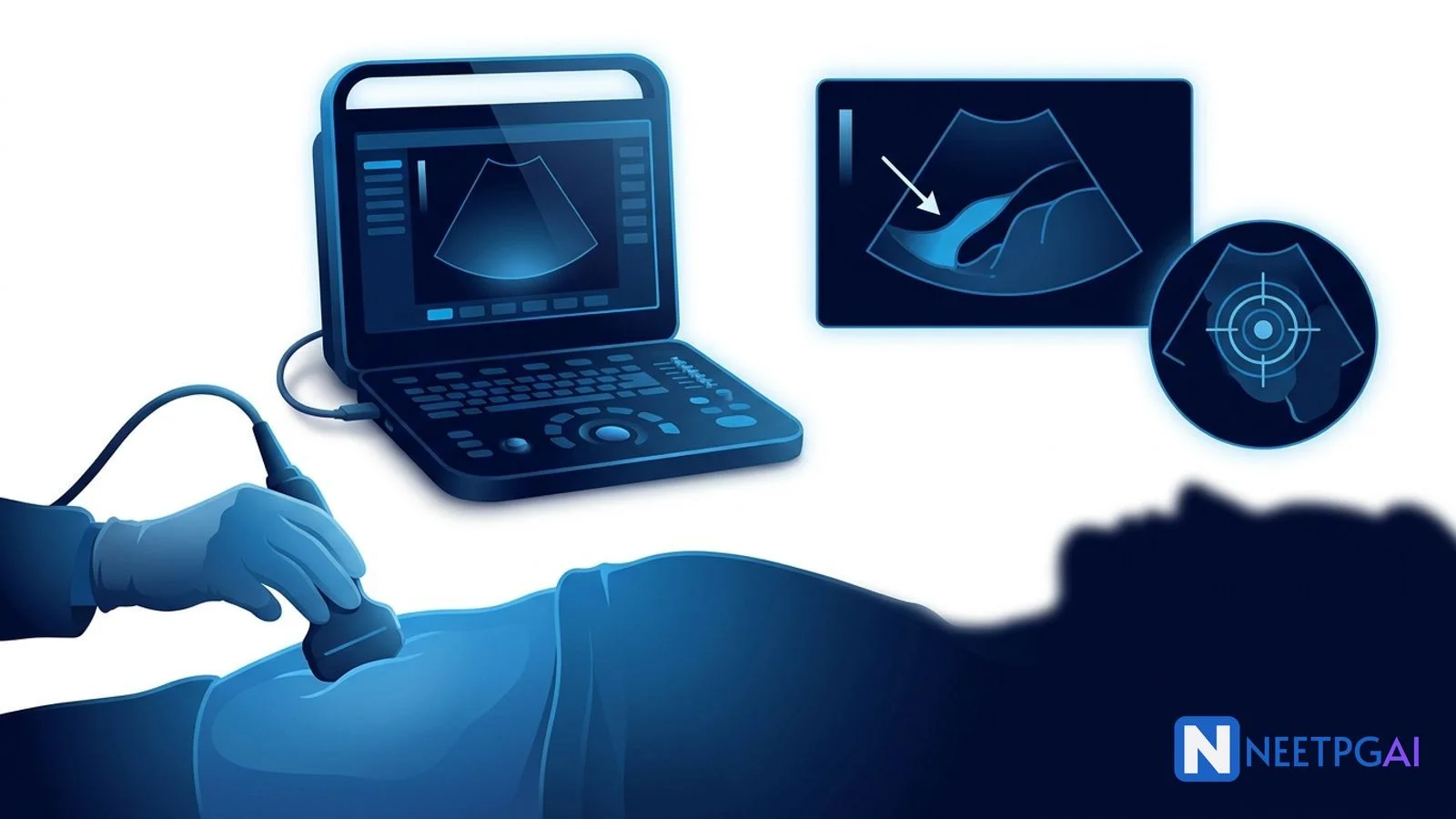
A bedside abdominal ultrasound is performed in the ED. A student should systematically identify these findings:
RUQ view — Morison's pouch:
- No free fluid between liver and right kidney
- Normal gallbladder, wall thickness 2 mm, no stones, negative sonographic Murphy's sign
- Liver parenchyma homogeneous, IVC and hepatic veins normal
LUQ view — splenorenal space:
- No free fluid between spleen and left kidney, no subphrenic fluid
- Spleen size within normal limits (11 cm)
Right iliac fossa (RIF):
- Blind-ended tubular structure arising from the caecal base measuring 10 mm outer diameter (normal <= 6 mm)
- Non-compressible on graded pressure
- Target sign on cross-section — concentric hypoechoic wall with echogenic center
- Mild hyperechoic periappendiceal fat changes
- Color Doppler shows increased wall hyperemia
- Small appendicolith (hyperechoic focus with posterior shadow) near the tip
- Small amount of free fluid adjacent to the appendix — no generalized peritonitis
Suprapubic view — pouch of Douglas:
- Urinary bladder normally filled, walls symmetric
- Uterus retroverted, endometrial stripe 6 mm (consistent with luteal phase); NO intrauterine gestational sac visible
- Both ovaries normal size with preserved Doppler flow; no adnexal mass
- 4 mL of free fluid in the pouch of Douglas (physiological in reproductive-age women; minimal)
Beta-hCG sent simultaneously: negative.
MCQ question as it appears in NEET PG
A 28-year-old woman presents with 18 hours of migratory right iliac fossa pain, anorexia, fever 38.1 C, and positive Rovsing's sign. Bedside ultrasound shows a blind-ended tubular structure at the caecal base with outer diameter 10 mm, non-compressibility, target sign on cross-section, an appendicolith, and increased color Doppler hyperemia. Free fluid is absent from Morison's pouch. Urine beta-hCG is negative. Which of the following is the most appropriate next step?
- (a) Start IV antibiotics and arrange interval appendicectomy in 6 weeks
- (b) Arrange urgent CECT abdomen to confirm before surgical referral
- (c) Refer for laparoscopic appendicectomy after surgical review
- (d) Discharge with oral antibiotics and safety-net review in 48 hours
Take a moment to work through this before reading the analysis below.
Step-by-step visual analysis
A systematic reading protocol is critical — missing a single criterion (diameter 6 mm or above, non-compressibility, target sign) can either under-call or over-call appendicitis. Use this protocol every time an abdominal ultrasound image appears in an NEET PG MCQ.
Step 1: Identify the probe position and view
- Probe frequency — curvilinear 2-5 MHz for deep structures (liver, spleen, kidneys), linear high-frequency 7-15 MHz for superficial structures (appendix, subcutaneous, testes)
- Standard views — RUQ (longitudinal between ribs), LUQ (intercostal), suprapubic (transverse and longitudinal), RIF (graded compression linear probe)
- Patient position — supine for FAST; left lateral decubitus improves splenorenal visualization
Step 2: Assess for free fluid systematically
Free fluid appears as anechoic (black) areas in dependent recesses.
- Morison's pouch (right subhepatic) — MOST sensitive for free fluid in the supine patient; detects 250-620 mL of fluid
- Splenorenal space (left) — second most common site; fluid often tracks to subphrenic
- Pouch of Douglas — most sensitive PELVIC recess; detects as little as 100 mL of free fluid; physiological 2-5 mL at ovulation is normal
- Pericardial (subxiphoid) — detects as little as 50 mL of pericardial effusion
Step 3: Assess the target organ — appendix in this case
Graded compression ultrasound of the appendix is the specific test when appendicitis is suspected.
| Feature | Normal | Appendicitis |
|---|
| Origin | Arises from caecal base | Same |
| Shape | Blind-ended tubular | Blind-ended tubular, often distended |
| Outer diameter | <= 6 mm | 6 mm or above (often 7-12 mm) |
| Compressibility | Compressible | Non-compressible |
| Cross-section | Thin wall | Target sign (concentric hypoechoic wall, echogenic center) |
| Wall layers | Preserved | Loss of layer differentiation (gangrenous) |
| Periappendiceal fat | Isoechoic to surrounding fat | Hyperechoic (inflamed mesentery) |
| Doppler flow | Minimal | Hyperemia (increased wall flow) |
| Appendicolith | Absent | Present in 10-20 percent — increases perforation risk |
Step 4: Rule out perforation
Features suggesting perforated appendicitis — which changes management toward urgent surgery:
- Loss of echogenic submucosal layer (gangrenous wall)
- Peri-appendiceal collection or abscess
- Generalized free fluid (not just adjacent to appendix)
- Localised pneumoperitoneum as echogenic foci with comet-tail artifact
- Air bubbles within any fluid collection
In this patient: no collection, only small localized free fluid adjacent to appendix — suggests uncomplicated acute appendicitis, NOT perforated.
Step 5: Exclude the differential (especially in women)
In a reproductive-age woman with RIF pain, always exclude gynecological causes BEFORE committing to appendicectomy. ALWAYS check beta-hCG.
- Ectopic pregnancy — check beta-hCG first; empty uterus above discriminatory zone (1500-2000 mIU/mL) with adnexal mass is diagnostic
- Ovarian torsion — unilaterally enlarged ovary, heterogeneous stroma, peripheral follicles, absent/reduced Doppler
- Mittelschmerz — mid-cycle rupture of follicular cyst; small amount of free fluid, clinical history
- PID / tubo-ovarian abscess — complex adnexal mass, free fluid, cervical motion tenderness clinically
In this patient: beta-hCG is negative; ovaries are normal with preserved flow; appendix is clearly inflamed. Appendicitis is the diagnosis.
Step 6: Decide on further imaging vs surgery
Ultrasound findings plus clinical picture (Alvarado score 7 or above in this patient) are diagnostic. CT is reserved for equivocal cases, suspected perforation with abscess (for drainage planning), or BMI above 35 where ultrasound visualization is poor.
Answer and detailed explanation
Correct answer: (c) Refer for laparoscopic appendicectomy after surgical review
This patient has uncomplicated acute appendicitis — classical history (migratory RIF pain, anorexia, vomiting), positive Rovsing's sign, fever, and diagnostic ultrasound (appendix 10 mm, non-compressible, target sign, appendicolith, hyperemia). The standard of care in India and globally is laparoscopic appendicectomy within 12-24 hours of diagnosis. Laparoscopic approach has lower wound infection rates, shorter hospital stay, and faster return to activity compared to open appendicectomy (Cochrane review, 2018).
Why each distractor is wrong:
| Option | Why incorrect |
|---|
| (a) IV antibiotics + interval appendicectomy | Non-operative management (NOM) with antibiotics alone is NOT standard of care when appendicolith is present — the CODA trial (NEJM, 2020) showed 41 percent failure rate with appendicolith vs 25 percent without. Appendicolith is associated with higher perforation and treatment failure. Interval appendicectomy at 6 weeks is reserved for appendiceal mass/abscess, not uncomplicated appendicitis. |
| (b) CECT before surgical referral | Ultrasound is diagnostic here — all six criteria are met. CT adds radiation without changing management. CT is reserved for equivocal ultrasound, suspected abscess, BMI above 35, or atypical presentations. Routine CT before appendicectomy delays definitive care and exposes young women (age under 30) to unnecessary radiation. |
| (d) Discharge with oral antibiotics | Uncomplicated acute appendicitis with fever, appendicolith, and clear imaging findings requires inpatient surgical care. Discharge risks perforation, abscess, and sepsis. Oral antibiotic outpatient management is NOT supported by evidence for appendicitis with appendicolith (high failure rate 41 percent per CODA). |
NEET PG trap alert: The commonest wrong answer in this scenario is "CT to confirm". Remember: in a reproductive-age woman, ultrasound is the preferred first-line investigation (no radiation, can assess gynecological differential with same probe by moving to pelvis). When ultrasound is diagnostic with all criteria met, proceed directly to surgical referral. Do NOT add CT by reflex.
Practice surgery MCQs with AI-powered explanations to build abdominal ultrasound pattern recognition. For a full review, see our radiology high-yield topics guide and surgery high-yield topics guide with targeted drills.
Similar patterns comparison table
The eight ultrasound patterns most commonly tested in NEET PG acute abdomen image MCQs — memorize this table, it covers approximately 90 percent of abdominal USG questions:
| Ultrasound finding | Diagnosis | Key distinguishing features |
|---|
| Anechoic fluid in Morison's pouch after blunt trauma | Hemoperitoneum (solid organ injury) | Supine patient, post-trauma; positive FAST mandates CT or laparotomy based on stability |
| Blind-ended tubular at caecal base, 10 mm, non-compressible, target sign, hyperemia, +/- appendicolith | Acute appendicitis | McBurney tenderness, migratory pain, fever; appendicolith increases perforation risk |
| Gallbladder wall above 3 mm + pericholecystic fluid + positive sonographic Murphy + gallstones | Acute cholecystitis | Boas' sign (right shoulder tip referred pain), fever, Murphy's sign; WBC elevated |
| Target/doughnut sign on transverse RUQ in a child | Ileocolic intussusception | Age 3 months-3 years, red-currant jelly stool, sausage-shaped mass, pseudo-kidney on long axis |
| Unilaterally enlarged ovary with peripheral follicles and absent/reduced Doppler flow | Ovarian torsion | Sudden unilateral pelvic pain, vomiting; surgical detorsion is time-critical (< 6 hours ideal) |
| Empty uterus with adnexal tubal ring + echogenic free fluid in pouch of Douglas + positive beta-hCG above 1500 | Ectopic pregnancy (often ruptured) | Amenorrhea, positive pregnancy test, shock if ruptured; urgent surgery |
| Dilated fluid-filled bowel loops with hyperactive peristalsis and keyboard sign | Small bowel obstruction | Bilious vomiting, distension, absolute constipation; differentiate from ileus (no peristalsis) |
| Anechoic cystic structure with internal echoes adjacent to uterus in reproductive age woman | Hemorrhagic ovarian cyst | Mid-cycle pain, stable vitals; usually self-limiting, surgery only if rupture with hemodynamic instability |
| Dilated CBD above 6 mm with stone in distal CBD + intrahepatic duct dilatation | Choledocholithiasis (with or without cholangitis) | Jaundice, fever if cholangitis; MRCP if USG inconclusive; ERCP for treatment |
| Enlarged bulky hypoechoic pancreas with peripancreatic fluid | Acute pancreatitis | Epigastric pain radiating to back, raised lipase above 3x ULN; USG mainly excludes gallstones |
Clinical application: combining ultrasound with beta-hCG and FAST algorithm
Non-contrast abdominal ultrasound combined with beta-hCG is the minimum workup in every woman of reproductive age with acute abdomen — the diagnostic pathway diverges completely based on pregnancy status.
The key algorithm at a glance:
| Presentation | First-line imaging | Purpose |
|---|
| Trauma with hemodynamic instability | E-FAST | Detect hemoperitoneum, hemothorax, pneumothorax, pericardial tamponade — positive scan mandates laparotomy |
| Reproductive-age woman with pelvic pain | Transabdominal + transvaginal USG with beta-hCG | Exclude ectopic pregnancy, ovarian torsion, hemorrhagic cyst before committing to general surgical diagnosis |
| Right iliac fossa pain | Graded compression USG | Diagnose appendicitis; exclude gynecological differential in women |
| Right upper quadrant pain with fever | USG HBS (hepatobiliary) | Diagnose acute cholecystitis; screen for CBD dilatation and cholangitis |
| Pediatric red-currant jelly stool | USG abdomen | Diagnose intussusception; assess viability via Doppler |
| Jaundice | USG HBS | Detect CBD dilatation, level and cause of obstruction |
| Suspected aortic aneurysm rupture | Bedside USG | Detect AAA above 3 cm; CT only if stable enough |
Early ultrasound shortens diagnostic time, reduces CT radiation exposure (especially in young women and children), and is directly assessable in the emergency department or bedside in ICU — core skills tested in NEET PG radiology and surgery sections.
Frequently asked questions
What is the FAST scan and what are its four views?
FAST (Focused Assessment with Sonography for Trauma) is a bedside ultrasound protocol to detect free intraperitoneal fluid (usually blood) in trauma. Four standard views: (1) right upper quadrant — Morison's pouch (hepatorenal space), the most dependent area in the supine patient and the most sensitive view for hemoperitoneum; (2) left upper quadrant — splenorenal space and subphrenic recess; (3) suprapubic — pouch of Douglas (rectovesical in males, rectouterine in females), the most dependent pelvic recess; (4) pericardial (subxiphoid) — detects pericardial effusion and tamponade. Extended FAST (E-FAST) adds bilateral pleural views for pneumothorax and hemothorax. Sensitivity for hemoperitoneum 73-88 percent, specificity above 95 percent.
What are the ultrasound criteria for acute appendicitis?
Graded compression ultrasound uses six established criteria. First, a blind-ended tubular structure arising from the base of the caecum. Second, outer-wall-to-outer-wall diameter 6 mm or above (diameter under 6 mm excludes appendicitis with high negative predictive value). Third, non-compressibility on graded pressure (normal appendix is compressible). Fourth, target sign on cross-section — concentric layers of the inflamed wall. Fifth, periappendiceal fat echogenicity increase (inflammation of surrounding mesentery). Sixth, hyperemia on color Doppler (increased vascularity). An appendicolith (hyperechoic focus with posterior shadowing) increases perforation risk by 2-3 fold. Sensitivity is 85-90 percent, specificity 90-95 percent in experienced hands.
How do you distinguish acute cholecystitis from biliary colic on ultrasound?
Acute cholecystitis has four ultrasound features. First, gallbladder wall thickening above 3 mm (normal is up to 3 mm). Second, pericholecystic fluid (anechoic collection adjacent to the gallbladder). Third, sonographic Murphy's sign — maximal tenderness when the probe is pressed directly over the gallbladder fundus (sensitivity 63-86 percent, specificity 85-90 percent when combined with stones). Fourth, gallbladder distension (transverse diameter above 4 cm, longitudinal above 10 cm). Biliary colic (uncomplicated gallstone disease) shows gallstones in a non-thickened gallbladder with no wall edema, no pericholecystic fluid, and negative sonographic Murphy's sign. Cholecystitis imaging plus fever and leukocytosis clinches the diagnosis.
What is the target sign in intussusception and how is it seen on ultrasound?
The target sign (also called doughnut or bullseye sign) is the pathognomonic transverse-section ultrasound appearance of intussusception — multiple concentric hypoechoic and hyperechoic rings representing telescoped bowel layers. On longitudinal section, the same structure appears as the pseudo-kidney sign (alternating bands resembling a kidney). Typical target sign diameter is 2.5-3.5 cm. Ultrasound is 97-100 percent sensitive and 88-98 percent specific for intussusception and is the imaging modality of choice in children. Ileocolic intussusception (the commonest type) is visualized in the right upper quadrant or along the colonic course. Color Doppler assesses vascularity — absent flow suggests bowel ischemia and need for urgent surgery rather than pneumatic reduction.
How is free intraperitoneal fluid graded on ultrasound?
Free fluid grading uses the Huang-McKenney scoring system. Grade 0: no free fluid. Grade 1: fluid in one area only, thickness under 0.5 cm (small). Grade 2: fluid in one area only, thickness 0.5-1 cm OR fluid in multiple areas (moderate). Grade 3: fluid in multiple areas OR thickness above 1 cm anywhere (large). Morison's pouch is the most sensitive site for detecting blood in supine trauma patients — 250-620 mL is the minimum detectable volume. The pouch of Douglas detects as little as 100 mL in females. In gynecology, physiological free fluid (under 5 mL in Douglas pouch at ovulation) is normal and should NOT be confused with pathological hemoperitoneum.
What ultrasound findings suggest ovarian torsion?
Ovarian torsion shows five characteristic findings. First, unilaterally enlarged ovary (above 4 cm or volume above 20 mL) compared to contralateral side. Second, heterogeneous stromal echogenicity from edema and hemorrhage. Third, peripheral follicles pushed to the periphery of the swollen stroma (string-of-pearls sign). Fourth, free fluid in the pouch of Douglas. Fifth, and most critical, ABSENT or DIMINISHED arterial Doppler flow in the affected ovary — but partial torsion can have preserved flow, so a positive Doppler DOES NOT exclude torsion. The whirlpool sign (twisted vascular pedicle on Doppler) is highly specific. Time-critical: viability drops from 90 percent at 6 hours to under 50 percent at 24 hours — surgical detorsion is the treatment, NOT oophorectomy unless frankly necrotic.
What are the ultrasound features of ectopic pregnancy?
Transvaginal ultrasound in a woman of reproductive age with positive pregnancy test and acute abdomen shows four classic features of ectopic pregnancy. First, empty uterus when beta-hCG is above 1500-2000 mIU/mL (the discriminatory zone) — a transvaginal uterus should show a gestational sac at these levels in a normal intrauterine pregnancy. Second, an adnexal mass separate from the ovary (tubal ring or blob sign). Third, live extrauterine gestation (ectopic with cardiac activity) is pathognomonic but seen in only 15-20 percent. Fourth, free fluid (often echogenic — hemoperitoneum) in the pouch of Douglas suggests tubal rupture. A pseudo-sac in the uterus (decidual reaction with no yolk sac or fetal pole) can mislead — always confirm the intrauterine nature with yolk sac identification.
How is abdominal ultrasound tested in NEET PG?
NBE tests abdominal ultrasound through four patterns: FAST scan interpretation in trauma (identifying free fluid in Morison's pouch, pouch of Douglas, splenorenal space), appendicitis criteria (diameter above 6 mm, non-compressibility, target sign), cholecystitis features (wall thickening above 3 mm, pericholecystic fluid, sonographic Murphy's sign), and pediatric intussusception target sign vs adnexal torsion whirlpool sign. Expect 1-2 abdominal ultrasound questions per NEET PG paper in the radiology and surgery sections, often as image vignettes or clinical scenarios requiring you to pick the next diagnostic step or correct interpretation.
This content is for educational purposes for NEET PG exam preparation. It is not a substitute for professional medical advice, diagnosis, or treatment. Clinical information has been reviewed by qualified medical professionals.
Sources and references
- Rumack CM, Levine D, Diagnostic Ultrasound, 5th Edition (Elsevier, 2018) — comprehensive reference for abdominal ultrasound interpretation across trauma, gastrointestinal, hepatobiliary, and gynecological acute abdomen.
- Dahiya N et al., "The Focused Assessment with Sonography for Trauma (FAST) examination," Radiologic Clinics of North America, 2019 — protocol and pitfalls of the four-view FAST approach with sensitivity and specificity data.
- Flum DR et al., "A Randomized Trial Comparing Antibiotics with Appendectomy for Appendicitis (CODA trial)," New England Journal of Medicine, 2020 — pivotal trial informing appendicolith-based treatment decisions.
Strengthen your ultrasound pattern recognition by working through abdominal imaging vignettes. Review the radiology high-yield topics, the surgery high-yield topics, and drill targeted abdominal USG MCQs on the NEETPGAI platform. Ready for unlimited AI-powered MCQs with detailed explanations? Explore NEETPGAI Pro.
For personalized study guidance on radiology and surgery, try the AI Tutor — it adapts to your weak areas and explains concepts the way a senior resident would.
Written by: NEETPGAI Editorial Team
Reviewed by: Pending SME Review
Last reviewed: April 2026
This article is reviewed by qualified medical professionals for clinical accuracy and exam relevance. For corrections or updates, contact the editorial team.