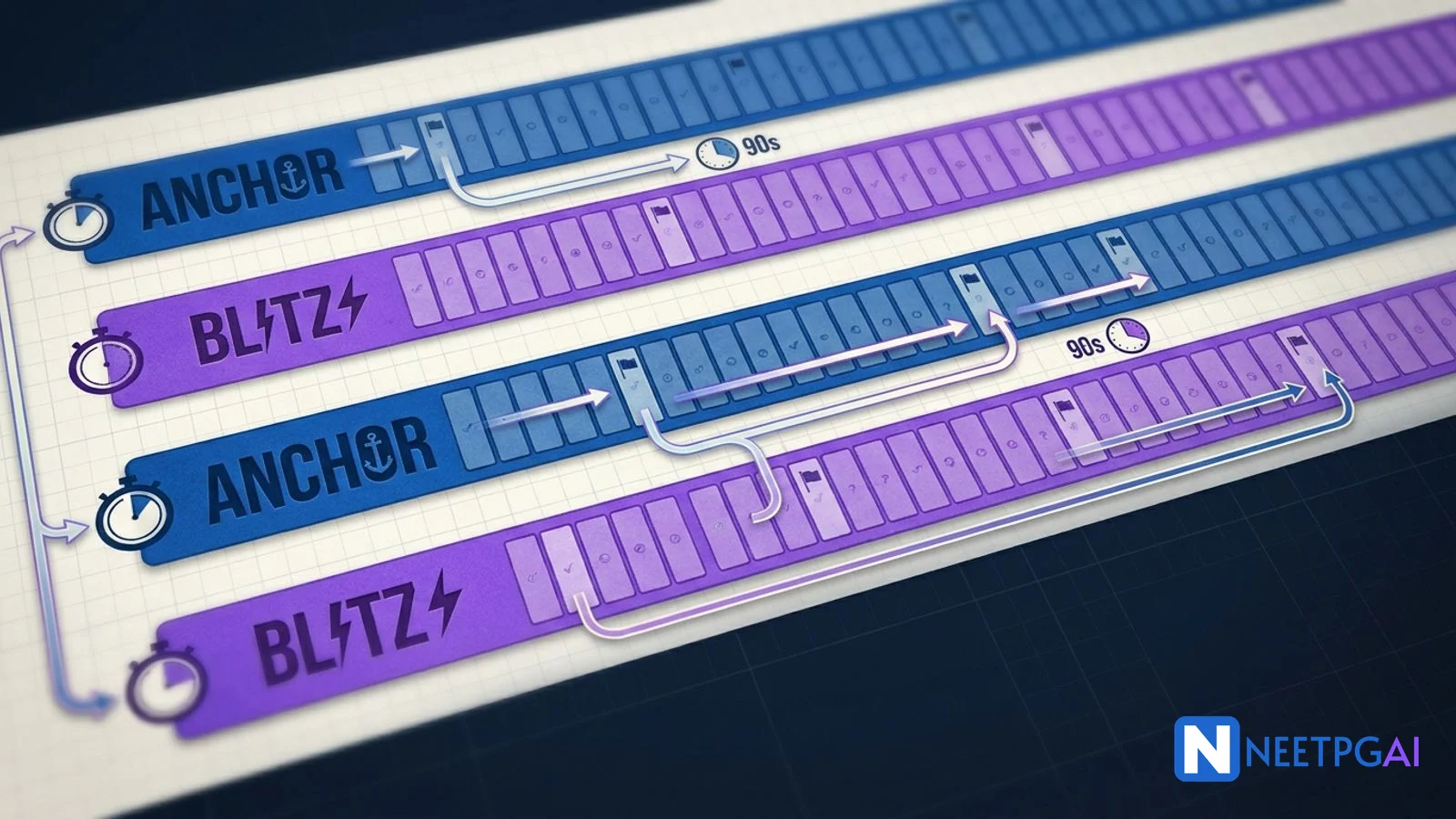
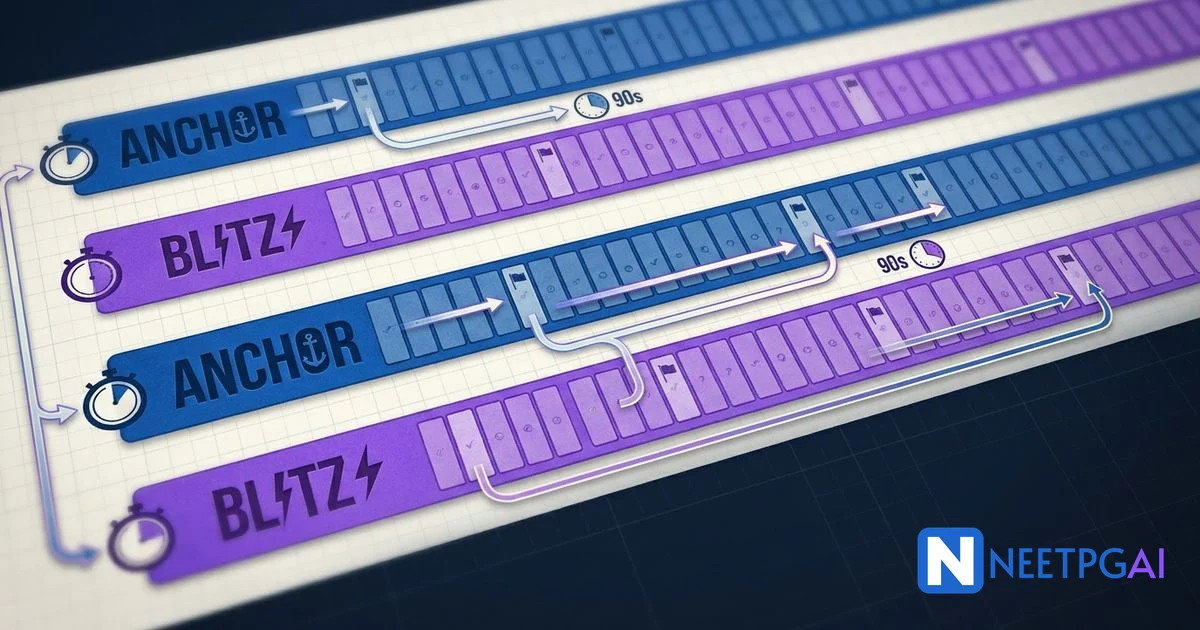
q: "Why should I blitz through ortho and ophthal but anchor on medicine and surgery?"
a: "Minor specialities like ortho, ophthal, ENT, derm, psych, FMT and anesthesia tend to be high-yield single-concept questions on INI-CET — classic signs, named instruments, named implants, classic lesion images. The question is often answerable in 20-30 seconds if you know the content, and unknowable even in 2 minutes if you do not. The time-ROI curve is sharp: either you know it or you do not. The right strategy is to blitz through at 25-30 sec per question, mark the unknowns via Review-Mark, and move on. On the other hand, medicine, surgery, OBG and pediatrics on INI-CET feature longer clinical vignettes requiring synthesis of multiple findings. The ROI curve for these is gentler — 45-70 seconds of focused reading often converts an unknown into a solved one because the stem itself contains the clues. These are anchor sections: slow down, read all four options, let the stem guide you. The practical implication is a two-speed strategy within the paper. First pass through minor-speciality blocks at under 30 seconds per question flagging unknowns, and through major-clinical blocks at 60-70 seconds per question answering more thoroughly. Second pass uses the time saved on minor specialities to revisit flagged items. This usually gains 4-8 marks over a one-speed approach — enough to shift rank by 300-500 places in the AIIMS pool."
q: "How many questions should I flag via Review-Mark in each block and when should I return to them?"
a: "Flag ratio should be 5-10 questions per 50-question block, so 20-40 total across the paper. More than 40 flagged across 180 min is unmanageable in review time; fewer than 20 flagged usually means you are over-answering on first pass and will run short on time later. Return to flagged items in two moments. First, in the last 5 minutes of each block — this is critical because INI-CET section blocks are time-locked. Once a block ends you cannot return to it. The last 5 minutes of a 45-minute block (so from minute 40 to minute 45) is reserved exclusively for revisiting flagged items of THAT block only. Do not use these 5 minutes for new questions in the next block. Second, if you finish a block ahead of time (rare but possible on easier blocks like Block 2), use that buffer to review flagged items of the current block more carefully — but only within that block's time. Rule of thumb for returning: if your gut points to one option in 20 seconds on second look, go with it. If you remain genuinely 50-50 after 60 seconds of second look, pick the one you leaned toward originally — second-guessing on second look typically drops accuracy. Mark the one you lean toward and move. On INI-CET MD/MS with -1/3 marking, every flagged item deserves a final answer — leaving blank is almost never optimal."
Share this article
Ready to put this into practice?
Start practicing NEET PG MCQs with AI-powered explanations.
q: "What is a trap question on INI-CET and how do I identify it in real time?"
a: "A trap question has one option that looks obviously correct within 10 seconds of reading the stem — but the correct answer is actually a different, less-obvious option that fits a specific detail in the stem. AIIMS examiners are famous for building these. Three identification signals in real time. Signal one: your gut answer is obvious within 5 seconds. Instead of marking fast, read the stem a second time. Specifically read for negatives (not, except, least, most unlikely), modifiers (acute vs chronic, mild vs severe, recent vs long-standing), and numeric values (age, duration, specific lab cutoffs). The trap option usually ignores one of these details. Signal two: two options look equally correct — one broad classical, one specific to the stem. Trap questions often pair a textbook-classic answer with a stem-specific answer, and the stem-specific is correct. Signal three: an option contains a buzzword from the first line of the stem. The buzzword may be a distractor planted to lead you away from the real diagnosis. Example: stem opens with a patient flying frequently and the obvious answer is pulmonary embolism, but the stem's clinical details (sudden dyspnea with tympanic chest, deviated trachea) actually describe pneumothorax. The flying detail is a buzzword plant. Three defenses against traps: slow down on the second reading, scan all four options, pick the one that explains ALL stem details not just one. The habit of pattern-matching to a buzzword is efficient for 80 percent of questions but costly for the 20 percent of trap questions on INI-CET."
q: "How does section time management differ between INI-CET and NEET PG under the 2026 revised pattern?"
a: "NEET PG under the 2026 revised pattern is 180 Q / 720 marks / 210 min in 5 locked sections of 36 Q and 42 min each. Each section locks permanently when its timer expires. INI-CET is 200 Q / 180 min in 4 locked blocks of 50 Q and 45 min each. Three differences matter. First, question count per section: 36 Q (NEET PG) vs 50 Q (INI-CET). This means NEET PG section locking happens 5 times with smaller recovery per section, while INI-CET locks 4 times with larger per-section stakes. Running out of time on an INI-CET block costs more because 50 Q are gone, not 36 Q. Second, time per question average: 70 sec (NEET PG, +4/-1 math) vs 54 sec (INI-CET, +1/-1/3 math). Faster paper, friendlier marking. Third, section ordering: on both exams the subject distribution within each section is random (not grouped by subject). This means a mock-practice habit of "I know I will see medicine in Section 1" is wrong on both. Train for a mixed-subject random-order experience in both. Practical implication: Train NEET PG mocks at 42-min sectional pace with 36 Q blocks; train INI-CET mocks at 45-min block pace with 50 Q blocks. Do not interchange the pacing training — the different per-question time and the different per-section stakes require different reflexes. The one shared principle is review-mark discipline: last 5 min of every section or block is for flagged items only."
q: "If I finish a block early, should I move to the next block or review flagged items?"
a: "On INI-CET, you CANNOT move to the next block until the current block's timer expires or you explicitly submit the block. If your center uses computer-based testing with block locking, the system holds you in the current block for the full 45 minutes. If finishing early (rare on INI-CET first pass, more common on Block 2 or Block 4 for strong candidates), use the remaining time to review flagged items of the current block. Priority order for review time: (1) items flagged via Review-Mark where you had a gut lean; (2) items where you can now eliminate 2 of 4 options with fresh eyes; (3) items where you can eliminate 1 of 4 and the attempt is net-positive under -1/3 math. Do NOT change confidence-driven correct answers. A classical trap is to feel uneasy about a confident answer in review and change it to a doubt-driven one — accuracy drops 10-15 percent on such changes. Rule of thumb: only change an answer if you can articulate a new reason you did not have on first pass. If the only reason is a general uneasy feeling, keep the original answer. If you have truly answered all 50 to full confidence and all flagged items have been resolved, use the remaining time for a deep breath, posture reset, and water sip — do not force an action. The best candidates sometimes finish Block 2 or Block 4 with 2-3 minutes of calm sit-time. That rest translates into sharper performance in the next block."
Version 1.0 — Published October 2026
Quick Answer
INI-CET: 200 Q in 180 min across 4 locked blocks of 50 Q / 45 min each. Average 54 sec per question. Blitz minor specialities (ortho, ophthal, ENT, derm, psych, FMT) at 25-30 sec per Q — single-concept recall. Anchor on medicine, surgery, OBG, pediatrics at 60-70 sec per Q — clinical vignette synthesis. Flag 5-10 items per block. Last 5 min of each block = review flagged items of that block only. Fill all 200 answers.
Why This Matters for NEET PG & INI-CET
INI-CET is won in the final 10 marks. The gap between an AIIMS New Delhi seat and a tier-3 INI seat is often fewer than 15 marks. In those 15 marks, 8-12 come from pure content knowledge, and 3-7 come from how you spent your time inside the hall. A disciplined section strategy adds those 3-7 marks for free, without any extra content revision.
The core principle is that INI-CET subjects are NOT equal in time ROI. Minor specialities reward speed; major clinical subjects reward depth. Treating them as equal costs you both ways — you either rush medicine and lose marks on vignette synthesis, or you overthink dermatology and run out of time on recent-advances in medicine.
This article maps the time ROI of each subject, gives you a per-block pacing plan, and tells you how to handle trap questions, flag-and-return discipline, and the moment-by-moment reset tactics that top AIIMS rankers use.
INI-CET Structure in One Table
Parameter
Value
Total questions
200
Total time
180 min
Number of blocks
4
Questions per block
50
Time per block
45 min
Average time per Q
54 sec
Block locking
At end of 45 min, cannot return
Marking (MD/MS)
+1 right, -1/3 wrong
Marking (MDS)
+1 right, -1/5 wrong
Guess break-even (MD/MS)
1 in 4
INI-CET section ordering is NOT subject-grouped. Each block contains a mix of subjects. You do not know in advance which block holds pediatrics or which holds pharmacology. The strategy is therefore subject-type-based, not block-number-based.
The Blitz-vs-Anchor Framework
Blitz subjects (25-35 sec per Q)
Subject
Why blitz
Classical items
Orthopedics
Image recognition heavy — classical fractures, implants
These subjects together contribute 40-55 marks on INI-CET. Blitz them in 25-35 sec per Q. If you do not know the answer in 30 sec, flag and move. The marginal gain of 60 extra seconds on an unknown dermatology question is low; the opportunity cost of those 60 seconds elsewhere is high.
Anchor subjects (60-70 sec per Q)
Subject
Why anchor
Vignette elements
Medicine
Multi-step clinical reasoning
Age, HPI, labs, imaging, management
Surgery
ATLS, management, OIS grading
Trauma, hemodynamics, imaging, OR decision
OBG
Pregnancy management, labour, oncology
Gestation, risk factors, FHR, intervention
Pediatrics
Growth, development, immunization, syndromes
Age-specific, weight, Hb, dev-milestones
These subjects together contribute 85-95 marks. Anchor at 60-70 sec per Q. Read the stem twice, scan all four options, pick the one that explains ALL stem details. The marginal gain of a slower, more careful read is high — these are the vignettes that convert 20-second blanks into solved questions.
Image subjects (variable, usually 30-45 sec)
Subject
Why
Items
Pathology
Pattern recognition from histology, gross
Robbins classics
Radiology
X-ray, CT, MRI, USG
Signs, measurements
Microbiology
Gram stain, media, parasite ova
Classical slides
Image questions are either known-in-20-sec or unknown-in-2-min. Blitz unknowns, carefully answer knowns.
Minute-by-Minute Pacing Plan
Block 1 (0-45 min)
0:00-0:02 — Breathe, read instructions.
0:02-0:03 — Start Q1. If hard, flag and move within 90 sec.
0:03-0:40 — Work steadily. Target 54 sec per Q average.
HFrEF vs HFpEF, GDMT (ACEI/ARB/ARNI, BB, MRA, SGLT2)
TB
60 sec
DS vs MDR vs XDR, BPaL regimen
Diabetes
65 sec
Updates — SGLT2, GLP-1, finerenone, tirzepatide
Stroke
70 sec
Thrombolysis window, thrombectomy, imaging
Surgery — Anchor Lane
Topic
Time budget
What to synthesise
Trauma / ATLS
70 sec
Primary survey ABCDE, FAST, massive transfusion
Splenic injury
65 sec
OIS grading, operative vs non-op
Breast
60 sec
DCIS vs invasive, sentinel LN, biologicals (trastuzumab)
GI oncology
70 sec
HCC screening, pancreatic Ca workup
OBG — Anchor Lane
Topic
Time budget
What to synthesise
Hypertensive disorders
65 sec
Gestational HTN, preeclampsia, HELLP, eclampsia
Labour management
70 sec
Partograph, CTG interpretation
Oncology
65 sec
Cervical FIGO 2018, ovarian staging
MTP Act 2021
50 sec
Gestation limits, authorised persons
Pediatrics — Anchor Lane
Topic
Time budget
What to synthesise
Neonatology
70 sec
Resuscitation, surfactant, RDS
Immunization
60 sec
Schedule, new vaccines (HPV, Rota, PCV)
Nutrition
60 sec
MAM, SAM, F75/F100
Pediatric emergencies
70 sec
PALS, status epilepticus, shock
Trap Question Identification
Three signals of a trap
Gut answer within 5 seconds. Re-read for negatives (not, except, least) and modifiers.
Two options look equally correct. Pick the one that fits the stem's specific detail, not the textbook classic.
Buzzword in opening line. The buzzword is often a planted distractor. Scan the actual clinical details.
Trap example
Stem: A 28-year-old man flying frequently presents with sudden-onset dyspnea and pleuritic chest pain. On examination, trachea deviated to left, right chest hyperresonant, right breath sounds absent.
Train the blitz-vs-anchor reflex on NEETPGAI mocks. Our mock engine shows per-question timing feedback, flags where you went slow on blitz subjects and where you rushed anchor subjects, and surfaces the trap-question patterns you miss repeatedly.