Quick Answer
Malpresentation is a compulsory NEET PG obstetrics chapter — types, ECV, delivery decisions and shoulder dystocia are recurrent themes. Lock these:
- Vertex 96 percent, breech 3 to 4 percent at term; face, brow, shoulder rarer.
- Frank breech is the commonest breech (60 percent) and the safest for planned vaginal delivery.
- Footling breech — cord prolapse and head entrapment risk; absolute caesarean.
- ECV at 36 to 37 weeks — 50 to 70 percent success; give anti-D if Rh negative.
- Term Breech Trial 2000 — planned caesarean reduced perinatal mortality; now the default.
- Vaginal breech is still permitted in strictly selected cases at experienced centres.
- Mentum-anterior face — vaginal delivery possible; mentum-posterior — caesarean.
- Brow presentation — usually converts; if persistent, caesarean.
- Transverse lie — no vaginal delivery possible; ECV or caesarean.
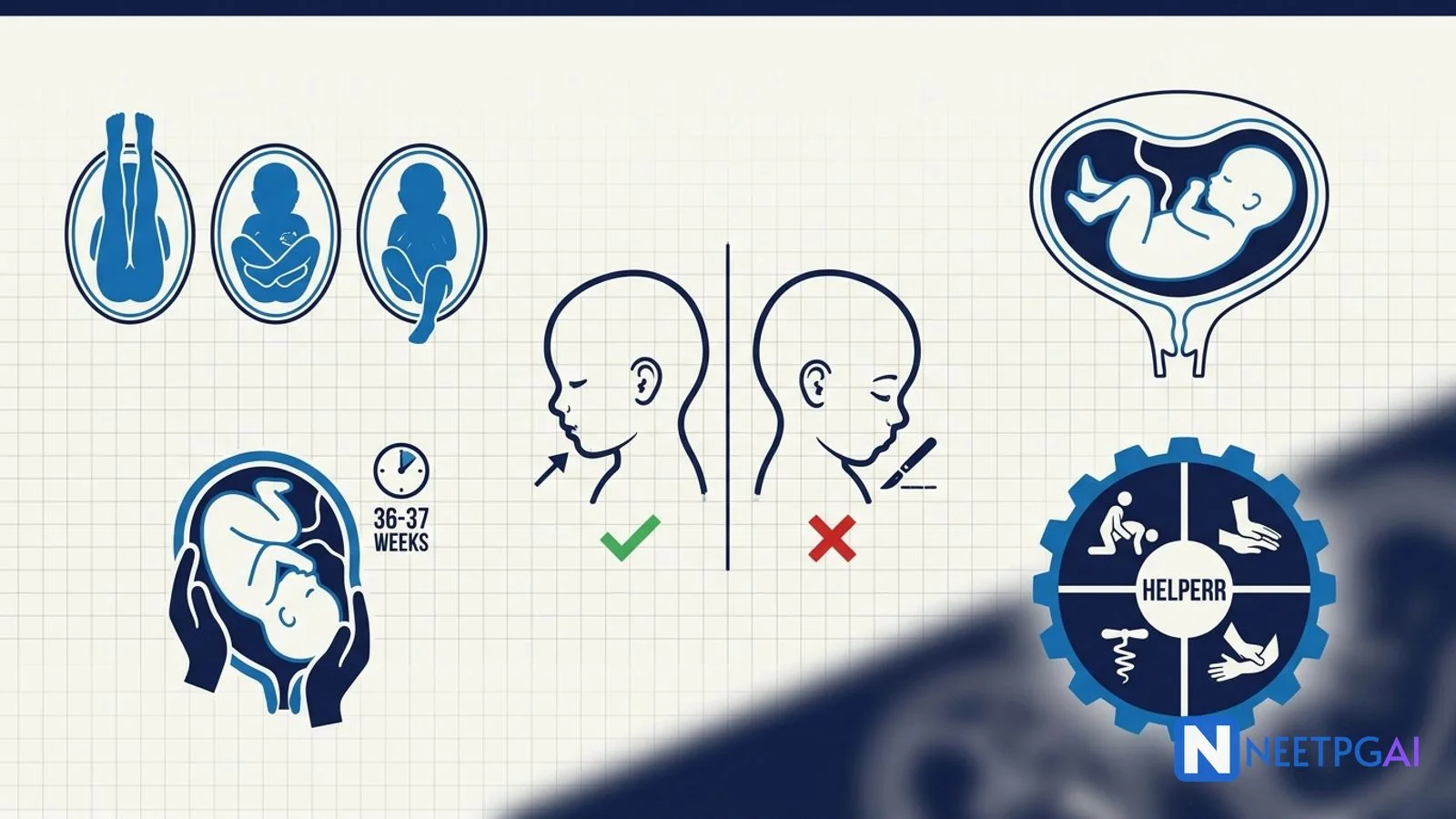
- Shoulder dystocia HELPERR — Help, Episiotomy consider, Legs (McRoberts), Pressure suprapubic, Enter manoeuvres, Remove posterior arm, Roll (Gaskin). Never fundal pressure.
Malpresentation is a compulsory read for NEET PG obstetrics — recognising breech types, timing external cephalic version, deciding delivery mode after the Term Breech Trial, and running the shoulder dystocia drill are recurrent MCQ themes. This deep dive walks through presentation types, decision-making and Indian delivery realities.
Presentation and lie at term
- Vertex — 96 percent at term; occiput leads.
- Breech — 3 to 4 percent at term; sacrum leads.
- Face — mentum leads; rare.
- Brow — bregma leads; rare, transient.
- Shoulder / transverse lie — 0.3 percent; scapula leads.
- Compound — a hand or foot beside the head.
Breech presentation
Types
- Frank breech (60 percent) — hips flexed, knees extended; feet near the head; safest for vaginal breech.
- Complete breech — hips and knees flexed; feet at the buttocks.
- Footling breech (single or double) — one or both hips extended, feet present first; poor cervical dilator; cord prolapse and head entrapment risk; absolute caesarean.
- Kneeling breech — rare variant.
Risk factors
- Prematurity (the fetus has not yet rotated to vertex).
- Uterine anomalies (bicornuate, septate).
- Placenta praevia.
- Fibroids and pelvic mass.
- Polyhydramnios and oligohydramnios.
- Short umbilical cord.
- Fetal anomalies (hydrocephalus, anencephaly, myelomeningocele).
- Multiparity.
Complications of breech delivery
- Cord prolapse.
- Head entrapment (unfused cervix, footling).
- Birth trauma (brachial plexus injury, humerus/clavicle fracture, intracranial haemorrhage).
- Hypoxic-ischaemic injury.
- Increased perinatal mortality.
External cephalic version (ECV)
- Offered at 36 to 37 weeks — earlier attempts often reverse; later attempts constrained by liquor and engagement.
- Success 50 to 70 percent; higher with multiparity, adequate liquor and non-engaged breech.
- Tocolysis with terbutaline or nifedipine improves success.
- Continuous CTG monitoring before and after; anti-D immunoglobulin for Rh-negative unsensitised women.
- Absolute contraindications — prior classical caesarean, ruptured membranes, active vaginal bleeding, placenta praevia, non-reassuring CTG, severe IUGR, multiple pregnancy (twin B), uterine anomalies, any absolute indication for caesarean.
- Complications are uncommon — placental abruption, cord accident, transient fetal bradycardia, PROM, rupture (rare), Rh isoimmunisation.
Delivery decisions after the Term Breech Trial
- Term Breech Trial (Hannah, Lancet 2000) — planned caesarean reduced perinatal mortality and short-term serious morbidity from about 5.0 percent to 1.6 percent, without increasing maternal morbidity.
- Planned caesarean became the default for term singleton breech.
- PREMODA and subsequent cohorts showed that in strictly selected pregnancies (frank or complete breech, normal fetal size, adequate maternal pelvis, experienced operator) planned vaginal breech achieved outcomes similar to caesarean.
- Modern practice — planned caesarean for most; carefully selected vaginal breech in units with expertise.
- Vaginal breech technique — Bracht for spontaneous delivery, Løvset manoeuvre for arms, Mauriceau-Smellie-Veit or Piper forceps for the after-coming head; never pull on the breech before the umbilicus, allow spontaneous descent to the scapulae.
Face presentation
- Mentum leads.
- Mentum anterior — delivery vaginally possible as the head extends further under the pubis; long labour.
- Mentum posterior — undeliverable vaginally (the fetal head cannot extend further); requires caesarean.
- Do not attempt manual conversion to vertex.
Brow presentation
- Presenting diameter is the mento-vertical (13 to 13.5 cm) which exceeds the average pelvic inlet.
- Usually transient — converts to vertex or face during labour.
- If persistent — caesarean.
Transverse lie and shoulder presentation
- No vaginal delivery is possible for a transverse lie at term — the fetal shoulder cannot descend through the pelvis.
- Back-down transverse is more amenable to ECV than back-up; a back-up lie may still fail version.
- Attempt ECV at 37 weeks or planned caesarean.
- Labour in transverse lie is an emergency — risk of arm prolapse, cord prolapse and eventually uterine rupture (Bandl ring, obstructed labour).
- Internal podalic version may be offered only for the second twin.
Cord prolapse — obstetric emergency
- Descent of cord past the presenting part after ROM.
- Diagnosed by palpating a pulsating loop of cord vaginally, seeing it at the vulva, or unexplained profound fetal bradycardia after ROM.
- Immediate actions — call for help, elevate the presenting part manually or by filling the bladder with 500 to 700 mL saline through a Foley, place the woman in knee-chest or steep Trendelenburg (or exaggerated Sims left-lateral for transfer), give tocolysis, avoid handling the exposed cord (spasm), keep it moist and warm.
- Delivery — immediate caesarean unless full dilatation and vertex permits a rapid vaginal delivery.
- Decision-to-delivery time is the single most important determinant of neonatal outcome.
Shoulder dystocia — HELPERR drill
Shoulder dystocia is the impaction of the anterior shoulder behind the pubic symphysis after delivery of the head. Hypoxic brain injury may occur within 5 to 7 minutes.
- H — Help (call for extra staff, neonatologist, anaesthetist).
- E — Evaluate for episiotomy (does not relieve the bony impaction but may create space for internal manoeuvres).
- L — Legs into McRoberts (hyperflexion of hips onto the maternal abdomen; flattens the sacrum and rotates the pubic symphysis).
- P — suprapubic Pressure (Rubin I; backward and lateral pressure on the anterior shoulder to disimpact).
- E — Enter the pelvis for internal manoeuvres — Rubin II (rotate the anterior shoulder to the oblique), Wood corkscrew (rotate the posterior shoulder anteriorly by 180 degrees).
- R — Remove the posterior arm (deliver the posterior arm along the fetal chest to reduce the shoulder-to-shoulder diameter).
- R — Roll the woman onto hands and knees (Gaskin manoeuvre; gravity and pelvic reorientation aid delivery).
- Do NOT apply fundal pressure — worsens impaction and predisposes to uterine rupture.
- Zavanelli manoeuvre (replacement of the head and emergency caesarean) is a last-resort salvage.
Risk factors and prevention
- Maternal diabetes and gestational diabetes.
- Fetal macrosomia (over 4 to 4.5 kg).
- Previous shoulder dystocia.
- Prolonged second stage and instrumental delivery.
- Post-dates pregnancy.
- Maternal obesity.
- Anticipate risk factors; document the drill; debrief the team; refer to a tertiary unit if suspected macrosomia.
Birth injuries
- Erb palsy (C5 to C6) — waiter's tip posture; most recover.
- Klumpke palsy (C8 to T1) — claw hand; rarer; poorer prognosis.
- Clavicular or humeral fracture — usually heal without sequelae.
- Hypoxic-ischaemic encephalopathy in delayed delivery.
India-specific context
- Home birth with unrecognised malpresentation — persistent challenge in remote areas; delayed transfer contributes to perinatal mortality.
- Limited experienced vaginal breech operators — post-Term-Breech-Trial skills eroded; most Indian teaching hospitals now default to caesarean for breech.
- Rising caesarean rate — the National Family Health Survey-5 recorded around 22 percent nationally with wide state variation and higher rates in the private sector; malpresentation is a legitimate indication.
- Ayushman Bharat and PMJAY cover caesarean in empanelled hospitals, improving access for emergency indications.
- Tertiary ECV availability — offered at teaching hospitals but under-utilised at the peripheral level; awareness campaigns and simulator training are expanding.
- JSY and JSSK incentives have shifted births to institutions, allowing recognition of malpresentation and timely referral.
NEET PG MCQ traps
- Commonest breech at term — frank breech (60 percent).
- Footling breech — absolute caesarean.
- Best time for ECV — 36 to 37 weeks.
- Anti-D after ECV in Rh-negative unsensitised women.
- Term Breech Trial — planned caesarean superior for short-term perinatal outcomes.
- Mentum anterior — vaginal delivery possible; mentum posterior — caesarean.
- Brow presentation — presenting diameter mento-vertical, usually converts.
- Transverse lie in labour — emergency caesarean; risk of Bandl ring and rupture.
- Cord prolapse — bladder fill, knee-chest, immediate caesarean.
- Do not handle exposed cord — causes vasospasm.
- Shoulder dystocia — HELPERR; never fundal pressure.
- McRoberts + suprapubic pressure resolves 40 to 60 percent of shoulder dystocias.
- Erb palsy — C5 to C6, waiter's tip posture.
- Klumpke palsy — C8 to T1, claw hand.
- Løvset manoeuvre — extraction of extended fetal arms in vaginal breech.
- Piper forceps — for the after-coming head.
- Zavanelli manoeuvre — replacement of head and emergency caesarean; last resort in intractable shoulder dystocia.
- Bandl ring — pathological retraction ring in obstructed labour, precedes rupture.
- Prematurity — commonest cause of breech.
- Half of shoulder dystocias occur without any predictable risk factor — universal drill training.
Frequently asked questions
What are the three types of breech presentation and how do they differ in delivery risk?
Frank breech (about 60 percent of term breech) — hips flexed, knees extended so both feet are near the head; the buttocks and thighs form a smooth wedge that dilates the cervix effectively and is the safest for planned vaginal breech delivery. Complete breech — hips and knees flexed, feet at the level of the buttocks; the presenting part is less regular but still dilates the cervix reasonably. Footling breech (single or double) — one or both hips extended so the feet present first; the poorly-fitting presenting part fails to dilate the cervix fully, allowing the arms and after-coming head to enter a partially-dilated cervix — head entrapment and cord prolapse are common, and footling breech is an absolute indication for caesarean. Kneeling breech is a rare variant. Risk factors for breech include prematurity, uterine anomalies (bicornuate, septate), placenta praevia, fibroids, polyhydramnios and oligohydramnios, short cord, and fetal anomalies (hydrocephalus, anencephaly, myelomeningocele).
What is external cephalic version (ECV), when is it done, and what are its contraindications?
ECV is a manual manoeuvre performed at or after 36 to 37 weeks to convert a breech or transverse fetus to cephalic presentation. Success rates are 50 to 70 percent; higher with multiparity, adequate liquor and unengaged breech, and lower with anterior placenta, obesity, low liquor and engaged breech. It is offered under continuous CTG monitoring, usually with tocolysis (terbutaline or nifedipine) and after informed consent. Complications are uncommon but include placental abruption, cord accident, transient fetal bradycardia, PROM, uterine rupture (rare), and Rh isoimmunisation — anti-D immunoglobulin should be given to Rh-negative unsensitised women. Absolute contraindications include prior classical caesarean or T-incision, ruptured membranes, active vaginal bleeding, placenta praevia, non-reassuring CTG, multiple pregnancy (twin B), severe IUGR, oligohydramnios, uterine anomalies preventing version, and any absolute indication for caesarean. If ECV is successful, women can labour and deliver spontaneously; if it fails, planned caesarean or a carefully selected vaginal breech delivery is the alternative.
How did the Term Breech Trial change breech delivery practice and what is the modern position?
The Term Breech Trial (Hannah et al., Lancet 2000) was a multicentre randomised trial of planned caesarean versus planned vaginal delivery for term singleton frank or complete breech. Planned caesarean was associated with a statistically and clinically important reduction in perinatal mortality and short-term serious neonatal morbidity — from about 5.0 percent in the planned vaginal group to 1.6 percent in the planned caesarean group — with no significant increase in maternal morbidity. As a result, planned caesarean became the default recommendation worldwide and vaginal breech skills eroded. Subsequent reanalysis and observational cohorts (notably the PREMODA French cohort) showed that in strictly selected pregnancies (frank or complete breech, no fetal compromise, adequate maternal pelvis, normal-sized fetus, experienced operator) planned vaginal breech delivery could achieve outcomes similar to planned caesarean. Modern guidance (RCOG, ACOG, FIGO) therefore permits carefully selected vaginal breech delivery in units with the necessary expertise while recognising that most breeches at term are delivered by planned caesarean. The vaginal breech technique includes Bracht, Løvset for the arms, and Mauriceau-Smellie-Veit or Piper forceps for the after-coming head.
What is the HELPERR mnemonic and why is shoulder dystocia a life-threatening obstetric emergency?
Shoulder dystocia occurs when the anterior fetal shoulder becomes impacted behind the maternal pubic symphysis after delivery of the head, and gentle downward traction fails to deliver the shoulders. The neonate is at risk of hypoxic brain injury within 5 to 7 minutes because compression of the cord and chest impairs oxygen delivery and prevents lung expansion. Other risks include brachial plexus injury (Erb palsy from C5 to C6 stretch — waiter's tip posture), clavicular or humeral fracture, PPH and third or fourth degree perineal laceration. HELPERR is a stepwise drill — Help (call for extra staff, neonatologist), Evaluate for episiotomy (does not itself relieve the dystocia but may aid manoeuvres), Legs into McRoberts position (hyperflexion of the hips onto the maternal abdomen flattens the sacral promontory and rotates the pubic symphysis), suprapubic Pressure (Rubin I — direct backward pressure on the anterior shoulder), Enter the pelvis for internal manoeuvres (Rubin II rotates the anterior shoulder to the oblique, Wood corkscrew rotates the posterior shoulder), Remove the posterior arm, and finally Roll the woman to hands and knees (Gaskin manoeuvre). Fundal pressure is contraindicated — it worsens impaction and predisposes to uterine rupture. Risk factors are macrosomia, gestational diabetes, previous shoulder dystocia, prolonged second stage and instrumental delivery, but half of shoulder dystocias occur without any risk factor — every attendant must know the drill.
How is cord prolapse recognised and what is the emergency management pathway?
Cord prolapse is the descent of the umbilical cord past the presenting part after rupture of membranes, so the cord lies in the vagina or protrudes at the introitus. It is an obstetric emergency because compression between the presenting part and the bony pelvis causes fetal hypoxia within minutes. Diagnosis is by feeling a pulsating loop of cord on vaginal examination after ROM, or by seeing it at the vulva, or by unexplained profound fetal bradycardia after ROM. Risk factors include malpresentation (footling breech, transverse lie), high or unengaged head, polyhydramnios, prematurity, multiple pregnancy (second twin), long cord and iatrogenic ROM in an unengaged fetus. Management is immediate — call for help, elevate the presenting part manually or by filling the bladder with 500 to 700 mL of saline through a Foley to lift the head off the cord, place the woman in knee-chest or steep Trendelenburg (or exaggerated Sims left-lateral for transfer), give tocolysis (terbutaline) if delivery is not imminent, avoid handling the exposed cord (spasm) but keep it moist and warm, and proceed to immediate caesarean unless full dilatation and vertex allows a rapid vaginal delivery. Rapid decision-to-delivery time is the single most important determinant of neonatal outcome.
This content is for educational purposes for NEET PG exam preparation. It is not a substitute for professional medical advice, diagnosis, or treatment. Clinical information has been reviewed by qualified medical professionals.
Written by: NEETPGAI Editorial Team
Reviewed by: Pending SME Review
Last reviewed: September 2026