Quick Answer
Lipoprotein metabolism is where biochemistry meets cardiology — a NEET PG favourite.
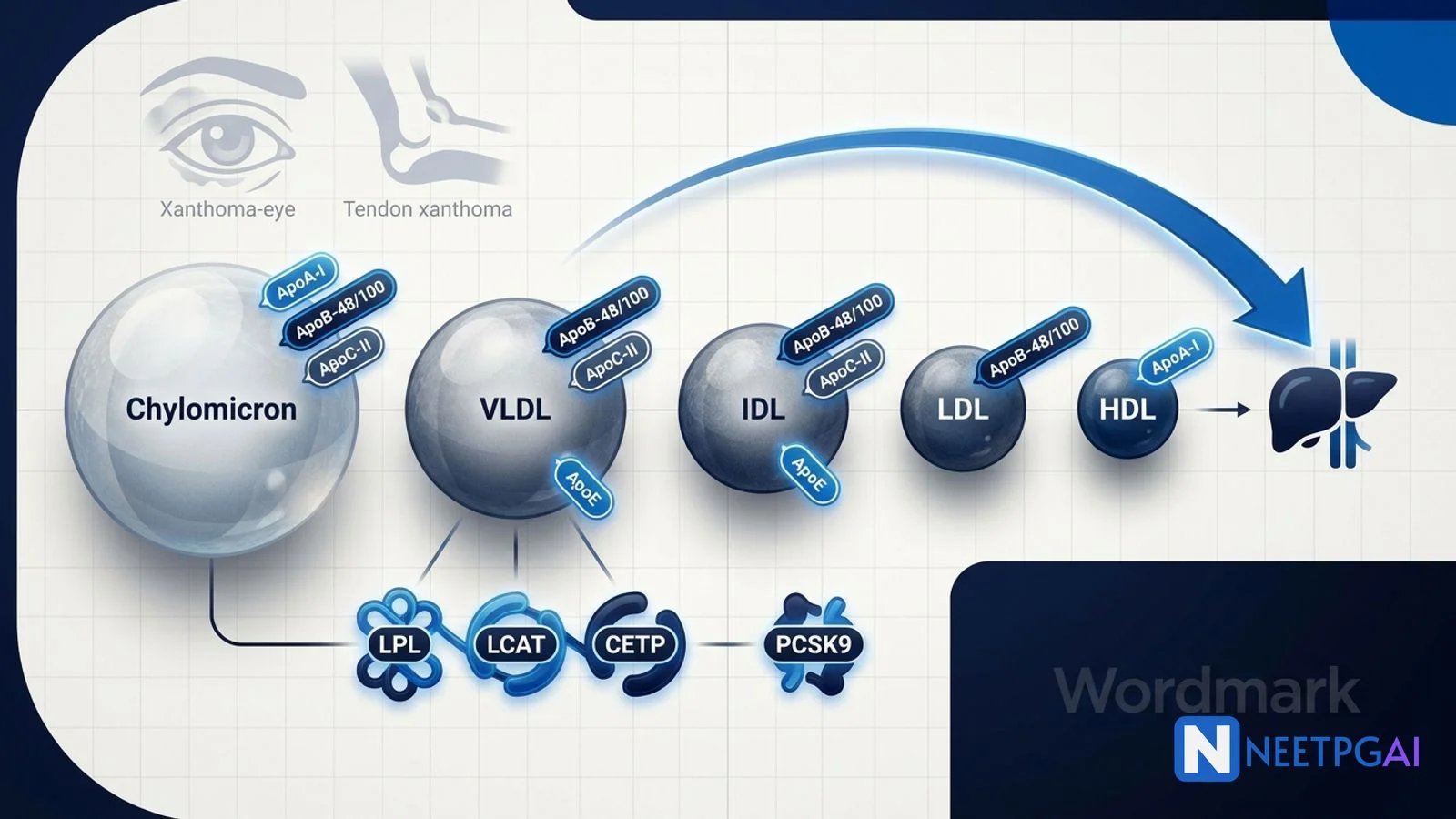
- Lipoprotein classes — chylomicrons (largest, least dense, dietary), VLDL (hepatic TG), IDL, LDL (peripheral cholesterol delivery), HDL (reverse transport).
- Apolipoproteins — ApoA-I (HDL, LCAT activator), ApoB-48 (chylomicrons), ApoB-100 (VLDL/LDL, LDL receptor ligand), ApoC-II (LPL activator), ApoE (chylomicron remnant, IDL).
- Enzymes — LPL (endothelial TG hydrolysis, activated by ApoC-II), hepatic lipase, LCAT (HDL cholesterol esterification), CETP, PCSK9 (LDL receptor degradation).
- Frederickson types I to V — genetic dyslipidaemias; type III shows palmar-crease xanthomas.
- Familial hypercholesterolemia — autosomal codominant; tendon xanthomas; juvenile MI in homozygotes.
- Reverse cholesterol transport — HDL, ABCA1, LCAT, CETP, hepatic uptake.
- Statins — HMG-CoA reductase inhibition; upregulate LDL receptors; hepatic clearance rises.
Lipoprotein metabolism connects biochemistry to cardiology and public health — a NEET PG favourite because a single well-crafted vignette can test ApoB-48 vs ApoB-100, LPL deficiency, statin mechanism and the Indian phenotype. Given India's leading position in premature coronary disease, this topic keeps expanding.
This NEETPGAI deep dive covers the five lipoprotein classes, the apolipoprotein alphabet, the Frederickson genetic dyslipidaemias, reverse cholesterol transport and statin pharmacology. Pair it with the nucleotide metabolism guide for the other high-yield biochemistry pillar.
Lipoprotein classes
Lipoproteins solubilise hydrophobic lipids (triglyceride, cholesterol, cholesterol ester) in aqueous plasma. They are classified by density (which reflects lipid-to-protein ratio).
| Class | Density | Origin | Main lipid | Key apoproteins |
|---|
| Chylomicron | Lowest (largest) | Intestine | Dietary TG | ApoB-48, ApoA-I, ApoC-II, ApoE |
| VLDL | Very low | Liver | Endogenous TG | ApoB-100, ApoC-II, ApoE |
| IDL | Intermediate | VLDL remnant | TG + cholesterol | ApoB-100, ApoE |
| LDL | Low | IDL | Cholesterol ester | ApoB-100 |
| HDL | High (smallest) | Liver, intestine | Cholesterol ester | ApoA-I, ApoA-II, ApoC, ApoE |
Size — decreases from chylomicron (largest) to HDL (smallest). Density rises in the opposite direction. Higher lipid content = lower density = larger particle.
Apolipoproteins — the alphabet you must know
| Apo | Site | Function |
|---|
| A-I | HDL, chylomicron | Structural HDL; LCAT activator |
| A-II | HDL | Structural HDL |
| B-48 | Chylomicron | Intestinal structural; from edited mRNA |
| B-100 | VLDL, IDL, LDL | Hepatic structural; LDL-receptor ligand |
| C-II | Chylomicron, VLDL, HDL | Activates lipoprotein lipase (LPL) |
| C-III | VLDL, chylomicron, HDL | Inhibits LPL |
| E | Chylomicron remnant, IDL, VLDL | Ligand for hepatic remnant receptor (LRP) and LDL receptor |
ApoE isoforms — E2, E3, E4. E3 is the most common and normal. Homozygous E2/E2 (about 1 percent) has poor hepatic remnant clearance and can cause Type III dysbetalipoproteinemia. E4 is a strong risk factor for late-onset Alzheimer disease and modestly raises coronary risk.
Enzymes and receptors
Lipoprotein lipase (LPL) — endothelial capillary-bed enzyme (adipose, muscle, cardiac); hydrolyses TG in chylomicrons and VLDL to free fatty acids and glycerol. Activated by ApoC-II. Deficiency (or ApoC-II deficiency) produces chylomicronaemia (Frederickson type I) with eruptive xanthomas, lipaemia retinalis and recurrent pancreatitis.
Hepatic lipase (HL) — hepatic sinusoids; hydrolyses TG in IDL to form LDL; also acts on HDL.
LCAT (lecithin-cholesterol acyltransferase) — plasma enzyme activated by ApoA-I; esterifies free cholesterol on nascent (discoid) HDL to cholesterol ester (which moves into the particle core, converting HDL to mature spherical form). LCAT deficiency causes fish-eye disease (corneal opacity) or classical LCAT deficiency (proteinuria, renal failure).
CETP (cholesterol ester transfer protein) — plasma; transfers cholesterol esters from HDL to VLDL and LDL in exchange for triglycerides. Genetic CETP deficiency raises HDL markedly.
PCSK9 (proprotein convertase subtilisin/kexin type 9) — binds hepatic LDL receptor and targets it for lysosomal degradation. Gain-of-function mutations cause familial hypercholesterolaemia; loss-of-function variants lower LDL and coronary risk. Monoclonal antibodies (evolocumab, alirocumab) inhibit PCSK9 and dramatically lower LDL.
LDL receptor — hepatocyte surface; recognises ApoB-100 and ApoE. Endocytoses circulating LDL. Mutations cause familial hypercholesterolaemia (Type IIa). Statins upregulate LDL-R by depleting intracellular cholesterol.
LRP (LDL-receptor-related protein) — hepatic remnant receptor; recognises ApoE.
SR-B1 (scavenger receptor B1) — hepatic; selective uptake of HDL cholesterol ester without whole-particle degradation.
Lipoprotein trafficking — the two loops
Exogenous (dietary) loop — Small intestine absorbs dietary fat, packages TG plus cholesterol into chylomicrons with ApoB-48; secreted into lymph via lacteals; enters circulation via thoracic duct. Chylomicrons acquire ApoC-II and ApoE from HDL. LPL hydrolyses TG at peripheral capillaries; released FA go into adipose (storage) or muscle (oxidation). The depleted chylomicron remnant returns ApoC-II to HDL and is cleared by hepatic LRP (via ApoE).
Endogenous (hepatic) loop — Liver synthesises TG plus cholesterol and secretes VLDL with ApoB-100. VLDL acquires ApoC-II and ApoE from HDL. LPL hydrolyses VLDL TG, producing IDL. IDL is either taken up by liver (via ApoE-LRP) or further converted by hepatic lipase to LDL (lost ApoE and ApoC-II en route). LDL delivers cholesterol to peripheral tissues via LDL receptor and is cleared predominantly by hepatic LDL receptor.
Reverse cholesterol transport (HDL loop) — Nascent (discoid) HDL from liver and intestine picks up free cholesterol from macrophages, foam cells and peripheral tissues via ABCA1 (and from mature macrophages via ABCG1). LCAT esterifies the collected cholesterol. Mature spherical HDL delivers cholesterol back to liver via SR-B1 (selective uptake) or via CETP exchange with VLDL/LDL, which then return to liver via LDL receptor. Hepatic cholesterol is excreted as bile acids or free cholesterol into bile.
Frederickson classification (genetic dyslipidaemias)
| Type | Elevated | Cause | Presentation |
|---|
| I | Chylomicrons | LPL or ApoC-II deficiency | Eruptive xanthomas, lipaemia retinalis, pancreatitis; no premature CAD |
| IIa | LDL | LDL receptor mutation (FH) | Tendon xanthomas, corneal arcus, premature CAD |
| IIb | LDL + VLDL | Familial combined hyperlipidaemia | Very common; mixed dyslipidaemia; premature CAD |
| III | IDL, chylomicron remnants | ApoE2/E2 dysbetalipoproteinemia | Tuberoeruptive xanthomas, palmar-crease xanthomas (pathognomonic), premature CAD |
| IV | VLDL | Familial hypertriglyceridaemia | Obesity, insulin resistance; may progress to type V |
| V | Chylomicrons + VLDL | Mixed | Eruptive xanthomas, pancreatitis, premature CAD |
Palmar-crease xanthomas (xanthoma striatum palmare) are pathognomonic for type III (dysbetalipoproteinemia, ApoE2/E2) — a favourite NEET PG image question.
Familial hypercholesterolaemia (FH)
Autosomal codominant. Most cases from LDL receptor mutations; smaller fraction from ApoB defects (familial defective ApoB) and PCSK9 gain-of-function.
- Heterozygous FH — 1 in 250 to 500 in most populations; LDL 190 to 400 mg/dL; tendon xanthomas (Achilles, extensor digitorum), corneal arcus, premature CAD (fourth to fifth decade in men; a decade later in women).
- Homozygous FH — 1 in 250,000; LDL 400 to 1000 mg/dL; tuberoeruptive xanthomas from childhood; aortic stenosis (cholesterol deposition on valve); MI as early as the second decade.
Treatment — high-intensity statin (atorvastatin 40 to 80 mg, rosuvastatin 20 to 40 mg) plus ezetimibe plus PCSK9 inhibitor (evolocumab, alirocumab); LDL apheresis or evinacumab (anti-ANGPTL3) for homozygous FH; screen and treat family members (cascade screening); lifestyle changes are adjunctive but never enough alone.
Simon Broome and Dutch Lipid Clinic Network criteria — clinical scoring for FH diagnosis integrating LDL, family history, tendon xanthomas and genetic testing.
Statin pharmacology
Statins competitively inhibit HMG-CoA reductase, the rate-limiting enzyme of the mevalonate pathway (cholesterol synthesis). Depletion of intracellular cholesterol upregulates hepatic LDL receptors, driving increased clearance of circulating LDL.
Intensity classes — high (atorvastatin 40 to 80 mg, rosuvastatin 20 to 40 mg) lowers LDL by 50 percent or more; moderate (atorvastatin 10 to 20 mg, rosuvastatin 5 to 10 mg, simvastatin 20 to 40 mg, pravastatin 40 to 80 mg) lowers by 30 to 50 percent; low intensity is now rarely used.
Side effects — myalgia (5 to 15 percent), rare rhabdomyolysis (highest with simvastatin plus cyclosporine, gemfibrozil, macrolides, azole antifungals), transaminase elevation (usually mild; monitor if symptomatic), new-onset diabetes (small absolute risk offset by CV benefit), rare immune-mediated necrotising myopathy with anti-HMGCR antibodies. Pravastatin and rosuvastatin have less CYP3A4 interaction.
Guideline positioning — universal in secondary prevention post-ACS; primary prevention guided by 10-year ASCVD risk estimator (with Indian/South Asian adjustments); ezetimibe added if LDL target not met; PCSK9 inhibitor next; bempedoic acid and inclisiran (siRNA) newer options.
NEET PG MCQ traps
- Chylomicron ApoB-48 — intestinal; edited mRNA.
- LDL/VLDL ApoB-100 — hepatic; LDL receptor ligand.
- ApoC-II — activates LPL.
- ApoE — remnant clearance; E2/E2 = type III.
- LPL deficiency — chylomicronaemia (type I); recurrent pancreatitis.
- LCAT — activated by ApoA-I; esterifies HDL cholesterol.
- CETP — HDL cholesterol ester to VLDL/LDL exchange.
- PCSK9 — degrades LDL receptor; monoclonal inhibitors lower LDL.
- Palmar-crease xanthomas — type III (dysbetalipoproteinemia).
- Tendon xanthomas — heterozygous familial hypercholesterolaemia.
- Statin mechanism — HMG-CoA reductase inhibition; LDL receptor upregulation.
- Simvastatin plus gemfibrozil or cyclosporine — high rhabdomyolysis risk.
- Ezetimibe — inhibits intestinal cholesterol absorption (NPC1L1).
- PCSK9 inhibitors — evolocumab, alirocumab; monoclonal.
- Inclisiran — siRNA against PCSK9; twice-yearly.
- Bempedoic acid — ACL inhibitor (upstream of HMG-CoA); intolerant-of-statin option.
- Niacin — lowers TG, raises HDL; flushing (prostaglandin); use paracetamol pre-dose; failed HDL outcome trials (AIM-HIGH, HPS2-THRIVE).
- Fibrates — PPAR-alpha agonists; TG lowering; myopathy risk with statins.
- Omega-3 (EPA) — icosapent ethyl (REDUCE-IT) reduces CV events in patients with elevated TG.
- Homozygous FH — LDL apheresis; consider evinacumab (anti-ANGPTL3).
India-specific context
- Small dense LDL phenotype — South Asian pattern; higher atherogenicity at lower LDL numbers.
- Premature CAD — Indians experience MI approximately a decade earlier than European populations; INTERHEART data.
- Lipoprotein(a) elevation — common in Indians; not routinely tested but a real risk contributor.
- BMI cut-offs — Indian guidelines use overweight over 23 and obese over 25 (vs 25 and 30 in Western guidelines).
- PMJAY coverage — statins widely available; PCSK9 inhibitors and inclisiran remain out-of-pocket and largely unaffordable at population scale.
- Cascade screening for FH — India Familial Hypercholesterolaemia Registry launched to address under-diagnosis; only a small fraction of estimated FH cases are identified nationally.
Frequently asked questions
What is the difference between ApoB-48 and ApoB-100?
ApoB-48 and ApoB-100 arise from the same gene through post-transcriptional RNA editing. ApoB-48 is made only in the intestine (from an edited mRNA that stops at 48 percent of the full length) and is the structural apoprotein of chylomicrons carrying dietary lipids. ApoB-100 is made in the liver (unedited mRNA), forms the structural backbone of VLDL, IDL and LDL, and is the ligand for the LDL receptor mediating hepatic clearance.
How does familial hypercholesterolemia present and how is it treated?
Familial hypercholesterolemia (FH) is autosomal codominant, most commonly from LDL receptor mutations (also ApoB defects, PCSK9 gain-of-function). Heterozygous FH (1 in 250 to 500) causes markedly raised LDL, tendon xanthomas, corneal arcus and premature coronary disease in the fourth or fifth decade. Homozygous FH (1 in 250,000) presents in childhood with severe hypercholesterolaemia, tuberoeruptive xanthomas, aortic stenosis and MI as early as the second decade. Treat with high-intensity statin plus ezetimibe plus PCSK9 inhibitor; LDL apheresis for homozygous. Cascade-screen first-degree relatives.
What is reverse cholesterol transport and which molecules drive it?
Reverse cholesterol transport is the pathway that returns excess peripheral cholesterol to the liver for biliary excretion. Nascent HDL (ApoA-I) picks up cholesterol from macrophages and peripheral cells via the ABCA1 transporter. LCAT (activated by ApoA-I) esterifies free cholesterol, driving it into the HDL core. CETP transfers cholesterol esters to VLDL and LDL in exchange for triglycerides; hepatic uptake via SR-B1 (selective uptake) and LDL receptor completes the loop. Higher HDL-cholesterol is generally protective, though HDL-raising drugs like niacin and CETP inhibitors have not delivered outcome benefits.
How do statins work and what are their major side effects?
Statins competitively inhibit HMG-CoA reductase, the rate-limiting step of hepatic cholesterol synthesis. Depletion of intracellular cholesterol upregulates LDL receptors, increasing hepatic clearance of circulating LDL. Side effects include myalgia (5 to 15 percent), rare rhabdomyolysis (highest with simvastatin plus cyclosporine or gemfibrozil), transaminase elevation (usually mild), new-onset diabetes (small absolute risk), and rare immune-mediated necrotising myopathy with anti-HMGCR antibodies. Rosuvastatin and atorvastatin are the highest-intensity options.
Why is the Indian phenotype at higher cardiovascular risk at lower BMI?
South Asians have a characteristic 'small dense LDL' phenotype with high triglycerides, low HDL and disproportionate visceral adiposity even at BMI below Western obesity thresholds. Small dense LDL is more atherogenic (longer plasma residence, easier oxidation, higher arterial-wall uptake). Combined with high lipoprotein(a) levels and genetic factors, Indians face coronary events approximately a decade earlier than European populations. The INTERHEART and PROLIFIC studies confirmed these patterns and drive the lower BMI cut-offs (over 23 overweight, over 25 obese) used in Indian guidelines.
This content is for educational purposes for NEET PG exam preparation. It is not a substitute for professional medical advice, diagnosis, or treatment. Clinical information has been reviewed by qualified medical professionals.
Written by: NEETPGAI Editorial Team
Reviewed by: Pending SME Review
Last reviewed: September 2026