Quick Answer
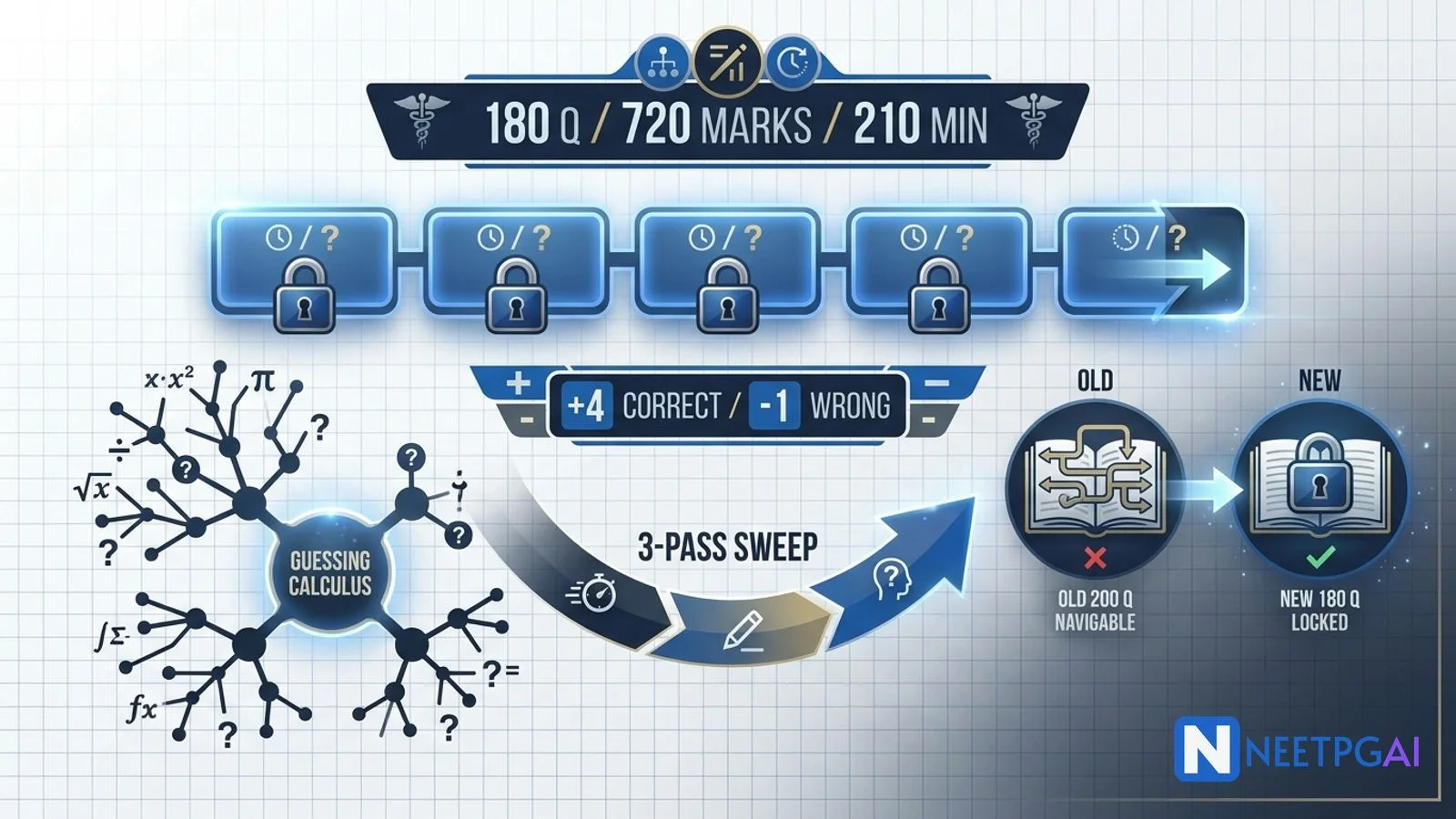
NEET PG 2026 has moved to a 5-section format — 180 MCQs across 5 non-transferable sections of 36 questions and 42 minutes each, +4 correct, −1 wrong, 210 minutes total, 720 max marks, NBEMS-conducted, ranked. Every section permanently locks when its 42-minute timer expires. This is a structural change — old strategies from the 200-MCQ single-block era break here. The essentials:
- Section lock — each 42-minute block permanently closes at the timer; no returning; no time carryover; Mark for Review is section-scoped
- Per-question budget — 70 seconds average per question; tighter than it sounds because images and long vignettes eat 90-120 seconds each
- Section-by-section pacing template — 30-second scan, minutes 0-27 confidence pass, 27-37 return pass, 37-40 guess pass, 40-42 final review
- Guessing calculus — +4/−1 means blind guess has +0.25 EV, 1-option elimination +0.67 EV, 2-option elimination +1.5 EV — never leave blank if you can see the options
- Cannot bank time — finishing Section 1 in 30 minutes does NOT give you 54 minutes for Section 2; the leftover 12 minutes are lost
- Reset between sections — 5-second deep breath at each transition; do not carry a bad section into the next
- Mock training must be section-locked — a mock that lets you revisit all 180 questions at the end trains a habit that fails on exam day
- Historical cutoffs — 350/800 pre-2026 renormalises to approximately 315/720 (50 percent); keep old references intact but reset your absolute-marks intuition to the new scale
Every serious 2026-year aspirant should switch to a section-lock training regime by Month −3 and treat the exam as 5 mini-exams rather than one long block.
The 2026 format change — what NBEMS actually changed
NEET PG 2026 marks the first major structural revision to the exam pattern since NBEMS took over. The pre-2026 format was straightforward — 200 MCQs, 800 marks, 3.5 hours, single continuous block, full navigation freedom across all questions, with Mark for Review as a global tool used at the end. The 2026 revised pattern is materially different:
| Feature | Pre-2026 | NEET PG 2026 |
|---|
| Total MCQs | 200 | 180 |
| Total marks | 800 | 720 |
| Duration | 210 minutes | 210 minutes |
| Structure | Single block | 5 sections (Groups A-E) |
| Questions per section | Not applicable | 36 |
| Time per section | Not applicable | 42 minutes |
| Section lock | No | Yes — permanent when timer expires |
| Back-navigation | Full across all 200 | Within-section only |
| Mark for Review | Global | Section-scoped |
| Marking | +4 / −1 | +4 / −1 |
| Unattempted | 0 | 0 |
| Conducted by | NBEMS | NBEMS |
| Result type | Rank list | Rank list |
The five practical consequences:
- You cannot bank time. Finishing Section 1 in 30 minutes does not carry 12 extra minutes into Section 2. Those minutes are lost.
- You cannot borrow time. A tough Section 3 cannot steal minutes from an easy Section 4.
- Mark for Review resets each section. You cannot flag Section 1 questions for review at minute 200.
- Fewer questions, lower total marks — 180/720 vs 200/800 means each mark is worth more of your final rank. A dropped mark hurts more.
- The exam is 5 mini-exams. Every section is a self-contained race with a fixed budget.
Section lock — the single most important structural change
Section lock is non-negotiable. When the 42-minute timer on Section N runs out, the section permanently closes — no return, no changes, no attempting skipped questions, no using saved time to review. The next 42-minute window opens on Section N+1 and you have no path back.
Five behavioural implications every aspirant must internalise:
1. Pace deliberately per section, not per exam
Do not treat 210 minutes as a single time budget. Treat it as five 42-minute budgets. If you race through Section 1 to save time, you lose that saved time and enter Section 2 mentally fatigued from unnecessary speed.
2. Commit to answers within the section
An answer you are second-guessing in Section 3 cannot be revisited during Section 4. Make the best decision you can within the section and move on — dwelling on a Section 2 answer during Section 3 is pure destruction.
3. Use Mark for Review aggressively within the section
Section-scoped flagging is a tool, not a limitation. Flag any question that will take more than 60-90 seconds on Pass 1 and return during the Pass 2 window (minutes 27-37 of the section). Do NOT let the timer expire on a flagged question — that flagged item stays unattempted forever.
4. A slow section is permanently lost
If Section 2 has 11 unattempted questions when the timer runs out, those 11 questions score 0 and cannot be attempted at the end. Even a blind guess on all 11 would have delivered approximately +2.75 marks in expected value. Missing pace discipline directly costs marks.
5. Mental model — 5 mini-exams
Reset psychologically at each transition. Each section has its own beginning, middle, and end. Treat Section 3 as its own new exam, not the continuation of Sections 1-2.
Section blueprint — what NBEMS has and has not published
As of September 2026, NBEMS has not published the exact subject distribution per section. The safest assumption based on historical NBEMS blueprint patterns:
- Each section is a mixed 36-question set spanning basic sciences and clinical subjects
- Front sections (1-2) tend to lean basic sciences (Anatomy, Physiology, Biochemistry, Microbiology, Pathology, Pharmacology)
- Middle sections (2-4) blend basic sciences and clinical
- Later sections (4-5) lean clinical (Medicine, Surgery, OBG, Pediatrics, plus PSM and short subjects)
- 15-20 percent of the total paper is image-based (roughly 5-7 per section)
- 30-40 percent are long clinical vignettes (roughly 11-15 per section)
Do not over-plan the blueprint — NBEMS may vary section composition across shifts. Plan sections as mixed 36-question sets with the 30-second section scan at start telling you the actual mix in your section.
The section-by-section pacing template
The concrete pacing plan that works inside a 42-minute section:
Minutes 0-0.5 — the section scan (30 seconds)
- Flick through all 36 questions quickly
- Count image-based questions, long vignettes, short-recall items
- Note the rough subject spread
- Mentally set your Pass 1 pace based on the mix (heavier images and long vignettes = tighter pace on short items)
Minutes 0.5-27 — the confidence pass (Pass 1)
- Read questions in order
- Answer questions you can solve confidently in 30-45 seconds
- Flag any question that will take more than 60 seconds and move on
- Hard cap — no single question gets more than 90 seconds on Pass 1
- Target — all 36 questions either answered or flagged by minute 27
Micro-checkpoints within Pass 1:
- Minute 12 — should have finished 12 questions
- Minute 21 — should have finished 24 questions
- Minute 27 — all 36 questions either answered or flagged
If you are 2 or more questions behind at a checkpoint, accelerate on remaining short items to protect the budget.
Minutes 27-37 — the return pass (Pass 2)
- Return to flagged questions with fresh eyes
- 60-90 seconds per question
- Re-read the vignette carefully, eliminate 2 wrong options, pick the better of the remaining 2
- Even if uncertain, commit — do not re-flag
Fresh eyes on Pass 2 correctly resolve 40-60 percent of previously-flagged questions in NEETPGAI mock analytics. The mental reset alone often surfaces a keyword you missed.
Minutes 37-40 — the guess pass (Pass 3)
- Any remaining unattempted questions get an educated guess
- Apply guessing calculus — even a blind guess has +0.25 EV; a 1-option elimination has +0.67 EV
- Never leave blank if you have any elimination or topic familiarity
- Random-click if you truly have no clue AND cannot see the question
Minutes 40-42 — the final review
- Scan for miskeyed answers (accidentally clicked wrong option)
- Review any questions where your instinct now says wrong
- Do NOT change confident answers on a whim — first-answer bias is real; only change if you have specific new reasoning
Guessing calculus under +4/−1
The math on random guesses under NEET PG's marking scheme:
| Scenario | Guess accuracy | Expected value per attempt |
|---|
| Blind random guess (no elimination) | 25 percent | 0.25 × 4 + 0.75 × (−1) = +0.25 |
| Eliminate 1 option | 33 percent | 0.33 × 4 + 0.67 × (−1) = +0.67 |
| Eliminate 2 options | 50 percent | 0.5 × 4 + 0.5 × (−1) = +1.5 |
| Eliminate 3 options | 100 percent | 1.0 × 4 = +4.0 |
| Blank | Not applicable | 0 |
Practical rules:
- Never leave a question blank if you can see the options. Even a blind guess has positive expected value.
- Any elimination pushes value strongly positive. A 1-option elimination is +0.67 vs +0.25 for blind — worth doing if you have partial knowledge.
- Do not chase small edges. Spending 90 seconds to eliminate one option to move from 25 percent to 33 percent accuracy is poor time use — spend that 90 seconds on a fresh question with real potential.
- The break-even is 20 percent accuracy. You would need to be worse than a blind random guess for blank to beat guessing — essentially impossible on 4-option questions.
Practical mock training — the section-lock regime
Mocks MUST reproduce section-lock exactly. A mock that lets you navigate freely across all 180 questions at the end trains a habit that will destroy you on exam day. The transition to section-lock mocks is the single most important adjustment for the 2026 batch.
Platform check
- NEETPGAI mocks — 2026 5-section-42-min structure with section-lock enabled by default; per-question timing dashboards match the exam interface
- Marrow Grand Test — check that the 2026 mode is enabled in your account settings
- PrepLadder Rank Bank — verify the section-lock toggle
- DAMS mocks — legacy mocks may still be in the old 200-Q single-block format; skip these unless the 2026 mode is available
Any mock still using the pre-2026 UI trains the wrong habits — do not use it in the final 3 months.
Training timeline
Month −3 to −2
- 1 full 3.5-hour section-locked mock per week (Sunday morning, same slot as exam)
- 3 x 42-minute single-section drills per week (Monday, Wednesday, Friday)
- Daily 30-minute short-block drills (20 questions in 20 minutes)
- 60-90 minute post-mock timing post-mortem on the same day
Month −2 to −1
- 2 full section-locked mocks per week (Wednesday and Sunday)
- 4 single-section drills per week
- Daily short blocks continue
- Introduce subject-specific timed sets for weak subjects
Month −1 to −0
- 3 full mocks per week (Sunday, Wednesday, Saturday)
- Daily single-section drills
- Reduce to 1-2 mocks in the final week to preserve mental energy
- No new content acquisition; annotation review dominates
Between sections — the transition ritual
The 5-section format punishes emotional slippage. A bad Section 2 that bleeds into Section 3 mentally is a compounding disaster. Build a hard transition ritual:
- Timer expires — stop trying to do anything with the closing section
- Deep breath — in for 4 seconds, hold 4, out for 4 (box breathing round)
- Physical reset — roll shoulders, blink deliberately, briefly stretch fingers
- Hydrate if allowed — small sip only; avoid full stomach mid-exam
- Mental reset — "the previous section is done and unchangeable; only this new section matters now"
- Open Section N+1 with the pre-committed 30-second scan
If breaks are permitted between sections, do NOT discuss with neighbours. Social comparison mid-exam spikes anxiety. Stand up, stretch briefly, close eyes for 15 seconds, return.
Common pitfalls in the 2026 format
Pitfall 1 — training on old-format mocks
A mock with global back-navigation trains a habit that fails on exam day. Verify every mock is section-locked before starting.
Pitfall 2 — assuming review time will be available
The Section 5 final review pass is section-scoped — only Section 5 questions are reviewable. If you skipped questions in Sections 1-4, they are permanent zeros. Attempt everything within its section.
Pitfall 3 — panic when a section locks with unattempted questions
Almost every aspirant will have 1-3 unattempted questions in a section at the timer. Accept it, transition ritual, move to Section N+1. Do NOT let a bad section bleed into the next.
Pitfall 4 — over-preparing for the old format
Books, videos, and mock series published before mid-2026 may still describe the 200/800 pattern. The core content is still valid but the strategy chapters need updating — use 2026-format-specific strategy content (NEETPGAI, NBEMS official notification 2026).
Pitfall 5 — banking time from an easy section
Racing through Section 1 to build a buffer for later sections does not work — the buffer does not exist. Pace deliberately per section.
Pitfall 6 — leaving questions blank
Under +4/−1, blank has 0 expected value while a blind guess has +0.25. Never leave a question blank if you can see the options.
Pitfall 7 — Mark for Review as a stall tactic
Flag decisively — items you cannot solve within 60-90 seconds on Pass 1. Do not flag items you have already answered but are second-guessing; commit and move on.
Pitfall 8 — ignoring per-section analytics
If you have taken 10 mocks and never looked at your per-section timing or per-section accuracy, you are flying blind. Use NEETPGAI dashboards to identify which sections you consistently mis-pace or under-perform in.
India-specific — the 2026 batch context
The 2026 batch is the first to sit for the section-locked exam. NBEMS official notification 2026 confirms the pattern in its recent information bulletin. The change was announced with sufficient lead time (over 12 months) for the batch to adapt, but many candidates still practise on legacy 200-Q mock platforms that do not enforce section-lock. Verify your mock platform.
The upcoming NEXT exam integration timeline remains uncertain — as of September 2026, NEXT has not replaced NEET PG. Plan for NEET PG 2026 as your primary exam and monitor NMC / NBEMS notifications for NEXT updates.
Historical marks — how to interpret pre-2026 references
Old prep material and cutoff references use the 800-mark scale. Renormalise mentally to 720:
| Reference cutoff (800) | Percentage | Equivalent on 720 |
|---|
| 400/800 (General 50 percent) | 50 percent | 360/720 |
| 350/800 (2022 approximate General) | 43.75 percent | 315/720 |
| 300/800 (borderline) | 37.5 percent | 270/720 |
Keep old references intact when discussing pre-2026 exam years — 2022 was 400/800, not 360/720. Renormalise only for internal comparison and target-setting.
Mistakes to avoid
Mistake 1 — Practising on old-format mocks
Section-lock must be enabled on every mock. Any legacy mock trains wrong habits.
Mistake 2 — Assuming your review time will be available
Every section is a self-contained race. No end-of-exam global review.
Mistake 3 — Banking time
You cannot bank time between sections. Pace deliberately per section.
Mistake 4 — Panicking after a bad section
The 5-section format punishes catastrophising. Reset psychologically at each transition.
Mistake 5 — Leaving questions blank under +4/−1
Even a blind guess has positive expected value. Never leave blank if you can see the options.
Mistake 6 — Over-preparing for the pre-2026 pattern
Books and mocks published before mid-2026 need strategy chapters updated. Content is still valid; strategy is not.
Mistake 7 — Ignoring per-section analytics
Use NEETPGAI dashboards to identify per-section timing and accuracy patterns. Data beats intuition in the final 3 months.
How to start today
- Verify your mock platform is 2026-format — 5 sections of 36 x 42 with section-lock enabled
- Take a full section-locked mock this weekend on Sunday morning
- Do a 60-minute timing post-mortem — per-section time, per-section accuracy, dwelling questions
- Practise the pacing template on Monday's single-section drill — no exceptions on the 90-second hard cap
- Build the transition ritual — 5-second deep breath at every section end
- Track per-section metrics over 4 weeks — target consistent Pass 1 completion by minute 27 in every section
Key takeaways
- NEET PG 2026 has moved to 5 non-transferable sections of 36 questions × 42 minutes each — 180 MCQs, 720 marks, +4/−1
- Section lock means each section permanently closes at its 42-minute timer; no returning, no time carryover, no global Mark for Review
- The per-question budget is 70 seconds average, tight because images and long vignettes eat 90-120 seconds each
- The pacing template — 30-second scan, minutes 0-27 confidence pass, 27-37 return pass, 37-40 guess pass, 40-42 final review
- Guessing calculus under +4/−1 makes blind guessing positive EV — never leave blank if you can see the options
- Section transition rituals prevent one bad section from destroying the rest of the exam
- Mocks must reproduce section-lock exactly; legacy 200-Q single-block mocks train wrong habits
- Historical cutoffs (400/800) renormalise to 360/720 but keep old references intact for reference
Frequently asked questions
What is the new NEET PG 2026 exam pattern and how does it differ from previous years?
NEET PG 2026 has moved to a 5-section format — 180 MCQs delivered across 5 non-transferable sections of 36 questions and 42 minutes each, totalling 210 minutes (3 hours 30 minutes). Marking is +4 for correct, −1 for wrong, and 0 for unanswered, maximum 720 marks. The exam is conducted by NBEMS and produces a rank list. The pre-2026 pattern was 200 MCQs over 3.5 hours in a single continuous block with 800 total marks and full navigation freedom across all questions. The three material changes are — (1) section lock — each section permanently closes when its 42-minute timer expires; you cannot return to a previous section for review, changes, or unattempted questions; time not used in an early section is lost, not carried forward; (2) Mark for Review is now section-scoped — you can flag questions to return to only within the current section, not at the end of the exam; (3) fewer questions and lower total marks (180/720 vs 200/800) mean each question is worth more of your final rank, so any lost mark hurts more. Historical cutoff references (like the 2022 or 2024 General category cutoff of 350/800) should be renormalised to the new 720 scale (approximately 315/720 at 50 percent) but the historical marks remain valid for reference. NBEMS has not yet published the exact subject distribution per section as of September 2026 — plan sections as mixed clinical/basic-science 36-question sets, with the front sections leaning basic-science and later sections leaning clinical based on historical NBEMS blueprint patterns.
What does section lock mean practically and how does it change your strategy?
Section lock is the single most important structural change in NEET PG 2026 and rewires how you should approach every mock and the exam itself. When your 42 minutes on a section expires the section permanently closes — you cannot navigate back to review answers, change wrong answers, attempt questions you skipped, or use time you saved to check flagged items. Practically, this changes five things. (1) You cannot bank time — finishing Section 1 in 30 minutes does not give you 54 minutes for Section 2; the leftover 12 minutes are simply lost. Pace deliberately per section rather than racing through easy sections. (2) You must commit to answers within the section — an answer you are second-guessing in Section 3 cannot be revisited from Section 4; make the best decision now and move on. (3) Mark for Review is a section-only tool — no more end-of-exam global review pass; use flags aggressively within the 42 minutes and return before the timer runs out. (4) A slow section is permanently lost — a section where you attempted only 25 of 36 questions leaves 11 questions unattempted forever (net −0, but the +44 you could have earned from confident guesses is gone). This makes section-level pace discipline non-negotiable. (5) The mental model is 5 mini-exams rather than one long one — treat each 42-minute block as a self-contained race with its own beginning, middle, and end, and reset psychologically at each transition. The mocks you take must reproduce section-lock exactly — a mock that lets you revisit all 180 questions at the end trains a habit that will destroy you on exam day. NEETPGAI mock analytics show per-section timing patterns and identify which sections you consistently mis-pace so you can drill those specifically.
How should you allocate time within a 42-minute section and what is a good section-by-section pacing template?
The workable pacing template inside a 42-minute section — first 30 seconds for a section scan (flick through the 36 questions to count image-based, long-vignette, short-recall items and mentally set pace); minutes 0-27 for the confidence pass (answer all questions you can solve in 30-45 seconds, flag anything that will take more than 60 seconds); minutes 27-37 for the return pass on flagged questions (60-90 seconds each with fresh eyes); minutes 37-40 for the guess pass (any remaining unattempted questions get an educated guess); minutes 40-42 for the final review (scan for miskeyed answers and change only if you have specific new reasoning). Micro-checkpoints inside a section — at minute 12 you should have finished 12 questions on the confidence pass; at minute 21 you should have finished 24; at minute 27 all 36 should be either answered or flagged. If you are 2 or more questions behind at a checkpoint, accelerate — accept slightly rougher answers on remaining short-recall items to protect your time budget. Across the full exam of 5 sections — Section 1 (minutes 0-42), Section 2 (42-84), Section 3 (84-126), Section 4 (126-168), Section 5 (168-210) — do NOT relax between sections; take a 5-second micro-break (deep breath in for 4 seconds and out for 4) at each transition, hydrate briefly if allowed. Do not discuss with anyone if you have any break option — social comparison spikes anxiety mid-exam. Complete the mental reset — the section that just ended is done and unchangeable; the section that starts now is the only one you can affect.
What is the correct guessing calculus under +4/−1 marking and when should you leave blank?
The expected value math on a random 4-option MCQ with +4 correct and −1 wrong shows that guessing is almost always positive expected value. Zero elimination (blind 25 percent guess) — 0.25 × 4 + 0.75 × (−1) = +0.25 per attempt (still positive, still guess if you have zero clue on the topic). Eliminate 1 option (33 percent accuracy) — 0.33 × 4 + 0.67 × (−1) = +0.67 per attempt (clearly guess). Eliminate 2 options (50 percent accuracy) — 0.5 × 4 + 0.5 × (−1) = +1.5 per attempt (huge value, definitely guess). Leaving blank gives 0 per attempt. The break-even point is 20 percent accuracy — you would need to be worse than a blind random guess for blank to beat guessing, which is essentially impossible on a 4-option question. Practical rule — never leave a question blank if you have any topic familiarity or partial elimination. However, spending 90 seconds agonising to eliminate one option to get from 25 percent to 33 percent accuracy is poor time use — spend that 90 seconds on a fresh question with real potential instead. Do the elimination if you already have partial knowledge; do not chase small edges. The two guesses you might skip — a question you have absolutely no time to even read (blank is better than a random click without seeing the options because you might accidentally identify a correct one from the stem), and a topic you are highly confident you know absolutely nothing about AND the section is already fully attempted (blank is same as blind guess at 0 vs +0.25 — trivially different). In practice, guess everything you can see.
How do you manage psychological pressure across 5 sections and prevent one bad section from ruining the exam?
The 5-section format makes emotional resilience as important as knowledge. The biggest failure mode is catastrophising after a hard section — spending Section 3 mentally replaying Section 2 destroys your Section 3 performance and creates a compounding downward spiral. Four techniques that work. (1) The one-section-at-a-time frame — treat each 42-minute block as a self-contained mini-exam; whatever happened in the previous section is done and unchangeable; the only section you can affect is the one in front of you now. (2) Section transition ritual — at the 42-minute mark on Section N, take a deep breath in for 4 seconds and out for 4 seconds while the platform loads Section N+1; consciously release the previous section; open Section N+1 with a fresh mind and a specific pre-committed opening move (do the 30-second section scan). (3) Reframe a bad section — even a section where you scored 60 out of the possible 144 marks (10 correct, 5 wrong, 21 unattempted) is worth 35 marks net, and 4 strong remaining sections at 110 marks each still totals 475/720, which is well above the 50 percent cutoff. The exam does NOT reward or punish based on any one section; only the aggregate matters. (4) Panic-recovery protocol during the exam — if you catch yourself catastrophising, do a 5-4-3-2-1 grounding technique (5 things you see, 4 you hear, 3 you touch, 2 you smell, 1 you taste); box breathing 4-4-4-4 for 2-4 rounds; immediate refocus on the current question. If pre-exam anxiety is triggering panic attacks or interfering with study 2 or more weeks pre-exam, seek professional help — a therapist for CBT or a short course anxiolytic under psychiatrist supervision (NIMHANS, AIIMS mental health helpline, iCall) can meaningfully change outcome.
Written by: NEETPGAI Editorial Team
Reviewed by: Pending Editorial Review
Last reviewed: September 2026