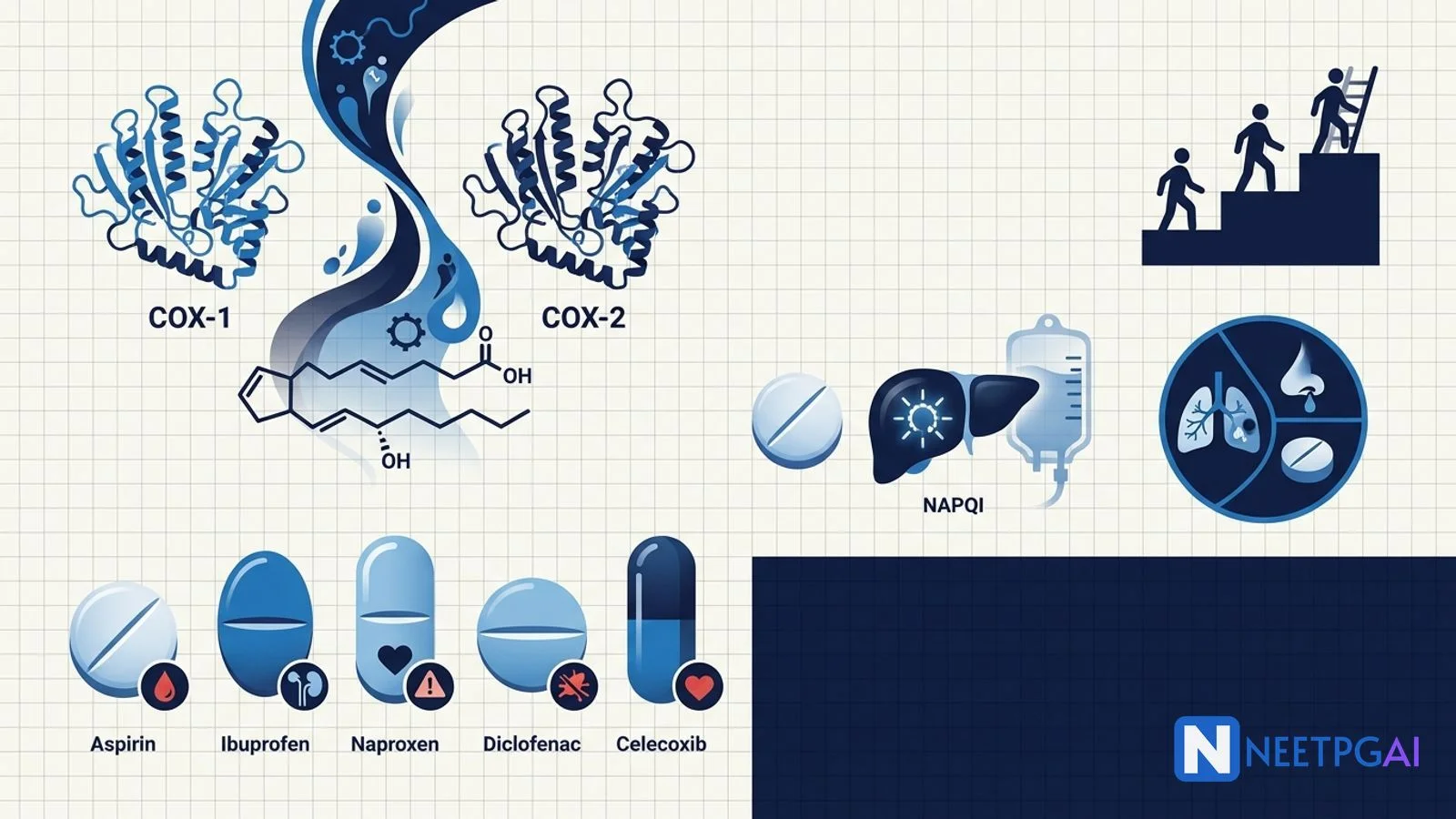
Paracetamol — no anti-inflammatory or antiplatelet action; hepatotoxic via NAPQI in overdose; treat with N-acetylcysteine.
Adverse effects — GI bleed, AKI, CV risk, hypertension, allergic reactions (Samter triad), avoid third trimester.
Opioids — WHO analgesic ladder; naloxone reversal; India tramadol misuse.
Non-steroidal anti-inflammatory drugs and analgesics are among the most widely prescribed — and misprescribed — medicines in India, making them a NEET PG pharmacology favourite. The topic couples classic biochemistry (arachidonic acid cascade) with high-yield clinical scenarios (peptic ulcer, AKI, Reye syndrome, paracetamol overdose) and India-specific realities (OTC diclofenac, tramadol misuse, agricultural-worker AKI).
This NEETPGAI deep dive covers COX biology, NSAID subclasses, paracetamol pharmacokinetics and toxicity, opioid basics and adjuvant analgesics. Pair this with the corticosteroids and glucocorticoid therapy guide for the other pillar of anti-inflammatory pharmacology.
COX biology and the arachidonic acid cascade
Membrane phospholipids release arachidonic acid via phospholipase A2 (which is itself inhibited upstream by glucocorticoids). Arachidonic acid is metabolised through two main pathways.
Cyclooxygenase (COX) produces prostaglandins, prostacyclin and thromboxane.
Inflammation, pain, fever — target of therapeutic NSAIDs
COX-3
Central, splice variant of COX-1
Central prostaglandins
Speculative target of paracetamol
Selective inhibition of COX-2 spares COX-1 and reduces GI toxicity but also removes vascular PGI2 while leaving platelet TXA2 intact — creating a pro-thrombotic imbalance and explaining the cardiovascular signal.
Non-selective NSAIDs
Non-selective NSAIDs inhibit both COX isoforms.
Drug
Notes
Exam pearl
Aspirin
Irreversible COX inhibitor; 8 to 10 day antiplatelet effect
Reye syndrome in children with viral illness; low-dose CV prevention; salicylate toxicity — mixed metabolic acidosis with respiratory alkalosis
Ibuprofen
Short half-life; commonest OTC in India
Preferred paediatric antipyretic; may blunt aspirin's antiplatelet effect if co-administered
Naproxen
Longer half-life; may have the most favourable CV profile among non-selective agents
Preferred in patients with CV risk who need chronic NSAID
Diclofenac
Widely used in India; higher CV risk (2015 label warning)
OTC availability drives AKI in dehydrated agricultural workers
Indomethacin
Potent; used for gout, PDA closure in preterm
High CNS side effects
Ketorolac
Potent parenteral analgesic
Limit to 5 days for GI and renal risk
Piroxicam
Long half-life
Higher GI toxicity; less commonly used now
Mefenamic acid
Analgesic for dysmenorrhoea
Watch for haemolytic anaemia
Selective COX-2 inhibitors (coxibs)
Selective COX-2 inhibitors (celecoxib, etoricoxib) have significantly less GI toxicity than non-selective NSAIDs. Celecoxib has a sulfonamide moiety and is contraindicated in patients with sulfa allergy. Rofecoxib was withdrawn in 2004 (VIGOR and APPROVe trials) after increased MI and stroke; valdecoxib followed. Celecoxib appears to have a smaller but real cardiovascular signal; the PRECISION trial (2016) found celecoxib non-inferior to naproxen and ibuprofen for CV events at moderate doses.
Clinical uses of NSAIDs
Mild-to-moderate pain of any origin.
Osteoarthritis and rheumatoid arthritis (symptomatic; not disease-modifying).
Dysmenorrhoea (mefenamic acid, naproxen).
Migraine (naproxen, aspirin, ibuprofen).
Acute gout attack (indomethacin, naproxen).
Postoperative pain (ketorolac, diclofenac).
Fever.
Patent ductus arteriosus closure in preterm neonates (indomethacin, ibuprofen).
Low-dose aspirin for secondary cardiovascular prevention (established) and primary prevention (much narrower indication after ASPREE, ARRIVE, ASCEND).
Adverse effects of NSAIDs (the exam checklist)
GI toxicity — dyspepsia, gastritis, peptic ulcer, upper GI bleed, perforation. COX-2 selective agents are safer but not risk-free. Add misoprostol or a PPI in high-risk patients (age over 65, prior ulcer, concurrent steroid or anticoagulant, high-dose NSAID).
Acute kidney injury — inhibition of prostaglandin-mediated afferent vasodilation; highest risk in elderly, CKD, heart failure, cirrhosis, nephrotic syndrome, dehydration and the ACE-inhibitor plus diuretic "triple whammy".
Analgesic nephropathy — chronic interstitial nephritis with papillary necrosis after prolonged NSAID or phenacetin exposure.
Cardiovascular — MI and stroke risk with high dose or long duration; strongest with diclofenac and selective COX-2 inhibitors; naproxen possibly least risk.
Hypertension worsening — via renal sodium retention and prostaglandin inhibition.
Bleeding — antiplatelet effect (reversible for most NSAIDs; irreversible for aspirin); hold NSAIDs 3 to 5 days before major surgery, aspirin 5 to 7 days.
Hypersensitivity — Samter's triad (asthma plus nasal polyps plus aspirin sensitivity); urticaria; angioedema; SJS and TEN (rare).
Hepatotoxicity — rare at therapeutic doses; diclofenac and sulindac carry small risk.
Pregnancy — avoid in the third trimester (premature closure of ductus arteriosus; oligohydramnios; risk of neonatal pulmonary hypertension). Also avoid at conception and after 20 weeks (FDA 2020 update flagging oligohydramnios).
Reye syndrome — aspirin plus viral illness (varicella, influenza) in children causing encephalopathy and fatty liver — avoid aspirin under 16 years except in specific indications like Kawasaki disease.
Nephrogenic diabetes insipidus — long-term NSAID exposure can rarely precipitate it.
Aplastic anaemia and agranulocytosis — rare with phenylbutazone, indomethacin.
Paracetamol (acetaminophen)
Paracetamol is centrally acting (probably a weak COX-3 inhibitor and modulator of endogenous cannabinoid and serotonergic pathways). It is an effective antipyretic and analgesic with NO anti-inflammatory activity, NO antiplatelet effect and NO GI toxicity at therapeutic doses. It is the safest antipyretic in pregnancy and in children.
Metabolism — around 90 percent is glucuronidated and sulfated to non-toxic metabolites; 5 to 10 percent is oxidised by CYP2E1 to N-acetyl-p-benzoquinone imine (NAPQI), which is normally detoxified by conjugation with glutathione. In overdose, glutathione is depleted, unbound NAPQI causes centrilobular hepatic necrosis.
Toxic dose — over 4 g per day in adults; lower in patients with chronic alcohol use, malnutrition, isoniazid or phenytoin therapy (all induce CYP2E1 or deplete glutathione).
Presentation — Stage I (0 to 24 h): nausea, vomiting, malaise, often asymptomatic. Stage II (24 to 72 h): RUQ pain, transaminitis. Stage III (72 to 96 h): hepatic failure, encephalopathy, coagulopathy, AKI. Stage IV (over 96 h): recovery or death.
Management:
Activated charcoal within 1 to 2 hours of ingestion.
Measure paracetamol level at 4 hours post-ingestion (or at presentation if later); plot on the Rumack-Matthew nomogram.
N-acetylcysteine (NAC) replenishes glutathione. IV Prescott regimen: 150 mg/kg over 60 minutes, then 50 mg/kg over 4 hours, then 100 mg/kg over 16 hours. The SNAP regimen (12-hour) is used in many UK centres.
Refer to a transplant centre if King's College criteria met (pH under 7.30 after resuscitation; or PT over 100 seconds INR over 6.5, creatinine over 300 micromol/L, and grade III/IV encephalopathy simultaneously).
Opioids — brief overview
Opioids act on mu, kappa and delta receptors, all G-protein-coupled receptors. The mu receptor mediates analgesia, sedation, euphoria, respiratory depression, miosis, constipation and physical dependence.
Class
Drug
Notes
Weak
Tramadol, codeine, hydrocodone
Tramadol is widely used and increasingly misused in India; also serotonergic — risk of serotonin syndrome with SSRIs
Morphine gold standard; fentanyl for severe or breakthrough pain; methadone for maintenance
Partial agonist
Buprenorphine
Ceiling effect on respiratory depression; used in opioid maintenance
Mixed agonist-antagonist
Pentazocine, nalbuphine
Kappa agonist, mu partial agonist
Antagonist
Naloxone, naltrexone
Naloxone reverses overdose
Adverse effects — respiratory depression (the killer in overdose), constipation, nausea and vomiting, sedation, urinary retention, pruritus, miosis, tolerance and physical dependence, immunomodulation.
Naloxone — 0.4 to 2 mg IV, IM or intranasal; repeat every 2 to 3 minutes; may need infusion because of shorter half-life than most opioids.
WHO analgesic ladder — Step 1: non-opioid (paracetamol, NSAID) plus adjuvant. Step 2: weak opioid plus non-opioid plus adjuvant. Step 3: strong opioid plus non-opioid plus adjuvant. Updated 2018 guidance includes early consideration of strong opioids in severe pain and adds interventional options as Step 4.
Tramadol — serotonergic; risk of serotonin syndrome with SSRIs; India misuse concern.
Naloxone — 0.4 to 2 mg; may need infusion; watch for withdrawal.
Methadone — long half-life; QT prolongation risk; opioid maintenance.
PDA closure — indomethacin or ibuprofen in preterm neonates; paracetamol is the emerging alternative.
Analgesic nephropathy — chronic NSAID or phenacetin; papillary necrosis.
Aspirin discontinuation before surgery — 5 to 7 days for major elective; not always required for minor procedures.
Anti-platelet dose of aspirin — 75 to 150 mg for cardiovascular prevention.
Recent updates and India context
FDA 2020 update — NSAIDs at or after 20 weeks of pregnancy may cause fetal renal problems and oligohydramnios; extending the traditional third-trimester avoidance.
PRECISION trial (2016) — celecoxib non-inferior to naproxen and ibuprofen for CV events at moderate doses.
ASPREE, ARRIVE, ASCEND (2018) — narrowed primary-prevention aspirin indications; not routine in low-risk individuals.
Tramadol reclassification (India, 2018) — moved to Schedule H1 (though still widely available); NDPS Act amendment 2019 added stricter controls.
India NSAID misuse — OTC availability of diclofenac and ibuprofen drives AKI in agricultural workers with heat stress and dehydration; a public-health concern in Karnataka and Andhra Pradesh sugarcane belts.
US opioid crisis lessons — informing tighter Indian prescribing of tramadol, fentanyl patches and buprenorphine.
Vulture ban (India, 2006) — diclofenac veterinary use banned to protect Gyps vulture populations after mass die-off from NSAID-induced renal failure in scavenger birds.
WHO analgesic ladder update (2018) — encourages earlier use of strong opioids in severe acute cancer pain and adds interventional options.
Frequently asked questions
What is the difference between COX-1 and COX-2 and why does it matter clinically?
COX-1 is constitutively expressed and maintains gastric mucosa, platelet thromboxane A2 production and renal blood-flow autoregulation. COX-2 is induced at sites of inflammation and produces prostaglandins driving pain, fever and inflammation. Non-selective NSAIDs inhibit both, giving anti-inflammatory benefit but also GI ulceration, bleeding and renal effects. Selective COX-2 inhibitors (celecoxib) spare COX-1, reducing GI toxicity but do not reduce cardiovascular risk — some (rofecoxib) actually raised MI risk, leading to its 2004 withdrawal.
Why is aspirin different from other NSAIDs at antiplatelet doses?
Aspirin irreversibly acetylates serine-529 of platelet COX-1, permanently blocking thromboxane A2 production for the 8 to 10 day lifespan of that platelet — because platelets have no nucleus and cannot resynthesise COX. Even low doses (75 to 100 mg per day) achieve this antiplatelet effect. Other NSAIDs cause reversible COX inhibition; their antiplatelet effect wanes as drug levels fall. That is why aspirin is the cornerstone of secondary cardiovascular prevention and why it must be held for 5 to 7 days before major surgery.
What is the antidote for paracetamol overdose and how is it dosed?
N-acetylcysteine (NAC) is the antidote. It replenishes hepatic glutathione, which detoxifies the reactive metabolite NAPQI generated by CYP2E1. Give IV NAC — 150 mg/kg over 60 minutes, then 50 mg/kg over 4 hours, then 100 mg/kg over 16 hours (21 hours total, Prescott regimen) or an equivalent shortened SNAP protocol. Timing is critical — NAC is most effective within 8 to 10 hours of ingestion but still worthwhile up to 24 hours. Plot the 4-hour paracetamol level on the Rumack-Matthew nomogram to decide.
Which patients are at highest risk of NSAID-induced acute kidney injury?
NSAID-mediated AKI results from inhibition of prostaglandin-dependent afferent arteriolar vasodilation, which becomes critical when renal perfusion is compromised. Highest-risk groups include the elderly, patients with pre-existing CKD, heart failure, cirrhosis or nephrotic syndrome, patients on ACEi/ARB plus diuretic (the triple-whammy), volume-depleted patients (diarrhoea, vomiting, exercise, fasting), and Indian agricultural workers exposed to heat and dehydration. Even short courses can precipitate AKI in these groups.
What is Samter's triad?
Samter's triad — also called aspirin-exacerbated respiratory disease (AERD) or NERD (NSAID-exacerbated) — is the combination of asthma, chronic rhinosinusitis with nasal polyps, and hypersensitivity to aspirin and other non-selective COX inhibitors. The mechanism is shunting of arachidonic acid metabolism from COX to LOX, producing excess leukotrienes. All non-selective NSAIDs must be avoided; selective COX-2 inhibitors are usually tolerated. Leukotriene modifiers (montelukast, zafirlukast) and aspirin desensitisation are therapeutic options.
This content is for educational purposes for NEET PG exam preparation. It is not a substitute for professional medical advice, diagnosis, or treatment. Clinical information has been reviewed by qualified medical professionals.
Written by: NEETPGAI Editorial Team
Reviewed by: Pending SME Review
Last reviewed: September 2026