Quick Answer
Operative delivery is a 2 to 3 question topic per NEET PG paper. Lock these:
- Prerequisites — cephalic, fully dilated, membranes ruptured, empty bladder, head engaged at or below the spines (+2 or below for low forceps), known position, no CPD, analgesia, consent.
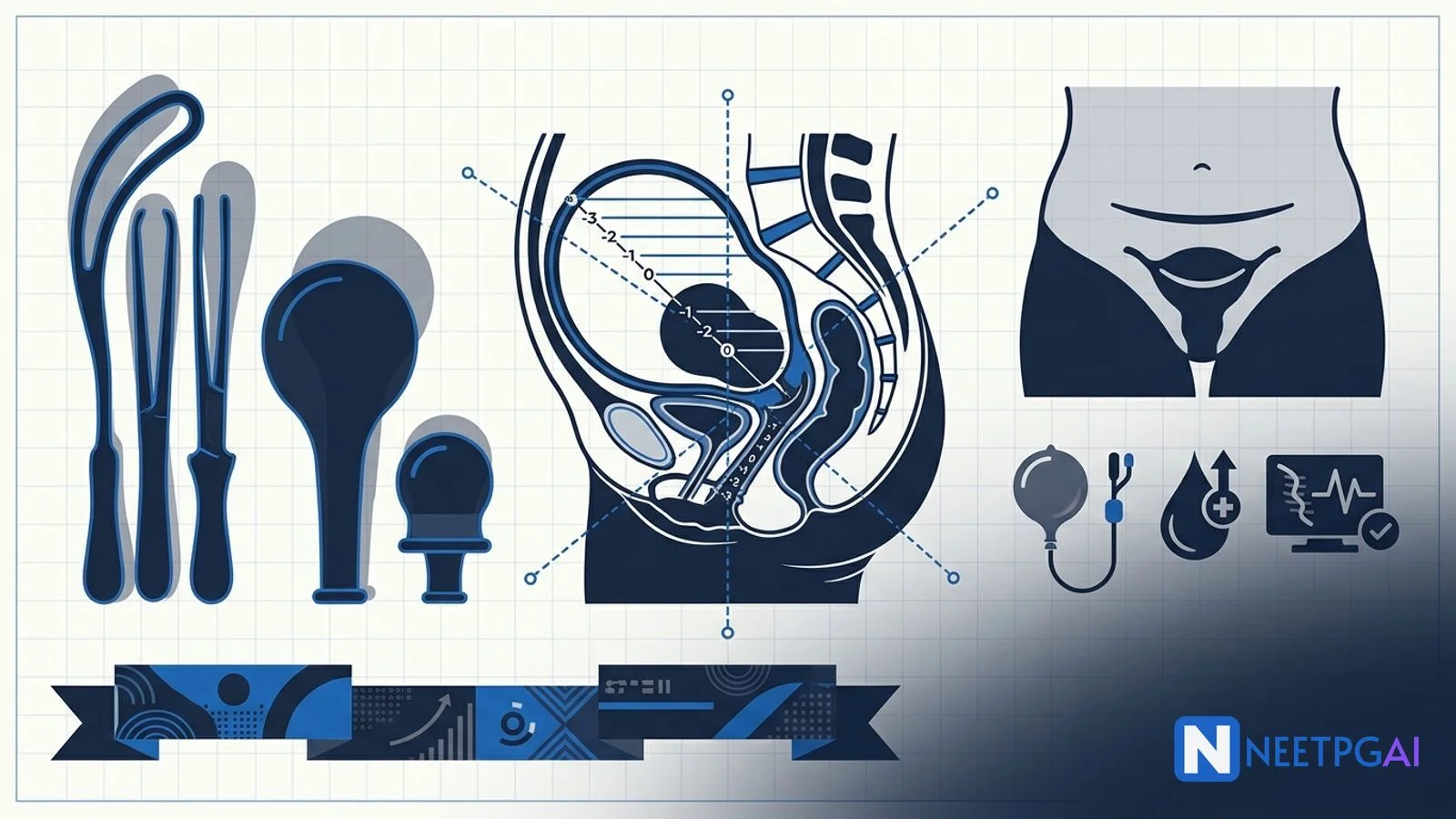
- Forceps types — Simpson (outlet or low), Kielland (rotational), Piper (after-coming head in breech), Wrigley (outlet).
- Vacuum — Ventouse (soft cup or rigid cup), Kiwi Omnicup (handheld disposable, common in India). Contraindicated below 34 weeks.
- Forceps vs vacuum — forceps = more maternal trauma; vacuum = more neonatal trauma (cephalhaematoma, subgaleal).
- Kerr incision — low transverse on the lower uterine segment; the standard modern cesarean.
- Category 1 cesarean — decision-to-delivery under 30 minutes.
- VBAC — 60 to 80 percent success; uterine rupture risk 0.5 to 1 percent; misoprostol contraindicated for induction.
- India — cesarean rate above 20 percent nationally, above 45 percent in private sector; well above WHO 10 to 15 percent.
Operative delivery — instrumental vaginal delivery with forceps or vacuum, and cesarean section — is a high-yield NEET PG topic because it fuses anatomy, obstetric mechanics, and safety checklists that examiners can test in short vignettes. This deep dive covers indications, prerequisites, complications, and the India-specific epidemiology every candidate needs. Pair it with the preterm labour and tocolysis clinical case for a full labour-ward toolkit.
Operative vaginal delivery — the shared checklist
Both forceps and vacuum require the same core prerequisites; miss any one and injury rates rise sharply.
- Cephalic presentation with a known position (occipito-anterior, transverse or posterior).
- Cervix fully dilated (10 cm) and effaced.
- Membranes ruptured.
- Bladder empty (catheterise or spontaneous void).
- Adequate analgesia — regional (epidural or spinal) preferred; pudendal block for outlet delivery.
- Station — head engaged at or below the ischial spines; low forceps at +2 or below; mid-cavity (station 0 to +2) is specialist-only; outlet only when the scalp is visible at the introitus. There is no role for forceps on an unengaged head.
- No cephalo-pelvic disproportion on clinical assessment.
- Informed consent — with a plan-B (cesarean) always discussed.
- Experienced operator, immediate OT access, neonatal resuscitation on standby.
Indications
- Prolonged second stage — over 2 hours nulliparous, over 1 hour multiparous (add 1 hour if epidural).
- Maternal exhaustion or inability to push effectively.
- Need to expedite delivery for maternal reasons — cardiac disease, severe hypertension, cerebrovascular malformation, uncontrolled seizures.
- Fetal distress in the second stage where instrumental delivery is quicker than cesarean.
Forceps — types and mechanics
Forceps have a cephalic curve (fits the fetal head) and a pelvic curve (fits the birth canal). Blades articulate at the English lock (used in Simpson) or the sliding lock (Kielland, allowing correction of asynclitism).
| Forceps | Use | Distinguishing feature |
|---|
| Simpson / Anderson | Low or outlet delivery | Fenestrated blade, long tapered cephalic curve — for moulded heads |
| Kielland | Rotational (occipito-transverse or posterior) | Minimal pelvic curve, sliding lock — allows rotation to occipito-anterior before traction |
| Piper | After-coming head in assisted breech | Long shanks with a reversed pelvic curve — applied from below the suspended fetal trunk to the engaged after-coming head |
| Wrigley | Outlet delivery only | Short, light — used for outlet or at cesarean to deliver a floating head |
Complications of forceps
- Maternal — third and fourth degree perineal tears, vaginal and cervical lacerations, vulvo-vaginal haematomas, post-partum haemorrhage, urinary retention, urethral or bladder trauma, later anal sphincter dysfunction and pelvic organ prolapse.
- Fetal / neonatal — facial nerve palsy, facial bruising, skull fractures (rare), intracranial haemorrhage, corneal abrasion.
Vacuum extraction
Vacuum uses negative-pressure suction applied to the fetal scalp near the flexion point (over the sagittal suture, about 3 cm anterior to the posterior fontanelle) to allow synergistic traction with maternal pushing.
- Silastic soft cup — flexible, lower scalp injury but slightly higher failure.
- Rigid metal (Malmstrom) cup — better traction, higher scalp trauma.
- Kiwi Omnicup (handheld single-use) — self-contained pump, widely used in Indian labour rooms because it does not need a wall vacuum source and is cheap enough for peripheral hospitals.
Rules of three
- Three contractions with descent expected.
- Three pop-offs mandate abandonment.
- Thirty minutes total application time.
Contraindications
- Gestation under 34 weeks — soft skull, high risk of intracranial and subgaleal haemorrhage.
- Fetal coagulopathy — including alloimmune thrombocytopenia.
- Suspected fetal scalp trauma or scalp electrode injury.
- Face or brow presentation.
- Non-vertex presentation.
Complications
- Neonatal — cephalhaematoma (subperiosteal, limited by suture lines), subgaleal haemorrhage (potentially life-threatening — can contain the neonate's entire blood volume), retinal haemorrhage, hyperbilirubinaemia (from resorption of the collection), scalp abrasions and lacerations.
- Maternal — fewer perineal injuries than forceps but similar rates of PPH.
Forceps vs vacuum — the exam-worthy comparison
| Feature | Forceps | Vacuum |
|---|
| Maternal perineal trauma | Higher (3rd/4th degree tears) | Lower |
| Neonatal scalp trauma | Lower | Higher (cephalhaematoma, subgaleal) |
| Preterm use | Acceptable | Contraindicated below 34 weeks |
| Facial nerve palsy | Yes | Rare |
| Retinal haemorrhage | Rare | More common |
| Operator skill required | Higher | Moderate |
| Failure rate | Lower | Higher |
Cesarean section — classification and indications
Classification by urgency (RCOG / NICE)
- Category 1 — immediate threat to life of mother or fetus; decision-to-delivery under 30 minutes (some units target 15 minutes for cord prolapse with fetal bradycardia).
- Category 2 — maternal or fetal compromise not immediately life-threatening; delivery within 75 minutes.
- Category 3 — no compromise but early delivery needed.
- Category 4 — elective / scheduled.
Common indications
- Previous cesarean (repeat cesarean is the largest driver of the rising rate).
- Malpresentation — breech (external cephalic version failed or declined), transverse or oblique lie.
- Placenta previa (grade III or IV).
- Placental abruption with fetal compromise.
- Severe pre-eclampsia or eclampsia with unfavourable cervix.
- Fetal distress in the first stage or before instrumental prerequisites are met.
- Failure to progress / arrest of labour with adequate contractions.
- Cephalo-pelvic disproportion.
- Macrosomia (estimated fetal weight above 4.5 kg in diabetics, above 5 kg in non-diabetics).
- Multiple pregnancy — non-vertex first twin, higher-order multiples.
- HIV-positive with high viral load (over 1000 copies/mL near term).
- Active genital herpes at labour onset.
- Prior classical cesarean or myomectomy entering the cavity.
- Cord prolapse.
Techniques — incisions and layers
Skin incisions:
- Pfannenstiel — transverse suprapubic, curved, 2 cm above the pubic symphysis; cosmetically preferred; most common.
- Joel-Cohen — transverse, straight, higher (about 3 cm below the anterior superior iliac spine line); faster; part of the Misgav-Ladach cesarean.
- Midline vertical — faster access for perimortem cesarean, morbidly obese women with a large panniculus, or when abdominal exposure needs to extend upward.
Layers cut — skin, subcutaneous fat, rectus sheath, rectus muscle (separated, not cut), transversalis fascia, parietal peritoneum, visceral peritoneum (bladder flap reflected), lower uterine segment.
Uterine incisions:
- Lower segment transverse (Kerr) — standard; thin lower segment, low blood loss, low future rupture risk, permits TOLAC.
- Lower segment vertical (Kronig) — occasional; may extend upward.
- Classical (upper segment vertical) — reserved for placenta previa covering the lower segment, lower segment fibroids, preterm transverse lie with poorly formed lower segment, cervical cancer, dense adhesions, perimortem cesarean. Future rupture risk 4 to 9 percent; TOLAC contraindicated.
The ERAS cesarean pathway
Enhanced Recovery After Surgery has reshaped cesarean care in the last decade — carbohydrate-loading up to 2 hours pre-op, spinal anaesthesia preferred, prophylactic phenylephrine to prevent hypotension, single-dose IV antibiotics 30 to 60 minutes before incision (cefazolin 2 g plus azithromycin 500 mg if labouring or membranes ruptured), oxytocin bolus followed by infusion for atony prevention, TXA if bleeding risk high, delayed cord clamping when appropriate, skin-to-skin in theatre, early oral intake within 2 hours, early mobilisation within 6 to 8 hours, opioid-sparing multimodal analgesia (paracetamol plus NSAID plus TAP block or intrathecal morphine), early urinary catheter removal within 12 hours, and discharge on day 2 to 3.
Complications of cesarean
Immediate
- Haemorrhage — atony, extension of the uterine incision, placenta accreta spectrum.
- Visceral injury — bladder (0.3 percent), bowel (0.1 percent), ureteric injury (0.03 percent, higher in repeat cesarean with adhesions).
- Anaesthetic — spinal hypotension, high spinal, failed intubation (rare but historically a major cause of maternal death), aspiration.
- Venous thromboembolism — cesarean roughly doubles VTE risk; mechanical and pharmacological prophylaxis are standard.
Delayed
- Wound infection — 3 to 15 percent (higher with obesity, diabetes, prolonged labour, ruptured membranes).
- Endometritis — 5 to 20 percent; polymicrobial; treat with broad-spectrum antibiotics.
- Deep vein thrombosis and pulmonary embolism.
Long-term
- Adhesions — with each subsequent cesarean.
- Placenta accreta spectrum — accreta, increta, percreta; risk rises steeply with each cesarean (roughly 3 percent after 1, 11 percent after 2, 40 percent after 3, over 60 percent after 4 in the presence of placenta previa).
- Uterine rupture in future pregnancy or TOLAC.
- Scar endometriosis in the abdominal wall.
- Cesarean scar ectopic pregnancy — implantation of a subsequent gestation in the niche of a prior scar.
Trial of labour after cesarean (TOLAC) and VBAC
Candidates
- Single previous low-transverse cesarean.
- Cephalic-presenting singleton at term.
- No other absolute indication for repeat cesarean.
- Facility with immediate cesarean capability and continuous electronic fetal monitoring.
- Informed consent — women choose between planned repeat cesarean and TOLAC.
Contraindications
- Prior classical or T-shaped incision.
- Prior uterine rupture.
- More than two previous cesareans.
- Previous myomectomy entering the endometrial cavity.
- Placenta previa or other indication for elective repeat.
- Non-availability of round-the-clock obstetric, anaesthetic and neonatal cover.
Success rates and risks
- Success 60 to 80 percent in appropriately selected women.
- Uterine rupture risk 0.5 to 1 percent for a single low-transverse scar; rises to around 2 to 2.5 percent with prostaglandin induction (avoid prostaglandins — misoprostol is absolutely contraindicated).
- Successful VBAC carries lower morbidity than repeat cesarean; failed TOLAC (emergency intrapartum cesarean) carries the highest morbidity.
India-specific context
- NFHS-5 (2019 to 2021) — institutional cesarean rate 21.5 percent overall (28 percent urban, 17 percent rural); private sector 47 percent, public sector 14 percent. Both above the WHO population target of 10 to 15 percent.
- Robson ten-group classification is now embedded in LaQshya labour-room quality audits — groups 1 and 2 (low-risk term primigravidae) drive most of the excess.
- Janani Suraksha Yojana (JSY) and Janani Shishu Suraksha Karyakram (JSSK) provide cash incentives for institutional delivery and free cesarean, driving up institutional births but also under-monitored cesarean volumes.
- Ayushman Bharat / PMJAY covers cesarean and obstetric emergencies for eligible families; state schemes (Aarogyasri, MJPJAY) do the same regionally.
- PMSMA (Pradhan Mantri Surakshit Matritva Abhiyan) targets high-risk pregnancy identification on the 9th of every month — a key screening tool for planning safe delivery.
- VBAC availability is low in the private sector because of medico-legal fears; higher in public teaching hospitals and mission hospitals.
- Rural OT access remains a bottleneck — the National Health Mission's First Referral Unit strategy targets 24x7 cesarean access at CHC level.
NEET PG MCQ traps
- Vacuum contraindication — under 34 weeks (soft skull, subgaleal haemorrhage risk).
- Kielland forceps — rotational; occipito-transverse or persistent occipito-posterior.
- Piper forceps — after-coming head in an assisted breech vaginal delivery.
- Wrigley forceps — outlet delivery; also used to deliver a floating head at cesarean.
- Subgaleal haemorrhage — vacuum complication; can contain a neonate's entire blood volume.
- Facial nerve palsy — classic forceps complication.
- Prerequisites — cephalic, fully dilated, membranes ruptured, empty bladder, head engaged at or below the spines (+2 or below for low forceps), position known, no CPD, analgesia, consent.
- Category 1 cesarean — decision-to-delivery under 30 minutes.
- Kerr incision — low transverse lower segment; standard; TOLAC permitted.
- Classical incision — vertical upper segment; TOLAC contraindicated; future rupture 4 to 9 percent.
- Uterine rupture after single low-transverse cesarean — 0.5 to 1 percent.
- Misoprostol — contraindicated for cervical ripening or labour induction in a previous cesarean.
- Placenta accreta risk rises with each cesarean; roughly 60 percent with placenta previa and four or more prior cesareans.
- HIV — plan cesarean at 38 weeks if viral load over 1000 copies/mL near term.
- Active genital herpes at labour onset — cesarean.
- Pfannenstiel — cosmetically preferred transverse suprapubic skin incision.
- Joel-Cohen — straight higher transverse; part of the Misgav-Ladach cesarean.
- ERAS cesarean — spinal anaesthesia, single-dose antibiotic prophylaxis 30 to 60 minutes before incision, early oral intake, early mobilisation.
- VTE prophylaxis — cesarean doubles risk; mechanical and pharmacological measures standard.
- NFHS-5 cesarean rate — 21.5 percent India; 47 percent private sector.
Frequently asked questions
What are the absolute prerequisites for operative vaginal delivery?
A validated checklist must be satisfied before any instrumental delivery — cephalic presentation with a known position, fully dilated cervix, ruptured membranes, empty bladder, adequate maternal analgesia (regional or pudendal block), an engaged head at or below the ischial spines — low forceps at station +2 or below, mid-cavity forceps (specialist only) between station 0 and +2, and outlet forceps only when the scalp is visible at the introitus, no clinical suspicion of cephalopelvic disproportion, informed maternal consent, an experienced operator, and immediate access to an operating theatre and neonatal resuscitation. Skipping any single item — for example, attempting forceps before the head has clearly passed the ischial spines, or with a persistent occipito-posterior position that has not been diagnosed — is the commonest cause of maternal and neonatal injury.
How does vacuum extraction compare with forceps for maternal and neonatal outcomes?
Forceps and vacuum are complementary rather than competing tools. Forceps produce more maternal trauma — third and fourth degree perineal tears, vaginal wall lacerations, urinary retention and higher rates of anal sphincter injury — but fewer neonatal complications. Vacuum (soft cup or the handheld Kiwi Omnicup used widely in Indian labour rooms) produces less maternal trauma but more neonatal complications — cephalhaematoma, subgaleal haemorrhage (which can be life-threatening), retinal haemorrhage and jaundice. Vacuum is contraindicated below 34 weeks, in fetal coagulopathy, in suspected fetal scalp trauma and after failed forceps. A pull count of three, three attempts, or thirty minutes without progress mandates abandonment.
What are the layers cut during a lower segment cesarean and why is the Kerr incision preferred?
Layers from superficial to deep are skin, subcutaneous fat, rectus sheath (transverse in a Pfannenstiel), rectus muscle (usually separated not cut), transversalis fascia, parietal peritoneum, visceral peritoneum reflected off the bladder, and the lower uterine segment. The Kerr incision is a low transverse curvilinear incision on the lower uterine segment. It is preferred because the lower segment is thin and relatively avascular, it heals well, uterine rupture risk in a future pregnancy is under one percent, and it permits a trial of labour after cesarean (TOLAC). The classical (upper vertical) incision is reserved for placenta previa covering the lower segment, lower segment fibroids, preterm transverse lie, cervical cancer, dense adhesions or perimortem cesarean — its future rupture risk is four to nine percent, precluding TOLAC.
Who is a candidate for VBAC and when should trial of labour after cesarean be avoided?
A candidate for VBAC has a single previous low-transverse cesarean, a cephalic-presenting singleton at term, no other absolute indication for repeat cesarean (placenta previa, malpresentation, previous classical or T-shaped incision, prior uterine rupture, more than two previous cesareans, previous myomectomy entering the cavity), an obstetrician-staffed facility with immediate cesarean capability, continuous electronic fetal monitoring in labour, and informed consent. Success rates are 60 to 80 percent in appropriately selected women. Uterine rupture risk is 0.5 to 1 percent for a single low-transverse scar and rises with induction (especially with prostaglandins — misoprostol is contraindicated) and with augmentation.
Why are Indian cesarean rates so far above the WHO ten-to-fifteen percent recommendation?
National Family Health Survey rounds show the Indian institutional cesarean rate climbing above 20 percent nationally and above 45 percent in the private sector, well past the WHO ten-to-fifteen percent target. Drivers include a rising obstructed labour and eclampsia burden that legitimately needs cesarean, older maternal age and higher BMI, over-medicalisation of low-risk labour in private facilities, defensive obstetrics, non-availability of round-the-clock skilled personnel to conduct VBAC safely, and payment structures that reward cesarean over vaginal birth. Robson ten-group classification is now used by many Indian hospitals to audit and drive down non-essential cesareans; PMSMA and LaQshya quality initiatives explicitly track cesarean rates in group 1 and group 2 (low-risk primigravidae).
This content is for educational purposes for NEET PG exam preparation. It is not a substitute for professional medical advice, diagnosis, or treatment. Clinical information has been reviewed by qualified medical professionals.
Written by: NEETPGAI Editorial Team
Reviewed by: NEETPGAI Medical Advisory Board
Last reviewed: September 2026