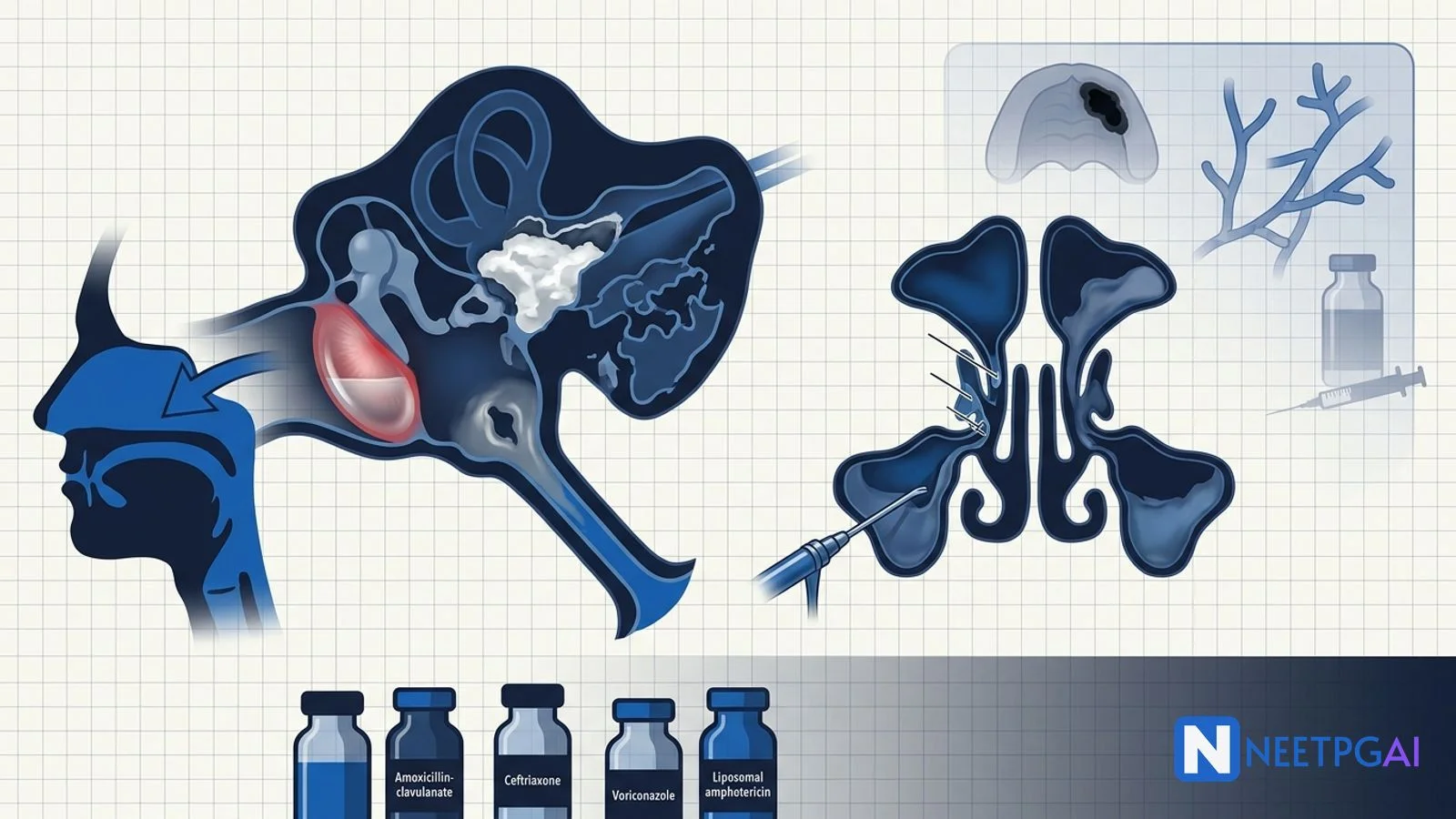
FESS — first-line surgical option for chronic rhinosinusitis failing 12 weeks of medical therapy.
Mucormycosis — broad aseptate hyphae with right-angle branching; liposomal amphotericin plus debridement.
Otitis media and sinusitis remain the bread-and-butter of ENT for NEET PG, NEXT and FMGE — both are extremely common in clinical practice and lend themselves to crisp vignette MCQs ("a 4-year-old with three days of ear pain and a bulging red tympanic membrane"). The 2021 post-COVID mucormycosis surge in India added an entirely new clinical pattern that is now examined at every level. The newer 2018 IDSA and AAO-HNS guidelines also tightened the indications for antibiotic prescribing and watchful waiting.
This NEETPGAI deep dive covers the full otitis media spectrum (AOM, OME, CSOM, complications), the sinusitis classification, antibiotic choices, FESS indications, and the India-specific mucormycosis problem. Pair this with the leprosy classification and MDT guide and the common mistakes in dermatology guide for a complete infectious disease ENT-derm package.
Acute otitis media (AOM)
Pathogenesis and microbiology
Eustachian tube dysfunction (most often after a viral upper respiratory infection) creates negative middle ear pressure, transudation of fluid, and bacterial seeding from the nasopharynx. The classical triad of pathogens:
Streptococcus pneumoniae — the leading cause; PCV-13 vaccination has reduced this proportion in children.
Non-typeable Haemophilus influenzae — second most common; resistant to amoxicillin via beta-lactamase production in 25 to 50 percent of strains.
Moraxella catarrhalis — third; nearly all strains beta-lactamase positive.
Middle ear effusion — bulging tympanic membrane, decreased or absent mobility on pneumatic otoscopy, air-fluid level, or otorrhoea.
Middle ear inflammation — distinct erythema of the tympanic membrane or otalgia interfering with normal activity or sleep.
Pneumatic otoscopy is the gold-standard bedside test; tympanometry can confirm effusion.
Treatment — watchful waiting vs antibiotics
Patient
Approach
Less than 6 months
Antibiotics for all
6 to 23 months, severe (T greater than 39 C, severe otalgia, otorrhoea, bilateral)
Antibiotics
6 to 23 months, non-severe unilateral
Antibiotics OR observation with follow-up
24 months and older, non-severe
Observation for 48 to 72 hours with analgesia
First-line antibiotic — amoxicillin 80 to 90 mg/kg/day in two divided doses.
Second-line — amoxicillin-clavulanate (high dose) — if amoxicillin in the prior 30 days, concurrent purulent conjunctivitis (suggesting H. influenzae), or treatment failure.
Penicillin allergy — cefdinir, cefuroxime, or azithromycin.
Duration — 10 days under 2 years; 5 to 7 days in older children with mild disease.
Otitis media with effusion (OME)
Persistent middle ear effusion without signs of acute infection — the tympanic membrane is dull or retracted, mobility decreased, and conductive hearing loss is the predominant symptom. Most cases resolve within 3 months. Indications for tympanostomy tube (grommet) placement:
Bilateral OME for greater than 3 months with hearing loss greater than 20 dB.
Unilateral or bilateral OME with structural damage, speech delay or vestibular symptoms.
Recurrent AOM (four or more episodes in 6 months, or six in 12 months) with effusion at the time of decision.
Adenoidectomy is added in children over 4 years or with persistent nasal obstruction.
Chronic suppurative otitis media (CSOM)
CSOM is defined as a permanent tympanic membrane perforation with chronic or recurrent ear discharge for more than 6 weeks. The cardinal NEET PG distinction is between safe (tubotympanic) and unsafe (atticoantral) disease.
Feature
Safe CSOM (tubotympanic)
Unsafe CSOM (atticoantral)
Other name
Mucosal disease
Squamosal disease
Perforation
Central (pars tensa)
Attic or marginal (posterosuperior)
Discharge
Mucoid, profuse, non-foul-smelling
Scanty, foul-smelling (cholesteatoma)
Cholesteatoma
Absent
Present
Granulations
Absent
Often present
Hearing loss
Conductive
Conductive or mixed
Complications
Rare
Common (intracranial)
Treatment
Aural toilet, antibiotics, myringoplasty
Modified radical or radical mastoidectomy
Cholesteatoma — the unsafe lesion
A cholesteatoma is a destructive collection of keratinising squamous epithelium in the middle ear, attic or mastoid. It erodes ossicles (incus first), bone, the lateral semicircular canal (fistula sign positive) and the facial nerve canal. Classic clinical signs:
Schwartze sign — pink reflex through the tympanic membrane (vascular cholesteatoma) — actually classical for otosclerosis; in cholesteatoma the analogous sign is keratin debris visible through the perforation.
Sagging of the posterosuperior canal wall — bone erosion from expanding cholesteatoma.
Fistula test positive — vertigo and nystagmus on pressing the tragus (lateral semicircular canal eroded).
Marginal or attic perforation with whitish flakes.
High-resolution CT temporal bone confirms bone erosion and extent; diffusion-weighted MRI is highly sensitive for residual cholesteatoma after surgery.
Myringoplasty — closes a tympanic membrane perforation only.
Tympanoplasty — closes perforation and reconstructs the ossicular chain (Wullstein types I to V).
Cortical (simple) mastoidectomy — removes mastoid air cells, leaves posterior canal wall intact; for mastoiditis.
Modified radical mastoidectomy (MRM) — removes diseased mastoid cells and creates a common cavity with the external auditory canal; preserves the tympanic membrane remnant and middle ear (canal-wall-down).
Radical mastoidectomy — MRM plus removal of the tympanic membrane and ossicles; used for extensive cholesteatoma.
Sinusitis
Classification by duration
Acute rhinosinusitis (ARS) — less than 4 weeks.
Subacute — 4 to 12 weeks.
Chronic rhinosinusitis (CRS) — 12 weeks or longer; subdivided into CRS with nasal polyps (CRSwNP) and without (CRSsNP).
Recurrent acute — four or more episodes per year with full resolution between.
Acute bacterial rhinosinusitis (ABRS)
Most acute rhinosinusitis is viral and self-limited. IDSA / AAO-HNS criteria for ABRS:
Persistent — 10 or more days without improvement.
Severe — fever above 39 degrees C and purulent discharge or facial pain for 3 to 4 consecutive days at onset.
Worsening (double sickening) — initial improvement followed by new fever, headache or increased nasal discharge.
Pathogens mirror AOM — S. pneumoniae, H. influenzae, M. catarrhalis.
Antibiotics:
First-line: amoxicillin-clavulanate 500/125 mg three times daily or 875/125 mg twice daily for 5 to 7 days (10 days in children).
Penicillin allergy: doxycycline or respiratory fluoroquinolone (levofloxacin, moxifloxacin).
Adjuncts: intranasal corticosteroids, saline irrigation, decongestants (short courses only — rebound congestion with oxymetazoline beyond 3 days).
Chronic rhinosinusitis (CRS)
Symptoms for 12 weeks or more — nasal congestion, facial pain or pressure, nasal discharge or postnasal drip, hyposmia — plus objective evidence (endoscopic findings of polyps, oedema, purulent middle meatus discharge, or CT mucosal disease).
Management:
Medical — intranasal corticosteroids (mometasone, fluticasone) for 12 weeks, daily saline irrigation, culture-directed antibiotics, oral corticosteroid bursts for polyps.
Biologics — dupilumab, omalizumab, mepolizumab for severe CRSwNP refractory to surgery.
Surgical — FESS when medical therapy fails.
Functional Endoscopic Sinus Surgery (FESS)
Indications:
CRS refractory to 12 weeks of maximal medical therapy.
Nasal polyposis.
Allergic fungal sinusitis, fungal ball.
Invasive fungal sinusitis (urgent).
Mucoceles with bony erosion.
Orbital or intracranial complications of acute sinusitis.
Biopsy of suspected sinonasal neoplasm.
CSF leak repair.
The ostiomeatal complex (OMC) is the surgical target — uncinectomy, maxillary antrostomy, anterior ethmoidectomy, frontal recess clearance, and sphenoidotomy as indicated. Complications include orbital injury (medial rectus, optic nerve), CSF leak through the cribriform plate, and carotid artery injury in sphenoid surgery.
India-specific: post-COVID mucormycosis
The rhino-orbito-cerebral mucormycosis (ROCM) epidemic during the second COVID wave (April to July 2021) recorded over 51,000 cases across India — the largest such cluster ever. Drivers:
Uncontrolled diabetes mellitus (new-onset hyperglycaemia from COVID + steroids).
Corticosteroid overuse in mild COVID without oxygen requirement.
Zinc supplementation (proposed but contested).
Industrial oxygen with contaminated humidifier water.
Clinical features
Facial pain, nasal congestion, blood-tinged or black nasal discharge.
Palatal eschar (black necrotic ulcer on hard palate) — pathognomonic.
Orbital involvement — periorbital oedema, proptosis, ophthalmoplegia, vision loss.
Griesinger sign — postauricular oedema over the mastoid emissary vein in sigmoid sinus thrombosis.
Picket-fence fever with rigors — lateral sinus thrombosis.
Tobey-Ayer test — compression of the contralateral jugular causes a rise in CSF pressure but ipsilateral compression does not (lateral sinus thrombosis).
MRM (canal-wall-down) preserves the tympanic membrane and middle ear; radical removes them.
ABRS criteria — persistent (10 days), severe (greater than 39 C with discharge for 3 to 4 days), or worsening (double sickening).
Amoxicillin-clavulanate is first-line for ABRS, not plain amoxicillin (resistance rates higher than AOM in adults).
Oxymetazoline beyond 3 days causes rhinitis medicamentosa (rebound).
FESS addresses the ostiomeatal complex (OMC).
Mucormycosis — broad aseptate hyphae with right-angle branching (vs Aspergillus — narrow septate with acute-angle branching).
Liposomal amphotericin B is preferred over conventional amphotericin (less nephrotoxicity, higher tolerated dose).
Allergic fungal sinusitis — eosinophilic mucin, Charcot-Leyden crystals, fungal hyphae without tissue invasion; treated with FESS plus steroids, NOT antifungals.
Recent updates and Indian context
AAP 2013 AOM guideline (still current) — watchful waiting approach for non-severe unilateral disease in children over 2 years; high-dose amoxicillin remains first-line.
IDSA 2012 ABRS guideline — amoxicillin-clavulanate (not plain amoxicillin) is first-line because of higher H. influenzae resistance in adults.
EPOS 2020 (European Position Paper on Rhinosinusitis) — biologics (dupilumab, omalizumab, mepolizumab) approved for severe CRSwNP refractory to FESS.
ICMR 2021 mucormycosis guideline — algorithmic stepwise approach for suspected ROCM in COVID-recovered diabetics; mandates daily endoscopic surveillance during liposomal amphotericin therapy.
PCV-13 (Prevnar 13) — included in Indian Universal Immunisation Programme (UIP) since 2017 (rolled out state by state) — has reduced pneumococcal AOM in children.
DGHS guidelines on rational antibiotic use in ARI — discourages amoxicillin for viral URI in primary care, addresses Indian over-prescription patterns.
AIIMS New Delhi ENT protocols — now include MRI temporal bone diffusion-weighted imaging for residual cholesteatoma detection, replacing routine second-look surgery in many cases.
Frequently asked questions
How is acute otitis media diagnosed and managed?
AOM requires acute onset, middle ear effusion (bulging tympanic membrane, decreased mobility, otorrhoea) and middle ear inflammation (erythema or otalgia). First-line therapy in children over 2 years with non-severe unilateral disease is watchful waiting for 48 to 72 hours with adequate analgesia. Severe disease, bilateral disease in under 2 years, or otorrhoea mandates antibiotics — high-dose amoxicillin 80 to 90 mg/kg/day is first-line, with amoxicillin-clavulanate if recent antibiotic exposure or treatment failure.
What distinguishes safe (tubotympanic) from unsafe (atticoantral) CSOM?
Safe CSOM (tubotympanic, mucosal disease) has a central perforation of the pars tensa, mucoid non-foul-smelling discharge, conductive hearing loss, and no cholesteatoma — complications are rare. Unsafe CSOM (atticoantral, squamosal disease) has an attic or marginal perforation with cholesteatoma, scanty foul-smelling discharge, granulation tissue, and a high risk of intracranial complications. Cholesteatoma is destructive keratinising squamous epithelium in the middle ear that erodes ossicles and bone.
What are the IDSA criteria for acute bacterial sinusitis?
ABRS is diagnosed when one of three patterns is present — persistent symptoms (purulent nasal discharge, congestion or facial pain) lasting 10 or more days without improvement; severe symptoms (high fever above 39 degrees C and purulent discharge or facial pain) for 3 to 4 consecutive days at illness onset; or worsening symptoms (double sickening) — initial improvement followed by new fever, headache or increased nasal discharge. First-line antibiotic is amoxicillin-clavulanate; reserve fluoroquinolones for penicillin allergy.
When is FESS indicated in chronic rhinosinusitis?
Functional Endoscopic Sinus Surgery is indicated when chronic rhinosinusitis fails maximal medical therapy (3 months of intranasal corticosteroids, saline irrigation, and a course of culture-directed antibiotics). Absolute indications include nasal polyposis refractory to medication, fungal sinusitis (allergic fungal, fungal ball, invasive), mucoceles with bone erosion, and orbital or intracranial complications. The ostiomeatal complex is the surgical target.
How is post-COVID mucormycosis managed?
Rhino-orbito-cerebral mucormycosis surged across India after the second COVID wave (2021), driven by uncontrolled diabetes, corticosteroid overuse, and zinc supplementation. Diagnosis requires high suspicion in a diabetic with sinonasal pain, facial swelling, palatal eschar or proptosis, confirmed by KOH mount and histopathology showing broad aseptate ribbon-like hyphae with right-angle branching. Treatment is liposomal amphotericin B 5 to 10 mg/kg/day plus aggressive surgical debridement plus reversal of immunosuppression (insulin, stop steroids).
This content is for educational purposes for NEET PG exam preparation. It is not a substitute for professional medical advice, diagnosis, or treatment. Clinical information has been reviewed by qualified medical professionals.
Written by: NEETPGAI Editorial Team
Reviewed by: Pending SME Review
Last reviewed: May 2026