Version 1.0 - Published October 2026
Quick Answer
The anticipated difficult airway is managed by careful bedside assessment (Mallampati, 3-3-2, LEMON, MACOCHA in critical care) followed by awake fiberoptic intubation when difficulty is predicted. The ASA 2022 Difficult Airway Algorithm limits intubation attempts to 3 by the primary operator plus 1 by an experienced helper, mandates optimisation between attempts, and triggers supraglottic rescue (iGel, LMA Supreme, LMA Fastrach) if intubation fails. Cannot-intubate-cannot-ventilate (CICV) requires immediate verbal declaration and scalpel-bougie-tube cricothyroidotomy within 3-5 minutes to prevent hypoxic brain injury.
Why This Matters for NEET PG and INI-CET
Airway management is examined every year across NEET PG, INI-CET, and FMGE because it is the one skill in anesthesia that any doctor - surgeon, physician, intensivist, ED resident - may be required to perform in an emergency. The ASA Difficult Airway Algorithm, Mallampati classification, pre-oxygenation protocol, and cricothyroidotomy technique collectively generate 3-5 anesthesia MCQs per NEET PG sitting and often appear as case-based INI-CET stems.
The 2022 ASA update introduced several changes examinable in NEET PG 2026: explicit limits on intubation attempts, mandatory optimisation between attempts, the "3-5 minute" time window for CICV, and formal integration of video laryngoscopy as an alternative first-line device. Candidates miss marks because they memorise the 2003 ASA algorithm (two attempts, surgical airway as fourth-line) instead of the 2022 update.
Beyond the exam this is life-saving material. A newly qualified doctor may face an anticipated difficult airway in the ED, the labour room, the ward, or a code-blue - knowing when to go awake, how to pre-oxygenate properly, when to switch to a supraglottic airway, and when to call CICV and open the neck is not optional knowledge.
Predictors of a Difficult Airway
Mallampati Classification
Done with the patient sitting upright, head neutral, mouth maximally open, tongue protruded without phonation.
| Class | Visibility |
|---|
| I | Soft palate, uvula, tonsillar pillars |
| II | Soft palate and uvula |
| III | Only soft palate and base of uvula |
| IV | Only hard palate (no soft palate) |
Classes III and IV predict difficult direct laryngoscopy.
3-3-2 Rule and LEMON
| Metric | Normal | Abnormal |
|---|
| Mouth opening (interincisor distance) | 3 fingerbreadths or greater | Less than 3 cm |
| Mandibular length (mentum to hyoid) | 3 fingerbreadths | Less than 3 fingerbreadths |
| Hyoid to thyroid notch | 2 fingerbreadths | Less than 2 fingerbreadths |
LEMON mnemonic for emergency airway assessment:
- Look externally - face, body habitus, trauma, blood, vomit, foreign body
- Evaluate 3-3-2
- Mallampati
- Obstruction - stridor, trismus, hoarse voice, drooling
- Neck mobility - neck extension less than 35 degrees is abnormal
Other Bedside Metrics
- Thyromental distance - less than 6 cm (or less than 3 fingerbreadths) with head extended = difficulty
- Sternomental distance - less than 12.5 cm = difficulty
- Upper lip bite test - inability to bring lower incisors to upper lip (Class III) = difficulty
- Neck circumference - greater than 40 cm in obese patients = difficult mask and intubation
OBESE Mnemonic - Difficult Mask Ventilation
- Obese BMI greater than 26
- Bearded
- Elderly, greater than 55 years
- Snorers (OSA)
- Edentulous
MACOCHA Score - Difficult Intubation in Critical Care
Validated for ICU patients where elective indicators do not apply.
- Mallampati 3 or 4 (5 pts)
- Apnea syndrome (OSA, 2 pts)
- Cervical immobility (1 pt)
- Opening mouth less than 3 cm (1 pt)
- Coma (1 pt)
- Hypoxaemia (SpO2 less than 80%, 1 pt)
- Anesthesiologist non-trained (1 pt)
Score greater than or equal to 3 predicts difficult intubation.
Pre-oxygenation and Apneic Oxygenation
Pre-oxygenation Protocol
Correct denitrogenation extends safe apnea time from approximately 1 minute to 6-8 minutes in a healthy adult.
Technique:
- Tight-fitting non-rebreather mask with 100% oxygen at 15 L/min
- Duration: 3 minutes of tidal breathing OR 8 vital-capacity breaths in 60 seconds
- Goal: end-tidal oxygen fraction (EtO2) greater than 85-90%
High-risk groups - obese (BMI greater than 30), pregnant, critically ill, paediatric - have reduced functional residual capacity and higher oxygen consumption. Add:
- Ramped position (external auditory meatus level with sternal notch)
- Apneic oxygenation
- BiPAP or non-invasive positive pressure ventilation during pre-oxygenation
Apneic Oxygenation (NO DESAT)
High-flow nasal cannula at 15 L/min oxygen or High-Flow Nasal Oxygen (HFNO, OptiFlow, THRIVE) at 40-70 L/min, started during pre-oxygenation and continued through intubation attempts.
Physiology - passive oxygen diffusion from pharynx to alveoli across a patent airway as alveolar oxygen is consumed; nitrogen washout prevents re-entry.
Gains - safe apnea time extended from 6 minutes to 10-15 minutes in healthy adults; more modest but still meaningful in obese and critically ill patients.
The ASA 2022 Difficult Airway Algorithm
Step 1 - Assess
Identify difficulty predictors using Mallampati, 3-3-2, LEMON, OBESE, MACOCHA as appropriate. Review prior anesthesia records.
Step 2 - Prepare and Position
- Pre-oxygenate to EtO2 greater than 85%
- Position: sniffing position (adult) or ramped (obese)
- Ensure help is available
- Difficult airway cart in the room: video laryngoscope, bougies, supraglottic airways, fiberoptic bronchoscope, cricothyroidotomy kit
Step 3 - Choose Primary Approach
Awake intubation is preferred for anticipated difficult airway. Decision tree:
- Suspected difficult mask ventilation PLUS difficult intubation? Choose AWAKE
- Difficult intubation only? Awake or asleep with spontaneous ventilation
- Easy mask ventilation, easy intubation predicted? Standard induction
Step 4 - Attempt Intubation
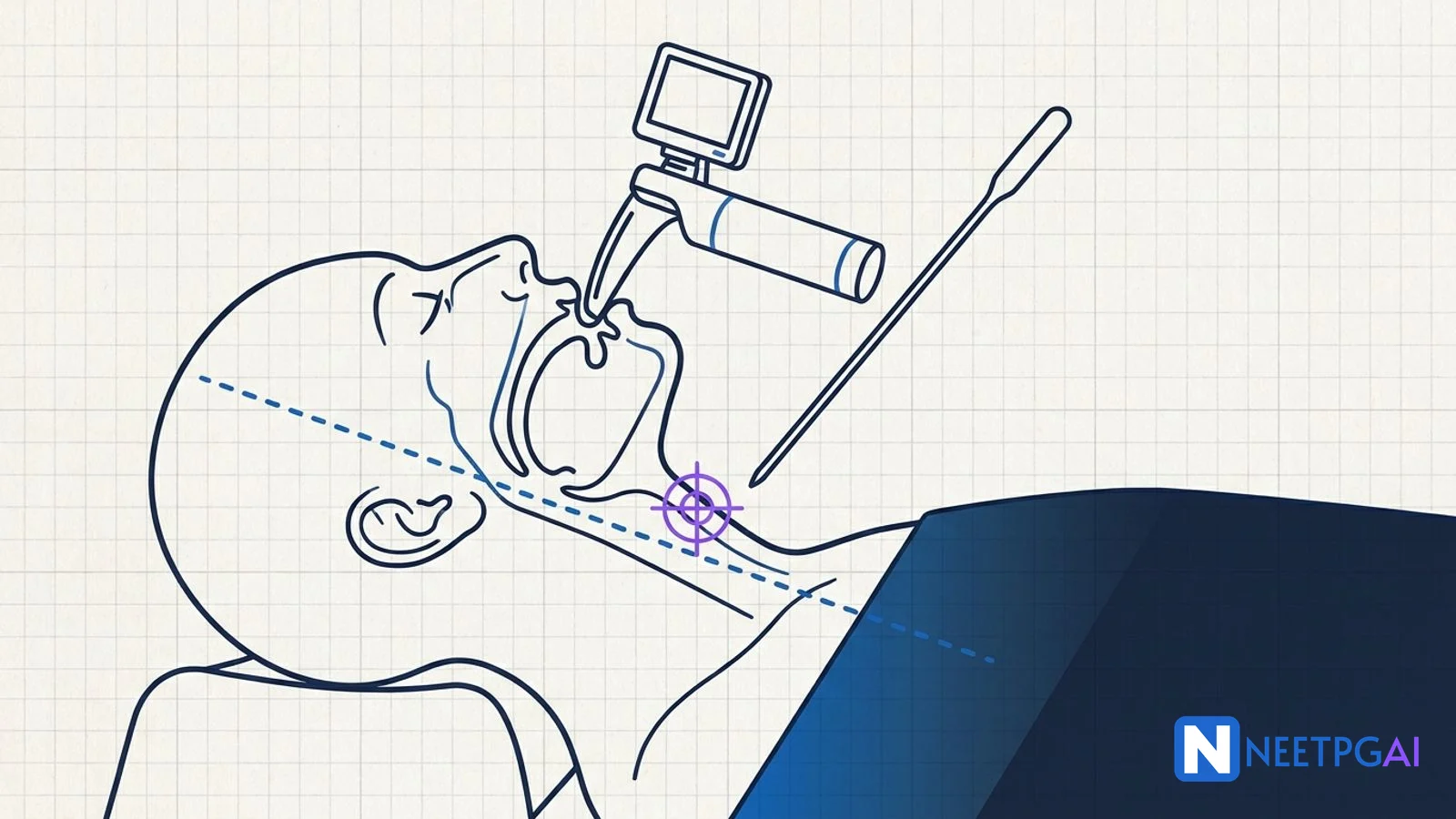
Primary technique: direct laryngoscopy with Macintosh blade, OR first-line video laryngoscopy (increasingly standard - CMAC, GlideScope).
Limit attempts: a maximum of 3 by the primary operator plus 1 by a more experienced provider.
Step 5 - Optimise Between Attempts
- Reposition (ramp, sniffing, external laryngeal manipulation - BURP)
- Change blade or move to video laryngoscope
- Use a bougie or stylet
- Add a second operator for cricoid pressure or external manipulation
- Deflate ETT cuff if any resistance
Step 6 - If Intubation Fails - Supraglottic Rescue
Insert iGel, LMA Supreme, or LMA Fastrach for ventilation. These can also be conduits for subsequent intubation via Aintree catheter.
Step 7 - If Supraglottic Fails - CICV
Declare "CICV, going to front of neck" verbally.
Step 8 - Front of Neck Access
- Adult: scalpel-bougie-tube cricothyroidotomy
- Child under 8: needle cricothyroidotomy with jet ventilation
Target: complete within 3-5 minutes of CICV declaration.
Step 9 - Decide to Wake or Proceed
- Non-urgent surgery: wake up, reschedule
- Urgent/emergency surgery: continue with surgical airway, proceed with surgery
Equipment and Techniques
Direct Laryngoscopy Blades
| Blade | Age | Mechanism |
|---|
| Macintosh (curved) | Adult, child over 2 | Tip in vallecula, indirect lifting of epiglottis |
| Miller (straight) | Infant, neonate, difficult | Direct lifting of epiglottis |
| McCoy | Adult | Flexible tip at distal end |
Video Laryngoscopy
Standard of care in difficult airways and increasingly in routine practice.
- CMAC - Macintosh-shaped blade with video camera; direct view possible as backup
- GlideScope - 60-degree angled blade; needs stylet (GlideRite rigid stylet)
- King Vision - channeled and non-channeled blades
Advantages: better glottic view (Cormack-Lehane I-II in 90%+), useful in cervical spine immobilisation, teaching value. Disadvantages: tube delivery through an angled view can be harder than seeing cords.
Supraglottic Airways
| Device | Features | Use |
|---|
| Classic LMA | First-generation; inflatable cuff | Elective anesthesia for brief procedures |
| ProSeal LMA | Gastric drain tube; higher seal | Positive pressure ventilation |
| LMA Supreme | Single-use ProSeal | Emergency rescue, elective |
| iGel | Non-inflatable gel cuff | Fast insertion, excellent rescue device |
| LMA Fastrach (ILMA) | Conduit for blind intubation up to 7.0 mm tube | Difficult airway rescue |
Awake Fiberoptic Intubation Technique
Six steps:
- Explain to patient; consent for awake procedure
- Antisialagogue - glycopyrrolate 0.2 mg IV 15-20 minutes prior
- Mild sedation - midazolam 1-2 mg plus dexmedetomidine 0.5-1 mcg/kg over 10 min
- Topical airway anaesthesia - 4% lidocaine nebulised, 10% spray oropharynx, bilateral SLN blocks, translaryngeal lidocaine (do not exceed 9 mg/kg total)
- Supplemental oxygen 4-6 L/min via nasal cannula throughout
- Load ETT on fiberoptic scope, advance under vision past cords, railroad tube in, confirm placement
Cricothyroidotomy - Scalpel-Bougie-Tube
Adult emergency front-of-neck technique:
- Extend neck, palpate cricothyroid membrane in midline
- Stabilise larynx with non-dominant hand
- Vertical 3-5 cm midline skin incision
- Horizontal stab through cricothyroid membrane; rotate scalpel 90 degrees
- Insert bougie into trachea (feel tracheal rings, hold-up at carina)
- Railroad 6.0 mm cuffed ETT over bougie
- Inflate cuff, confirm end-tidal CO2, auscultate, secure
Needle cricothyroidotomy with jet ventilation: 14 G cannula, high-pressure oxygen (Manujet or Sanders), I:E ratio 1:4 to prevent barotrauma. Preferred for children under 8 (cricoid is narrowest point - surgical cricothyroidotomy risks subglottic stenosis).
Convert to tracheostomy within 24-72 hours.
Rapid Sequence Induction (RSI)
Indicated for full stomach, pregnancy greater than 20 weeks, bowel obstruction, trauma, uncontrolled gastro-oesophageal reflux.
Protocol:
- Pre-oxygenate 3 minutes with 100% O2
- Pre-treatment with lidocaine 1.5 mg/kg (optional, for ICP concerns)
- Induction agent (3-second induction):
- Propofol 1.5-2.5 mg/kg (hypotension risk)
- Etomidate 0.3 mg/kg (haemodynamic stability but adrenal suppression)
- Ketamine 1-2 mg/kg (haemodynamic support in shock)
- Muscle relaxant - succinylcholine 1-1.5 mg/kg OR rocuronium 1.0-1.2 mg/kg
- Sellick's manoeuvre (cricoid pressure) traditionally recommended, now controversial
- No mask ventilation between induction and intubation (avoid gastric insufflation)
- Intubate within 45-60 seconds
Modified RSI
In anticipated difficult airway with full stomach - add gentle mask ventilation (less than 15 cm H2O pressure) to maintain oxygenation while cricoid pressure is maintained. Alternatively, use awake intubation.
Sugammadex for Rocuronium Reversal
- 16 mg/kg for immediate reversal in a can't-intubate scenario (within 2-3 minutes)
- 4 mg/kg for deep neuromuscular blockade (post-tetanic count 1-2)
- 2 mg/kg for moderate blockade (TOF 2 or more)
Does not reverse succinylcholine, atracurium, cisatracurium, vecuronium (though vecuronium is partially reversed).
Paediatric Difficult Airway Differences
- Larger occiput - requires shoulder roll instead of head ramp
- Larger tongue relative to oral cavity
- Higher and more anterior larynx (C3-C4 vs C5-C6 adult)
- Longer, floppier, omega-shaped epiglottis - Miller blade preferred under 2 years
- Cricoid is the narrowest point (not glottis) under 8 years - use needle cricothyroidotomy, not surgical
- Higher oxygen consumption and lower FRC - desaturation is rapid (safe apnea time less than 2 minutes in neonate)
- Pre-oxygenation less effective; apneic oxygenation technique must be used
High-Yield One-Liners
- Mallampati Class III and IV predict difficult direct laryngoscopy.
- Thyromental distance less than 6 cm = difficult intubation.
- Mouth opening less than 3 cm essentially guarantees difficulty with direct laryngoscopy.
- OBESE mnemonic predicts difficult MASK VENTILATION.
- MACOCHA score greater than or equal to 3 predicts difficult ICU intubation.
- Pre-oxygenation 3 minutes with 100% O2 at 15 L/min via tight-fitting mask achieves EtO2 greater than 85%.
- Apneic oxygenation (nasal 15 L/min) extends safe apnea time to 10-15 minutes.
- ASA 2022 limits intubation attempts to 3 by primary operator plus 1 by expert.
- Awake fiberoptic intubation is gold standard for ANTICIPATED difficult airway.
- iGel, LMA Supreme, LMA Fastrach are supraglottic rescue options.
- LMA Fastrach is a conduit for blind intubation up to 7.0 mm tube.
- CICV must trigger front-of-neck access within 3-5 minutes.
- Scalpel-bougie-tube cricothyroidotomy is the adult emergency technique.
- Needle cricothyroidotomy with jet ventilation is preferred in children under 8.
- Jet ventilation I:E ratio 1:4 to allow passive expiration (prevent barotrauma).
- Sugammadex 16 mg/kg immediately reverses rocuronium in can't-intubate rescue.
- Succinylcholine 1-1.5 mg/kg for RSI; onset 30-60 s, duration 5-10 min.
- Rocuronium 1.0-1.2 mg/kg is a succinylcholine alternative with sugammadex rescue.
- Cricoid pressure (Sellick's manoeuvre) is now controversial and may worsen view.
- Convert emergency cricothyroidotomy to tracheostomy within 24-72 hours.
Common Mistakes
-
More than 3 intubation attempts by the primary operator - each additional attempt increases airway oedema, bleeding, and conversion to CICV. ASA 2022 is explicit on the 3-attempt limit.
-
Delayed CICV declaration - operators often continue to attempt mask ventilation or supraglottic rescue past the safe window. Declare CICV verbally the moment both intubation (3 attempts) and supraglottic rescue have failed. The clock starts for front-of-neck access.
-
Inadequate pre-oxygenation - a loose mask, inadequate flow, or less than 3 minutes of pre-oxygenation gives you a safe apnea time of 1-2 minutes instead of 6-8 minutes. Always confirm EtO2 greater than 85%.
-
Choosing asleep induction in an anticipated difficult airway - when Mallampati, 3-3-2, or OBESE predict difficulty, awake intubation is the correct choice. Converting an awake-should-have-been-awake airway to a CICV emergency is a preventable catastrophe.
-
Surgical cricothyroidotomy in a child under 8 - the cricoid is the narrowest airway point in young children; a surgical hole can cause subglottic stenosis. Use needle cricothyroidotomy with jet ventilation instead.
Related Topics on NEETPGAI
Practice This on NEETPGAI
Drill the ASA 2022 algorithm, Mallampati classification, LEMON, OBESE, MACOCHA, and the cricothyroidotomy technique on real NEET PG and INI-CET PYQs. Our 28,000+ MCQ bank includes case-based airway vignettes with annotated images.
Start free on NEETPGAI - 28,000+ MCQs, real PYQs, mock tests simulating NEET PG 2026's 5-section lockout, and an AI tutor that will walk you through any difficult airway case step by step.