Version 1.0 — Published October 2026
Quick Answer
Spinal (L3-L4 or L4-L5, bupivacaine 0.5 percent hyperbaric 2-3 mL, onset 2-5 min, dense block) and epidural (catheter, 10-20 mL volume, segmental, slower onset) are the two neuraxial regionals; CSE combines both. GA = induction (propofol/thiopental/etomidate/ketamine) + muscle relaxant (sux/rocuronium) + maintenance (isoflurane/sevoflurane/desflurane or TIVA). Caesarean defaults to spinal; abdominal and thoracic default to GA plus epidural. Complications: PDPH (blood patch), LAST (Weinberg lipid rescue 1.5 mL/kg Intralipid 20 percent), high spinal, awareness, PONV.
Why This Matters for NEET PG & INI-CET
Anaesthesia carries 5-8 questions in INI-CET and 4-6 in NEET PG per paper. The content concentrates in six predictable buckets — neuraxial techniques and dose, induction agent choice, muscle relaxant pharmacology, inhalational agents, specific complications (PDPH, LAST, awareness, PONV, high spinal), and surgery-specific anaesthetic choice. Each bucket is tested through a clinical stem that rewards a decision — "which drug", "which block", "which complication", "what next" — rather than isolated recall. The six most-tested complications (PDPH, LAST, high spinal, malignant hyperthermia, awareness, PONV) carry disproportionate weight because they have defined antidotes, specific scoring criteria, and clear exam-answer paths.
Beyond board exams, these are the questions you will face as an anaesthesia resident on day one — Caesarean under spinal, orthopaedic hip under spinal versus GA, open cholecystectomy under GA plus epidural, pregnancy with aortic stenosis under which anaesthetic. The exam questions mirror real residency case-mix exactly.
The Three Neuraxial Techniques
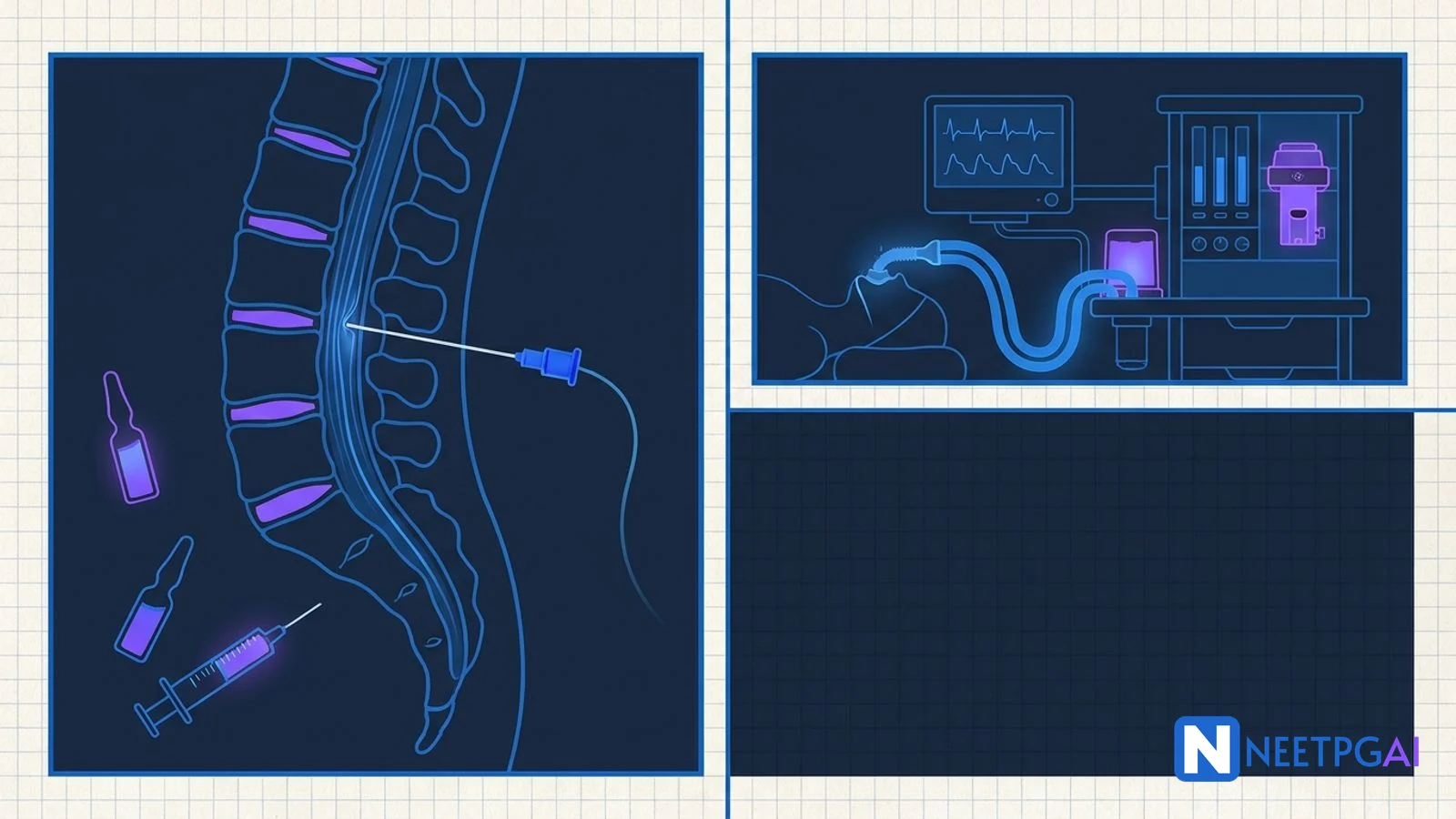
Spinal (Subarachnoid) Anaesthesia
Site: L3-L4 or L4-L5 interspace (conus medullaris ends at L1-L2 in adults).
Needle: 25-27 G Whitacre or Sprotte (pencil-point) preferred over Quincke (cutting) — much lower PDPH rate.
Layers pierced (midline approach): skin → subcutaneous tissue → supraspinous ligament → interspinous ligament → ligamentum flavum → dura → arachnoid → subarachnoid space.
Confirmation: free flow of clear CSF through needle hub.
Drugs:
| Drug | Dose | Duration |
|---|
| Bupivacaine 0.5% hyperbaric | 2-3 mL (10-15 mg) | 90-180 min |
| Bupivacaine 0.5% isobaric | 2.5-3 mL | 90-180 min |
| Ropivacaine 0.5% | 2.5-3 mL | 90-120 min |
| Lidocaine 5% hyperbaric | AVOID (TNS risk) | 45-90 min |
| Fentanyl adjuvant | 10-25 mcg | prolongs sensory |
| Morphine adjuvant | 100-300 mcg | 18-24 h analgesia |
Block levels:
- T4 (nipple line) — Caesarean
- T6 (xiphisternum) — lower abdominal
- T10 (umbilicus) — hernia, perineal
- L1 — lower limb
Advantages: fast onset (2-5 min), dense sensory + motor block, awake patient, minimal drug dose.
Disadvantages: fixed duration (single-shot), haemodynamic sympathectomy (hypotension), PDPH risk.
Epidural Anaesthesia
Site: lumbar for lower abdominal/limb, thoracic for upper abdominal/thoracic.
Needle: 17-18 G Tuohy.
Technique: loss-of-resistance to saline (preferred — lower PDPH) or air. Catheter threaded 3-5 cm into epidural space.
Drugs:
| Drug | Concentration | Volume |
|---|
| Bupivacaine | 0.0625-0.5% | 10-20 mL bolus; 5-10 mL/h infusion |
| Ropivacaine | 0.1-0.75% | similar |
| Fentanyl adjuvant | 1-5 mcg/mL | |
Advantages: continuous infusion, segmental block (useful for post-op analgesia), post-op pain control for days.
Disadvantages: slower onset (10-20 min), less dense block, higher failure rate, accidental dural puncture risk (0.5-1 percent).
Combined Spinal-Epidural (CSE)
Needle-through-needle: Tuohy identifies epidural space, long 25-27 G spinal needle passed through Tuohy lumen to pierce dura, small intrathecal dose given, spinal needle withdrawn, catheter threaded through Tuohy, Tuohy withdrawn.
Advantages: fast onset of spinal + duration flexibility of epidural.
Indications: Caesarean, prolonged lower-limb surgery, labour analgesia.
General Anaesthesia
Induction Agents
| Agent | Dose | Pros | Cons | Ideal for |
|---|
| Propofol | 1.5-2.5 mg/kg | Fast, smooth emergence, antiemetic | Hypotension, apnoea, pain on inj | Default elective adult |
| Thiopental | 3-5 mg/kg | Fast, cheap, ICP-lowering | Hypotension, histamine, no analgesia | Status epilepticus, neuro |
| Etomidate | 0.2-0.3 mg/kg | Haemodynamic stability | Adrenal suppression, N&V, myoclonus | Shock, cardiac |
| Ketamine | 1-2 mg/kg IV, 4-6 mg/kg IM | Maintains airway, bronchodilator, raises BP | Raises ICP/IOP, emergence delirium | Asthma, haemorrhagic shock, children IM |
Muscle Relaxants
Depolarising: suxamethonium (succinylcholine) 1-1.5 mg/kg IV.
- Fastest onset (30-60 sec), shortest duration (5-10 min).
- Used for RSI, difficult airway.
- Contraindications: hyperkalaemia, burns greater than 24 h, crush injury, denervation injury, muscular dystrophy (hyperkalaemic arrest), pseudocholinesterase deficiency (prolonged paralysis), malignant hyperthermia susceptibility.
Non-depolarising:
| Drug | Dose | Duration | Elimination |
|---|
| Rocuronium | 0.6-1.2 mg/kg | 30-45 min | Hepatic + renal |
| Vecuronium | 0.08-0.1 mg/kg | 30-45 min | Hepatic + renal |
| Atracurium | 0.5 mg/kg | 20-35 min | Hofmann elimination (safe in renal/hepatic failure) |
| Cisatracurium | 0.15 mg/kg | 35-45 min | Hofmann elimination |
Reversal:
- Neostigmine 0.04-0.07 mg/kg + glycopyrrolate 0.01 mg/kg (standard reversal)
- Sugammadex 2-4 mg/kg for rocuronium/vecuronium (fast, complete, works for deep block)
Maintenance
Inhalational:
| Agent | MAC | Features |
|---|
| Isoflurane | 1.17 | Cheap, pungent, slow emergence |
| Sevoflurane | 2.0 | Non-pungent (induction gas in kids), fast emergence |
| Desflurane | 6.0 | Fastest emergence, pungent (not for induction) |
| Nitrous oxide | 104 (cannot alone) | Cheap carrier, second-gas effect |
All volatiles are MH triggers; dantrolene is the specific antidote.
TIVA: propofol infusion 100-200 mcg/kg/min when volatiles are contraindicated (MH, PONV-sensitive, scavenging failure).
Surgery-Specific Choice
| Surgery | Default anaesthetic | Alternative |
|---|
| Caesarean (elective) | Spinal (bupivacaine 1.6-2 mL + fentanyl + morphine) | CSE if prolonged |
| Caesarean (emergency crash) | GA + RSI | Spinal if time permits |
| Caesarean (coagulopathy, local sepsis) | GA | - |
| Lower-limb orthopaedic | Spinal | Combined femoral + sciatic |
| Hip arthroplasty | Spinal (reduces blood loss, DVT, POCD) | GA |
| Shoulder arthroscopy | Interscalene block + GA LMA | GA alone |
| Upper limb (arm, forearm) | Brachial plexus block (supraclavicular, axillary) | GA |
| Spine surgery | GA (prone, airway control) | - |
| Lower abdominal (hernia, appy) | Spinal T6 | GA |
| Open cholecystectomy | GA + thoracic epidural | - |
| Laparoscopic cholecystectomy | GA + ETT (pneumoperitoneum) | - |
| Thoracotomy | GA + double-lumen tube + thoracic epidural | GA + bronchial blocker |
| Craniotomy | GA (TIVA preferred) | - |
Key Complications
Post-Dural Puncture Headache (PDPH)
- Positional (worse upright, better supine), fronto-occipital, bilateral.
- Onset 24-72 h post-puncture.
- Mechanism: CSF leak greater than CSF production, downward brain traction, compensatory cerebral vasodilation.
- Risk: 18 G Tuohy accidental puncture 50-80 percent; 25 G Quincke 5-10 percent; 25-27 G Whitacre/Sprotte 1-3 percent.
- Prevention: pencil-point needles, parallel bevel orientation (if Quincke).
- Management ladder:
- Conservative — bed rest, fluids 2-3 L/day, caffeine 300-500 mg, paracetamol, NSAID.
- Epidural blood patch (EBP): 15-20 mL autologous blood injected into epidural space at or one below puncture level. Success 70-90 percent first attempt.
Local Anaesthetic Systemic Toxicity (LAST)
Order of symptoms: perioral tingling → metallic taste → tinnitus → dizziness → agitation → seizure → unconsciousness → arrhythmia → asystole.
Bupivacaine LAST = simultaneous CNS + CV collapse (uniquely cardiotoxic).
Dose thresholds:
| Drug | Plain | With adrenaline |
|---|
| Lidocaine | 4.5 mg/kg | 7 mg/kg |
| Bupivacaine | 2.5 mg/kg | 3 mg/kg |
| Ropivacaine | 3 mg/kg | - |
| Levobupivacaine | 2 mg/kg | - |
Weinberg lipid rescue (ASRA/ESRA guideline):
- Stop LA. Call help. Airway, oxygen 100 percent.
- Seizure: midazolam 2-5 mg or diazepam 5-10 mg IV. AVOID propofol in unstable patient.
- Modified ACLS: avoid vasopressin, CCB, beta-blocker, lidocaine; microdose adrenaline (1 mcg/kg), not standard 1 mg; amiodarone for arrhythmia.
- Intralipid 20 percent: 1.5 mL/kg bolus over 1 min + 0.25 mL/kg/min infusion. Repeat bolus 1-2 times. Max 10 mL/kg over 30 min.
- ECMO transfer if sustained arrest.
High Spinal / Total Spinal
- Excessive cephalad spread of intrathecal LA.
- Features: profound hypotension, bradycardia, apnoea (phrenic nerve C3-C5), unconsciousness.
- Management: intubate, 100 percent oxygen, IV fluids, adrenaline/noradrenaline, atropine.
Malignant Hyperthermia
- Hypermetabolic crisis in susceptible patients exposed to volatiles or succinylcholine.
- Features: masseter rigidity, hyperthermia (late), hypercarbia (earliest sign on EtCO2), tachycardia, rhabdomyolysis, metabolic acidosis.
- Antidote: dantrolene 2.5 mg/kg IV loading, repeat to 10 mg/kg total.
- Supportive: cooling, treat hyperkalaemia, bicarb, hydration.
Awareness Under Anaesthesia
- Explicit recall during GA. Incidence 0.1-0.2 percent.
- Risk: inadequate volatile dose, TIVA, obstetric and cardiac cases, muscle relaxant without sufficient hypnotic.
- Monitoring: BIS (target 40-60), end-tidal volatile monitoring.
- Prevention: adequate hypnotic depth, do not rely on muscle relaxant for anaesthesia.
PONV (Post-Operative Nausea and Vomiting)
- Risk factors (Apfel score): female, non-smoker, history of PONV/motion sickness, post-op opioid.
- Prevention: ondansetron 4 mg IV + dexamethasone 4-8 mg IV at induction; droperidol, metoclopramide second-line.
- TIVA with propofol lowers PONV significantly.
Decision Algorithm — Regional vs General
Is neuraxial contraindicated?
  (coagulopathy / local sepsis / raised ICP / patient refusal / severe AS / fixed cardiac output)
  YES → General anaesthesia
  NO ↓

Is airway difficult / aspiration risk / short duration / lower abdomen or limb?
  YES → Regional (neuraxial or peripheral)
  NO → General

Is prolonged post-op analgesia required?
  YES → Add epidural catheter / peripheral nerve catheter
  NO → Standard
High-Yield One-Liners
- Spinal: L3-L4 or L4-L5, bupivacaine 0.5% hyperbaric 2-3 mL, onset 2-5 min.
- Target T4 for Caesarean (nipple line); T6 for lower abdominal; T10 for perineal.
- Epidural: 17-18 G Tuohy, LOR saline, catheter 3-5 cm.
- CSE combines fast spinal onset with epidural duration.
- Propofol = default induction; etomidate = shocked patient; ketamine = asthma + haemodynamic instability.
- Sux CI in burns greater than 24h, crush, muscular dystrophy, hyperkalaemia, pseudocholinesterase deficiency.
- Rocuronium 0.6-1.2 mg/kg = sux alternative; sugammadex reverses it.
- Atracurium and cisatracurium = Hofmann elimination, safe in renal/hepatic failure.
- PDPH = positional, 24-72 h post-puncture, risk highest with large-bore cutting needle.
- EBP = 15-20 mL autologous blood into epidural space at puncture level, 70-90 percent success.
- LAST = perioral tingling → seizure → arrhythmia; bupivacaine = simultaneous CNS + CV.
- Lipid rescue: Intralipid 20% 1.5 mL/kg bolus + 0.25 mL/kg/min infusion.
- MH antidote: dantrolene 2.5 mg/kg loading, max 10 mg/kg total.
- Caesarean default = spinal. GA for crash LSCS or neuraxial contraindication.
- Awareness: BIS target 40-60; don't rely on muscle relaxant for anaesthesia.
Common Mistakes
- Using succinylcholine in burns, crush injury or muscular dystrophy — causes hyperkalaemic cardiac arrest. Use rocuronium instead.
- Giving propofol for seizure in a haemodynamically unstable LAST patient — further cardiac depression. Use midazolam or diazepam.
- Standard 1 mg adrenaline in LAST ACLS — worsens bupivacaine-induced arrhythmia. Use microdose 1 mcg/kg.
- Using lidocaine for arrhythmia in LAST — additional Na+ channel block. Use amiodarone.
- Spinal in a patient on therapeutic LMWH 12 hours earlier — epidural haematoma risk. Delay neuraxial 12 h after prophylactic LMWH and 24 h after therapeutic LMWH per ASRA.
Related Topics on NEETPGAI
Practice This on NEETPGAI
Anaesthesia MCQs reward clinical decision-making — which drug, which block, which complication. NEETPGAI's Anaesthesia bank carries over 1,500 MCQs tagged by technique and complication class, with Mermaid decision-flow diagrams in explanations. Free for every registered user. Sign up free and run a 20-Q regional-vs-general block tonight.