Version 1.0 - Published October 2026
Quick Answer
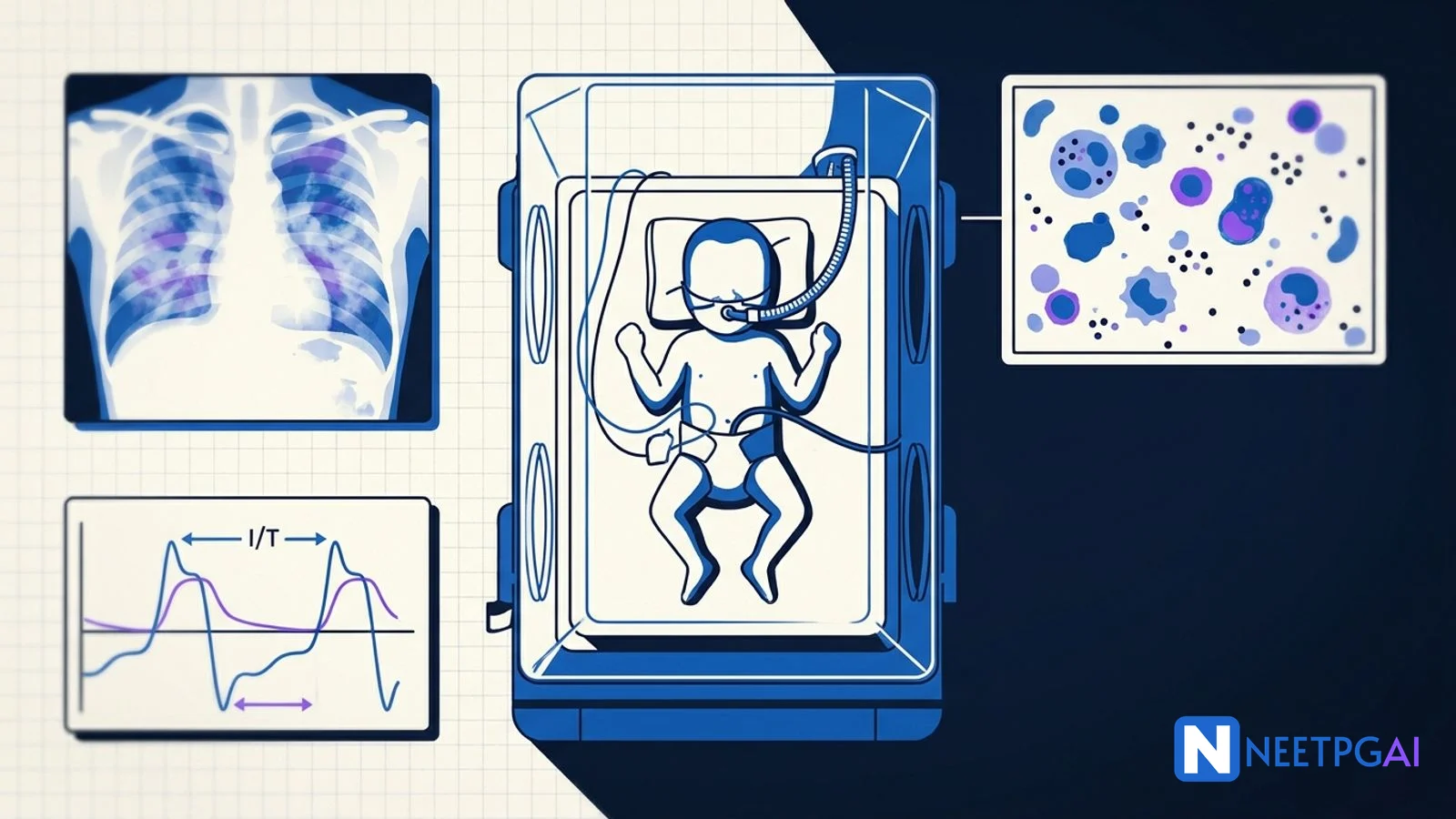
A 32-week preterm male on day 2 of life with maternal PROM 24 hours presenting with grunting, retractions, poor feeding, lethargy and temperature instability has EOS (early-onset sepsis, under 72 hours) with concurrent RDS until proven otherwise. Empirical therapy is ampicillin plus gentamicin (add cefotaxime if meningitis suspected or substitute for gentamicin), surfactant via LISA for RDS with FiO2 need over 30-40 percent, and nasal CPAP first-line respiratory support. Workup: blood culture 1 mL, CBC with I/T ratio over 0.2, CRP, procalcitonin, lumbar puncture when stable, chest X-ray. Watch for HIE differential by Sarnat staging if any history of perinatal asphyxia.
Why This Matters for NEET PG and INI-CET
Neonatal sepsis is a NEET PG and INI-CET perennial. India has one of the highest absolute burdens of neonatal mortality in the world - approximately 500,000 neonatal deaths annually, 40 percent from sepsis and sepsis-related complications. The exam tests this with 2-3 direct MCQs per NEET PG focusing on EOS vs LOS organism spectrum, empirical antibiotic choice, surfactant and CPAP indications, and the HIE differential (which is a common distractor and overlap in the preterm with perinatal distress).
INI-CET and AIIMS go deeper - testing I/T ratio cutoffs, procalcitonin kinetics, LISA vs INSURE surfactant delivery, bubble CPAP mechanics, Sarnat staging, hypothermia eligibility criteria from CoolCap and NICHD trials, CSF normal ranges in neonates, and complications like persistent pulmonary hypertension of the newborn (PPHN).
This clinical case walkthrough covers 7 MCQs across the full management arc - diagnosis, workup, empirical therapy, respiratory support decision, surfactant delivery, differential (HIE), and complications and follow-up. Build your clinical reasoning around this case and you will own neonatal sepsis for the exam.
The Case
A 32-week preterm male infant, birth weight 1.4 kg, was born by emergency caesarean section to a 26-year-old primigravida with premature rupture of membranes 24 hours before delivery. The mother had intermittent fever during labour (temperature 38.2 degrees Celsius) and received intrapartum ampicillin plus gentamicin. Apgar scores were 7 at 1 minute and 8 at 5 minutes. Initial resuscitation was uncomplicated. The baby was admitted to the NICU on nasal CPAP 5 cm H2O with FiO2 25 percent for mild respiratory distress.
On day 2 of life (approximately 36 hours of age) the baby develops worsening grunting, intercostal and subcostal retractions, poor feeding, lethargy and temperature instability (axillary temperature fluctuating between 36.0 and 37.9 degrees Celsius without environmental cause). FiO2 requirement has escalated to 35 percent on CPAP. The baby is tachycardic (heart rate 180), hypotensive (BP 48/26 mean 32), with cold peripheries and capillary refill 4 seconds. Random blood sugar is 42 mg/dL. CBC shows WBC 24,000 with 70 percent neutrophils, platelets 85,000.
MCQ 1 - Most Likely Diagnosis
Which of the following is the MOST likely primary diagnosis?
A. Transient tachypnoea of the newborn
B. Early-onset neonatal sepsis with likely respiratory distress syndrome
C. Hypoxic ischaemic encephalopathy
D. Congenital pneumonia from aspiration
Correct answer: B. Early-onset neonatal sepsis with likely respiratory distress syndrome.
Explanation: Three features converge on EOS. (1) Timing - presentation at 36 hours is within the EOS window (under 72 hours), (2) Risk factors - preterm 32 weeks, maternal PROM 24 hours (over 18 hours is a known risk factor), maternal intrapartum fever (suggestive of chorioamnionitis), (3) Clinical picture - temperature instability (both hypo- and hyperthermia in neonates), lethargy, poor feeding, worsening respiratory distress with escalating FiO2 requirement, hypotension with poor perfusion, thrombocytopenia (85,000) and leukocytosis with left shift. CRP and procalcitonin at this stage would reinforce the diagnosis.
Transient tachypnoea of the newborn (TTN) usually resolves by 24-48 hours and is not associated with lethargy, hypotension or thrombocytopenia. HIE is a term-baby diagnosis after perinatal asphyxia; this baby had Apgars of 7 and 8 and no asphyxia. Congenital pneumonia from aspiration overlaps with EOS and is often part of the same syndrome - the dominant working diagnosis remains EOS with pneumonia and probable surfactant deficiency (RDS) contributing to the respiratory picture.
MCQ 2 - Appropriate Initial Workup
Which of the following is NOT part of the initial sepsis workup in this baby?
A. Blood culture 1 mL from a peripheral site before antibiotics
B. Complete blood count with I/T ratio
C. Lumbar puncture when haemodynamically stable
D. Routine stool culture
Correct answer: D. Routine stool culture.
Explanation: The standard neonatal sepsis workup includes:
- Blood culture - minimum 1 mL from a clean peripheral site before antibiotics (the single most important investigation). Yield is 50-80 percent in true sepsis.
- CBC with differential - I/T (immature-to-total neutrophil) ratio over 0.2 is suggestive of sepsis; absolute neutrophil count less than 1500/microL carries high specificity; thrombocytopenia less than 100,000 is a late marker.
- CRP - rises at 12-24 hours, peaks at 24-48 hours; serial measurements are more useful than a single value; sensitivity under 70 percent at presentation.
- Procalcitonin - rises earlier than CRP (within 4-6 hours), peaks at 12-24 hours; more specific for bacterial infection in neonates after the physiological postnatal surge (which can elevate PCT in the first 48 hours of all neonates).
- Lumbar puncture - whenever haemodynamically stable, because meningitis coexists in 20-25 percent of EOS and alters antibiotic choice and duration.
- Chest X-ray - for respiratory signs.
- Blood sugar, electrolytes, blood gas - for metabolic status.
- Urine culture - via suprapubic aspiration or catheter (bag specimens unreliable); more important in LOS than EOS.
Stool culture is NOT routinely obtained unless there is diarrhoea or GI symptoms suggesting necrotising enterocolitis.
MCQ 3 - Empirical Antibiotic Choice
Which empirical antibiotic combination is MOST appropriate?
A. Vancomycin plus cefotaxime
B. Ampicillin plus gentamicin
C. Ceftriaxone plus amikacin
D. Meropenem monotherapy
Correct answer: B. Ampicillin plus gentamicin.
Explanation: EOS empirical therapy is ampicillin plus gentamicin - this combination covers:
- GBS, Enterococcus, Listeria, susceptible E. coli (ampicillin component).
- Gram-negatives including E. coli, Klebsiella, Enterobacter (gentamicin component).
- Synergy against GBS and Enterococcus.
Dose: ampicillin 50 mg/kg/dose IV every 12 hours (first week of life, under 29 weeks) up to every 6-8 hours (over 2 kg, over 1 week); gentamicin 4-5 mg/kg/dose IV every 24-36 hours (based on gestational and postnatal age; extended-interval dosing is standard in modern NICUs with trough monitoring).
Add cefotaxime if meningitis is suspected (poor penetration of aminoglycoside into CSF; cefotaxime at 50 mg/kg/dose IV every 8-12 hours covers gram-negative meningitis). Some units use cefotaxime instead of gentamicin for suspected meningitis.
Avoid ceftriaxone in neonates - it displaces bilirubin from albumin binding and precipitates with calcium in IV lines, causing fatal lung and renal precipitation. Cefotaxime is the preferred third-generation cephalosporin in neonates.
Vancomycin plus cefotaxime or vancomycin plus cefepime/piperacillin-tazobactam is empirical therapy for LOS (over 72 hours) in a NICU patient, not EOS.
Meropenem monotherapy is reserved for suspected ESBL-producing gram-negatives or multi-drug resistant pathogens, which is common in Indian NICUs with high ESBL prevalence - escalation is often needed if there is no clinical response in 48 hours.
Duration: 7-10 days for culture-proven sepsis without meningitis; 14-21 days for GBS meningitis; 21-28 days for gram-negative meningitis.
MCQ 4 - Respiratory Support Decision
The baby's FiO2 requirement rises to 55 percent on CPAP 7 cm H2O with grunting and retractions. Blood gas shows pH 7.22, PCO2 68 mmHg, PaO2 52 mmHg, HCO3 20 mEq/L. What is the next step?
A. Increase CPAP to 10 cm H2O
B. Intubate and start conventional mechanical ventilation plus deliver surfactant
C. Switch to high-flow nasal cannula
D. Observe for 2 hours on current settings
Correct answer: B. Intubate and start conventional mechanical ventilation plus deliver surfactant.
Explanation: The baby has met the standard criteria for intubation and surfactant:
- FiO2 requirement over 40-50 percent on optimal CPAP - this baby is on 55 percent and climbing.
- pH under 7.20 with PaCO2 over 65 mmHg despite CPAP - respiratory acidosis.
- Clinical deterioration - persistent grunting and retractions.
Surfactant is indicated for this preterm with RDS at FiO2 above 30-40 percent. Delivery options:
- LISA / MIST (Less Invasive Surfactant Administration / Minimally Invasive Surfactant Therapy) - thin catheter through vocal cords with baby spontaneously breathing on CPAP; preferred in modern practice; reduces mechanical ventilation duration and chronic lung disease (2019 European Consensus Guidelines).
- INSURE (INtubate - SURfactant - Extubate) - brief intubation, surfactant, extubation to CPAP within minutes.
- Full intubation plus mechanical ventilation plus surfactant - for babies who need ongoing ventilator support (like this case with pH 7.22 and PCO2 68).
Dose: poractant alfa 200 mg/kg initial, 100 mg/kg repeat at 6-12 hours if FiO2 remains elevated; beractant 100 mg/kg every 6 hours up to 4 doses.
Side effects of surfactant: transient bradycardia, hypoxia and apnoea during instillation; pulmonary haemorrhage in a small subset especially after rapid lung compliance improvement; endotracheal tube block.
Modes of ventilation: SIMV with pressure support, A/C, or volume-targeted ventilation (preferred to reduce volutrauma). High-frequency oscillatory ventilation (HFOV) for refractory respiratory failure, air-leak syndromes or persistent pulmonary hypertension.
High-flow nasal cannula is a non-invasive support option but is not appropriate here - this baby is failing CPAP.
MCQ 5 - Differential Diagnosis - HIE
Imagine the same baby had cord pH 6.95, 10-minute Apgar of 4, decreased tone, and now shows seizures and absent neonatal reflexes. What is the diagnosis and what is the time-sensitive intervention?
A. Severe neonatal sepsis - escalate antibiotics
B. Hypoxic ischaemic encephalopathy stage 2-3; start therapeutic hypothermia within 6 hours
C. Intracranial haemorrhage - urgent neurosurgery
D. Metabolic encephalopathy - start IV glucose
Correct answer: B. Hypoxic ischaemic encephalopathy stage 2-3; start therapeutic hypothermia within 6 hours.
Explanation: Hypoxic ischaemic encephalopathy (HIE) is diagnosed when there is evidence of perinatal asphyxia (cord pH under 7.0 or base deficit over 16 mEq/L, 10-minute Apgar under 5, continued resuscitation at 10 minutes OR acute sentinel perinatal event like placental abruption or cord prolapse) plus moderate-to-severe encephalopathy on exam.
Sarnat staging:
| Stage | Alertness | Tone | Reflexes | Seizures | Prognosis |
|---|
| 1 (mild) | Hyperalert | Mild hypotonia | Hyperactive | None | Excellent |
| 2 (moderate) | Lethargic | Moderate hypotonia | Decreased | Common | 20-40 percent death or disability |
| 3 (severe) | Stuporous/coma | Severe hypotonia or flaccid | Decreased or absent | Uncommon late | 80 percent death or disability |
Therapeutic hypothermia (whole body or selective head cooling to 33.5 degrees Celsius for 72 hours) is standard of care for Sarnat 2-3 HIE in term and late preterm (over 35-36 weeks). Eligibility (CoolCap, NICHD, TOBY trials):
- Gestational age over 35-36 weeks.
- Within 6 hours of birth.
- Cord pH under 7.0 OR base deficit over 16 mEq/L OR acute perinatal event plus 10-minute Apgar under 5 or continued resuscitation at 10 minutes.
- Moderate-to-severe encephalopathy on exam (Sarnat 2 or 3).
Hypothermia reduces death or disability by approximately 25 percent (NNT ~7). Cool for 72 hours then rewarm slowly at 0.5 degrees per hour. Supportive measures: seizure control with phenobarbitone (first-line) or levetiracetam, avoidance of hyperthermia, maintenance of normal glucose and PCO2 (hypocapnia worsens brain injury), fluid restriction for SIADH.
The crucial exam point: HIE is a term-baby diagnosis (preterm encephalopathy has different pathophysiology and does not benefit from hypothermia on current evidence), the 6-hour window is non-negotiable, and the primary intervention is cooling.
MCQ 6 - CSF Interpretation in Suspected Meningitis
Lumbar puncture on day 3 shows CSF WBC 180 cells/microL (85 percent neutrophils), protein 180 mg/dL, glucose 24 mg/dL (serum 92 mg/dL). What is the diagnosis and treatment duration?
A. Normal preterm CSF - no change
B. Bacterial meningitis - cefotaxime plus ampicillin for 14-21 days
C. Viral meningitis - supportive care
D. Fungal meningitis - amphotericin B
Correct answer: B. Bacterial meningitis - cefotaxime plus ampicillin for 14-21 days.
Explanation: Normal neonatal CSF values are wider than adult:
- WBC: term up to 20-30 cells/microL; preterm up to 25-30.
- Protein: term 60-120 mg/dL; preterm up to 150 mg/dL.
- Glucose: over 60 percent of serum.
This CSF shows:
- WBC 180 with neutrophil predominance (well above normal).
- Protein 180 (above the preterm cutoff of 150).
- Glucose 24, which is 26 percent of serum (far below the 60 percent cutoff).
This is bacterial meningitis.
Treatment: cefotaxime 150-200 mg/kg/day in divided doses PLUS ampicillin 300 mg/kg/day for Listeria coverage. Add vancomycin if MRSA or coagulase-negative Staph is a concern.
Duration:
- GBS meningitis: 14-21 days.
- Gram-negative meningitis: 21-28 days (longer because of relapse risk).
- Listeria: 14 days.
Repeat LP at 24-48 hours to confirm CSF sterilisation and at end of therapy for gram-negative meningitis.
Dexamethasone has NO proven benefit in neonatal meningitis (unlike childhood H. influenzae meningitis). Blood culture is positive in only 50-70 percent of neonatal meningitis cases - CSF culture is the gold standard. HSV PCR should be sent if there is seizure activity, hepatitis, vesicles or maternal history of primary genital herpes.
MCQ 7 - Follow-up and Complications
Which of the following is NOT a standard follow-up after neonatal sepsis with meningitis?
A. Hearing screen (OAE and BERA)
B. Neurodevelopmental assessment at 1, 2 and 3 years
C. Routine renal ultrasound at 3 months
D. Head imaging for subdural effusion or ventriculitis
Correct answer: C. Routine renal ultrasound at 3 months.
Explanation: Standard follow-up after neonatal sepsis with meningitis includes:
- Hearing screening: otoacoustic emissions (OAE) at discharge and brainstem evoked response audiometry (BERA) at 3-6 months. Meningitis causes sensorineural hearing loss in 10-30 percent and is the most important preventable developmental cause after neonatal infection.
- Neurodevelopmental assessment: at 6, 12, 24 and 36 months - cognitive, motor, language and behavioural domains using Bayley Scales of Infant Development or similar.
- Head imaging (cranial ultrasound initially, MRI at discharge or at follow-up): to detect subdural effusion, ventriculitis, hydrocephalus, periventricular leukomalacia, cerebral abscess.
- Ophthalmology screening in preterm infants under 32 weeks for retinopathy of prematurity.
- Chest X-ray and oxygen saturation monitoring: screen for bronchopulmonary dysplasia (chronic lung disease of prematurity) in survivors of RDS.
- Vaccinations: routine schedule by chronological (not corrected) age, except hepatitis B which may be delayed if preterm under 2 kg; influenza vaccine from 6 months.
Routine renal ultrasound at 3 months is NOT a standard follow-up unless there was documented AKI during sepsis or a specific indication (congenital renal anomaly, UTI).
High-Yield One-Liners
- EOS: under 72 hours; vertical transmission; GBS and E. coli dominant; empirical ampicillin plus gentamicin.
- LOS: over 72 hours; healthcare-acquired or community; vancomycin plus cefepime/pip-tazo for NICU patients.
- PROM over 18 hours is a significant risk factor for EOS.
- I/T ratio over 0.2 suggests sepsis.
- CRP rises at 12-24 hours; procalcitonin rises at 4-6 hours (earlier).
- Blood culture 1 mL minimum from peripheral site before antibiotics.
- Avoid ceftriaxone in neonates - displaces bilirubin, calcium precipitation; use cefotaxime.
- Surfactant indicated at FiO2 over 30-40 percent on CPAP in preterm.
- LISA/MIST = modern first-line delivery (2019 European Consensus Guidelines).
- CPAP 5-8 cm H2O first-line respiratory support in preterm RDS.
- Bubble CPAP - Indian NICU workhorse, equivalent outcomes to variable-flow CPAP.
- Intubation criteria: FiO2 over 40-50 percent on CPAP, pH under 7.20, PaCO2 over 65 mmHg, apnoea.
- HIE Sarnat 2 or 3 at term over 35-36 weeks + perinatal asphyxia = therapeutic hypothermia within 6 hours.
- Cooling to 33.5 degrees Celsius for 72 hours; rewarm at 0.5 degrees/hour.
- Normal neonatal CSF: WBC up to 20-30, protein 60-120 (term) up to 150 (preterm), glucose over 60 percent of serum.
- Bacterial meningitis treatment: cefotaxime plus ampicillin; GBS 14-21 days, gram-negative 21-28 days, Listeria 14 days.
- Dexamethasone: NO benefit in neonatal meningitis.
- Meningitis complications: hearing loss (10-30 percent), hydrocephalus, cerebral palsy, developmental delay.
- Phenobarbitone: first-line neonatal seizure control.
- BERA at 3-6 months mandatory after neonatal meningitis.
Common Mistakes
- Using ceftriaxone in a neonate - displaces bilirubin from albumin binding (risk of kernicterus) and precipitates with calcium in IV lines causing fatal lung/renal precipitation. Always use cefotaxime instead.
- Starting therapeutic hypothermia in a preterm under 35 weeks - cooling trials excluded preterm infants; hypothermia has no proven benefit and can cause instability in preterms. Reserve for term and late-preterm.
- Skipping lumbar puncture because the baby looks "too sick" - meningitis coexists with sepsis in 20-25 percent and changes antibiotic choice and duration. Defer LP only if haemodynamically unstable or bleeding diathesis; do it as soon as stable.
- Stopping antibiotics at 48 hours despite worsening clinical picture because blood culture is negative - blood culture sensitivity is 50-80 percent and false negatives are common with small volumes or prior antenatal antibiotic exposure. Clinical judgment and inflammatory markers drive duration, not culture alone.
- Treating molluscum-mimicking neonatal pustulosis with antibiotics without stain or culture - erythema toxicum neonatorum has sterile eosinophilic pustules and resolves spontaneously; starting antibiotics empirically is both wrong and risky. Always Wright stain pustules in a neonate before deciding.
Related Topics on NEETPGAI
Practice This on NEETPGAI
Neonatal sepsis is a reliable annual yield on NEET PG and INI-CET - EOS vs LOS, surfactant indications, CPAP mechanics and HIE differential appear every cycle. NEETPGAI's free 28,000+ MCQ bank includes real previous year clinical case questions with step-by-step explanations and spaced-repetition revision. Sign up free and build your paediatrics mastery with daily cases.