Version 1.0 - Published October 2026
Quick Answer
Myeloproliferative neoplasms (MPNs) are clonal stem cell disorders of mature myeloid cells. CML is defined by the Philadelphia chromosome t(9;22) producing BCR-ABL1 - treated with imatinib, dasatinib, nilotinib. Ph-negative MPNs (PV, ET, PMF) are defined by JAK2 V617F (95 percent of PV, 50-60 percent of ET and PMF), CALR or MPL mutations - treated with phlebotomy and hydroxyurea (PV/ET), ruxolitinib (symptomatic PMF). High-yield one-liners: aquagenic pruritus = PV, erythromelalgia = ET or PV, Philadelphia + = CML, massive splenomegaly = PMF.
Why This Matters for NEET PG and INI-CET
MPNs are a NEET PG favourite because they combine haematology, molecular biology, cytogenetics and therapeutic targeting into a tight high-yield cluster. Expect 1-2 direct MCQs and 1-2 indirect ones per NEET PG, with INI-CET and AIIMS consistently testing WHO diagnostic criteria, driver mutation specificities, drug mechanism of action (imatinib, ruxolitinib) and complications (transformation to AML, acquired vWD, splanchnic vein thrombosis).
The classic exam traps: (1) distinguishing primary from secondary polycythemia using serum erythropoietin and JAK2, (2) matching the symptom (aquagenic pruritus, erythromelalgia, Budd-Chiari syndrome, massive splenomegaly with dry tap) to the specific MPN, (3) matching the drug (imatinib to BCR-ABL1, ruxolitinib to JAK1/2) to the mutation, and (4) knowing WHO 2022 criteria for PV, ET and PMF including the trilineage megakaryocyte morphology that distinguishes early PMF from ET. Image MCQs often show peripheral smear with teardrop RBCs plus leukoerythroblastic picture (PMF) or hypercellular marrow with "dwarf" megakaryocytes (CML).
MPNs are also increasingly INI-CET territory because of molecular medicine: the Philadelphia chromosome is the first cancer with a successful targeted therapy and the paradigm case for teaching tyrosine kinase inhibition, kinase domain mutations (T315I gatekeeper), and quantitative molecular monitoring (BCR-ABL1 IS on PCR).
The MPN Family - Overview
MPNs are clonal haematopoietic stem cell neoplasms in which a single acquired mutation drives unregulated proliferation of one or more mature myeloid lineages (granulocytic, erythroid, megakaryocytic). The 2016 WHO classification (revised 2022) splits them into:
| Entity | Driver Mutation | Lineage Driven | High-Yield Feature |
|---|
| CML (chronic myeloid leukaemia) | BCR-ABL1 t(9;22) | Granulocytic | Imatinib response; blast crisis risk |
| PV (polycythemia vera) | JAK2 V617F (95%), JAK2 exon 12 (5%) | Erythroid dominant (panmyelosis) | Aquagenic pruritus; LOW EPO |
| ET (essential thrombocythemia) | JAK2 V617F (50-60%), CALR (20-30%), MPL (5%) | Megakaryocytic | Platelets >450; erythromelalgia |
| PMF (primary myelofibrosis) | JAK2 V617F (50-65%), CALR, MPL | Megakaryocytic + reticulin fibrosis | Dry tap, teardrop RBCs, massive splenomegaly |
Minor MPN entities: chronic neutrophilic leukaemia (CSF3R T618I), chronic eosinophilic leukaemia (FIP1L1-PDGFRA), systemic mastocytosis (KIT D816V), MPN-unclassifiable.
CML - BCR-ABL1 in Depth
Pathogenesis
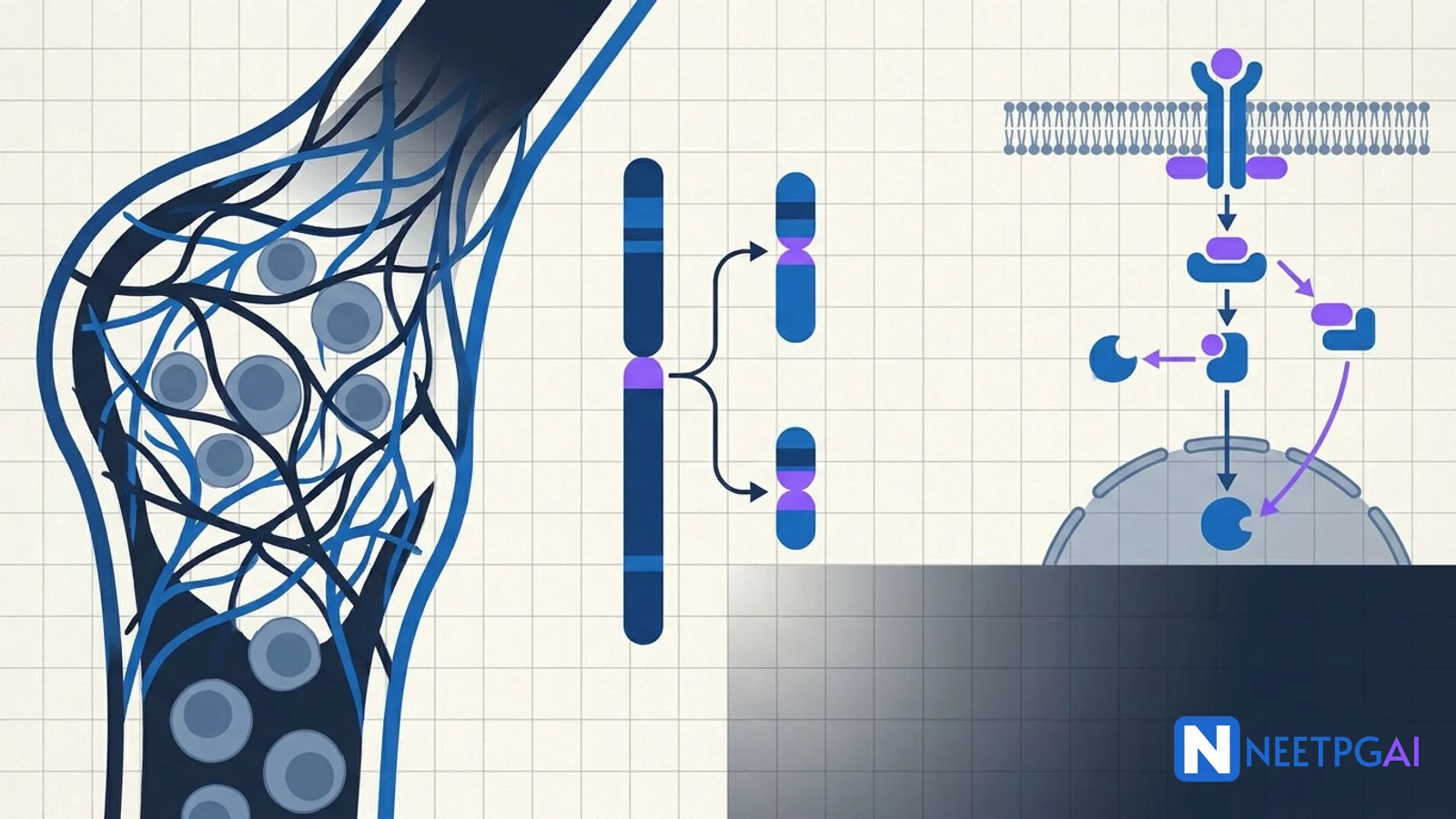
The reciprocal translocation t(9;22)(q34;q11.2) juxtaposes the BCR gene on chromosome 22 with the ABL1 proto-oncogene on chromosome 9. The resulting Philadelphia chromosome (der(22)) carries the BCR-ABL1 fusion. Three major fusion transcripts exist based on BCR breakpoint:
- p210 BCR-ABL1 (M-BCR, major breakpoint): classic CML - over 95 percent of cases.
- p190 BCR-ABL1 (m-BCR, minor breakpoint): Ph+ ALL - occasional CML.
- p230 BCR-ABL1 (micro-BCR): chronic neutrophilic leukaemia phenotype - rare.
BCR-ABL1 is a constitutively active tyrosine kinase. Downstream it activates RAS-MAPK (proliferation), PI3K-AKT-mTOR (survival), JAK-STAT (STAT5 proliferation and survival) and inhibits apoptosis via BAD phosphorylation.
Clinical Phases
| Phase | Blasts in Blood/Marrow | Features |
|---|
| Chronic (CP) | <10 percent | Asymptomatic, splenomegaly, leukocytosis, basophilia |
| Accelerated (AP) | 10-19 percent | Increasing resistance to therapy, additional cytogenetic abnormalities, basophilia >20 percent, thrombocytopenia <100 x 10^9/L unrelated to therapy, thrombocytosis >1000 x 10^9/L unresponsive to therapy |
| Blast crisis (BC) | >=20 percent | Behaves like acute leukaemia - 70 percent myeloid, 30 percent lymphoid lineage |
Diagnosis
- Peripheral blood: markedly elevated WBC often 100-500 x 10^9/L, with all stages of granulocytic maturation (myelocytes through segmented neutrophils), basophilia and eosinophilia, mild anaemia, platelets often elevated.
- Bone marrow: hypercellular, granulocytic hyperplasia, M:E ratio 10-25:1, "dwarf megakaryocytes" (small, hypolobated), reticulin fibrosis in a subset.
- Cytogenetics: Philadelphia chromosome by karyotype (90-95 percent) or FISH for BCR-ABL1 fusion.
- Molecular: RT-PCR for BCR-ABL1 transcripts - diagnostic (qualitative) and monitoring (quantitative, reported on the International Scale).
Treatment
| Line | Drug | Mechanism | Notes |
|---|
| 1st line (chronic phase) | Imatinib 400 mg OD | ATP-competitive TKI | First-generation; standard; cheap; good tolerability |
| 1st or 2nd line | Dasatinib 100 mg OD | 2nd gen TKI, also SRC inhibitor | Faster/deeper response; pleural effusion risk |
| 1st or 2nd line | Nilotinib 300 mg BID | 2nd gen TKI | Faster/deeper response; QT prolongation, hyperglycaemia |
| 2nd or 3rd line | Bosutinib | 2nd gen TKI | Diarrhoea predominant |
| T315I resistance | Ponatinib | 3rd gen TKI | Vascular toxicity; use after T315I confirmed |
| T315I resistance | Asciminib (STAMP inhibitor) | Allosteric myristoyl pocket | Newer, better safety |
| Advanced phase or TKI failure | Allo-HSCT | Curative | Reserved for TKI-resistant or blast phase |
Monitoring: quantitative BCR-ABL1 IS at diagnosis, 3, 6, 12 months and 3-6 monthly thereafter. Targets:
- Early molecular response (EMR): BCR-ABL1 IS less than or equal to 10 percent at 3 months.
- Complete cytogenetic response (CCyR): no Ph+ cells on karyotype OR BCR-ABL1 IS less than or equal to 1 percent.
- Major molecular response (MMR): BCR-ABL1 IS less than or equal to 0.1 percent.
- Deep molecular response (MR 4.0 / MR 4.5): BCR-ABL1 IS less than or equal to 0.01 percent / 0.0032 percent - prerequisite for treatment-free remission trials.
Polycythemia Vera (PV) in Depth
WHO 2022 Diagnostic Criteria
Need all 3 major OR first 2 major + minor:
Major:
- Haemoglobin greater than 16.5 g/dL (males) or greater than 16.0 g/dL (females), OR haematocrit greater than 49 percent (males) or greater than 48 percent (females), OR increased red cell mass more than 25 percent above mean normal predicted value.
- Bone marrow trilineage proliferation (panmyelosis) with pleomorphic mature megakaryocytes.
- JAK2 V617F or JAK2 exon 12 mutation.
Minor:
- Subnormal serum erythropoietin level.
Clinical Features
- Aquagenic pruritus: itching, often severe, 15-30 min after contact with warm water (bath/shower). Highly specific. Driven by mast cell activation and basophilic histamine release.
- Erythromelalgia: burning erythema of hands and feet due to microvascular platelet thrombosis; relieved by aspirin.
- Facial plethora, splenomegaly, headache, dizziness.
- Thrombosis: arterial (stroke, MI) and venous (DVT, PE, portal, hepatic - Budd-Chiari syndrome).
- Bleeding: acquired von Willebrand disease at very high platelet counts.
- Hyperviscosity: at haematocrit above 55-60 percent.
Investigations
- Low serum erythropoietin, elevated LDH, elevated vitamin B12 (transcobalamin from clonal granulocytes), hyperuricaemia.
- JAK2 V617F PCR positive in 95 percent; JAK2 exon 12 in 5 percent of V617F-negative PV.
- Bone marrow: hypercellular, panmyelosis, pleomorphic megakaryocytes clustered in loose groups, reticulin fibrosis absent to mild (if marked - think post-PV myelofibrosis).
Treatment
| Risk Category | Treatment |
|---|
| All patients | Low-dose aspirin 75-100 mg OD; phlebotomy to haematocrit less than 45 percent |
| High risk (age over 60 OR prior thrombosis) | Add cytoreduction: hydroxyurea 1st line, pegylated interferon alpha-2a 1st line in young/pregnant |
| Hydroxyurea intolerant or resistant | Ruxolitinib (JAK1/2 inhibitor) |
| Progressed disease (post-PV MF, AML) | Allo-HSCT if candidate |
Essential Thrombocythemia (ET) in Depth
WHO 2022 Diagnostic Criteria
Need all 4 major OR first 3 major + minor:
Major:
- Platelet count greater than or equal to 450 x 10^9/L.
- Bone marrow with proliferation of large mature megakaryocytes with hyperlobulated nuclei; no significant granulocytic or erythroid proliferation; reticulin fibrosis grade 0-1.
- Not meeting WHO criteria for CML, PV, PMF, MDS or other myeloid neoplasm.
- JAK2 V617F, CALR or MPL mutation.
Minor:
- Presence of a clonal marker OR exclusion of reactive thrombocytosis.
Clinical and Treatment Overview
Features: often asymptomatic incidental finding; thrombosis (arterial dominant); microvascular events (erythromelalgia, headache, visual symptoms); bleeding at platelets above 1500 x 10^9/L from acquired vWD. Risk stratification by IPSET-thrombosis: age over 60, prior thrombosis, JAK2 mutation, cardiovascular risk factors.
Treatment:
- Low risk: observation or aspirin.
- High risk: hydroxyurea plus aspirin; pegylated interferon alfa in young/pregnant; anagrelide 2nd line (platelet-selective).
- Pregnancy: aspirin plus pegylated interferon alfa; avoid hydroxyurea.
Primary Myelofibrosis (PMF) in Depth
WHO 2022 Diagnostic Criteria
Need all 3 major + at least 1 minor:
Major:
- Megakaryocytic proliferation with atypia, accompanied by reticulin and/or collagen fibrosis grade 2-3.
- Not meeting WHO criteria for ET, PV, BCR-ABL1-positive CML, MDS or other myeloid neoplasm.
- JAK2 V617F, CALR, MPL mutation OR another clonal marker OR exclusion of reactive myelofibrosis.
Minor (at least 1, confirmed in two consecutive determinations):
- Anaemia not attributed to a comorbid condition.
- Leukocytosis greater than or equal to 11 x 10^9/L.
- Palpable splenomegaly.
- LDH increased.
- Leukoerythroblastosis.
Clinical Features
- Massive splenomegaly (hallmark); fatigue, weight loss, early satiety.
- Leukoerythroblastic peripheral smear: nucleated red cells, teardrop RBCs (dacrocytes), immature myeloid cells.
- Dry tap on marrow aspiration - the hallmark; marrow is fibrotic and cells cannot be aspirated. Diagnosis by trephine biopsy showing reticulin stain positive fibrosis (grade 2-3).
- Constitutional symptoms (fever, night sweats, weight loss greater than 10 percent in 6 months).
- Transformation to AML in 10-20 percent.
Risk Stratification and Treatment
DIPSS score (age over 65, constitutional symptoms, Hb less than 10, WBC over 25, blood blasts 1 percent or more) stratifies to low, intermediate-1, intermediate-2, high risk with medians 15.4, 6.5, 2.9, 1.3 years. MIPSS70+ v2.0 adds driver mutation and high molecular risk (ASXL1, EZH2, SRSF2, IDH1/2).
Treatment:
- Low risk / asymptomatic: observation, transfusion as needed.
- Symptomatic splenomegaly or constitutional symptoms (intermediate-2 or high): ruxolitinib (JAK1/2 inhibitor).
- Fedratinib, momelotinib (anaemia-sparing), pacritinib (thrombocytopenia-sparing).
- Transplant candidate, intermediate-2 or high risk: allogeneic haematopoietic stem cell transplantation - the only curative option; 50-60 percent long-term survival in selected patients.
Summary Comparison Table
| Feature | CML | PV | ET | PMF |
|---|
| Driver | BCR-ABL1 | JAK2 (95%) | JAK2 50-60%, CALR 20-30%, MPL 5% | JAK2 50-65%, CALR, MPL |
| Blood dominant | WBC | Hb/Hct | Platelets | Teardrops + leukoerythroblastic |
| Marrow | Granulocytic hyperplasia, dwarf megas | Panmyelosis, pleomorphic megas | Large mature hyperlobulated megas | Fibrosis grade 2-3, atypical megas |
| Pathognomonic sign | Massive splenomegaly, basophilia | Aquagenic pruritus | Erythromelalgia | Dry tap, teardrops, massive splenomegaly |
| 1st line | Imatinib/dasatinib/nilotinib | Phlebotomy + aspirin +/- hydroxyurea | +/- Aspirin, hydroxyurea if high risk | Ruxolitinib if symptomatic |
| Curative | Allo-HSCT (rare need) | Allo-HSCT (rare) | Allo-HSCT (rare) | Allo-HSCT (standard in int-2/high) |
| Transformation to AML | Blast crisis via accelerated phase | 2-5 percent | <5 percent | 10-20 percent (highest) |
High-Yield One-Liners
- Philadelphia chromosome: t(9;22)(q34;q11.2), BCR-ABL1 fusion - 100 percent of CML.
- BCR-ABL1 isoforms: p210 (CML), p190 (Ph+ ALL), p230 (CNL phenotype).
- Imatinib (Gleevec) - ATP-competitive BCR-ABL1 TKI; cornerstone first-line CML.
- T315I gatekeeper mutation - resistant to all 1st/2nd gen TKIs; use ponatinib or asciminib.
- BCR-ABL1 molecular monitoring: International Scale (IS) by RT-PCR; MMR = IS less than or equal to 0.1 percent at 12 months.
- JAK2 V617F: 95 percent of PV, 50-60 percent of ET, 50-65 percent of PMF.
- JAK2 exon 12 mutation covers approximately 5 percent of PV (JAK2 V617F negative).
- CALR exon 9 mutation: 20-30 percent of ET and PMF; lower thrombotic risk in ET.
- MPL W515L/K mutation: 5-10 percent of ET and PMF.
- Aquagenic pruritus = polycythemia vera (highly specific).
- Erythromelalgia = ET or PV; relieved by aspirin.
- Massive splenomegaly + dry tap + teardrop RBCs = primary myelofibrosis.
- Low serum EPO = PV (not secondary erythrocytosis).
- Elevated vitamin B12 and LDH in MPNs (clonal granulocytes).
- Budd-Chiari syndrome - 30-40 percent are due to PV or ET.
- Acquired von Willebrand disease at platelets greater than 1500 x 10^9/L.
- Ruxolitinib: JAK1/2 inhibitor; approved for intermediate-2/high risk PMF and HU-intolerant PV.
- Allo-HSCT: curative; standard for intermediate-2/high risk PMF; rarely needed for CML on TKI.
- Transformation to AML: highest in PMF (10-20 percent).
- Hydroxyurea: standard cytoreduction in high-risk PV and ET; myelosuppression and leg ulcers at long term.
Common Mistakes
- Confusing primary from secondary erythrocytosis - do not diagnose PV without checking serum erythropoietin (LOW in PV, HIGH in secondary) and JAK2 (POSITIVE in PV).
- Starting aspirin at platelet count over 1500 x 10^9/L without screening for acquired vWD - acquired type 2A vWD worsens with aspirin and causes mucocutaneous bleeding. Check vWF antigen, activity and multimer analysis first.
- Diagnosing CML on basis of leukocytosis alone - leukemoid reaction (infection, G-CSF, severe inflammation) causes similar peripheral smear. Alkaline phosphatase score (LAP) is high in leukemoid reaction and LOW in CML (historical) - today, PCR for BCR-ABL1 is diagnostic.
- Giving ponatinib empirically for TKI resistance - ponatinib has significant vascular toxicity (arterial occlusion, VTE). Reserve for T315I-confirmed resistance; try nilotinib or dasatinib first for non-T315I resistance.
- Missing early PMF presenting as isolated thrombocytosis - early (prefibrotic) PMF can look like ET on blood counts. The distinguishing feature is marrow morphology (atypical, dense clustering of megakaryocytes with hyperchromatic nuclei in prefibrotic PMF versus large mature megakaryocytes in ET). Prefibrotic PMF has worse prognosis than ET - do not underclassify.
Related Topics on NEETPGAI
Practice This on NEETPGAI
MPNs are a reliable annual yield on NEET PG and INI-CET - driver mutations, WHO criteria and targeted therapy mechanisms recur every exam cycle. NEETPGAI's free 28,000+ MCQ bank includes real previous year questions on CML, PV, ET and PMF with step-by-step explanations and spaced-repetition revision. Sign up free and build your haematology mastery today.