Updated 23 November 2026
Quick Answer
A 32-week baby who deteriorates at 36 hours after maternal fever and 24 hours of ruptured membranes has early onset sepsis with respiratory distress syndrome until proven otherwise. Take a blood culture, send a sepsis screen, start ampicillin plus gentamicin, support breathing with CPAP and give surfactant. Intubate if CPAP fails; do the lumbar puncture once stable.
Why this case is built the way it is
Neonatal sepsis questions rarely ask you to name a bug in isolation. They hand you a sick preterm baby and test whether you can hold three overlapping problems at once: infection, surfactant deficiency and, as a distractor, asphyxia. The baby below has all the cues. Work through the seven questions in order, because each one depends on getting the previous step right.
One opinion before you start: in any preterm baby who is unwell in the first three days, treat sepsis as present until the cultures say otherwise. Students lose marks by choosing "observe" or "transient tachypnoea" because one feature looks benign. Sick newborns show infection in vague ways, and examiners know it. For the wider neonatology syllabus, the paediatrics high-yield topics guide shows where this case fits.
The case
A male baby is born at 32 weeks by emergency caesarean section, weighing 1.4 kg. His mother, a 26-year-old primigravida, had premature rupture of membranes 24 hours before delivery and a temperature of 38.2 °C in labour; she received intrapartum ampicillin and gentamicin. Apgar scores were 7 at 1 minute and 8 at 5 minutes, and resuscitation was routine. He goes to the NICU on nasal CPAP 5 cm H2O with FiO2 25% for mild distress.
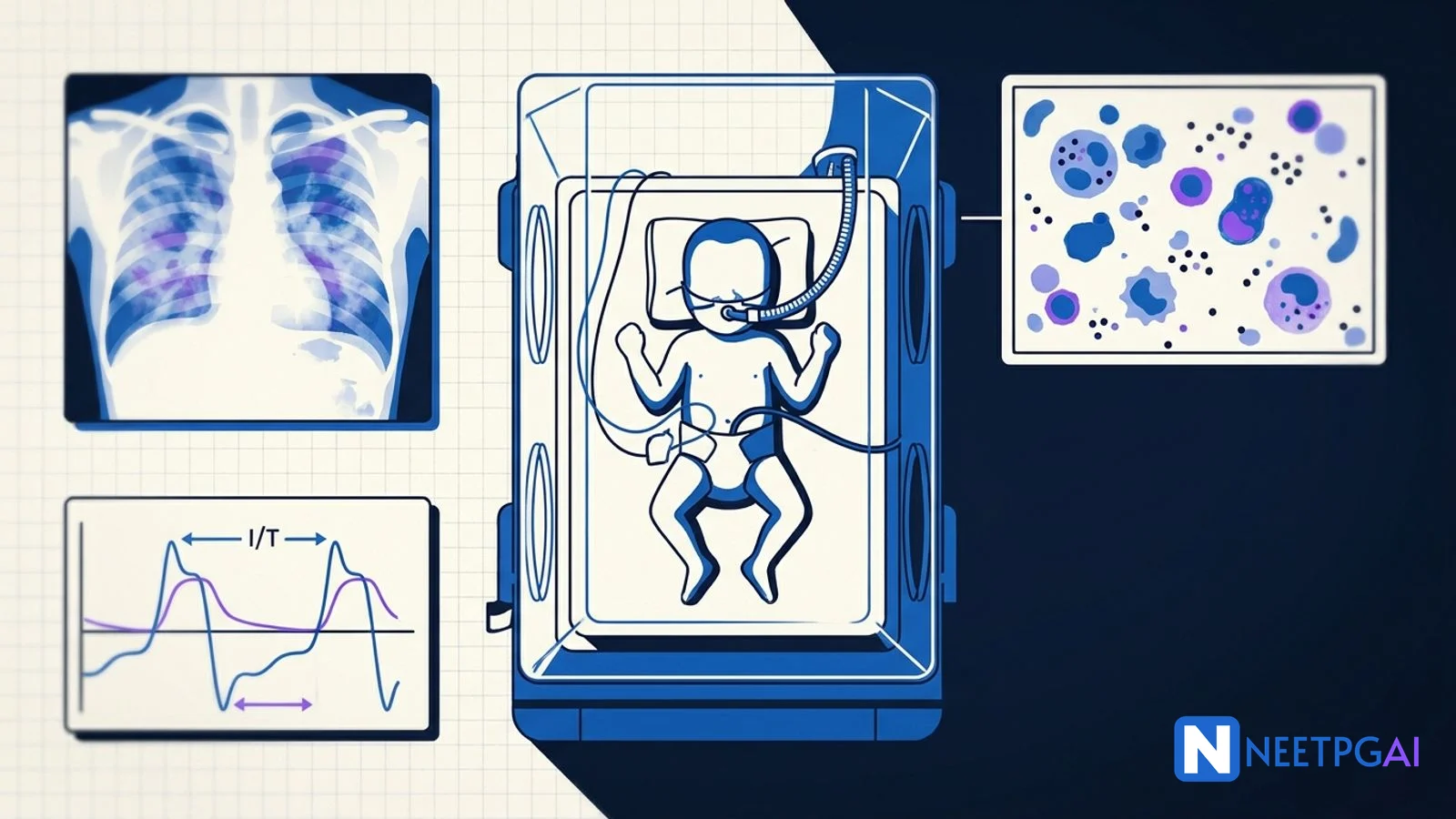
At about 36 hours of age he gets worse: more grunting, intercostal and subcostal retractions, poor feeding, lethargy, and an axillary temperature swinging between 36.0 and 37.9 °C without an environmental cause. FiO2 has crept up to 35%. Heart rate is 180, blood pressure 40/22 with a mean of 28 (below his gestational age in weeks, the usual bedside threshold for hypotension), peripheries are cold and capillary refill is 4 seconds. Blood glucose is 42 mg/dL. Total leucocyte count is 4,200/mm3 with an I/T ratio of 0.3, and platelets are 85,000/mm3.
Question 1: Is this sepsis, TTN or asphyxia?
Which of the following is the most likely primary diagnosis?
A. Transient tachypnoea of the newborn
B. Early onset neonatal sepsis with likely respiratory distress syndrome
C. Hypoxic ischaemic encephalopathy
D. Congenital pneumonia from aspiration
Answer: B, early onset sepsis with likely RDS.
Three things point here. Timing: 36 hours is inside the 72-hour early onset window. Risk factors: 32 weeks, membranes ruptured for more than 18 hours, and maternal fever suggesting chorioamnionitis. The picture: temperature instability, lethargy, poor feeding, rising oxygen need, poor perfusion, leucopenia, a raised I/T ratio and falling platelets. Hypoglycaemia (below 45 mg/dL by most Indian unit protocols) fits too.
Transient tachypnoea usually settles by 24-48 hours and doesn't cause lethargy, shock or thrombocytopenia. HIE needs an asphyxial event, and Apgars of 7 and 8 rule that out. Congenital pneumonia isn't really a separate answer; it is often how early onset sepsis presents in the lungs, layered on the surfactant deficiency you'd expect at 32 weeks.
Question 2: Which test is not part of the initial sepsis work-up?
Which of the following is not part of the initial work-up in this baby?
A. Blood culture of at least 1 mL from a peripheral site before antibiotics
B. Complete blood count with I/T ratio
C. Lumbar puncture when haemodynamically stable
D. Routine stool culture
Answer: D, routine stool culture.
The standard work-up:
- Blood culture, at least 1 mL, before antibiotics. This is the single most important test. Small volumes and intrapartum antibiotics both make false negatives common, so a negative culture never excludes sepsis on its own.
- CBC with differential, for leucopenia, neutropenia, the I/T ratio and platelets.
- CRP, which takes 12-24 hours to rise meaningfully, so serial values are more useful than one.
- Procalcitonin, which rises earlier but has a physiological surge in the first 24-48 hours of life in all newborns, which muddies early values.
- Lumbar puncture once the baby is stable, because meningitis changes the drug and the duration.
- Chest X-ray, blood glucose, electrolytes and a blood gas.
- Urine culture by suprapubic aspiration or catheter matters more in late onset sepsis.
Indian exams often ask about the composite sepsis screen used in AIIMS neonatal protocols and Ghai. Two or more positives make the screen positive:
| Component | Abnormal value |
|---|
| Total leucocyte count | Below 5,000/mm3 |
| Absolute neutrophil count | Below the age-specific (Manroe) reference |
| I/T ratio | Above 0.2 |
| Micro-ESR | Above 15 mm in the first hour |
| CRP | Above 1 mg/dL |
Apply it to this baby: leucopenia and an I/T ratio of 0.3 already give two positives, so the screen is positive before the CRP comes back. Stool culture belongs only to diarrhoea or suspected necrotising enterocolitis.
Question 3: Which empirical antibiotics?
Which empirical combination is most appropriate?
A. Vancomycin plus cefotaxime
B. Ampicillin plus gentamicin
C. Ceftriaxone plus amikacin
D. Meropenem monotherapy
Answer: B, ampicillin plus gentamicin.
Ampicillin covers GBS, Listeria, enterococci and some E. coli; gentamicin covers the gram-negatives (E. coli, Klebsiella, Enterobacter) and works synergistically against GBS and enterococci. Typical doses are ampicillin 50 mg/kg per dose (every 12 hours in the first week, more often later) and gentamicin 4-5 mg/kg per dose every 24-48 hours depending on gestation, with levels where available.
Add cefotaxime, or use it in place of gentamicin, if meningitis is suspected, because aminoglycosides penetrate CSF poorly. Ceftriaxone is the wrong cephalosporin in a newborn: it displaces bilirubin from albumin and can form fatal precipitates with intravenous calcium. Vancomycin with an antipseudomonal drug is late onset NICU sepsis cover. Meropenem is for proven or strongly suspected ESBL or multidrug-resistant organisms.
Here is the honest caveat for Indian practice. The textbook answer assumes a Western organism mix. The Delhi Neonatal Infection Study (DeNIS, 2016) found Klebsiella, E. coli and Acinetobacter dominating, with high rates of multidrug resistance, so many Indian units start with an aminoglycoside and a cephalosporin chosen from their own antibiogram and escalate early if the baby doesn't respond. For the exam, ampicillin plus gentamicin is still the answer unless the stem tells you about resistance.
Duration depends on what you find. Culture-negative sepsis with a reassuring course is often stopped at 48-72 hours. Culture-proven sepsis without meningitis usually gets 10-14 days (some units use 7-10 for uncomplicated bacteraemia). Meningitis needs longer, covered in question 6. The adult-and-child counterpart of this decision sits in the guide to sepsis and septic shock under Surviving Sepsis 2021.
Question 4: CPAP is failing; what next?
FiO2 rises to 55% on CPAP 7 cm H2O, with persistent grunting and retractions. Gas: pH 7.22, PaCO2 68 mmHg, PaO2 52 mmHg, HCO3 20 mEq/L. Next step?
A. Increase CPAP to 10 cm H2O
B. Intubate, start mechanical ventilation and give surfactant
C. Switch to high-flow nasal cannula
D. Observe for 2 hours on current settings
Answer: B.
The baby has failed CPAP by any standard definition: oxygen above 40-50% on optimal pressure, respiratory acidosis with a high PaCO2, and ongoing work of breathing. High-flow nasal cannula is a step down in support, not up, and waiting two hours in a shocked preterm is not a plan.
CPAP itself was the right first move. It splints the upper airway, recruits collapsed alveoli and raises FRC, and stabilises a floppy chest wall. The COIN (2008) and SUPPORT (2010) trials showed that starting very preterm babies on CPAP rather than routine intubation was a reasonable strategy. Bubble CPAP is cheap, simple and widely used in Indian NICUs.
Surfactant is indicated here regardless of route. The European Consensus Guidelines on RDS (2019) set the threshold at FiO2 above 0.30 on CPAP of at least 6 cm H2O. The three ways to give it:
| Method | What happens | When to use it |
|---|
| LISA / MIST | Thin catheter through the cords while the baby breathes on CPAP | Preferred for spontaneously breathing babies on CPAP |
| INSURE | Intubate, give surfactant, extubate to CPAP within minutes | When LISA isn't available or practical |
| Intubation and ongoing ventilation | Surfactant via the tube, stay on the ventilator | Babies who need ventilation anyway, like this one |
Doses: poractant alfa 200 mg/kg initially, then 100 mg/kg if needed; beractant 100 mg/kg, repeatable every 6 hours up to four doses. During instillation expect transient bradycardia, desaturation and tube blockage; pulmonary haemorrhage can follow a rapid improvement in compliance. Volume-targeted ventilation is preferred to limit volutrauma, and high-frequency oscillation is the rescue for air leak, refractory failure or pulmonary hypertension.
Question 5: What if this had been hypoxic ischaemic encephalopathy?
Suppose the baby had a cord pH of 6.95, a 10-minute Apgar of 4, low tone, seizures and absent primitive reflexes. Diagnosis and time-critical step?
A. Severe sepsis; escalate antibiotics
B. HIE, Sarnat stage 2-3; start therapeutic hypothermia within 6 hours
C. Intracranial haemorrhage; urgent neurosurgery
D. Metabolic encephalopathy; give IV glucose
Answer: B, though with an important catch about gestation.
HIE needs evidence of perinatal asphyxia (cord pH below 7.0 or base deficit of 16 or more, a 10-minute Apgar of 5 or less, ongoing resuscitation at 10 minutes, or a sentinel event such as abruption or cord prolapse) plus encephalopathy on examination. Sarnat and Sarnat (1976) graded it:
| Stage | Consciousness | Tone | Pupils | Seizures | Usual outcome |
|---|
| 1, mild | Hyperalert | Normal or mildly low | Dilated, reactive | None | Usually normal |
| 2, moderate | Lethargic | Moderately low | Constricted | Common | A substantial minority die or are disabled |
| 3, severe | Stupor or coma | Flaccid | Poorly reactive | Less frequent later | Most die or are severely disabled |
Therapeutic hypothermia, cooling to 33.5 °C for 72 hours and rewarming at 0.5 °C per hour, is standard for moderate to severe HIE in babies of at least 36 weeks in the trials that established it (NICHD, CoolCap, TOBY). Cooling must start within 6 hours. The Cochrane review of these trials put the number needed to treat to prevent one death or major disability at about 7.
Now the catch. Our baby is 32 weeks, and cooling has not been shown to help preterm babies, so in this exact patient the answer would be supportive care. And in India specifically, the HELIX trial (Lancet Global Health, 2021), run in India, Sri Lanka and Bangladesh, found that cooling did not reduce death or disability and was associated with more deaths. That doesn't change the exam answer for a term baby in a well-resourced NICU, but you should know the evidence is not settled for low and middle income settings. Supportive care either way: phenobarbitone for seizures, normal glucose and PaCO2, no hyperthermia, cautious fluids. Delivery room steps that come before all this are covered in the guide to neonatal resuscitation and emergencies.
Question 6: How do you read the CSF?
On day 3 the LP shows WBC 180/microL (85% neutrophils), protein 180 mg/dL and glucose 24 mg/dL with serum glucose 92 mg/dL. Diagnosis and duration?
A. Normal preterm CSF
B. Bacterial meningitis; cefotaxime plus ampicillin for 14-21 days
C. Viral meningitis; supportive care
D. Fungal meningitis; amphotericin B
Answer: B.
Neonatal CSF has wider normal ranges than adult CSF, which is why this gets examined:
| Parameter | Upper normal, term | Upper normal, preterm | This baby |
|---|
| White cells | About 20-30/microL | About 25-30/microL | 180, neutrophil-predominant |
| Protein | About 120 mg/dL | About 150 mg/dL | 180 mg/dL |
| CSF to blood glucose | Above about 0.6 | Above about 0.6 | 0.26 |
Every value is abnormal, and the low glucose ratio with neutrophils makes this bacterial. A sterile blood culture would not have excluded it, which is the argument for doing the LP once the baby is stable.
Treat with cefotaxime 150-200 mg/kg/day plus ampicillin 300 mg/kg/day (ampicillin covers Listeria and enterococci). Add vancomycin if MRSA or coagulase-negative staphylococci are likely, and aciclovir 60 mg/kg/day if HSV is possible (seizures, hepatitis, vesicles, maternal primary herpes). Durations: at least 14 days for GBS, at least 21 days for gram-negatives because they relapse more, and 14-21 days for Listeria. Repeat the LP at 24-48 hours in gram-negative meningitis to confirm sterility. Dexamethasone is not used in neonatal meningitis. A worked older-child comparison is in the meningococcal meningitis and sepsis case.
Question 7: What follow-up does he need?
Which is not standard follow-up after neonatal sepsis with meningitis?
A. Hearing screen (OAE and BERA)
B. Neurodevelopmental assessment through early childhood
C. Routine renal ultrasound at 3 months
D. Head imaging for subdural effusion or ventriculitis
Answer: C, routine renal ultrasound.
Hearing loss is the sequel you must not miss: OAE before discharge and BERA within the first few months. Then neurodevelopmental assessment through the first three years (cognition, motor, language, behaviour), and cranial ultrasound or MRI for hydrocephalus, subdural effusion, ventriculitis, abscess or periventricular leukomalacia.
Because he was preterm, add screening for retinopathy of prematurity (Indian guidance screens babies under 34 weeks or under 2,000 g at birth) and watch for bronchopulmonary dysplasia after RDS. Vaccinate by chronological age; the hepatitis B birth dose may be deferred in a baby under 2 kg born to an HBsAg-negative mother. Renal imaging is only needed with a specific reason such as AKI, a urinary infection or a known anomaly.
The traps built into neonatal sepsis questions
Ceftriaxone instead of cefotaxime is the commonest one. In a newborn, especially a jaundiced one or one on calcium, it is wrong.
Cooling the wrong baby is the next. Hypothermia is for babies of about 36 weeks or more within 6 hours of birth with moderate to severe encephalopathy. A 32-week baby, or a term baby seen at 9 hours, is outside the evidence.
Skipping the LP because the baby looks too sick is a trap in the other direction. Defer it while the baby is unstable or bleeding, then do it, because meningitis changes the drugs and doubles the duration.
Stopping antibiotics at 48 hours because the culture is negative, in a baby who is still deteriorating, is wrong. Culture misses many real infections in newborns; the clinical course decides.
Finally, don't let a 32-week baby's respiratory distress be explained by RDS alone when the mother was febrile. Both are usually true at once. Jaundice often follows sepsis in these babies, and phototherapy thresholds are covered in the guide to neonatal jaundice and hyperbilirubinaemia.
Frequently Asked Questions
What is the difference between early onset and late onset neonatal sepsis?
Early onset sepsis starts within 72 hours of birth and comes from the mother's genital tract, so GBS, E. coli and other gram-negatives dominate and ampicillin plus gentamicin is the classic cover. Late onset sepsis starts after 72 hours and is usually hospital or community acquired: coagulase-negative staphylococci, S. aureus, Klebsiella, Pseudomonas and Candida, needing cover chosen from the unit's antibiogram.
Which organisms cause early onset neonatal sepsis in India?
In Indian NICUs, gram-negative organisms such as Klebsiella, E. coli and Acinetobacter, along with Staphylococcus aureus, cause most early onset sepsis, and Group B Streptococcus is less prominent than in Western data. The Delhi Neonatal Infection Study (DeNIS, 2016) also found high rates of multidrug resistance. That is why many Indian units pick empirical antibiotics from their own antibiogram rather than a fixed textbook regimen.
What are the risk factors for early onset neonatal sepsis?
The main risk factors are prematurity, low birth weight, rupture of membranes for more than 18 hours, maternal fever in labour or chorioamnionitis, foul-smelling liquor, maternal GBS colonisation or a previous baby with GBS disease, and maternal urinary infection near delivery. When several occur together, as in a febrile mother with prolonged rupture delivering at 32 weeks, your threshold to screen and treat should drop.
What is a positive sepsis screen in a neonate?
In the sepsis screen used in AIIMS neonatal protocols and Ghai, two or more of these count as positive: total leucocyte count below 5,000/mm3, absolute neutrophil count below the age-specific reference, immature-to-total neutrophil ratio above 0.2, micro-ESR above 15 mm in the first hour, and CRP above 1 mg/dL. A positive screen supports antibiotics, but blood culture remains the diagnostic gold standard.
Why is ceftriaxone avoided in neonates?
Ceftriaxone displaces bilirubin from albumin, raising the risk of kernicterus in a jaundiced newborn, and it can form fatal ceftriaxone-calcium precipitates in the lungs and kidneys when given with intravenous calcium. Cefotaxime does neither, so it is the third-generation cephalosporin used in neonates, including for suspected meningitis. Ceftriaxone is generally acceptable in older infants without jaundice or calcium infusions.
When is surfactant given to a preterm baby?
The European Consensus Guidelines on RDS (2019) advise surfactant for a preterm baby with worsening respiratory distress syndrome who needs more than 30% oxygen on CPAP of at least 6 cm H2O. Poractant alfa is given at 200 mg/kg first, then 100 mg/kg if needed; beractant at 100 mg/kg. In a spontaneously breathing baby on CPAP the preferred route is LISA, a thin catheter passed through the cords.
What is the difference between INSURE and LISA?
INSURE means intubate, give surfactant, and extubate back to CPAP within minutes, so the baby is briefly ventilated through an endotracheal tube. LISA (less invasive surfactant administration) passes a thin catheter through the vocal cords while the baby keeps breathing on CPAP, then removes it. LISA avoids positive pressure ventilation and is linked to less need for mechanical ventilation and less chronic lung disease.
When does a preterm baby on CPAP need intubation?
Intubate when CPAP is clearly failing: oxygen requirement above about 40-50% on optimal pressure, respiratory acidosis with pH below 7.20 and PaCO2 above about 60-65 mmHg, recurrent apnoea despite caffeine, shock, or poor respiratory effort. A baby on 55% oxygen with pH 7.22 and PaCO2 68 who is still grunting has failed CPAP, so the answer is intubation, ventilation and surfactant, not more CPAP.
Who is eligible for therapeutic hypothermia in HIE?
In the major trials, babies were eligible if they were at least 36 weeks' gestation, under 6 hours old, had evidence of perinatal asphyxia (cord pH below 7.0, base deficit of 16 or more, 10-minute Apgar of 5 or less, or ongoing resuscitation at 10 minutes) and had moderate or severe encephalopathy. Cooling to 33.5 degrees C lasts 72 hours. Its benefit in low and middle income settings is now questioned after the HELIX trial.
How long are antibiotics given for neonatal meningitis?
Treat GBS meningitis for at least 14 days and gram-negative meningitis for at least 21 days, because relapse is more common with gram-negatives; Listeria usually gets 14-21 days. Cefotaxime plus ampicillin is the standard empirical pair. Repeat the lumbar puncture at 24-48 hours in gram-negative meningitis to confirm the CSF is sterile. Dexamethasone is not recommended in neonatal meningitis.
What follow-up does a baby need after neonatal meningitis?
Hearing assessment matters most: otoacoustic emissions before discharge and BERA within the first few months, because sensorineural hearing loss is a common sequel. Add neurodevelopmental follow-up through early childhood, head imaging for hydrocephalus, subdural effusion or abscess, retinopathy of prematurity screening if the baby was preterm, and routine vaccination by chronological age.
Work through more neonatal cases
Cases like this one test sequencing, and you only get fast at sequencing by doing it repeatedly. Paediatrics questions in the free practice section cover sepsis, RDS and HIE from a bank of 30,000+ approved MCQs. If you want to rehearse full stage-by-stage cases with feedback, the Case Simulator does that as part of Pro. Either way, create a free account to start.