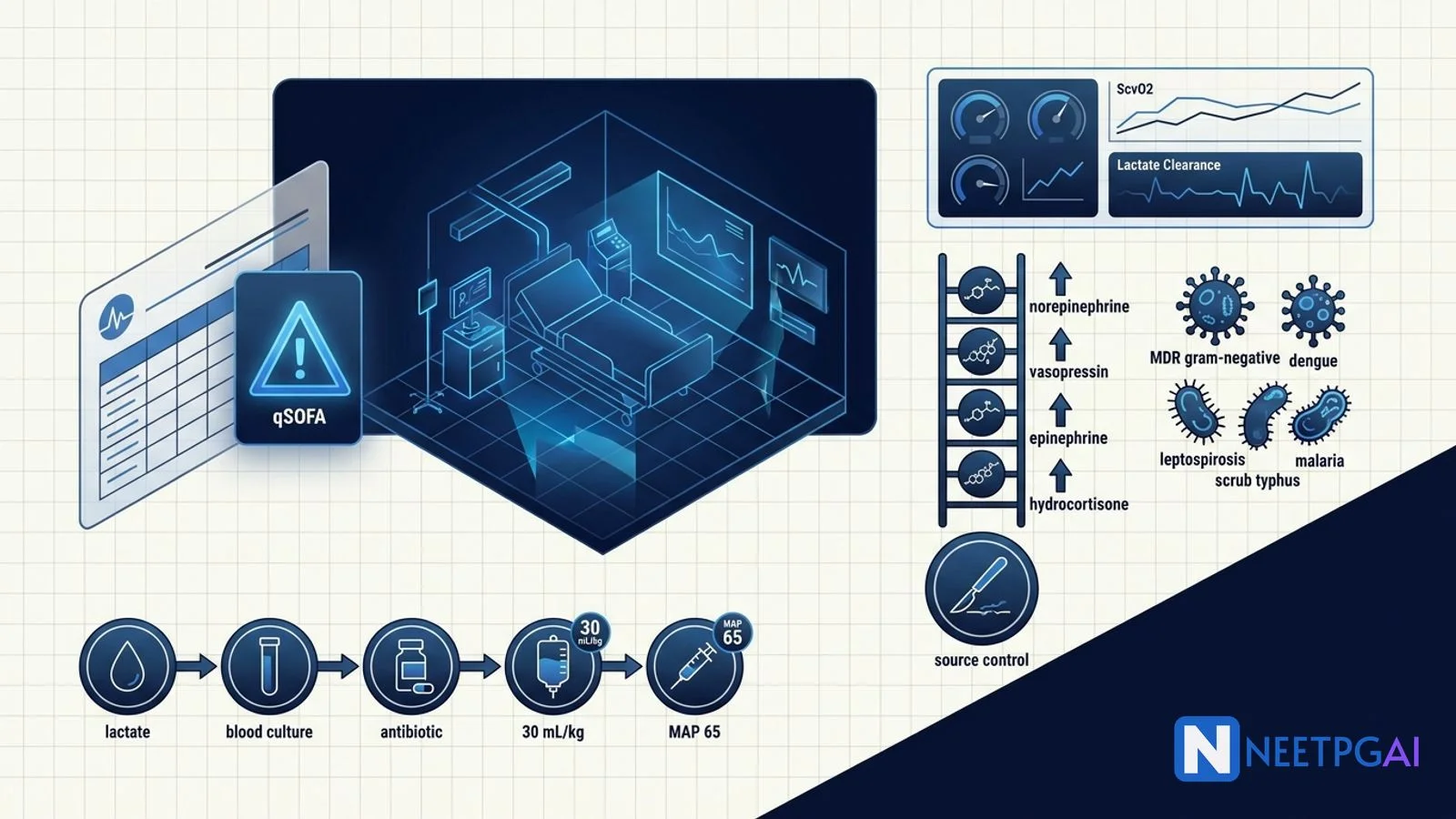
Sepsis is the leading cause of ICU mortality worldwide and a guaranteed NEET PG topic across Medicine, Surgery, and Critical Care. The high-yield framework:
Definition (Sepsis-3) — life-threatening organ dysfunction from a dysregulated host response, quantified by a SOFA rise of 2 or more.
Screen with qSOFA — RR 22 or above, altered mental status, SBP 100 or below; two or more points warrants urgent evaluation.
Septic shock — vasopressors needed to keep MAP 65 or above plus lactate over 2 despite adequate fluids.
Hour-1 bundle — lactate, cultures before antibiotics, broad-spectrum antibiotics within 1 hour for shock, 30 mL/kg balanced crystalloid if hypotensive or lactate 4+, and norepinephrine.
Source control — drain or debride within 6 to 12 hours; delays predict mortality.
Sepsis kills more Indians every year than road traffic accidents, and the antibiotic-resistance burden makes empirical therapy harder every cycle. NEET PG has moved decisively past SIRS-based questions — Sepsis-3 definitions, the 2021 Surviving Sepsis Campaign bundle, and vasopressor sequencing are now the tested standard.
This NEETPGAI deep dive covers the Sepsis-3 definitions, the qSOFA and SOFA scores, the 2021 hour-1 bundle, fluid choice, vasopressor and steroid escalation, source control, and the adjunctive strategies (glycemic, DVT, stress ulcer prophylaxis, nutrition) that show up as second-order questions. Pair it with the Medicine subject hub and the antimicrobial resistance guide.
Sepsis-3 definitions
The 2016 Sepsis-3 consensus retired the SIRS-based framework and simplified diagnosis around organ dysfunction.
Sepsis — life-threatening organ dysfunction caused by a dysregulated host response to infection. Operationalised as a suspected or documented infection plus an acute rise of 2 or more in the SOFA score.
Septic shock — a subset of sepsis in which underlying circulatory, cellular, and metabolic abnormalities are severe enough to substantially increase mortality. Clinically identified by a vasopressor requirement to maintain MAP 65 or above and serum lactate over 2 mmol/L in the absence of hypovolemia.
The abandoned SIRS criteria (temperature above 38 or below 36, HR above 90, RR above 20 or PaCO2 under 32, WBC over 12 or under 4 or over 10 percent bands) had poor specificity — most inpatients with any inflammation met SIRS.
SOFA score components (0 to 4 each)
System
Marker
Respiration
PaO2/FiO2 ratio
Coagulation
Platelet count
Liver
Bilirubin
Cardiovascular
MAP or vasopressor dose
Central nervous system
Glasgow Coma Scale
Renal
Creatinine or urine output
qSOFA — bedside screening
Respiratory rate 22 or above.
Altered mental status (GCS under 15).
Systolic BP 100 mmHg or below.
Two or more of three points warrants further workup for sepsis and organ dysfunction. qSOFA is a screening tool, not a diagnostic criterion — its specificity is high but sensitivity limited, so a low qSOFA in a septic-looking patient does not exclude sepsis.
Pathophysiology and clinical clues
Sepsis is driven by a dysregulated innate immune response — cytokine storm, complement activation, endothelial dysfunction, coagulation activation with microthrombi, and mitochondrial paralysis. The clinical result is distributive shock (low SVR), microcirculatory failure, tissue dysoxia (lactate accumulation), and multi-organ dysfunction.
Bedside clues in the emergency room:
Warm peripheries with brisk capillary refill early (distributive), transitioning to cold, mottled skin in decompensated shock.
Widened pulse pressure and tachycardia.
Hyperventilation from metabolic acidosis (Kussmaul-like breathing).
Altered mentation from cerebral hypoperfusion or septic encephalopathy.
Oliguria (under 0.5 mL/kg/hour) — an early sign of AKI.
The Surviving Sepsis Campaign 2021 bundle
The 2021 SSC bundle merged the historic 3-hour and 6-hour bundles into a single hour-1 bundle — five actions to initiate as fast as possible after sepsis is suspected. The 2021 update softened the language from "must complete within 1 hour" to "begin immediately", acknowledging real-world resource constraints.
The five bundle elements
Measure lactate — repeat every 2 to 4 hours until normalised if elevated.
Blood cultures before antibiotics — two peripheral sets and any relevant site (urine, CSF, sputum, wound). Do not delay antibiotics beyond 45 minutes waiting for cultures in septic shock.
Broad-spectrum antibiotics — within 1 hour for septic shock and possible sepsis with organ dysfunction; within 3 hours for possible sepsis without shock (2021 update softened rigid 1-hour target for the second group). Choose based on likely source, local antibiogram, and prior colonisation.
Balanced crystalloid 30 mL/kg within 3 hours for hypotension or lactate 4 mmol/L or above. Ringer's lactate or Plasma-Lyte is preferred over 0.9 percent normal saline (SMART and BaSICS trials — hyperchloremic acidosis and AKI risk with saline).
Vasopressors — start norepinephrine to target MAP 65 or above, either during or after fluid resuscitation. Do not wait to complete the fluid bolus if hypotension persists.
Vasopressor and steroid escalation
Line
Agent
Notes
First
Norepinephrine
Alpha-agonist; MAP target 65 mmHg or above
Second
Vasopressin 0.03 units/min
Fixed dose; do not exceed 0.06; V1a-mediated
Third
Epinephrine
Add for persistent hypotension; watch lactate rise (beta-2)
Fourth
Hydrocortisone 200 mg/day
Refractory shock on vasopressors more than 4 hours (ADRENAL, APROCCHSS)
Rescue
Angiotensin II (Giapreza)
For refractory vasodilatory shock in select centres
Dopamine is no longer recommended — the SOAP II trial showed higher arrhythmia rates without mortality benefit versus norepinephrine.
Source control
Identify the septic focus with imaging (CT abdomen, chest X-ray, POCUS) and drain, debride, or decompress within 6 to 12 hours if surgical. Missed source control is one of the strongest independent predictors of mortality.
Examples requiring source control:
Intra-abdominal abscess or perforation.
Cholangitis (ERCP or PTC drainage).
Obstructed pyelonephritis (ureteric stent or nephrostomy).
De-escalate within 48 to 72 hours based on culture and sensitivity — narrow the spectrum.
Duration — 7 to 10 days for most sources; shorter durations increasingly supported for uncomplicated bacteraemia and pyelonephritis.
Procalcitonin-guided de-escalation — a procalcitonin drop of 80 percent or a level under 0.5 ng/mL supports antibiotic discontinuation.
Antifungal cover — add empirical echinocandin for candidaemia risk factors (TPN, prior broad-spectrum antibiotics, gut surgery, colonised multiple sites).
Adjunctive care
Glycemic control — target 140 to 180 mg/dL (NICE-SUGAR showed tighter control 80 to 110 increases mortality from hypoglycaemia).
DVT prophylaxis — LMWH unless contraindicated.
Stress ulcer prophylaxis — PPI or H2RA only for high-risk mechanically ventilated patients (coagulopathy, shock, prior GI bleed).
Early enteral nutrition — start within 48 hours; PPN if enteral not tolerated after 7 days.
Lung-protective ventilation — 6 mL/kg predicted body weight tidal volume, plateau pressure under 30, driving pressure under 15 in ARDS.
Prone positioning — 12 to 16 hours per day for moderate-severe ARDS (PaO2/FiO2 under 150).
Restrictive transfusion — target Hb 7 g/dL or above; higher only if active bleeding or acute coronary syndrome (TRISS, TRICS III).
Renal replacement therapy — continuous or intermittent; timing debated (STARRT-AKI showed no benefit from routine early initiation).
Newer and adjunct therapies
Recombinant thrombomodulin (ART-123) — trials in sepsis-induced coagulopathy showed marginal benefit; not a standard-of-care in India.
Angiotensin II (Giapreza) — approved for refractory vasodilatory shock; ATHOS-3 trial.
Extracorporeal blood purification (hemadsorption, e.g. CytoSorb) — investigational; not endorsed by SSC 2021.
IV vitamin C, thiamine, hydrocortisone cocktail — CITRIS-ALI and VITAMINS trials failed to show mortality benefit; abandoned.
Post-sepsis morbidity
Post-sepsis syndrome affects up to 50 percent of survivors — cognitive decline, ICU-acquired weakness, PTSD, depression, and increased 1-year mortality. Structured post-ICU follow-up clinics are the emerging standard.
NEET PG MCQ traps
Sepsis-3 vs SIRS — SIRS is no longer part of sepsis definition; questions asking "which SIRS criteria define sepsis" are wrong-framed distractors.
qSOFA is a screening tool — not a diagnostic criterion; a low qSOFA does not exclude sepsis.
Balanced crystalloid over normal saline — SMART and BaSICS drove the 2021 change; "give 3 litres of 0.9 percent saline" is a wrong-answer trap.
Dopamine is off the list — SOAP II retired dopamine as first-line vasopressor.
Steroid timing — hydrocortisone is added only when vasopressors are needed for more than 4 hours; not routine.
Culture-before-antibiotic — do not delay antibiotics beyond 45 minutes in septic shock waiting for cultures.
Source control window — 6 to 12 hours for surgical foci; delay increases mortality.
Glycemic target — 140 to 180, not 80 to 110 (NICE-SUGAR).
Restrictive transfusion — Hb 7 is the threshold; 10 g/dL is a wrong-answer trap.
Vitamin C bundle — no proven mortality benefit; do not choose it as recommended therapy.
Indian ICU realities
MDR and XDR gram-negatives — carbapenem-resistant Enterobacterales (CRE), carbapenem-resistant Klebsiella, and ESBL-producing E. coli are common. Empirical carbapenem or carbapenem-plus-colistin/tigecycline is common in tertiary Indian ICUs; ceftazidime-avibactam and meropenem-vaborbactam are increasingly available for CRE.
Tropical differentials — always consider leptospirosis, severe dengue, malaria (P. falciparum), enteric fever, and scrub typhus and rickettsial illness in a "sepsis" presentation in India; empirical doxycycline or artesunate may be lifesaving.
PMJAY coverage — Ayushman Bharat covers sepsis and ICU care with package rates, though private tertiary care often exceeds the ceiling.
ICU bed availability — the COVID pandemic accelerated ICU expansion in tier-2 cities but capacity remains uneven.
Delayed presentation — many patients present in late septic shock after failed outpatient antibiotics; door-to-antibiotic times remain a quality metric.
Frequently asked questions
What is the Sepsis-3 definition of sepsis?
Sepsis-3 (2016) defines sepsis as life-threatening organ dysfunction caused by a dysregulated host response to infection. Organ dysfunction is quantified as an acute rise of two or more points in the SOFA score. Septic shock is a subset requiring vasopressors to maintain a MAP of 65 mmHg or above and a lactate greater than 2 mmol/L despite adequate fluid resuscitation. The old SIRS-based definition is no longer used.
What is the Surviving Sepsis Campaign 2021 hour-1 bundle?
The 2021 bundle groups five actions to complete rapidly after sepsis is suspected: measure lactate, obtain blood cultures before antibiotics, give broad-spectrum antibiotics within one hour for septic shock and within three hours for sepsis without shock, start 30 mL/kg balanced crystalloid if hypotensive or lactate 4 or above, and add norepinephrine to keep MAP at 65 or above.
What is the first-line vasopressor in septic shock?
Norepinephrine is first-line to maintain a MAP of 65 or above. Vasopressin at a fixed dose of 0.03 units per minute (not above 0.06) is added second when the norepinephrine dose is escalating. Epinephrine is third-line. Hydrocortisone 200 mg per day is added when septic shock remains refractory on vasopressors for more than four hours, based on the ADRENAL and APROCCHSS trials.
How much fluid does the Surviving Sepsis bundle recommend?
Thirty mL/kg of balanced crystalloid (Ringer's lactate or Plasma-Lyte) within the first three hours in patients with hypotension or lactate 4 mmol/L or above. Balanced crystalloids are preferred over 0.9 percent normal saline based on SMART and BaSICS trials. Reassess after the initial bolus using dynamic markers (pulse pressure variation, passive leg raise) rather than static CVP targets.
When is source control needed in sepsis?
Source control is mandatory within 6 to 12 hours when a surgically drainable focus is present — abscess, empyema, necrotising soft tissue infection, obstructed urinary tract, cholangitis, perforation, or infected necrosis. Delayed source control is one of the strongest independent predictors of mortality in septic shock. Concurrent antibiotics do not substitute for drainage or debridement.
This content is for educational purposes for NEET PG exam preparation. It is not a substitute for professional medical advice, diagnosis, or treatment. Clinical information has been reviewed by qualified medical professionals.
Written by: NEETPGAI Editorial Team
Reviewed by: Pending SME Review
Last reviewed: September 2026