Quick Answer
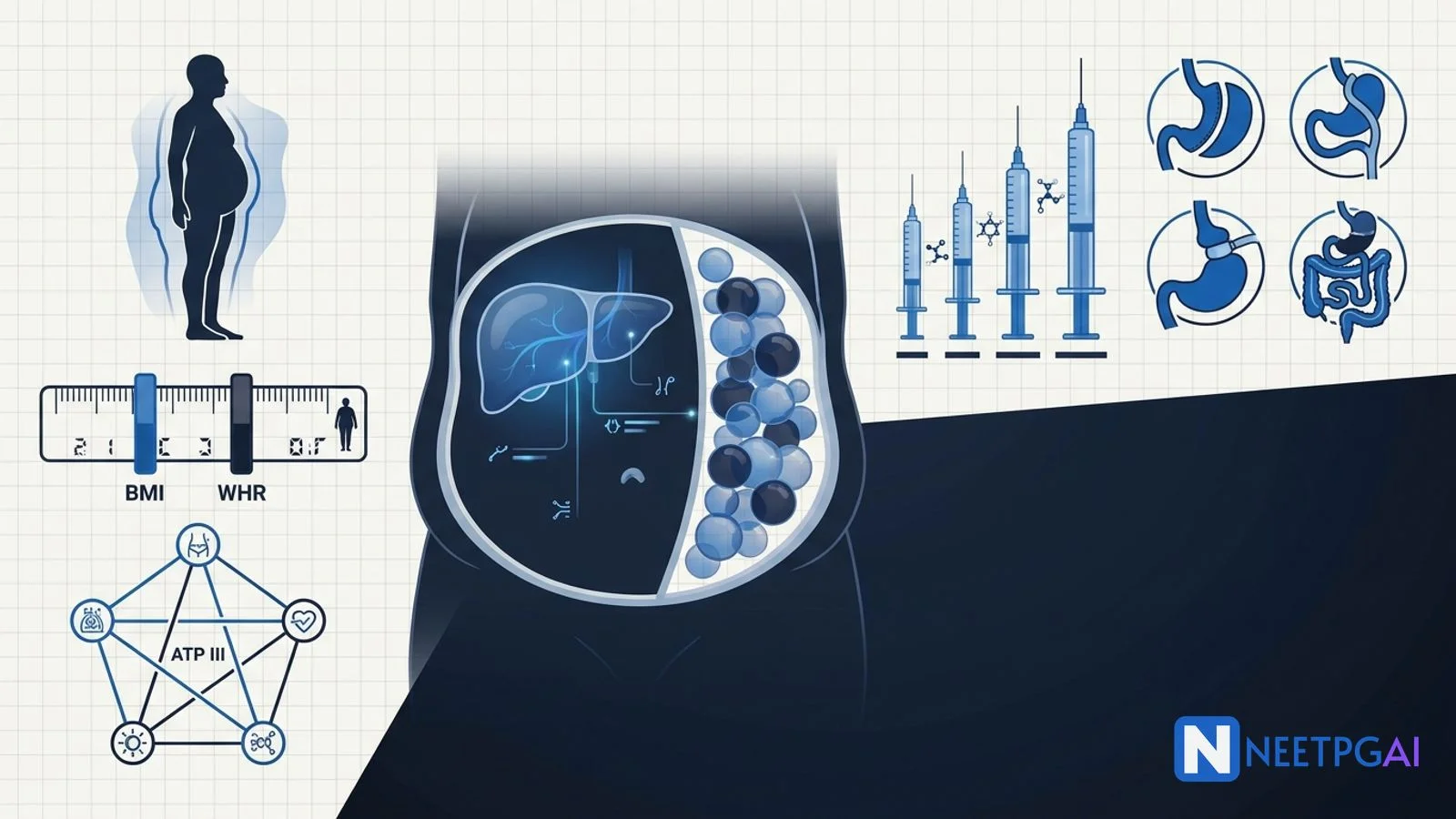
Obesity and metabolic syndrome deliver 2 to 3 NEET PG questions per paper across Medicine, Endocrinology, and Surgery. The high-yield framework:
- Classify by BMI — WHO obesity is BMI 30 or above; Indian consensus lowers this to 25 or above with a waist circumference above 90 cm (men) or 80 cm (women).
- Metabolic syndrome — three of five (central obesity, TG 150+, HDL under 40/50, BP 130/85+, FBG 100+).
- Lifestyle first — 5 to 10 percent weight loss produces meaningful metabolic benefit; Mediterranean or DASH pattern plus 150 minutes of moderate exercise per week.
- Pharmacotherapy — semaglutide (Wegovy) 15 to 17 percent loss; tirzepatide (Zepbound) 20 to 25 percent loss; orlistat, phentermine-topiramate, and naltrexone-bupropion are older options.
- Bariatric surgery — BMI 40+ or 35+ with comorbidity; sleeve gastrectomy is commonest globally and in India.
- Post-op vigilance — B12, iron, calcium, vitamin D, thiamine deficiencies; dumping; reflux after sleeve; anastomotic leak early.
Obesity is no longer a Western problem — India carries the world's third-largest burden of overweight adults and the fastest-growing childhood-obesity trajectory. NEET PG has adapted, moving beyond BMI arithmetic into GLP-1 pharmacology, bariatric indications, and Indian-specific phenotype questions.
This NEETPGAI deep dive covers classification (with Indian cutoffs), metabolic-syndrome criteria, pathophysiology of the thin-fat South Asian phenotype, lifestyle prescriptions, the modern GLP-1 and dual-incretin era, and bariatric surgery indications and long-term complications. Pair it with the Medicine subject hub and the diabetes management guide.
Classification of obesity
WHO classifies obesity by body mass index (BMI = weight in kg divided by height squared in metres).
| Category | WHO BMI | Indian consensus BMI |
|---|
| Underweight | Under 18.5 | Under 18.5 |
| Normal | 18.5 to 24.9 | 18.5 to 22.9 |
| Overweight | 25 to 29.9 | 23 to 24.9 |
| Obese class I | 30 to 34.9 | 25 to 29.9 |
| Obese class II (severe) | 35 to 39.9 | 30 to 34.9 |
| Obese class III (morbid) | 40 or above | 35 or above |
Central adiposity is measured by waist circumference:
- WHO/ATP III — above 102 cm men, above 88 cm women.
- Indian consensus — above 90 cm men, above 80 cm women.
Waist-hip ratio above 0.9 in men and above 0.85 in women also predicts cardiometabolic risk.
Metabolic syndrome — harmonised criteria
Any three of five confirm metabolic syndrome (2009 harmonised IDF/ATP III definition):
- Central obesity — waist circumference (ethnicity-specific).
- Triglycerides 150 mg/dL or above (or on lipid-lowering therapy).
- HDL under 40 mg/dL (men) or under 50 mg/dL (women).
- Blood pressure 130/85 or above (or on antihypertensive).
- Fasting plasma glucose 100 mg/dL or above (or on glucose-lowering therapy).
Pathophysiology and the South Asian phenotype
Obesity is a chronic, relapsing, multifactorial disease. Drivers include:
- Insulin resistance — adipose tissue expansion, especially visceral, provokes hepatic and peripheral insulin resistance.
- Adipokines — leptin (satiety, often resistant in obesity), adiponectin (insulin-sensitising, low in obesity), and pro-inflammatory cytokines (TNF-alpha, IL-6).
- Free fatty acids and ectopic fat — deposition in liver, muscle, and pancreas drives NAFLD and beta-cell dysfunction.
- Gut microbiome — Firmicutes-Bacteroidetes ratio and short-chain fatty acid production modulate energy harvest.
- Genetics — FTO, MC4R, and leptin/leptin-receptor variants; monogenic obesity is rare but treatable (setmelanotide).
- Environment — ultra-processed food, sedentary lifestyle, sleep deprivation, and endocrine disruptors.
The thin-fat Indian phenotype — South Asians have higher visceral adiposity, higher hepatic fat, lower muscle mass, and higher cardiometabolic risk at any given BMI compared with Caucasians. This is why Indian BMI cutoffs are lower and waist circumference is a more sensitive predictor.
Comorbidities
Obesity increases risk of:
- Type 2 diabetes (single strongest modifiable risk factor).
- Coronary artery disease and stroke.
- Hypertension and heart failure.
- Non-alcoholic fatty liver disease (NAFLD) and NASH.
- Obstructive sleep apnea.
- Polycystic ovary syndrome.
- Osteoarthritis of weight-bearing joints.
- 13 obesity-linked cancers (endometrial, breast postmenopausal, colorectal, pancreatic, hepatocellular, gastric cardia, gallbladder, kidney, ovarian, thyroid, meningioma, multiple myeloma, oesophageal adenocarcinoma).
- Depression, chronic kidney disease, and infertility.
Assessment
- BMI, waist circumference, blood pressure.
- Fasting lipids, HbA1c, fasting glucose (or OGTT).
- Liver function tests and fibrosis screening (FIB-4, ultrasound, Fibroscan for NAFLD/NASH).
- TSH to exclude hypothyroidism.
- Overnight polysomnography if OSA suspected.
- PHQ-9 or similar depression screen.
Lifestyle management (foundation of every plan)
- Diet — 500 to 1000 kcal/day deficit; Mediterranean, DASH, low-carbohydrate, or plant-based patterns each work if adhered to.
- Physical activity — at least 150 minutes moderate-intensity aerobic per week plus resistance training twice a week; more (200 to 300 minutes) for sustained loss.
- Behavioural therapy — self-monitoring, stimulus control, cognitive restructuring; motivational interviewing.
- Weight loss goal — 5 to 10 percent of body weight produces meaningful reductions in BP, HbA1c, and triglycerides.
Pharmacotherapy
Indications — BMI 30 or above, or 27 or above with a weight-related comorbidity, when lifestyle fails.
| Drug | Mechanism | Typical loss | Key toxicities |
|---|
| Orlistat | Pancreatic lipase inhibitor | 3 to 5 percent | Steatorrhea, fat-soluble vitamin loss |
| Phentermine-topiramate ER (Qsymia) | Sympathomimetic plus neuromodulator | 8 to 10 percent | Insomnia, teratogenic (topiramate) |
| Naltrexone-bupropion (Contrave) | Opioid antagonist plus DNRI | 5 to 8 percent | Nausea, HTN, seizure risk |
| Liraglutide 3 mg (Saxenda) | GLP-1 agonist (daily SC) | 6 to 10 percent | Nausea, pancreatitis, MTC (contraindicated in MEN 2) |
| Semaglutide 2.4 mg (Wegovy) | GLP-1 agonist (weekly SC) | 15 to 17 percent | Nausea, pancreatitis; STEP trials |
| Tirzepatide (Zepbound) | Dual GIP/GLP-1 agonist (weekly SC) | 20 to 25 percent | GI intolerance; SURMOUNT trials |
| Setmelanotide | MC4R agonist | Variable | For monogenic obesity (POMC, LEPR, PCSK1) |
Semaglutide and tirzepatide have shifted the landscape — pre-2020, medical therapy rarely matched 10 percent loss; now 20 percent is routine.
Indian access — branded Wegovy and Zepbound remain expensive; oral semaglutide (Rybelsus) is available and dulaglutide biosimilars are used off-label for weight where affordability limits the newer agents.
Bariatric surgery
Indications (traditional)
- BMI 40 or above.
- BMI 35 or above with a weight-related comorbidity (T2DM, OSA, HTN, dyslipidemia, joint disease).
- Failed medical therapy for at least 6 months.
The 2022 IFSO/ASMBS joint statement expanded eligibility to BMI 30 or above with metabolic disease, especially poorly controlled T2DM.
Procedures
- Sleeve gastrectomy — commonest globally and in India. Removes 80 percent of the greater curvature; restrictive plus reduction in ghrelin. Excess weight loss 60 to 70 percent.
- Roux-en-Y gastric bypass (RYGB) — restrictive plus malabsorptive; commonest for severe reflux, T2DM. Excess weight loss 70 to 80 percent.
- Adjustable gastric banding — largely abandoned; low durability, high reoperation.
- Biliopancreatic diversion with duodenal switch — most weight loss (80 to 90 percent) but highest nutritional risk.
- Endoscopic options — intragastric balloon and endoscopic sleeve gastroplasty for BMI 30 to 40 or bridge to surgery.
Outcomes
- 25 to 35 percent sustained body-weight loss.
- T2DM remission 70 to 80 percent within a year of RYGB.
- Cardiovascular mortality reduction of 30 to 50 percent in long-term studies (SOS study).
- Improvement in OSA, NAFLD, hypertension, PCOS, and joint pain.
Complications
Early (0 to 30 days) — anastomotic or staple-line leak, bleeding, DVT/PE, wound infection.
Late — nutritional deficiencies (vitamin B12, iron, calcium, vitamin D, thiamine, protein, folate), internal hernia (specifically after RYGB), marginal ulcer, dumping syndrome (RYGB), gastroesophageal reflux (worse with sleeve gastrectomy), gallstones (rapid weight loss), incisional and port-site hernia, and weight regain.
Peri-operative preparation — multidisciplinary evaluation (dietician, psychologist, endocrinologist, surgeon, anaesthetist), psychiatric clearance, smoking cessation, treatment of untreated OSA, and lifelong micronutrient supplementation.
Childhood obesity
- India — ICMR-INDIAB and NFHS-5 data show rising childhood overweight, especially in urban high-income households.
- Assessment — BMI-for-age percentile; overweight 85th to 95th, obese 95th or above.
- Management — family-based lifestyle interventions; screen for OSA, T2DM (rising in adolescents), NAFLD, PCOS, and pseudotumour cerebri.
- Pharmacotherapy — liraglutide 3 mg approved for age 12 and above; semaglutide 2.4 mg approved for adolescents (STEP TEENS).
- Bariatric surgery — specialised centres, adolescents with severe comorbidity.
NEET PG MCQ traps
- Indian BMI cutoffs — obesity is 25 or above, not 30; central obesity 90 cm men, 80 cm women.
- Metabolic syndrome needs 3 of 5 — not any single criterion.
- Tirzepatide is a dual GIP/GLP-1 agonist — not a pure GLP-1; largest weight loss in medical therapy to date.
- GLP-1 and MTC — contraindicated in personal or family history of medullary thyroid carcinoma or MEN 2.
- Orlistat causes fat-soluble vitamin (ADEK) malabsorption — supplement.
- Sleeve gastrectomy worsens reflux — RYGB is preferred if severe GERD present.
- Internal hernia after RYGB — high-yield emergency presentation, often normal CT; low threshold for laparoscopy.
- Thiamine deficiency after rapid weight loss — can cause Wernicke encephalopathy; supplement all bariatric patients.
- T2DM remission after RYGB — 70 to 80 percent; strongest evidence base for metabolic surgery.
- Setmelanotide — for monogenic (MC4R pathway) obesity only.
Indian context
- ICMR-INDIAB — prevalence of general obesity 28.6 percent and abdominal obesity 39.5 percent (2023 data).
- NPCDCS — National Programme for Prevention and Control of Non-Communicable Diseases screens at PHC level.
- PMJAY partial coverage — bariatric surgery for BMI 40+ with comorbidity is covered in some state packages.
- Ayushman Bharat Health and Wellness Centres — deliver community-level lifestyle interventions.
- Tertiary expertise — Apollo, Fortis, AIIMS, PGI Chandigarh, and CMC Vellore have established bariatric programmes; volumes have grown 10-fold in a decade.
- GLP-1 access — dulaglutide and semaglutide are widely used off-label for weight; cost remains a barrier for the majority.
Frequently asked questions
What are the Indian BMI cutoffs for obesity?
The 2009 Indian consensus lowered the obesity thresholds for South Asians because of the thin-fat phenotype and higher cardiometabolic risk at lower BMI. Overweight is BMI 23 to 24.9, obese is BMI 25 or above, and severe obesity is BMI 30 or above. Central obesity is defined as waist circumference above 90 cm in men and above 80 cm in women, compared with 102 and 88 cm in WHO/ATP III criteria.
How is metabolic syndrome diagnosed?
The harmonised criteria require three of five features — central obesity by ethnicity-specific waist circumference, triglycerides 150 mg/dL or above, HDL under 40 mg/dL in men or under 50 in women, blood pressure 130/85 or above, and fasting glucose 100 mg/dL or above. India uses lower waist cutoffs (90 cm men, 80 cm women) reflecting the South Asian phenotype.
What weight loss can semaglutide and tirzepatide achieve?
Semaglutide 2.4 mg weekly (Wegovy) produced 15 to 17 percent body-weight loss at 68 weeks in the STEP trials. Tirzepatide (Zepbound, a dual GIP/GLP-1 receptor agonist) achieved 20 to 25 percent loss in SURMOUNT-1 and is now the most effective pharmacotherapy short of surgery. Both are given as weekly subcutaneous injections; oral semaglutide (Rybelsus) is approved for obesity in some jurisdictions.
Who is a candidate for bariatric surgery?
Guidelines endorse bariatric surgery for BMI 40 or above, or BMI 35 or above with a serious comorbidity (T2DM, obstructive sleep apnea, uncontrolled hypertension, severe joint disease). Newer 2022 IFSO/ASMBS statements lower the threshold to BMI 30 or above with poorly controlled T2DM. In India, sleeve gastrectomy is now the commonest procedure followed by Roux-en-Y gastric bypass.
What are the main complications after bariatric surgery?
Early complications include anastomotic leak, bleeding, DVT, and internal hernia after gastric bypass. Long-term issues include nutritional deficiencies (vitamin B12, iron, calcium, vitamin D, protein, thiamine), dumping syndrome after bypass, gastroesophageal reflux (especially after sleeve gastrectomy), gallstones, and weight regain. Lifelong micronutrient supplementation and multidisciplinary follow-up are mandatory.
This content is for educational purposes for NEET PG exam preparation. It is not a substitute for professional medical advice, diagnosis, or treatment. Clinical information has been reviewed by qualified medical professionals.
Written by: NEETPGAI Editorial Team
Reviewed by: Pending SME Review
Last reviewed: September 2026